
How to Search Instagram by Followers

The most popular advice about searching Instagram by followers starts with the wrong assumption: that Instagram has a hidden filter where you can enter a follower range and sort the results. It doesn't. The consumer app is designed for personalized discovery, not structured account research, so a serious workflow needs more than a search bar and a spreadsheet.
Follower count still has value. It can help you define an initial account tier, prioritize candidates, and build a prospecting dataset. But it's only useful when paired with niche, geography, audience signals, engagement, and retrieval time. The practical solution is to move from manual browsing to an API-backed discovery pipeline that treats Instagram data as changing, incomplete, and subject to access constraints.
Table of Contents
- The Reality of Native Instagram Search Limitations
- Manual Workarounds for Small Scale Discovery
- Architecting an API Backed Discovery Pipeline
- Comparing Official Graph API and Captapi Scrapers
- Contextualizing Follower Counts with Demographic Data
- Navigating Privacy and Compliance in Data Extraction
The Reality of Native Instagram Search Limitations
Instagram's native search doesn't provide a user-defined follower-count filter. You can search by account name, handle, keyword, or related content, but you can't enter a range and ask Instagram to return every public profile with a matching audience size. Instagram search results are primarily influenced by query text, personal activity, and popularity, which makes follower totals an unreliable native discovery signal.
That distinction matters because two different tasks often get confused. Searching within another account's followers means browsing a relationship list associated with a known profile. Discovering new accounts within a follower tier means querying a much broader candidate universe by scale, topic, market, or audience. Instagram's consumer interface doesn't provide a clean, filterable database for the second task.
Why the search bar produces noisy results
Instagram personalizes results around the person performing the search. Previous interactions, familiar accounts, text relevance, and popularity all affect what appears. A profile with strong visibility in one user's experience might be absent or ranked differently for another user, even when both use the same phrase.
Hashtags can help with initial discovery, but they don't solve the ranking problem. A practical guide to how to search multiple tags on Instagram can help teams expand their keyword and topic queries, but hashtag exploration still produces candidates rather than a verified follower-range result.
Practical rule: Use Instagram's native search to generate ideas and seed accounts. Don't use it as the database that determines whether an account belongs in a specific follower tier.
For small research tasks, manual browsing may be enough. For influencer shortlisting, competitor monitoring, academic sampling, or recurring lead generation, teams need a repeatable collection layer. A technical overview of Instagram web scraping provides useful context for why browser-based discovery becomes difficult to maintain as volume and refresh frequency increase.
Manual Workarounds for Small Scale Discovery
Manual discovery works when the shortlist is small and the researcher can inspect every candidate. Start with a known competitor or category leader, open its visible follower list, and note accounts that appear relevant. Then visit each profile, record the displayed follower total, check the bio and recent posts, and remove accounts that fall outside the target niche.
Hashtags provide another route. Search a topic, review prominent posts, open the accounts behind them, and record profiles that match the intended geography or content category. Location pages, creator directories, and public search engines can add more candidates, but each source brings its own ranking bias and freshness problem.

What manual research gets right
Human review is valuable for context that a raw count can miss. A researcher can quickly identify whether an account covers the intended topic, whether its audience appears geographically relevant, and whether recent posts show genuine activity. Manual inspection also helps identify false positives such as repost pages, inactive profiles, or accounts whose follower totals are large but commercially irrelevant.
The problem is consistency. People estimate follower tiers differently, forget which profiles they've already reviewed, and rarely capture the exact time at which a count was observed. Without a database, historical growth becomes impossible to analyze, and a later researcher can't easily reproduce the original shortlist.
For a narrow task, create a simple review sheet with fields for username, profile URL, displayed follower count, category, location, account type, latest visible post date, and review timestamp. Keep the candidate source as well, whether it came from a hashtag, competitor follower list, directory, or search result.
If you need to inspect relationships rather than discover new accounts, a guide to downloading an Instagram following list can clarify the difference between collecting a known account's visible connections and building a follower-based discovery index. Those are separate data problems and should use separate collection logic.
Manual work becomes the wrong tool when the team needs regular refreshes, consistent ranking, or thousands of candidates. At that point, the cost isn't just researcher time. It's the absence of normalized records, timestamps, retry logic, and a defensible audit trail.
Architecting an API Backed Discovery Pipeline
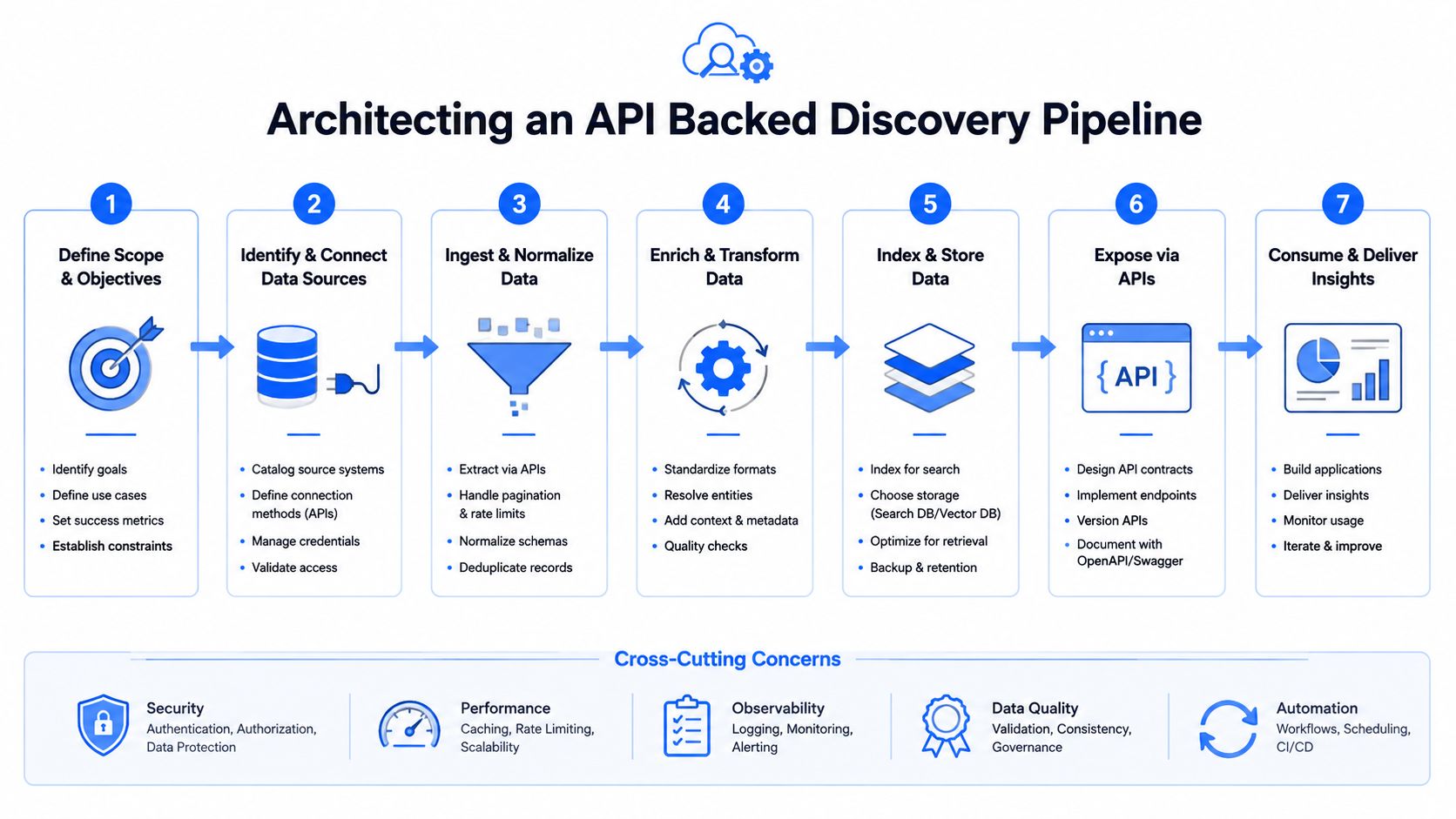
A reliable pipeline starts with a research specification, not an endpoint. Define the niche, geography, language, account type, target follower range, and minimum activity requirements before collecting usernames. Without those rules, the collector will return a large list that looks useful but can't support a consistent decision.
Build the collection stages separately
A production-minded workflow separates candidate discovery from profile enrichment. The discovery layer gathers permitted public usernames from search results, known competitor audiences, topical sources, and other approved inputs. The enrichment layer resolves those usernames and retrieves the fields needed for filtering.
The core sequence is straightforward: define a target range, collect public usernames, normalize and deduplicate records, retrieve the current followers_count, filter against the range, and rank the survivors with engagement and recency. This workflow is consistent with the capabilities and limitations described in the official Instagram Business Discovery documentation.
Normalize before making decisions. Convert handles to a consistent format, remove leading symbols where your schema doesn't need them, canonicalize profile URLs, and preserve the original input separately. Deduplicate by a stable account identifier when available, rather than relying only on display names, which can change or be shared by multiple profiles.
Treat counts as observations, not permanent attributes
A follower total is a point-in-time value. Store the retrieval timestamp beside the count, along with the source, response status, and account identifier. If a request fails, record the field as unavailable instead of writing zero, null without explanation, or an inferred value.
A useful record might contain:
- Identity: username, profile URL, platform account ID when available, and display name.
- Classification: niche, language, geography, account type, verification state, and privacy state.
- Metrics: follower count, engagement fields, posting activity, and the timestamp for every retrieved metric.
- Pipeline status: success, unavailable, restricted, rate-limited, transient error, or permanently invalid.
- Provenance: discovery source, retrieval method, request time, and processing version.
Caching reduces unnecessary repeat requests and makes downstream analysis more stable. Recheck shortlisted accounts before outreach or reporting, because the count that qualified an account earlier may no longer represent its current state. Retry transient failures with controlled backoff, but don't retry indefinitely or overwrite a successful historical observation with an incomplete response.
For implementation teams, data pipeline automation is a useful reference point for thinking about ingestion as an operational system rather than a one-off script. The important design choice is to preserve raw responses and normalized tables separately. That gives analysts a way to audit transformations without repeatedly querying the platform.
Ranking should happen after filtering, not before. A profile can meet the follower threshold and still fail the practical test because it has weak engagement, little recent activity, an unsuitable audience, or no clear connection to the campaign.
Comparing Official Graph API and Captapi Scrapers
The official Instagram Graph API is the right starting point when a team controls eligible professional accounts, can manage the required permissions, and needs a platform-supported integration. Its Business Discovery capability exposes public metadata and metrics for eligible professional accounts. It doesn't provide a general follower-search endpoint, and it doesn't expose individual follower lists as a universal research database.
A third-party public-data service takes a different route. Instead of designing the entire workflow around account ownership and official permissions, a team can use a service that resolves public profiles and returns available profile metadata, including follower-count information. That can reduce the amount of discovery and normalization code a team has to maintain, but it introduces a dependency on the service's coverage, freshness, terms, and failure behavior.
The architectural trade-off
Official access offers stronger alignment with Meta's supported interfaces, but it comes with eligibility and permission constraints. It also won't turn Instagram into a universal searchable index of every account and follower relationship. Teams that assume it will provide unrestricted follower-range discovery usually discover the limitation after building the wrong data model.
Scrapers and public-data APIs can be more flexible for public profile lookup, but flexibility doesn't remove the need for controls. A service may return an account's current public fields while other fields are unavailable because the profile is private, restricted, age-gated, personal, or no longer accessible. Your schema should distinguish those states.
| Decision factor | Official Graph API | Third-party public-data API |
|---|---|---|
| Access model | Permissioned access for supported account and app scenarios | Service-mediated access to available public data |
| Follower-range discovery | Not provided as a general native endpoint | Possible only when the service can discover and resolve public profiles |
| Data control | Platform-supported fields and documented behavior | Dependent on provider coverage, caching, and extraction behavior |
| Engineering burden | Permission management and platform-specific integration | Provider integration, response validation, and dependency monitoring |
| Compliance responsibility | Still required for your storage and use of data | Still required for your storage and use of data |
A practical comparison should focus less on which route sounds easier and more on the failure modes you can tolerate. Official endpoints may be preferable for durable integrations tied to owned or authorized professional accounts. A public-data API may suit research and discovery workflows that need profile resolution across a broader set of public inputs, provided the team validates freshness and access status.
The Instagram API alternative discussion is relevant when a team is evaluating public profile discovery alongside official access. Don't treat either route as a guarantee of complete coverage. Build the pipeline so missing fields, restricted profiles, stale observations, and transient errors remain visible to analysts.
The following product walkthrough can help teams evaluate how an API-mediated approach fits into their own collection and enrichment architecture.
Contextualizing Follower Counts with Demographic Data
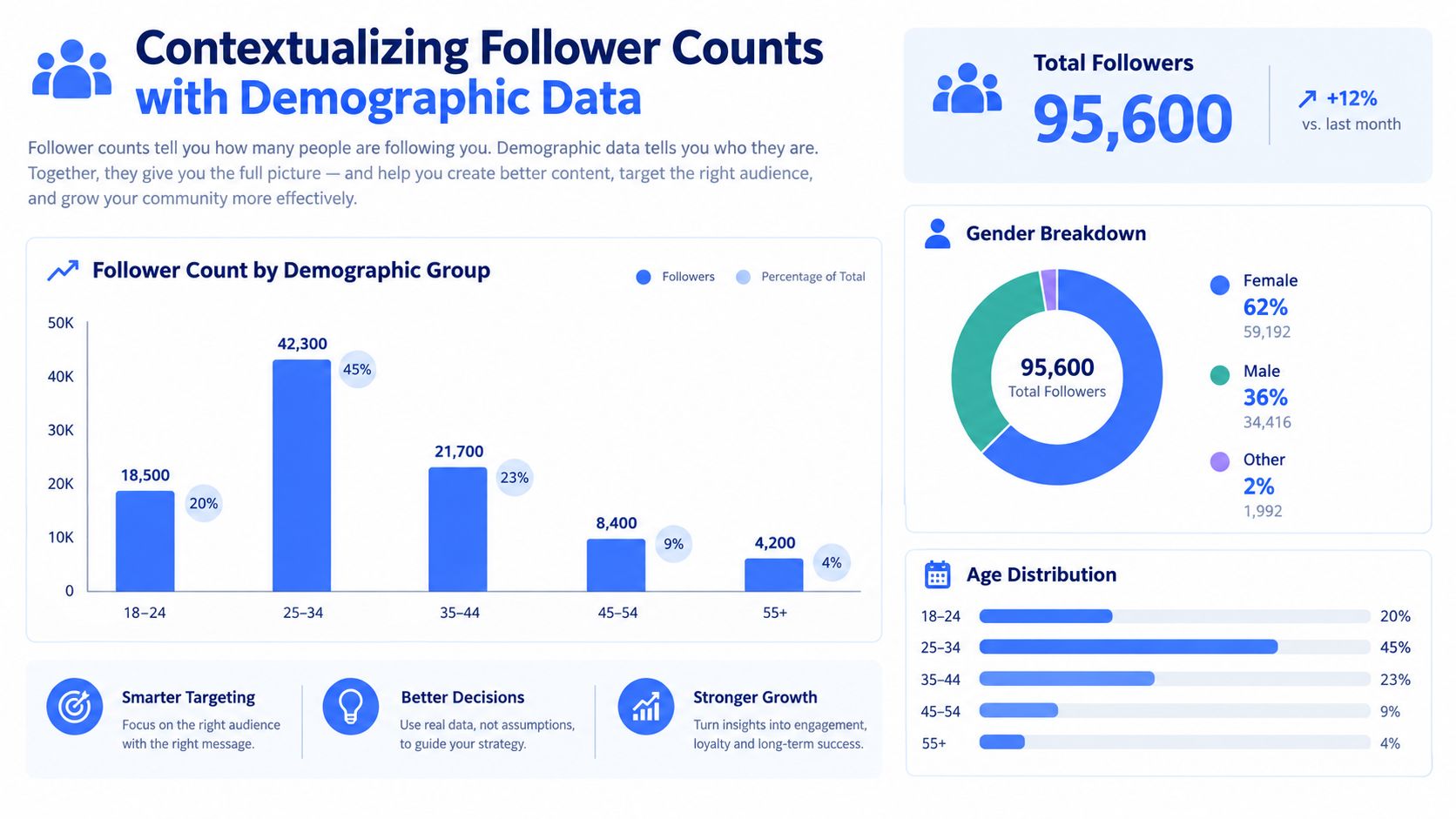
A follower count becomes meaningful only after you define whose attention matters. An account with a large audience in an irrelevant country or age group may be less useful than a smaller profile whose followers match the campaign precisely. The threshold should describe a research opportunity, not merely a number that looks impressive in a spreadsheet.
Instagram's audience distribution makes this especially important. Pew Research findings summarized in the available data report that 50% of U.S. adults used Instagram in 2025, with usage at 80% among adults aged 18 to 29 and 62% among adults aged 30 to 49. Adoption was 40% among adults aged 50 to 64 and 19% among adults aged 65 and older. These figures are documented in the Pew Research summary of Instagram usage by age.
Set thresholds around the audience you need
The age gap changes how you interpret a follower range. A creator serving younger adults may accumulate an Instagram audience differently from a creator serving older consumers, even when both have comparable awareness in their respective markets. A fixed threshold therefore creates uneven comparisons across categories.
Segment the candidate set before ranking it. At minimum, store the target geography, language, category, and visible audience indicators. Where professional account insights are lawfully available to the account owner or an authorized partner, those first-party signals can add much stronger context than public follower totals alone.
Instagram's global scale reinforces the need for segmentation. DataReportal reported at least 1.74 billion Instagram users worldwide in January 2025, equivalent to 26.9% of the global population aged 13 and above. The source explains that this is Meta advertising-planning data, so it represents an addressable advertising audience rather than a direct count of monthly active users. The DataReportal Instagram statistics reference also reports approximately 172 million Instagram users in the United States in early 2025, with 60.5% of U.S. adults included in Instagram's advertising audience.
Those figures establish the scale of the discovery problem, not the influence of any particular account. Use them to justify structured filtering, not to assume that every account has equal commercial value. A useful ranking model can combine follower range, engagement, posting recency, geography, topic fit, account type, and audience quality.
A follower count answers “how large is the visible account?” It doesn't answer “how valuable is this audience for the task?”
For research teams, demographic context also improves sampling. A dataset built only around high-count profiles can overrepresent categories with strong Instagram adoption and underrepresent accounts serving older or less platform-centered audiences. Define quotas or comparison groups before collecting profiles, then preserve the criteria used to include each account.
Navigating Privacy and Compliance in Data Extraction
Public visibility isn't a blanket permission to collect, retain, or repurpose everything associated with a profile. A privacy-conscious pipeline limits collection to fields that are necessary for a defined purpose, respects private and restricted accounts, and avoids attempting to obtain individual follower lists through unauthorized methods.
The official platform constraints matter here. Some personal, private, age-gated, or otherwise restricted accounts won't be available through supported interfaces. Your collector should report that absence clearly rather than treating an inaccessible profile as a failed match or trying to bypass the restriction.
Build compliance into the data model
Store only what downstream users need. If a campaign needs public profile discovery and follower-range filtering, it may not need email addresses, inferred identities, private relationships, or unrelated post content. Separate public profile metadata from any sensitive research notes, apply access controls, and define retention rules before the first collection job runs.
Protect credentials operationally. Keep API keys outside source code, restrict access by role, rotate credentials according to your security policy, and monitor unusual request patterns. Rate-limit your own workers, honor provider requirements, and use bounded retries so an error-handling loop doesn't become an uncontrolled request burst.
A practical checklist should include:
- Public scope: Collect only permitted public data and don't probe private or age-gated profiles.
- Purpose limitation: Document why each field is collected and remove fields that don't support that purpose.
- Provenance: Store retrieval time, source, response state, and transformation history.
- Data quality: Mark unavailable, restricted, stale, and failed fields explicitly.
- Security: Keep credentials secret, limit internal access, and protect stored exports.
- Retention: Delete records when the research purpose ends or the retention policy requires it.
- User rights: Maintain a process for handling appropriate requests about stored data, including a way to submit a data request.
Compliance also applies after extraction. Don't build lead lists that encourage unwanted contact, expose personal information, or imply that a public follower count proves consent to marketing. Review the social media compliance guidance before deploying a workflow across clients, regions, or sensitive research areas.
The strongest architecture makes responsible behavior the default. It uses public inputs, records uncertainty, refuses unauthorized access, and gives analysts enough context to understand what a number means and when it was collected.
Use Captapi to resolve public Instagram profiles, retrieve follower counts and profile metadata, and feed normalized results into a discovery pipeline that ranks accounts by more than audience size. Visit Captapi to evaluate the API for your shortlist, enrichment, and recurring social research workflows.