
7 Brand Tracking Example Case Studies
Counting mentions isn't brand tracking. It's only the collection layer.
A useful brand tracking example starts with a business question, such as whether a launch improved consideration, whether a competitor is gaining attention, or whether a reputation issue is spreading. It then connects that question to measurable signals, including mention volume, sentiment, engagement velocity, share of voice, creator reach, comment intent, and purchase-related behavior. The important part is the operating path, from multi-platform collection to classification, alerting, dashboard interpretation, and a decision.
The seven examples below treat brand tracking as a measurement system rather than a collection of success stories. They cover competitor intelligence, crisis detection, influencer evaluation, transcript-based topic research, launch measurement, customer sentiment, and research datasets. Captapi can support public-data extraction across YouTube, TikTok, Instagram, and Facebook, while dashboards, alerting, sentiment models, and attribution require additional implementation.
Table of Contents
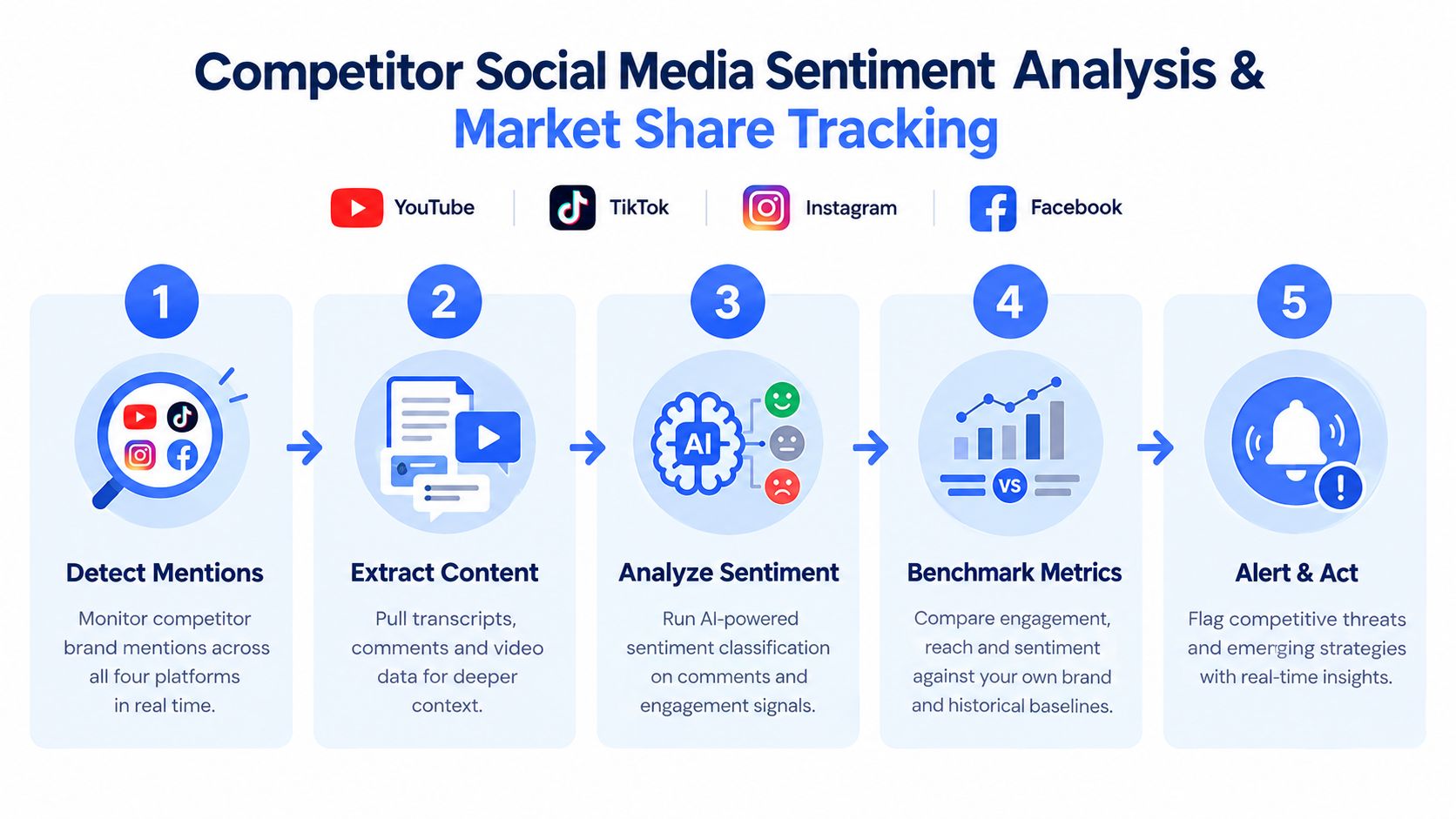
- 1. Competitor Social Media Sentiment Analysis and Market Share Tracking
- 2. Brand Mention and Crisis Detection Monitoring Pipeline
- 3. Influencer Marketing Campaign Performance and ROI Measurement
- 4. Content Strategy and Topic Trend Tracking Using Video Transcripts
- 5. Product Launch and Campaign Announcement Impact Measurement
- 6. Customer Sentiment and NPS Proxy Tracking Through Social Comments
- 7. Academic and OSINT Research Dataset Creation for Social Media Trends
- 7-Example Brand Tracking Comparison
- Turn These Examples Into a Repeatable Tracking System
1. Competitor Social Media Sentiment Analysis and Market Share Tracking
A software company comparing itself with competitors doesn't need a larger mention count by itself. It needs to know who is being discussed, why the discussion is happening, and whether attention is moving toward a buying decision.
A practical tracking system collects public videos, posts, comments, transcripts, channel details, and engagement metrics for a defined competitive set. A marketing agency might monitor SaaS competitors' product announcements and content themes. An e-commerce team could compare influencer partnerships, while an enterprise software team could examine how audiences respond to pricing or feature announcements.
The workflow should preserve the context behind every signal:
- Mention volume: Separate brand mentions from generic category discussion.
- Sentiment: Classify comments by praise, complaint, comparison, question, and purchase intent.
- Engagement velocity: Compare how quickly a post accumulates reactions against the account's normal baseline.
- Share of voice: Measure the proportion of relevant conversation associated with each competitor, not total platform activity.
- Message themes: Combine video transcripts with comments to distinguish what a brand says from what audiences discuss.
Competitor benchmarking with social data becomes more useful when analysts store weekly baselines instead of treating every new post as an isolated event. GPT-4o-mini summaries can reduce the time needed to review competitor messaging, but analysts should inspect representative comments before accepting an automated interpretation.
Practical rule: A competitor's rising conversation volume is an alert for investigation, not proof of stronger market position.
The decision layer might identify a neglected product objection, a new creator partnership, or a message that earns unusually strong engagement. The team can then adjust content, brief sales teams, or investigate whether consideration is changing through survey or transaction data. Public social signals are valuable context, but they don't independently establish market share or causality.
2. Brand Mention and Crisis Detection Monitoring Pipeline
Crisis monitoring succeeds when it detects a meaningful change early enough for a human team to investigate. A raw stream of brand mentions won't do that. The system needs a baseline, contextual classification, and an escalation rule.
A restaurant chain, for example, could search public TikTok comments and videos for its name alongside terms connected to food safety, illness, contamination, or service complaints. A technology company might watch product-launch conversations for recurring failure reports. A fashion brand could separate ordinary product criticism from discussions about counterfeit goods or misleading listings.
The collection layer should capture more than post titles. Comments reveal complaint patterns, while transcripts explain the subject of a creator's video before analysts examine every response. A channel-details lookup can also help identify whether a mention comes from a high-reach creator, a customer account, or a recurring critic.
A useful alert might combine several conditions:
- Velocity change: New relevant mentions rise above the normal rate for the brand or topic.
- Negative-theme concentration: Multiple authors describe a similar issue.
- Creator amplification: A high-engagement account introduces the complaint to a wider audience.
- Cross-platform confirmation: The same concern appears independently on more than one platform.
Teams can use social listening to understand audiences, then route qualified events through an alert creation workflow. The alert should include sample posts, transcript context, sentiment reasoning, author type, and the time window used for comparison. That information lets communications staff decide whether to respond, investigate internally, or monitor without escalating.
A sudden negative burst is a triage signal. It becomes a crisis only after people verify its subject, authenticity, spread, and business relevance.
3. Influencer Marketing Campaign Performance and ROI Measurement
An influencer report that shows views and likes can describe distribution without explaining value. A stronger brand tracking example follows the complete path from creator selection to message alignment, audience response, and downstream action.
Before a partnership begins, the team can capture each creator's public channel or page details, recurring engagement patterns, content themes, and audience discussion. During the campaign, it can compare the sponsored post with the creator's own baseline and with similar partnerships involving competing brands. That comparison helps identify whether a creator's apparent performance reflects an unusual campaign response or their normal level of activity.
The analysis should treat comments as evidence about quality, not just quantity. Positive reactions may indicate affinity, while questions about price, ingredients, compatibility, or availability may reveal commercial intent. Negative comments can expose a poor audience fit or a mismatch between the creator's usual voice and the brand message.
Turning creator data into a decision
A practical scorecard can combine:
- Audience context: Public channel size, category relevance, geography, and creator history.
- Content alignment: Whether the transcript and visual framing communicate the required product claim accurately.
- Response quality: Comment themes, sentiment, questions, objections, and repeated requests.
- Momentum: Engagement velocity during the early campaign window and its persistence afterward.
- Comparative value: Performance against other creators and against the brand's own content.
Performance attribution for campaign analysis should be treated as a measurement design problem, not a promise that public engagement proves return on investment. If sales or conversion data are available, analysts can join them to exposure or creator-level records. If they aren't, the output should be labelled as an engagement and brand-response assessment rather than revenue attribution.
A beauty brand could use this system to choose between TikTok and Instagram creators based on comment quality and message comprehension, not platform habit. A B2B company might discover that a smaller specialist audience produces more product questions and qualified conversations than a broad entertainment channel. The next campaign decision then follows from evidence, not follower count alone.
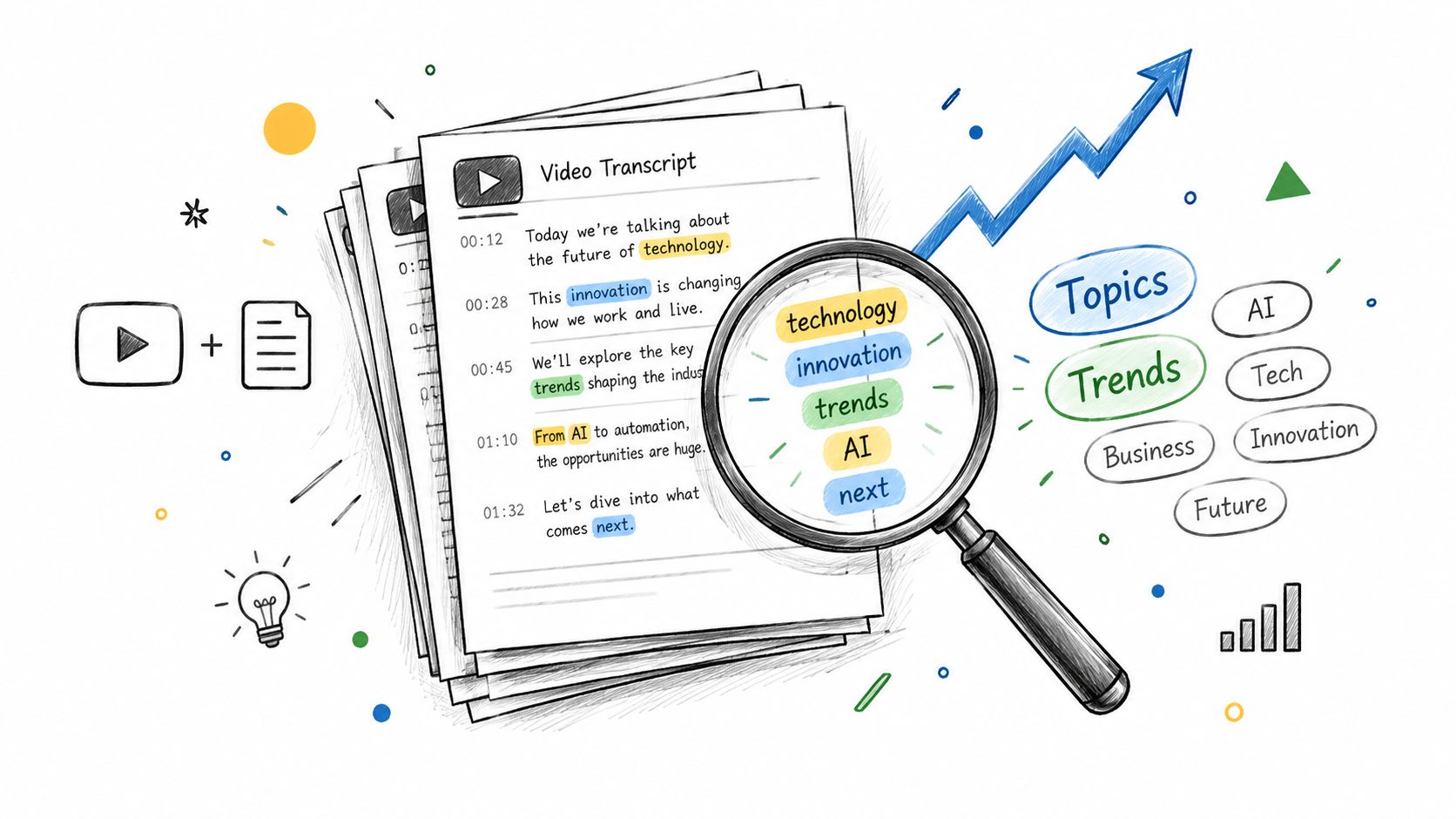
4. Content Strategy and Topic Trend Tracking Using Video Transcripts
Content teams often notice a topic after competitors have already made it familiar. Transcript tracking changes the unit of analysis from the headline to the ideas discussed throughout the video.
A creator researching a niche can collect public transcripts and metadata from relevant channels, then cluster recurring subjects, product terms, questions, and objections. A SaaS marketing team might compare how competitors describe a new feature category. A news organization could track how different publishers frame a developing issue. The system doesn't need to treat every mention as a trend. It should examine frequency, growth, engagement, source diversity, and audience response together.
A useful workflow starts with summaries for fast screening, then moves to full transcripts for selected videos. Comments add a second layer because viewers often ask about problems that the creator didn't address. Metadata, including upload timing and view activity, supplies context for judging whether a topic attracts attention or merely appears often.
From topic frequency to editorial action
Analysts can create a topic matrix with fields such as:
- Coverage: Which brands or creators discuss the subject.
- Language: The claims, phrases, and user problems associated with it.
- Audience response: Comment questions, objections, and engagement quality.
- Momentum: Whether the topic is appearing across more sources or only repeating within one channel.
- Content gap: Important questions that competitors mention but don't answer clearly.
Video content analysis with transcripts can feed a retrieval or semantic-clustering workflow, but automated clusters still need human review. Language changes by industry, and a transcript may contain a passing reference rather than a meaningful editorial theme.
The decision might be a new explainer, a comparison page, a product brief, or a response to an unanswered customer question. The strongest insight isn't that a topic is popular. It's that a specific audience problem is becoming visible across independent sources while existing content leaves it unresolved.
5. Product Launch and Campaign Announcement Impact Measurement
Launch tracking has a narrow window for useful action. If a product announcement creates confusion, the team needs to know while messaging, support documentation, and creator responses can still change.
Start with a pre-launch baseline for the brand's ordinary engagement and sentiment. Once the announcement is published, collect post performance, comments, transcripts, creator reactions, and competitor activity at a consistent cadence. The comparison should distinguish a large audience from a fast-moving audience. A post may receive many reactions because of distribution, while a smaller thread may contain more product objections or purchase questions.
An enterprise software team could use this method to assess the response to a feature announcement. An e-commerce retailer might examine whether a new product line creates enthusiasm, shipping concerns, price resistance, or requests for a missing variant. For a consumer electronics launch, analysts can compare review-video themes with official brand messaging.
The dashboard should show both movement and evidence:
- Reach and engagement: How much attention the announcement receives.
- Velocity: How quickly reactions and comments accumulate.
- Sentiment: Whether positive, neutral, or negative themes are changing.
- Objections: The most repeated product, price, service, or trust concerns.
- Amplification: Which creators or communities extend the announcement.
- Competitive context: Whether similar launches produce different audience reactions.
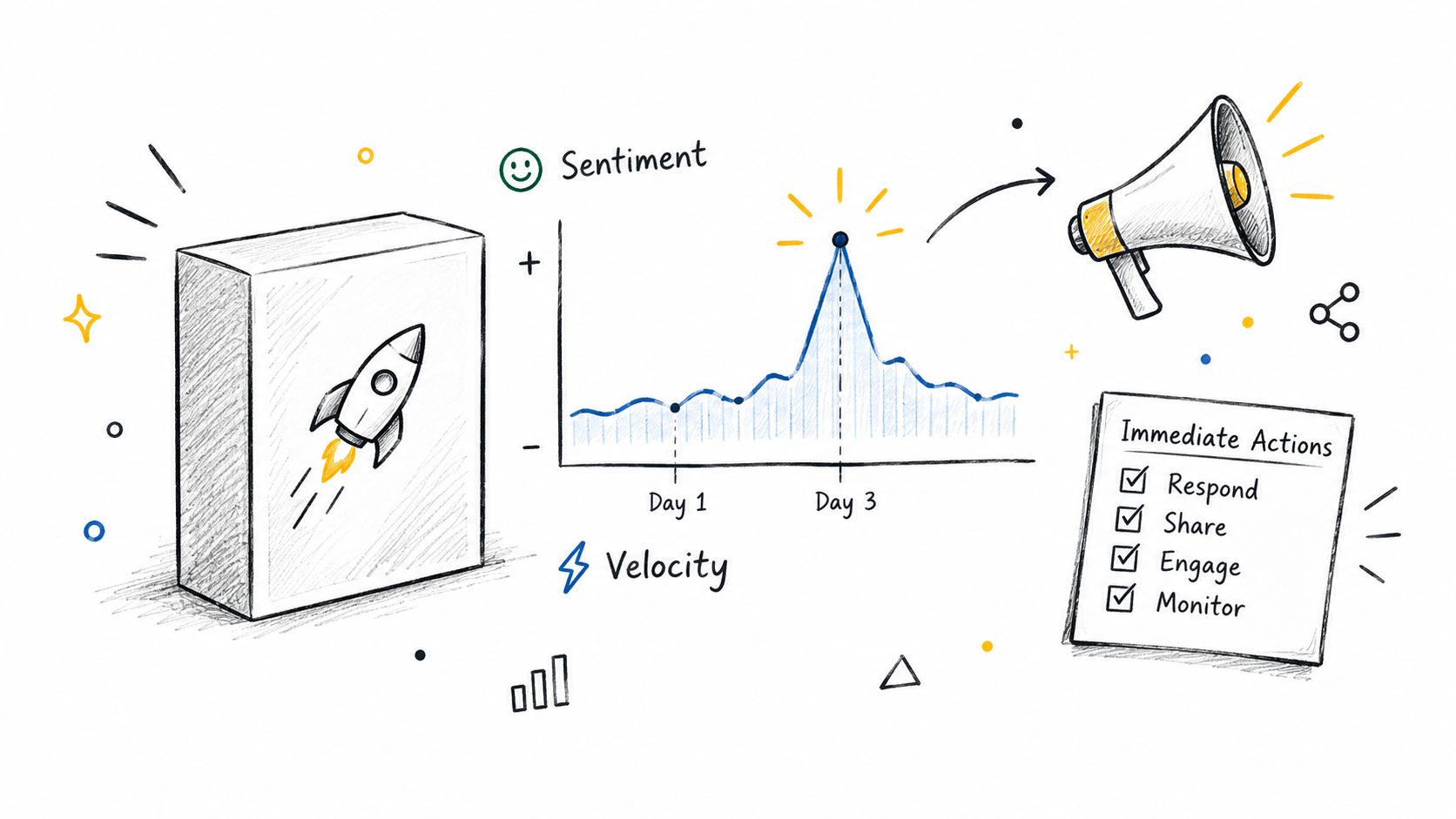
A launch video from a CEO or product leader deserves transcript analysis because the stated promise can be compared directly with audience interpretation. The resulting decision may involve revising a help article, clarifying a claim, briefing support agents, or asking a creator to address a recurring misunderstanding.
The measurement still has limits. A spike in social engagement doesn't prove improved consideration or sales, so teams should connect public data to brand-lift, survey, or transaction evidence where available.
6. Customer Sentiment and NPS Proxy Tracking Through Social Comments
Social comments can reveal customer language that a formal survey may miss, but they aren't NPS. They represent a self-selected, public subset of customers and observers. The responsible use is to treat them as a sentiment and feedback proxy, not as a replacement for a properly sampled recommendation question.
A consumer technology brand might review comments under product videos to find recurring complaints about battery life, setup, or compatibility. A SaaS company could classify YouTube questions about integrations and workflow friction. A restaurant chain might compare reactions to menu items, locations, and service experiences. In each case, the most useful output is a prioritized set of themes linked to specific content and customer contexts.
A rolling comment dataset can support several views:
- Tone: Positive, neutral, negative, mixed, or unclear.
- Intent: Praise, complaint, question, recommendation, feature request, or purchase interest.
- Theme: Product quality, price, service, availability, usability, or trust.
- Intensity: Casual reaction versus a detailed account of a failed experience.
- Recurrence: Whether the issue appears across posts, platforms, or customer groups.
Comment sentiment analysis is most reliable when a model's output is tested against human-labelled examples from the category. Sarcasm, slang, multilingual comments, coordinated activity, and replies taken out of context can all distort classification.
Social comments are an early-warning and discovery layer. They aren't a statistically representative customer satisfaction score.
The resulting dashboard can help product managers prioritize feature requests by combining repetition with meaningful engagement, while customer teams can identify language for support documentation. Analysts should also compare brand-owned content with competitor conversations, because criticism may reflect a category-wide problem rather than a company-specific weakness. Formal NPS or satisfaction research can then test whether the observed social themes extend to the broader customer base.
7. Academic and OSINT Research Dataset Creation for Social Media Trends
A research dataset is a brand tracking example with a different endpoint. The objective isn't a campaign adjustment. It's a reproducible evidence base for studying misinformation, virality, creator behavior, disclosures, or changes in public conversation.
A journalist investigating influencer disclosures might collect public videos, captions, comments, transcripts, and engagement data across relevant accounts. An academic team could examine how claims travel through video discussions. An OSINT analyst might compare the timing, language, and amplification of competing narratives. The same extraction system can support exploratory research before the team commits to a larger dataset.
Good dataset design begins with a clear unit of analysis. Is it a video, a comment, an author, a channel, a topic, or an interaction between them? Researchers should preserve raw responses, collection timestamps, platform identifiers, search parameters, transcript availability, and processing versions. Without those fields, later analysts can't distinguish a change in public conversation from a change in collection method.
Making public-data research defensible
A rigorous pipeline should include:
- Scoping: Use search results to define the population and remove irrelevant accounts.
- Triangulation: Combine transcripts with comments and engagement rather than relying on one signal.
- Reproducibility: Store raw JSON, transformation logic, model versions, and exclusions.
- Bias documentation: Record platform coverage, language limits, moderation effects, and nonrepresentative sampling.
- Ethical handling: Follow applicable platform rules, privacy requirements, and research review procedures.
Captapi's public-data extraction can simplify collection across platforms, but it doesn't remove the researcher's responsibility to document methods or interpret results cautiously. A large dataset can still produce a weak conclusion if the search query favors one narrative, deleted content is invisible, or engagement is mistaken for influence.
The strongest research question connects observed social activity to a defined construct. Instead of asking whether a topic went viral, researchers can ask which sources introduced it, how audiences responded, and which signals preceded wider adoption. That design turns an archive of posts into an analyzable measurement system.
7-Example Brand Tracking Comparison
| Solution | 🔄 Implementation Complexity | ⚡ Resource Requirements (Cost & Time) | 📊 Expected Outcomes & ⭐ Effectiveness | Ideal Use Cases | 💡 Key Advantages / Tips |
|---|---|---|---|---|---|
| Competitor Social Media Sentiment Analysis & Market Share Tracking | Low, fast setup, automated thereafter | Low cost; free tier for small tracking; growth $29–99; 2–3 hrs to implement | Benchmark competitor performance; detect emerging strategies; ⭐⭐⭐⭐ | Marketing agencies, e‑commerce, enterprise product teams | Centralized multi‑platform view; use GPT‑4o‑mini summaries; store weekly baselines; leverage 600 RPS |
| Brand Mention & Crisis Detection Monitoring Pipeline | Moderate → High, needs alert routing + model tuning | Moderate cost; requires sentiment model training; 1–2 weeks to implement | Real‑time alerts for reputation threats; rapid response; ⭐⭐⭐⭐ | PR teams, restaurant chains, product launch monitoring | Sub‑second cache; transcript mention detection; create custom queries; train brand‑specific sentiment |
| Influencer Marketing Campaign Performance Tracking & ROI Measurement | Low → Moderate, dashboard + custom metrics | Low‑to‑moderate API costs; free tier for small sets; 4–6 hrs initial setup | ROI measurement, influencer selection optimization; ⭐⭐⭐⭐ | Agencies, beauty/fitness brands, B2B influencer programs | Unified cross‑platform tracking; extract comments 48‑72 hrs post‑launch; build comparative scorecards |
| Content Strategy & Topic Trend Tracking Using Video Transcripts | Low, transcript extraction + summaries; advanced NLP optional | Low cost (2–5 credits/video); 3–4 hrs setup; ~30 min/week for ongoing | Early topic detection, content gap identification; high signal for strategy; ⭐⭐⭐⭐⭐ | Content strategists, editorial teams, growth managers | AI summaries for scale; batch 20+ transcripts weekly; integrate into RAG for clustering |
| Product Launch & Campaign Announcement Impact Measurement | Moderate, real‑time dashboards and monitoring pipelines | Low‑to‑moderate; costs spike during launches; 2–3 days pre‑launch setup | Real‑time engagement velocity and objection detection; ⭐⭐⭐⭐ | Product marketing, PR, social teams during launches | Hourly pulls first 72 hrs; extract comments within 6 hrs; set negative‑sentiment alert thresholds |
| Customer Sentiment & NPS Proxy Tracking via Social Comments | Low, comment extraction + sentiment pipeline; requires tuning | Low cost; free tier suitable for small brands; 2–3 hrs initial, 1 hr/week | Ongoing sentiment/NPS proxy with bias caveats; ⭐⭐⭐ | Customer success, product managers, UX researchers | Cost‑effective alternative to surveys; export weekly for 30‑day trends; prioritize feature requests by frequency+engagement |
| Academic & OSINT Research Dataset Creation for Social Media Trends | Moderate, research design + large batch coordination | Variable (scale dependent); plan 2–4 weeks design + 1–2 weeks collection | Large, reproducible datasets for research/OSINT; strong cross‑platform coverage; ⭐⭐⭐⭐ | Academic researchers, OSINT analysts, investigative journalists | Bulk export 100+ videos; batch API calls for efficiency; store raw JSON and document methodology |
Turn These Examples Into a Repeatable Tracking System
The common operating model is straightforward, but each step needs a decision attached to it. Start by defining what someone will do with the result. A communications team may need to investigate a reputation spike. A content team may need to select a topic. A brand manager may need to decide whether a campaign changed perception. Without that decision, the dashboard becomes a display of activity rather than a management tool.
Next, select the platforms, audience segments, and metrics that match the question. Mention volume and engagement can describe attention. Sentiment, comment intent, and transcript themes explain the quality of that attention. Share of voice adds competitive context. Survey, brand-lift, and transaction data help test whether public signals connect to consideration or purchase behavior.
The baseline matters because an isolated number has little meaning. Store comparable observations over time, preserve platform and content-type fields, and separate unique authors from raw mentions. For fast-moving communities, segment by language, geography, creator cluster, and audience size rather than allowing a platform-wide average to hide an emerging shift.
Decision rule: Keep a reported movement only when it exceeds reasonable measurement uncertainty, appears across independent signals, and survives review of campaign timing and external events.
This caution is essential because a tracker is observational. Competitor activity, pricing, seasonality, category shocks, and platform changes can move the numbers at the same time as a campaign. The brand-tracking survey guidance from Sprig highlights the need to consider confidence intervals, minimum detectable change, sample planning, and practical counterfactuals. Public social data adds speed and detail, but it also adds nonrepresentative sampling and moderation bias.
A sensible implementation path is incremental:
- Begin with brand and competitor mention tracking, engagement metrics, and a stable collection schedule.
- Add transcript and comment analysis to identify themes, objections, and audience intent.
- Layer in share-of-voice comparisons once the competitive set and relevance rules are consistent.
- Introduce crisis alerts with thresholds, human review, and escalation ownership.
- Connect campaign records to survey, conversion, or transaction data before claiming attribution.
Captapi can simplify cross-platform extraction through a consistent REST interface for public YouTube, TikTok, Instagram, and Facebook data. Teams still own compliant data handling, sentiment-model quality, dashboard design, sampling decisions, and the business response. A modern SEO reporting tool can complement this work when brand visibility needs to be connected with search reporting, but neither system should be treated as a substitute for a clearly defined decision framework.
Captapi offers one API for extracting public social data, including comments, transcripts, summaries, engagement metrics, search results, and channel or page details across major platforms. Use Captapi to build a repeatable brand tracking workflow, then connect its outputs to your own sentiment review, alerts, dashboards, and campaign decisions.