
Comment Sentiment Analysis: Build a Reliable Pipeline
A dashboard shows a healthy stream of positive comments after a product launch. The campaign team relaxes, until someone reads the replies and notices that “brilliant, another outage” and “love waiting three weeks for support” have been counted as positive. The model didn't detect approval. It detected familiar positive words.
That gap separates a demo from a production system. Comment sentiment analysis has to handle sarcasm, slang, emojis, multilingual phrasing, spam, changing topics, and uneven class distributions. It also has to tell your team when its own predictions are unreliable. A polarity score is only useful when the pipeline behind it preserves context, measures error accurately, and gives people a way to audit ambiguous results.
Table of Contents
- The Reality of Comment Sentiment Analysis Pipelines
- Collecting and Preprocessing Comment Data
- Choosing Models and Labeling Strategies
- Evaluating Performance Beyond Accuracy
- Scaling and Deploying the Pipeline
- Handling Toxicity and Edge Cases
- Common Pitfalls and Best Practices
The Reality of Comment Sentiment Analysis Pipelines
A basic sentiment tutorial usually follows a neat path: collect text, remove punctuation, run a classifier, and count positive and negative outputs. Real comment streams don't cooperate. Users reply to one another, quote a brand's wording, use irony as shorthand, and compress an entire complaint into an emoji or two.
Consider a comment that says, “Fantastic, the new update deleted my settings.” A keyword model sees “fantastic” and may assign positive sentiment. A more capable model might infer negativity from the surrounding event, but even that inference depends on knowing what “the new update” changed and whether the commenter is being literal. A comment can also express mixed intent, such as praising a product while criticizing delivery or support.

Why polarity is only the first layer
Sentiment analysis became a formal research field in the early 2000s, initially covering opinions, evaluations, attitudes, and emotions expressed in text, including online resources. By 2013 to 2015, research had expanded toward comment-level analysis across platforms, treating emotional tone in user-generated text as a practical natural language processing problem. This early survey of sentiment analysis research documents that broader development.
Production systems should therefore separate at least three questions:
- What is the sentiment? Positive, negative, neutral, or mixed.
- What is the subject? Product quality, shipping, pricing, support, policy, or something else.
- What should happen next? Ignore, aggregate, route to support, escalate to moderation, or send to a human reviewer.
The third question is where many implementations fail. A negative comment from a high-impact customer may deserve attention even if it represents only one item in a large stream. A repeated bot message may inflate negativity without representing a genuine customer experience. Treating every comment as an independent, equally trustworthy vote produces tidy charts and poor decisions.
Production rule: Never let a single sentiment label carry the full meaning of a comment. Store the text, source, timestamp, topic, confidence, moderation signals, and model version alongside the prediction.
A useful overview of the broader workflow is available in this guide to social sentiment analysis. The practical distinction is simple: an academic experiment asks whether a model can classify a prepared dataset, while a production pipeline asks whether the output remains useful after platform changes, campaign spikes, new slang, and human review.
Collecting and Preprocessing Comment Data
The model can't repair missing context or inconsistent ingestion. Start by defining a common record before collecting anything:
comment_id
platform
parent_comment_id
author_id_hash
published_at
text
language
engagement_metadata
source_url
collection_timestamp
Keep raw text immutable. Create a separate normalized field for model input so analysts can inspect what changed during preprocessing. Parent and thread identifiers matter because “yes, exactly” has almost no sentiment meaning without the comment it answers.
Build a stable ingestion layer
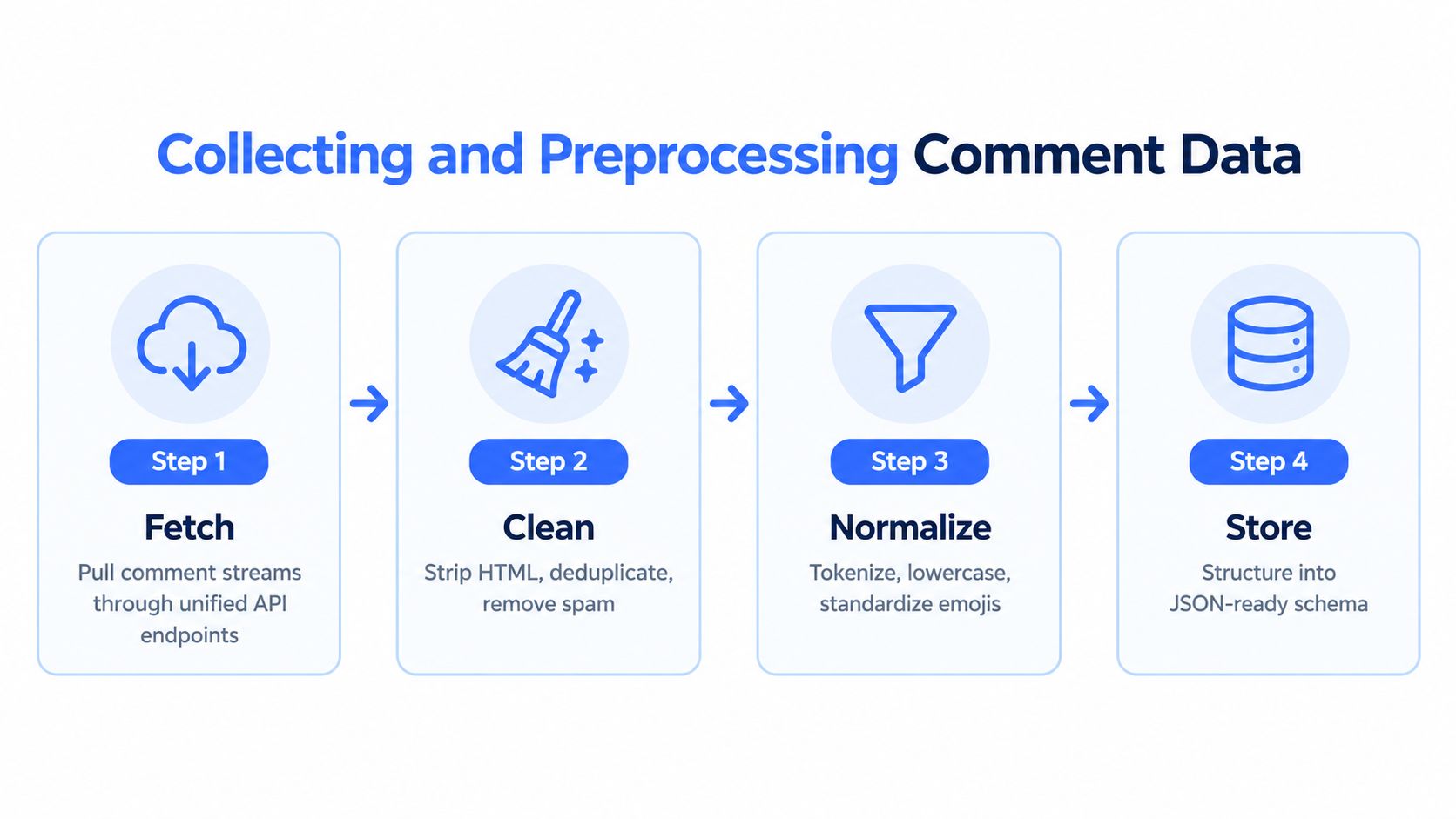
A unified REST interface can collect public comments from YouTube, TikTok, Instagram, and Facebook without forcing the rest of the pipeline to understand four different response formats. Pull pagination metadata, platform identifiers, timestamps, reply relationships, and any available engagement fields, not just the visible comment text. A practical guide to social media data gathering illustrates why collection should be treated as a structured data problem rather than a copy-and-paste task.
Respect platform terms, rate limits, privacy requirements, and deletion requests. Hash or remove author identifiers when identity isn't required for the use case. Store collection timestamps because a later audit needs to distinguish the original publication time from the time your system retrieved the comment.
Clean without erasing meaning
Deduplication should use more than exact string matching. The same spam message may contain changing URLs, usernames, or whitespace, so compare normalized text and repeated author-pattern signals. Don't remove every short comment, repeated phrase, or emoji. “👍” can be a meaningful positive response, while “sure 😂” may be sarcastic or dismissive.
Useful preprocessing steps include:
- Strip presentation noise: Remove HTML artifacts, tracking parameters, and accidental markup while retaining punctuation that carries tone.
- Normalize carefully: Map equivalent emoji forms and whitespace patterns, but preserve repeated exclamation marks, question marks, and capitalization as optional model features.
- Detect language early: Route multilingual and code-mixed comments to an appropriate model or a human-review queue instead of translating every comment without review.
- Retain thread context: Include the parent comment or a compact context window when replies depend on earlier text.
- Mark suspicious content: Add spam, bot-like, abuse, and duplicate flags rather than deleting every questionable record.
A labeled sample should go through this process before annotation. If annotators see a cleaned version while the deployed model sees a different representation, your evaluation won't describe production behavior.
Choosing Models and Labeling Strategies
No model family wins every comment-sentiment problem. The right choice depends on volume, latency, language coverage, explainability, and the cost of a wrong decision.
| Approach | Best For | Limitations |
|---|---|---|
| Rule-based analysis | Fast triage, explicit terms, transparent business rules | Misses context, irony, negation, and changing language |
| Traditional machine learning | Stable domains, high-throughput classification, interpretable features | Needs representative labels and usually struggles with unseen phrasing |
| Transformer classifier | In-domain sentiment and topic classification with strong contextual features | Requires careful fine-tuning, monitoring, and domain-specific evaluation |
| Large language model | Nuanced classification, mixed intent, explanations, and taxonomy discovery | Higher cost and latency, variable output control, and difficult reproducibility without strict schemas |
A rule-based layer still has a place. It can identify explicit escalation terms, route known product names, and provide a cheap first pass before a more expensive model runs. It shouldn't be the final authority on sentiment. Keyword dictionaries tend to fail when a word changes meaning by community, negation, or context.
Traditional classifiers such as Naive Bayes or support vector machines remain useful when the vocabulary is stable and the team values speed and inspectable features. A TF-IDF representation with an SVM can be a strong baseline because it exposes which terms drive predictions. That baseline gives you a reference point for judging whether a more complex system earns its operational cost.
Transformer models handle context more effectively, especially after fine-tuning on comments from the target platform. Large language models can go further for mixed-intent labels, topic extraction, and difficult edge cases. They also introduce new controls you must engineer: constrained JSON output, prompt versioning, retries, token limits, privacy filtering, and a policy for uncertain responses. A model that writes a convincing explanation isn't automatically a model that classified the comment correctly.
Design the label scheme first
Start with labels your team can act on. A useful schema might include sentiment, topic, intent, urgency, toxicity, and an uncertainty flag. Don't force annotators to choose positive or negative when a comment is mixed or has no discernible opinion.
Write annotation rules with examples of:
- Sarcasm and ironic praise
- Questions that imply dissatisfaction
- Product praise paired with service criticism
- Replies whose meaning depends on the parent comment
- Slang, dialect, emoji combinations, and code-mixed language
- Spam, abuse, promotional content, and non-opinion statements
Use multiple annotators for an initial sample and measure disagreement. Disagreement isn't merely annotation noise. It often reveals an unclear taxonomy, missing context, or a category that should be routed to human review instead of forced into a binary label.
Class imbalance requires deliberate sampling. A dataset dominated by neutral comments can make a weak classifier look successful because it learns to predict the majority class. Keep the natural distribution in a held-out test set, but consider balanced training batches, class weights, or targeted collection of rare but important categories. Do not manufacture a reassuring score by evaluating only on a balanced sample if production traffic won't be balanced.
For teams that want structured outputs from a collection service, a sentiment analysis API workflow can provide the ingestion layer, while labeling, model selection, and quality control remain responsibilities of the analysis system.
Evaluating Performance Beyond Accuracy
Accuracy answers one narrow question: how often did the predicted label match the label in the test set? It says little about whether the model catches the negative comments your support team cares about or whether it wrongly classifies sarcasm as praise.
Suppose neutral comments dominate a test corpus. A model can predict neutral frequently and still achieve an attractive accuracy score while missing most negative cases. The remedy is to inspect precision, recall, F1 score, and the confusion matrix for each important class.
- Precision tells you how many comments predicted as negative were in fact negative. Low precision creates alert fatigue.
- Recall tells you how many of the genuinely negative comments the model captured. Low recall lets serious issues pass unnoticed.
- F1 score balances those two concerns, but it should be reported per class when the costs of errors differ.
- The confusion matrix shows the shape of failure. It can reveal whether negative comments become neutral, positive comments become neutral, or one minority class disappears entirely.
Test where the model wasn't trained
A rigorous benchmark compared 24 sentiment-analysis approaches across 18 labeled datasets, including social-network messages and news comments. The study found that performance varies substantially by domain, and no single method dominates across every comment-like dataset. The comparative benchmark study supports a practical engineering conclusion: one benchmark score isn't a deployment argument.
Use three evaluation layers:
- In-domain validation: Test on comments that resemble the source, topic, language, and time period used in training.
- Cross-domain testing: Hold out an entire platform, topic, campaign, or community to expose generalization failures.
- Temporal testing: Evaluate on later comments so vocabulary and conversation patterns can change.
Track metrics by language, platform, topic, comment length, and moderation status. A single aggregate score can hide a severe failure in a small but business-critical segment.
Start trend analysis with a 30-day neutral baseline before measuring change, as recommended in practical social-media sentiment guidance. Interpret net sentiment against the account's own history and relevant competitors, not as an isolated universal grade. A positive-to-negative ratio can be informative in context, but the correct threshold depends on the community, category, and moderation policy.
For teams connecting sentiment to customer experience decisions, the SigOS guide on customer churn signals offers useful context on treating customer sentiment as a signal that should be combined with broader behavioral evidence, rather than used as a standalone prediction.
Scaling and Deploying the Pipeline
A local notebook usually hides the operational details that determine whether comment sentiment analysis survives production. You need a clear separation between ingestion, preprocessing, inference, persistence, monitoring, and downstream delivery. Each stage should be independently retryable and should record enough metadata to reproduce a prediction.
Choose batch or streaming deliberately
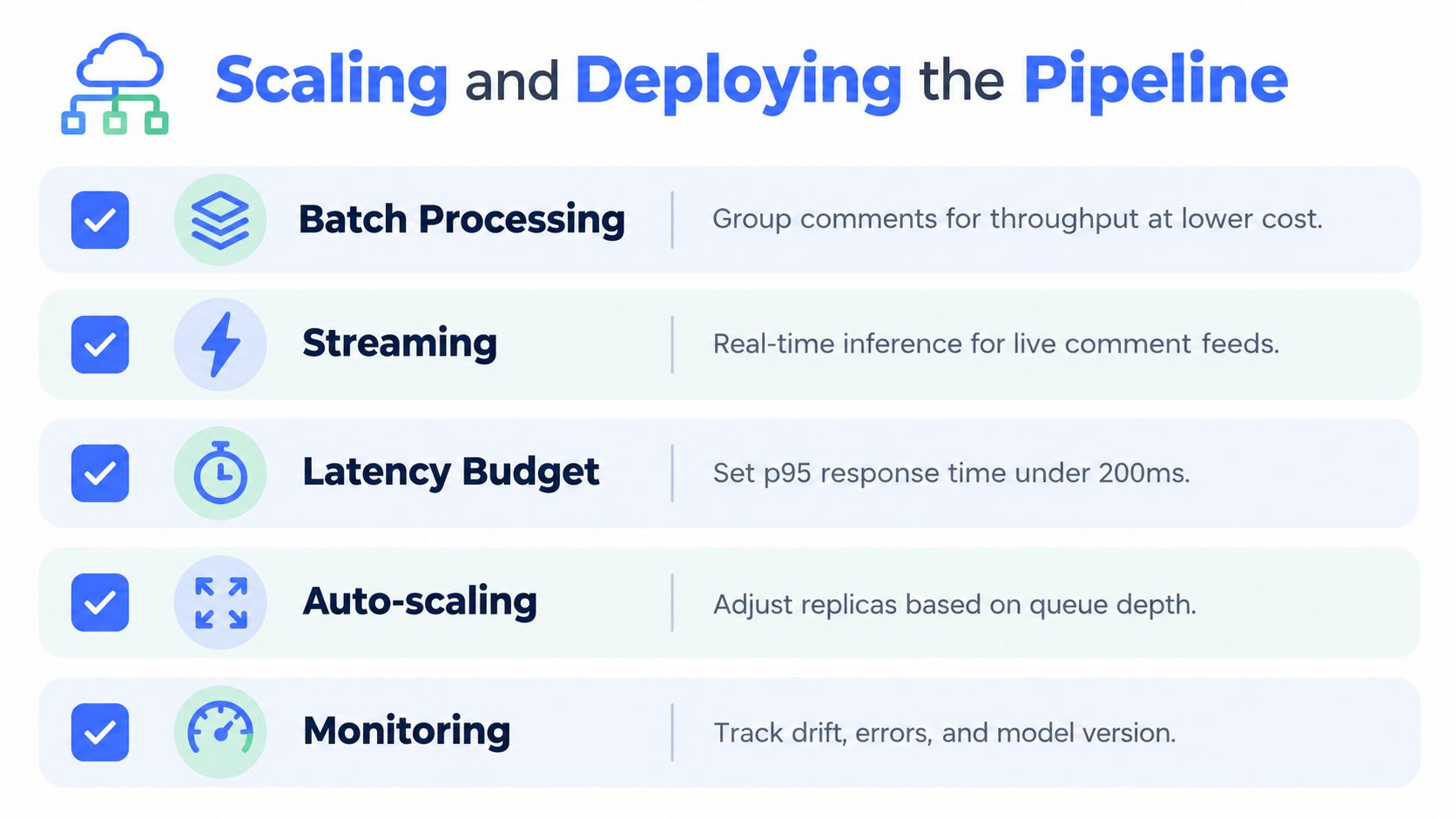
Batch processing suits historical reporting, competitor research, and scheduled exports. A worker can collect a group of comments, normalize them, run inference, and write results in bulk. Batching reduces per-request overhead and makes expensive models easier to control.
Streaming is appropriate when teams need rapid detection during an active launch, outage, or moderation event. It demands stronger backpressure handling, idempotent processing, queue management, and a policy for late-arriving replies. Don't build streaming merely because it sounds modern. If nobody can respond to a signal quickly, a scheduled batch may deliver the same business value with less failure risk.
A practical architecture looks like this:
- Ingestion queue: Accepts platform events or polling results and assigns an idempotency key.
- Normalization worker: Produces the canonical text and metadata fields while retaining the raw record.
- Inference service: Applies the selected model and returns labels, probabilities or confidence indicators, and model version.
- Review queue: Holds low-confidence, high-impact, or policy-sensitive comments for people.
- Analytics store: Supports trend queries by platform, topic, language, campaign, and time.
- Alerting layer: Sends only actionable changes to Slack, email, ticketing, or CRM systems.
Make failures visible
Monitor more than uptime. Log queue depth, processing latency, empty responses, duplicate rates, language distribution, label distribution, confidence shifts, and the proportion sent to human review. A sudden change in the share of positive comments may indicate a real audience reaction, a platform format change, a broken parser, or a model problem.
Cache immutable or frequently requested records where policy permits. Keep dataset versions and model artifacts together so a dashboard result can be traced to the exact training data, preprocessing configuration, and inference version that produced it. When retraining, compare the candidate model with the current model on the same fixed regression set and on fresh, manually reviewed comments.
Rate limits and partial platform failures are normal. Use exponential backoff, bounded retries, dead-letter queues, and checkpointed pagination. Never let a retry create duplicate comments or skip a page without notice. The data pipeline automation reference is useful for thinking about repeatable extraction and downstream processing as one system rather than as disconnected scripts.
Deploy model changes behind a versioned interface. Run shadow inference before switching production traffic, compare disagreement cases, and give reviewers a way to label errors directly from the monitoring dashboard. Retraining should follow evidence from drift and audit findings, not a calendar alone.
Handling Toxicity and Edge Cases
A comment can be negative without being abusive, abusive without expressing a clear opinion, or both. A spam message can contain positive language designed to attract clicks. If the pipeline collapses all of these into positive, negative, and neutral, it mixes customer insight with moderation risk and produces misleading summaries.
Recent market data illustrates why this separation matters. 20% of 168.8 million social comments analyzed in 2025 contained spam, bot activity, or abuse, according to the cited Respondology report coverage. The same source reports that 47% of users hold brands responsible for toxic or spammy comments. These figures don't establish a universal rate for your channels, but they do show why moderation and sentiment increasingly belong in the same operational design.
Use separate dimensions
Don't label toxicity as a sentiment class. Store separate fields such as:
- Sentiment: The emotional direction of the opinion.
- Toxicity: Whether the content violates your abuse or harassment policy.
- Spam likelihood: Whether the content appears automated, promotional, duplicated, or irrelevant.
- Intent: Complaint, question, praise, threat, request, recommendation, or other actionable category.
- Review priority: A business or safety decision based on impact and confidence.
Sarcasm needs targeted treatment rather than a promise that a larger model will solve it. Build a challenge set containing ironic praise, understatement, memes, quoted text, and emoji combinations. Include the parent comment where possible. Route uncertain examples to humans and feed adjudicated labels back into the regression set.
Treat language as a quality boundary
Sarcasm, code-mixing, and multilingual comments remain difficult because many systems perform best on monolingual text and struggle when literal wording conflicts with intended meaning. Recent discussion of these limitations also highlights annotator disagreement on nuanced or culture-bound comments.
Don't hide this weakness behind automatic translation. Detect language and code-mixing, measure performance separately, and document where the model is not reliable. A fallback can preserve the original text, use a language-specific model, or send the record to review. Translation may help retrieval, but it can remove slang, cultural references, or the exact wording needed for moderation.
A governance layer should define retention, access, escalation, and appeal procedures. The responsible AI governance guidance can help teams turn those principles into operational controls. Sentiment is an input to a decision, not permission to punish a user or suppress criticism automatically.
Common Pitfalls and Best Practices
The most damaging failures are usually process failures, not exotic modeling problems. Teams train on convenient comments, report one aggregate accuracy score, and deploy without a review path. The system then encounters sarcasm, a new product name, a platform-specific format, or a sudden spam campaign and continues producing confident-looking outputs.
Use this compact checklist before deployment:
- Define actionable labels: Separate sentiment, topic, toxicity, spam, intent, and uncertainty.
- Preserve context: Keep thread relationships, timestamps, language, and raw text.
- Build representative evaluation: Include natural class imbalance, multiple sources, later data, and difficult edge cases.
- Audit humans regularly: Sample high-confidence predictions, low-confidence predictions, and high-impact comments.
- Track history: Establish a 30-day neutral baseline before interpreting movement, then compare trends with relevant historical and competitive context.
- Version everything: Store the dataset, preprocessing code, label policy, model, and prediction metadata.
A small manually reviewed sample is more valuable than a large unlabeled stream when you're diagnosing failure. Reviewers should record why a prediction was wrong, whether the taxonomy was ambiguous, and whether the model needs more context. That turns production monitoring into a learning loop instead of a passive dashboard.
Captapi provides a consistent REST interface for collecting public comments across YouTube, TikTok, Instagram, and Facebook, with structured data that can feed preprocessing, labeling, and sentiment inference workflows. Visit Captapi to explore the API and start building a comment pipeline you can test, audit, and operate reliably.