
Web Scraping vs API: The Complete Developer Guide
Most advice on web scraping vs API starts with the wrong question. It asks which one is cheaper per request, then pretends the rest of the system doesn't matter. In production, the bill shows up somewhere else, in retries, blocked requests, parser rewrites, rate-limit workarounds, and the engineer time needed to keep data flowing.
| Dimension | Web Scraping | API |
|---|---|---|
| Data access | Publicly visible page content, often broader coverage | Fields and history the provider exposes |
| Structure | Raw HTML or rendered pages, then parse and normalize | Structured responses with a defined schema |
| Reliability | More brittle, site changes can break extraction | More predictable, but still dependent on provider continuity |
| Maintenance | Selector fixes, anti-bot handling, monitoring, retries | Authentication changes, deprecations, quota management |
| Cost model | Upfront build plus ongoing operational load | Usage-based or quota-based access, with vendor dependency |
The better model is total cost per successfully delivered record. That means counting not just the request that left your service, but the record that arrived clean, current, and usable. If a pipeline needs retries, cache lookups, schema cleanup, or human intervention before a record is trustworthy, that cost belongs in the comparison.
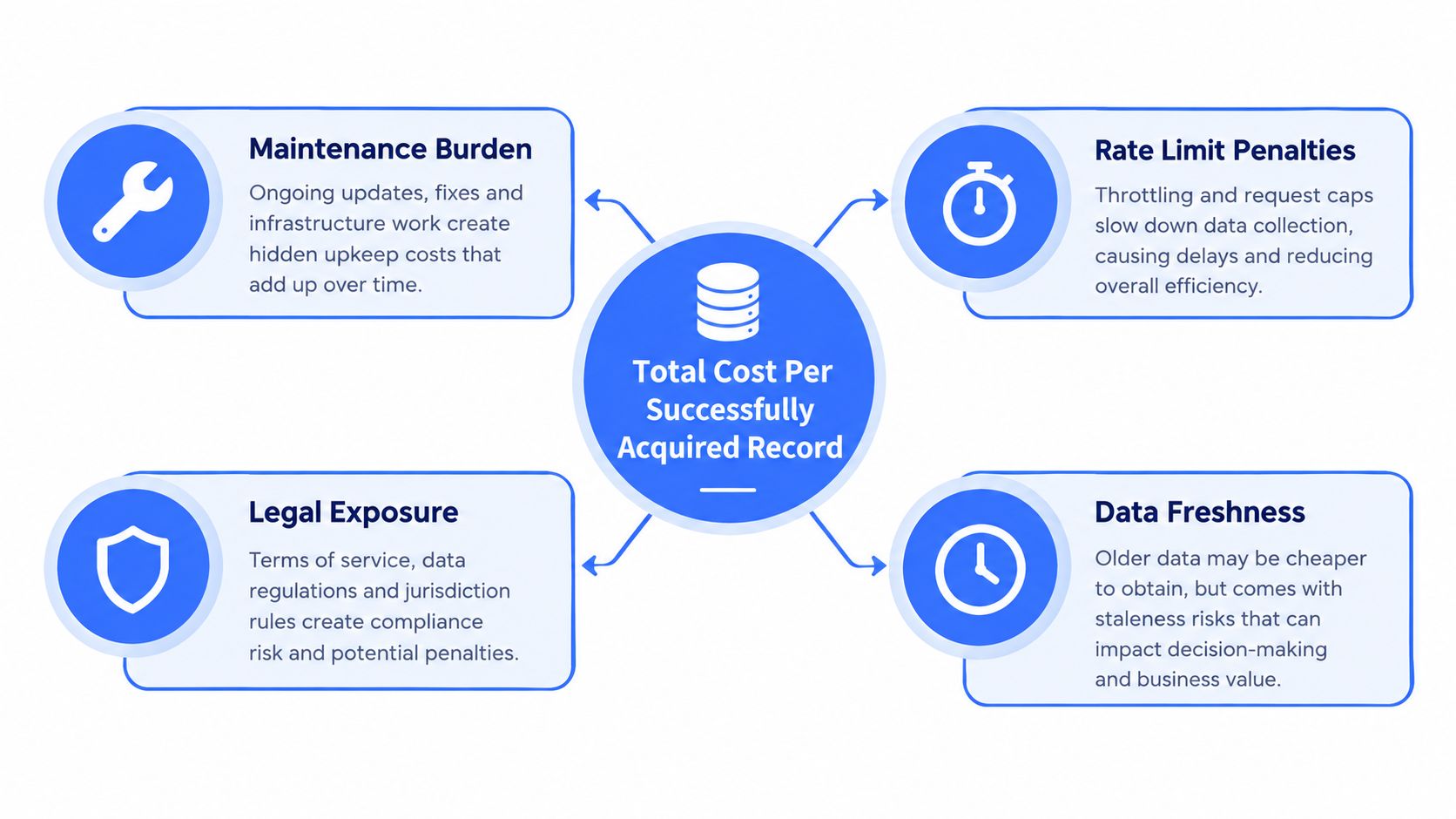
A useful way to think about the debate is this, scraping buys breadth and control, while an API buys predictability and outsourced maintenance. Neither is “free.” The decision is which failure mode your team wants to own, and whether your pipeline can absorb it without turning into a maintenance project. For a practical adjacent overview of extraction patterns, the note on data extraction fundamentals is a useful companion.
Table of Contents
- Rethinking Web Scraping vs API Decisions
- Technical Architecture and Data Extraction Differences
- Reliability, Rate Limits, and Performance Trade-offs
- Legality, Compliance, and Governance Risks
- Cost Analysis Including Hidden Maintenance Expenses
- Common Use Cases and Decision Scenarios
- Decision Checklist and Hybrid Architecture Guidance
- Final Recommendations for Modern Data Pipelines
Rethinking Web Scraping vs API Decisions
The most common mistake is treating scraping as the cheap option and APIs as the expensive one. That framing hides the work that turns raw data into a usable record, especially when a page changes, a block appears, or a field disappears without warning. A scraper may still “run” while returning partial or stale output, which is usually the more expensive failure.
Cost is not the request, it's the delivered record
A better decision starts with the downstream record you need. If a product feed needs price, title, availability, and canonical URL, then every one of those fields has to survive extraction, normalization, and validation before the record is usable. If your team spends hours recovering from drift, that cost belongs in the pipeline economics.
Practical rule: count the engineering time required to keep the pipeline truthful, not just the time required to send the request.
The debate shifts here. A production API often looks expensive until you compare it against the support burden of browser execution, proxy churn, CAPTCHA handling, retry orchestration, monitoring, and parser maintenance. Scraping can still win at scale, but only when the volume justifies the operational overhead and the team can sustain the system.
Freshness and failure recovery matter as much as access
The best ingestion strategy depends on how much delay the business can tolerate. If missed or late records hurt ranking, alerting, or lead response, then reliability has real value even when the unit price is higher. If the data only needs to be current occasionally, a more fragile but broader source might be acceptable.
Hybrid teams usually land on a simple pattern. Use the source that gives the cleanest record first, then ask what happens when it breaks, drifts, or excludes a field you need. That question leads to resilient design, which is more useful than arguing over which label is cheaper.
Technical Architecture and Data Extraction Differences
APIs and scrapers solve the same business problem through very different mechanics. An API gives you a defined interface, structured fields, and a response shape that usually stays consistent until the provider changes it. Scraping starts with what a browser sees, then forces your system to parse, render, and interpret content that was never designed as an ingestion contract.
Structured endpoints versus page parsing
API integration is usually straightforward because the provider has already modeled the data. You authenticate, call an endpoint, and handle a response that's easier to validate downstream. That matters when your pipeline depends on predictable schemas, because fewer surprises reach the transformation layer.
Web scraping is looser by nature. It may read HTML directly, or it may need a browser to render JavaScript before the data even appears. The parser then has to survive layout shifts, renamed classes, missing nodes, pagination quirks, and page variants that only show up in production traffic.
Authentication and schema stability
Authentication is also different in practice. APIs usually centralize access control in keys, tokens, or user grants, while scraping may have to deal with session cookies, login walls, or page-level constraints. The result is that API failures are often obvious, while scraper failures can look like success until the extracted values are inspected later.
Schema consistency is the quiet advantage of APIs. If the provider changes a field, the change is normally explicit enough for a client to notice. With scraping, the HTML can shift in ways that preserve page rendering but break selectors, and that's why extraction logic often needs ongoing attention from engineering. For a more implementation-oriented companion, the guide on extracting data from a web page fits naturally here.
An API is usually easier to normalize. A scraper is usually easier to extend into places the provider didn't plan for.
That trade-off is why mature teams rarely talk about scraping versus APIs as ideology. They talk about whether the data contract is stable, whether the page can be rendered reliably, and how much maintenance they're willing to own once the first version ships.
Reliability, Rate Limits, and Performance Trade-offs
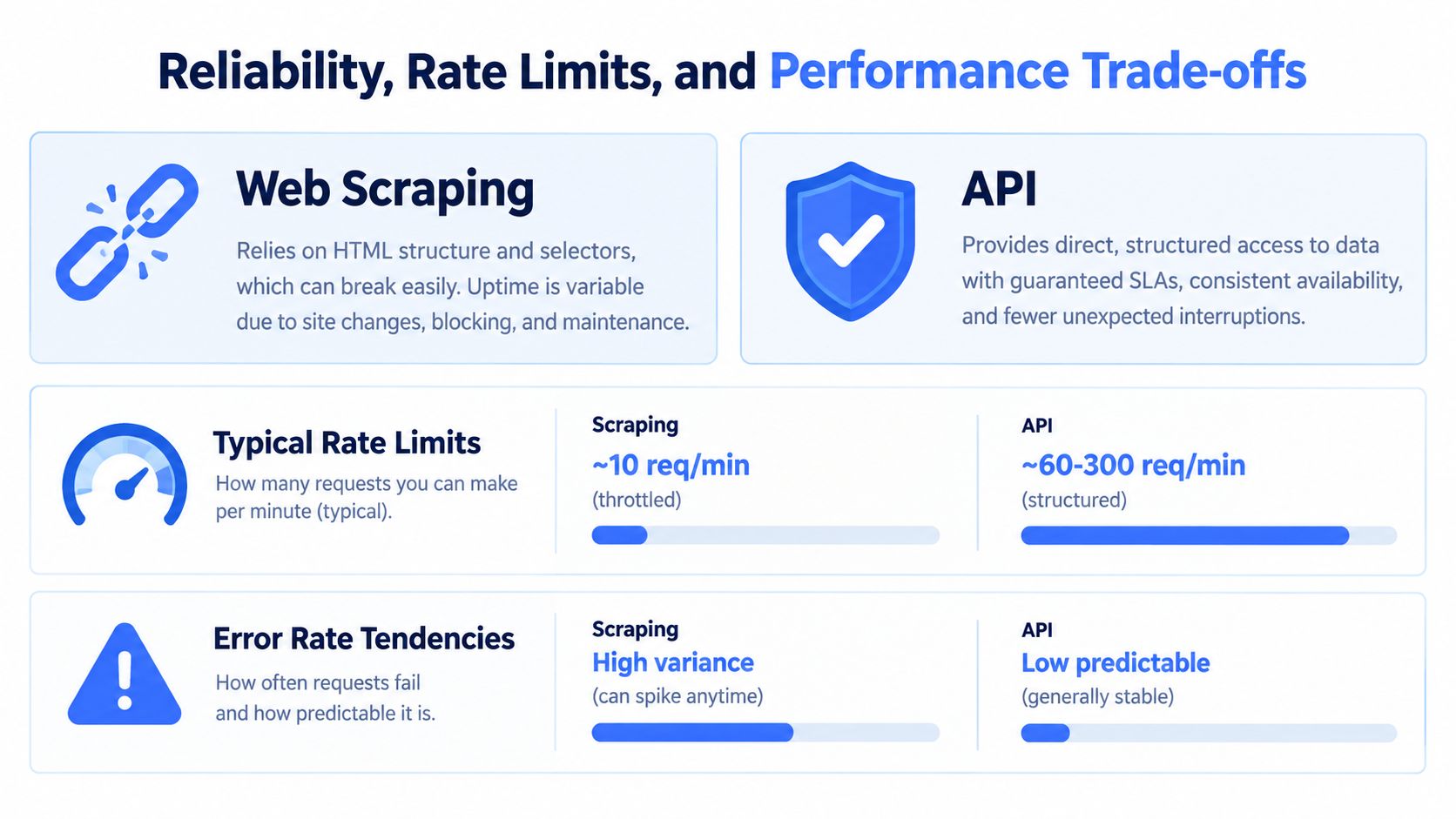
A pipeline that delivers cheap requests but produces incomplete records is not efficient. Reliability should be measured by the total cost per successfully delivered record, including retries, validation, incident response, and repair work. APIs often provide more consistent response behavior, while scraping also depends on the target page's availability, rendering path, and tolerance for automated traffic.
What happens when scale increases
At higher volume, throughput must be balanced against access constraints. Scrapers commonly require concurrency controls, backoff logic, retries, and block handling because target sites may throttle, reject, or degrade requests without warning. APIs typically expose their ceilings more clearly, which makes capacity planning easier even when the permitted rate is limited. A practical guide to API rate limits explains the controls teams need to account for when planning request volume.
API ceilings are typically explicit and documented. Scraping throughput depends on target-site tolerance, page complexity, rendering requirements, and the mix of endpoints or page types, so it can only be established through load testing against the specific targets. The web scraping versus API comparison provides useful context, but its figures should not replace a benchmark of your own workload. Measure successful, validated records per unit of time, not request counts alone.
The hidden cost of unstable extraction
Scraping failures often appear after the HTTP request succeeds. A page may load while a selector returns an empty value, or a dynamic component may differ by geography, session state, or login context. Monitoring therefore needs to cover record quality, field completeness, duplicate rates, and structural drift alongside status codes.
Operational habit: log extracted field counts and mismatch rates, not just request status.
Caching and a unified data layer can reduce the operational impact of unstable sources. Separating collection from serving prevents a slow or failing target from immediately affecting users, dashboards, or downstream jobs. It also creates a place to quarantine suspicious records before they reach production systems.
Performance is therefore a resilience question. The faster option per request can still cost more per usable record if it requires frequent retries, manual inspection, or recovery after layout changes. Benchmark both approaches with the same validation rules and count only records that pass those checks.
Legality, Compliance, and Governance Risks
Legal risk is where a lot of technical comparisons get dangerously simplistic. Publicly visible data is not the same thing as permission to collect it, and an API is not automatically compliant just because it is official. Terms, access controls, privacy obligations, copyright, purpose, and jurisdiction all shape what a team can safely do.
Public availability does not end the conversation
A page being visible in a browser means the data can be seen, not that every collection method is acceptable. Login walls, account-bound content, and restricted endpoints raise the risk profile, while openly accessible pages can still be constrained by terms or privacy rules. Teams that skip this review often discover the issue only after they've already built the pipeline.
APIs usually make governance easier because they come with a provider-controlled access path and clearer service terms. Scraping is harder to standardize because the source page, the purpose of collection, and the legal environment all affect the outcome. The safe pattern is to treat governance as an engineering requirement, not a checkbox after the extractor ships.
What a usable governance model needs
A production team should know where each field came from, how it was obtained, and what happens if the source changes or disappears. That means tracking provenance, deleting stale records when needed, and knowing which data can be retained, merged, or redistributed under your policy. Teams also need escalation rules for when API data and page data disagree, because silent inconsistency is often more dangerous than a hard error.
Practical rule: if you can't explain the collection method to legal, security, and data consumers in one paragraph, the pipeline isn't ready.
The legal angle in the comparison of website scraping and legal considerations is worth reading alongside your own policy review. The goal isn't fear, it's control, because control is what lets a pipeline survive audits, disputes, and source changes without becoming a liability.
Cost Analysis Including Hidden Maintenance Expenses
The request price is rarely the cost that determines whether a pipeline works financially. The useful measure is the cost per successfully delivered record after infrastructure, maintenance, retries, failed jobs, normalization, and support are included. Two approaches can look inexpensive at the start, then separate sharply once production reliability and team ownership enter the calculation.
Scraping costs hide in infrastructure and labor
A scraping system may require browser execution, proxies, CAPTCHA handling, retries, monitoring, parser rewrites, and engineering time. Each expense can appear manageable in isolation. Together, they turn “free access” into an operational system that needs regular care. A layout change can invalidate a parser even when the required business fields remain unchanged.
Maintenance also has an opportunity cost. Engineers handling selector failures and recovery work are not improving the data model or downstream product. A web scraping service can shift some of that work to a managed provider, although the contract, coverage, and failure-handling model still need review.
APIs transfer part of the operational burden to the vendor. They can still introduce quota overages, vendor lock-in, deprecations, authentication changes, and withdrawn access. Those costs may appear as support tickets, migration work, or architectural limits rather than as broken jobs. They belong in the same calculation.
Volume changes the economics
The breakeven depends on your delivered-record cost. If parser rewrites, proxy spend, browser execution, and recovery work exceed the vendor's per-record fee, the API wins. If coverage requirements make vendor pricing multiply beyond the budget ceiling, scraping may win. The relevant boundary changes with failure rates, record quality, and how much maintenance the team can sustain.
A broader web scraping versus API comparison provides useful context, but request pricing alone cannot settle the decision. Model the full path from collection to an accepted record.
- Low-volume, production-critical data: an API often wins because the vendor carries more maintenance work.
- High-volume, broad-coverage data: scraping may win when the team can support the operational load.
- Mixed requirements: a hybrid architecture can cost less than forcing one method to handle every source.
- Uncertain schema needs: the lower-cost option is the one that reduces rework, not necessarily the one with the lowest request fee.
Track parser failures, retry volume, manual review, and discarded records alongside invoices. The finance question is simple: what does one correct record cost after failures, recovery, and normalization? That figure is more useful than the advertised request price.
Common Use Cases and Decision Scenarios
Different workloads push the choice in different directions. A team building a RAG pipeline doesn't care about the same failure modes as a team tracking competitor pricing, and a research workflow can tolerate very different latency than an alerting system. The right answer comes from the shape of the data contract, not from preference.
When APIs usually win
APIs fit best when the source is already authoritative and the fields matter more than exhaustive coverage. Social and platform data, authenticated services, and structured product feeds are common examples because the contract is clearer and the downstream system can normalize less. If the provider gives you the exact fields you need, the API path usually saves the most maintenance.
That's also where public-data APIs can be practical. Captapi, for example, exposes public social-media and web-page information through a REST interface, which is useful when the team wants structured JSON without building and maintaining its own scraper stack. It isn't a universal replacement for scraping, but it is a clean option when the source and contract line up.
When scraping earns its keep
Scraping wins when the visible page contains fields the API leaves out, when freshness matters at the page level, or when the task depends on multiple public sources that don't share a common interface. Market research, directory enrichment, SERP review, and content inventory work often fall into this category. If the data exists in the browser and the API doesn't expose it, scraping becomes the only way to recover the missing surface area.
A lead-gen workflow is a good example. Teams that need company names, job titles, and site-level details often combine sources and then clean the result into one schema. The data enrichment checklist for lead gen is a useful external reference for thinking about field coverage before you build the pipeline.
One more thing matters here, especially for AI pipelines.
A realistic mixed workflow
A common production pattern is to use the API for the stable core and scraping for the gaps. That gives the team a predictable backbone while preserving access to fields that only appear on the page. It also makes debugging easier because the source of truth is explicit, which matters when model inputs, reporting dashboards, or customer-facing workflows depend on the result.

Hybrid systems tend to age better because they don't force every field through the same mechanism. The API covers what the provider already supports, while the scraper reaches for the fields or freshness the API doesn't expose yet.
Decision Checklist and Hybrid Architecture Guidance
The right choice gets clearer when you force the problem into a short checklist. Start with what the downstream system needs, because schema shape, legal exposure, and maintenance capacity matter more than abstract preference. A team that answers those questions directly usually reaches the same conclusion the hard way later, only with less rework.
A practical checklist
- Data requirements. Decide whether the workload needs structured fields, raw page content, historical depth, or page-level freshness.
- Legal constraints. Review terms, privacy concerns, access controls, and whether public visibility alone is enough for your use case.
- Budget. Set a real ceiling for cost per record, not just request spend.
- Technical capacity. Be honest about whether your team can maintain parsers, retries, and monitoring over time.
A scraper is easiest to justify when the team needs fields the API doesn't provide and can tolerate the upkeep. An API is easiest to justify when the source is authoritative, the schema is clear, and the system values predictability over reach. If both are true in different parts of the pipeline, don't force a binary choice.
Why hybrid architecture is often the right answer
The most resilient architecture uses the API as the primary source and scraping as a controlled fallback or enrichment layer. That pattern reduces the blast radius of page changes while keeping access to missing fields and fresher public content. It also gives teams a place to put validation rules, so disagreements between sources become visible instead of silent.
Use the most governable source first, then add the brittle one only where it creates real value.
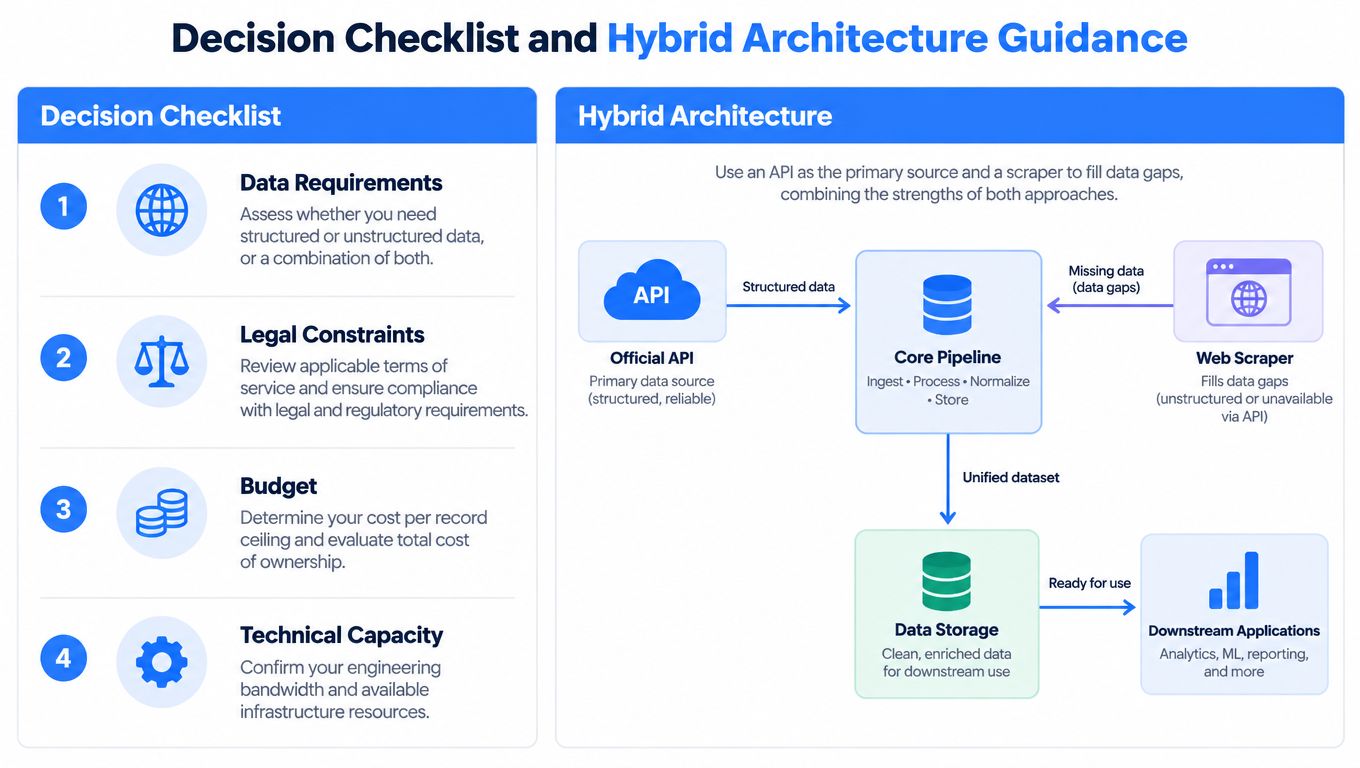
That architecture is especially useful when a pipeline serves both product and research needs. It keeps the core stable for production use, while leaving room to enrich, verify, or repair records without rebuilding the whole system every time a source changes.
Final Recommendations for Modern Data Pipelines
The cleanest recommendation is not “choose APIs” or “choose scraping.” It's to choose the source that gives you the most reliable record at the lowest real operating cost for the current stage of your product. Early teams often prefer APIs because they want fewer moving parts, while later-stage teams sometimes accept scraping when the business value of broader coverage outweighs the upkeep.
Use APIs when the data is already structured, the source is authoritative, and your team needs predictable operation. Use scraping when the page contains public information the API doesn't expose, when freshness is tied to the rendered page, or when the use case depends on breadth more than stability. Use both when one source covers the core and the other fills the gaps.
The decision will change as your workload changes. A prototype can survive brittle extraction that a production model, alerting system, or customer-facing dashboard cannot. Revisit the choice when schema needs grow, when legal review tightens, or when maintenance starts to show up in every sprint.
For teams building AI, marketing, or research pipelines, the smartest path is usually the one that keeps records trustworthy without locking the system into avoidable maintenance. If you want a managed API-based alternative for public social and web-page data, visit Captapi and see whether structured access fits your pipeline better than maintaining another scraper stack.