
TikTok Research API Guide: Key Features & Use Cases

The most popular advice about the TikTok Research API is also the most misleading: check the official API first, then build your product around it. That works for an eligible academic research team. It fails quickly for a commercial analytics platform, an AI startup, or an industrial research group that needs repeatable public TikTok data.
The official API is valuable, but it was built for transparency, safety research, and independent oversight, not unrestricted commercial extraction. Access is approved per project, usage is governed by quotas, and returned records shouldn't automatically be treated as complete ground truth. Teams outside that model need a different route, often a commercial third-party API, or a hybrid design that keeps sanctioned research collection separate from production data services.
Table of Contents
- TikTok Research API at a Glance
- Official Research API History and Availability
- Access Eligibility and Application Requirements
- Available Endpoints and Data Fields
- Quotas, Rate Limits, and Pagination Strategy
- Data Completeness and Reliability Concerns
- Third-Party TikTok Data Alternatives
- Building Production Pipelines with TikTok Data
- Choosing the Right Approach for Your Use Case
TikTok Research API at a Glance
The first mistake I see teams make is treating the TikTok Research API as the default path for any serious data pipeline. In practice, it is one access model among several, and for many commercial teams it is not the one they can use.
TikTok introduced the Research API as a controlled research product, with early testing for members of its Content and Safety Advisory Councils in November 2022 and access for qualified academic researchers in the United States in February 2023. That starting point still defines how it should be read. It supports public-interest research, platform oversight, and transparency work under approval-based access.
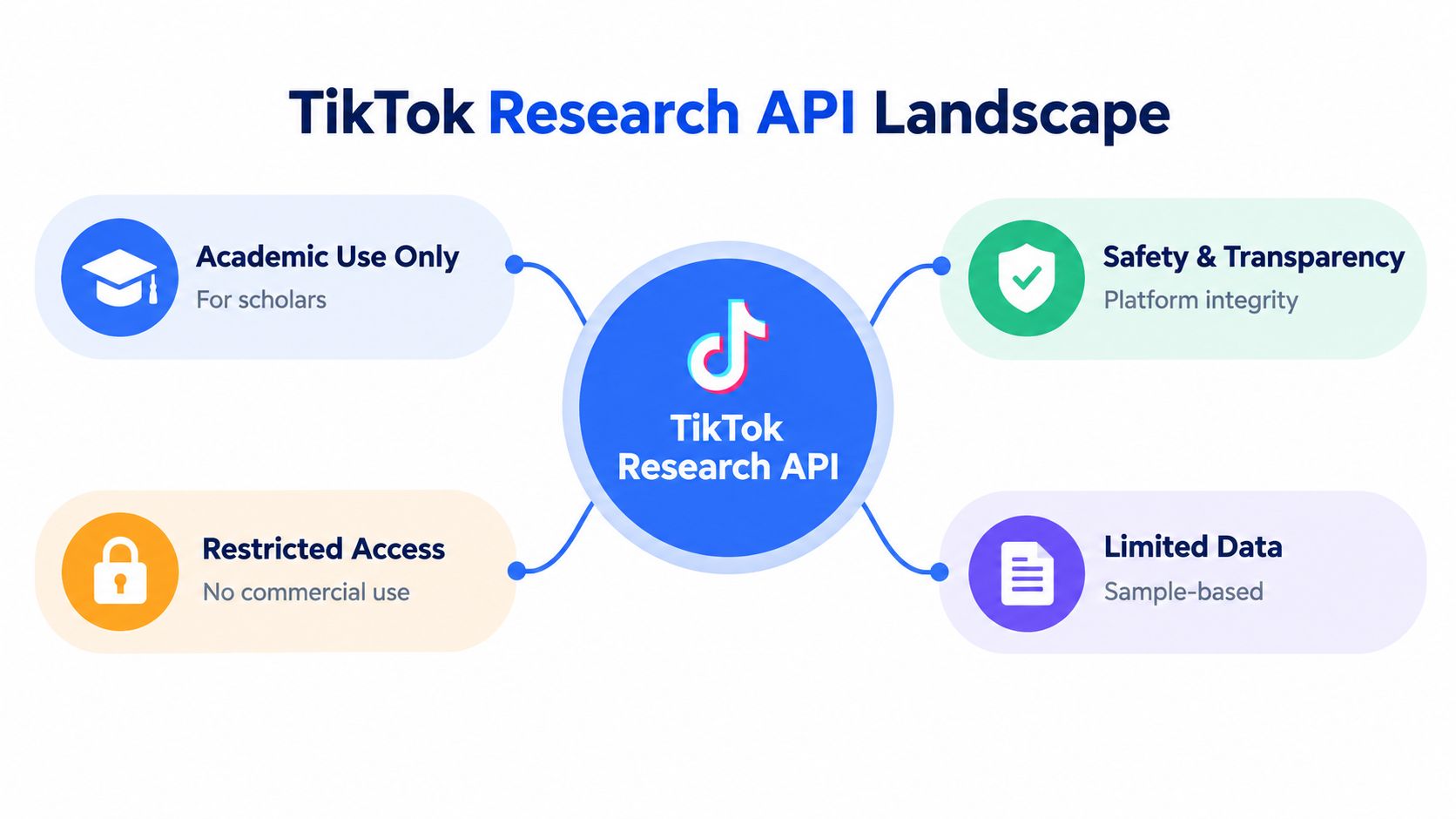
For teams building with TikTok data, four operating models show up repeatedly:
- Official research access: Fit for approved academic, nonprofit, and independent research projects using public TikTok data.
- Creator-authorized integrations: Fit when creators connect their own accounts and grant access to their own content.
- Commercial third-party APIs: Fit for companies that need public content, metadata, transcripts, comments, or discovery data without academic eligibility.
- Custom collection systems: Fit for teams prepared to own browser automation, compliance review, schema drift, and failure handling.
These paths come with different permissions, reliability profiles, and operational costs. A standard developer account does not grant research access. A third-party provider serves a different role, usually broader commercial usability with its own sourcing, compliance, and service constraints.
For a broader comparison, review a comparison of social media API access models. The right setup depends on your use case, eligibility, data sensitivity, and scale requirements, including whether the official API and a provider such as Captapi need to coexist in the same stack.
Official Research API History and Availability
The Research API's timeline explains why current access remains gated. TikTok made an initial version available for testing to members of its Content and Safety Advisory Councils in November 2022. It then opened access to qualified academic researchers in the United States in February 2023, creating a formal path for scholarly analysis of public platform data. These milestones are documented in TikTok's announcement about expanding Research API access.
The next important change was geographic. On July 20, 2023, TikTok announced an expansion to Europe for researchers affiliated with institutions in the European Economic Area, Switzerland, and the United Kingdom. TikTok's developer changelog records that European expansion as taking effect on August 10, 2023. The expansion widened eligibility, but it didn't remove the research-purpose and institutional requirements.
Supported markets and what they mean
Current eligibility generally covers organizations and researchers in the following supported markets:
- United States
- European Economic Area
- United Kingdom
- Canada
- Switzerland
- Brazil
Those locations shouldn't be read as a promise of automatic approval. Geographic eligibility is only one gate. The applicant still needs an eligible organization, a defined research project, suitable expertise, and a credible approach to ethics, security, and confidentiality.
The history also corrects a common planning error. Teams often interpret European availability as evidence that the API has become a general commercial product. It hasn't. The European expansion broadened who could apply while preserving the original governance model.
Planning rule: Treat the Research API as a regulated research channel with geographic eligibility, not as a public data export endpoint.
For commercial teams, the timeline is useful because it prevents wasted implementation work. Confirm organizational eligibility and project purpose before designing a collector, schema, or dashboard around the official endpoints. If the project is marketing intelligence, a paid product, or a general-purpose social-listening service, assume you'll need another data source unless TikTok confirms otherwise.
Access Eligibility and Application Requirements
Commercial teams often waste time on the wrong question. The hard part is not getting a TikTok developer account. The hard part is qualifying for the Research API at all.
Access depends on who is applying, why they need the data, and whether TikTok accepts the project. Eligible applicants come from academic, nonprofit, or independent research organizations in supported markets, and they need to show real research and data-analysis capability. For engineering teams, that changes the design sequence. Check eligibility before you spec collectors, storage, or analyst workflows.
The application is tied to a specific project. TikTok expects a defined proposal, funding disclosure, research ethics coverage, and clear commitments around security, confidentiality, and compliance with the Research Tools Terms. A principal researcher can add collaborators after approval, but that does not turn the account into a reusable company-wide data pipe. Approval stays attached to the approved research activity.
The scope and credential model
On the implementation side, access uses a client key and client secret. The main research permission is the research.data.basic scope, with additional scope coverage available for certain European under-18 data. That credential model matters because it signals how TikTok wants this API used. Narrow scope, narrow purpose, controlled access.
Use a practical screening checklist before anyone writes ingestion code:
- Organization fit: Confirm the applicant is an eligible institution or nonprofit.
- Research purpose: Define a public-interest or non-commercial project with a specific question, population, and method.
- Research capability: Show experience in data analysis, security, and responsible research practice.
- Ethics and funding: Document oversight, funding sources, privacy handling, and retention decisions.
- Technical controls: Specify who gets credentials, how access is logged, and how sensitive outputs are protected.
The official API and enterprise alternatives split here. Commercial social-listening dashboards, marketing intelligence products, and general-purpose data services don't fit the official eligibility model. Reframing a product feature as research does not fix that mismatch. If the business need is ongoing commercial access, use a different architecture, such as a commercial third-party API, for example Captapi, instead of betting delivery on an approval path built for regulated research use.
Architecture consequence: Eligibility is a product constraint. Validate it before you commit to the official API as a foundational dependency.
When the organization, project, and governance model line up, the official API is workable. When they do not, treat that as an access boundary and design accordingly.
Available Endpoints and Data Fields
The Research API exposes several useful surfaces, but its data model is narrower than many developers expect. The main areas are public video metadata, comments, and account-related information. The TikTok API endpoint reference can help teams compare this research-oriented model with broader commercial data interfaces.
Video queries
Video queries use the endpoint https://open.tiktokapis.com/v2/research/video/query/. Requests require UTC start_date and end_date values, and the permitted date range can't exceed 30 days between the lower and upper bounds, according to TikTok's Research API FAQ.
Public video fields include:
- Creation time
- Duration
- Total likes
- Total comments
- Voice-to-text output
- Subtitles
The date-window rule affects query planning. A collector can't treat a multi-month research period as one request. It needs separate windows, consistent filters, deterministic pagination, and a storage layer that records which windows have completed.
Comments and account data
The Comments API provides comment text, likes, replies, and posting time. Those fields support qualitative coding, conversation analysis, moderation research, and engagement studies, but they also create privacy and retention obligations. Store only what the research question needs, and separate raw text from derived aggregates where possible.
Account-related fields include bios, profile images, follower and following totals, liked videos, reposted videos, and pinned videos. The Followers and Following Lists API provides list-oriented retrieval with separate quota treatment, which makes it useful for network research but operationally distinct from video and comment collection.
The API's field inventory is best understood as structured access to public platform records. It doesn't guarantee that every visible app experience, every historical state, or every record associated with a query will be returned. That distinction becomes important when you design validation and missingness reporting.
Quotas, Rate Limits, and Pagination Strategy
The quota model determines whether a collector will finish on schedule. Across the Research Tools APIs, the documented baseline allows up to 1,000 requests per day and 100,000 records retrieved per day. Video and comment requests return no more than 100 records per request, so even a well-designed pipeline must paginate and monitor its remaining budget. These limits are set out in TikTok's published Research API quota documentation.
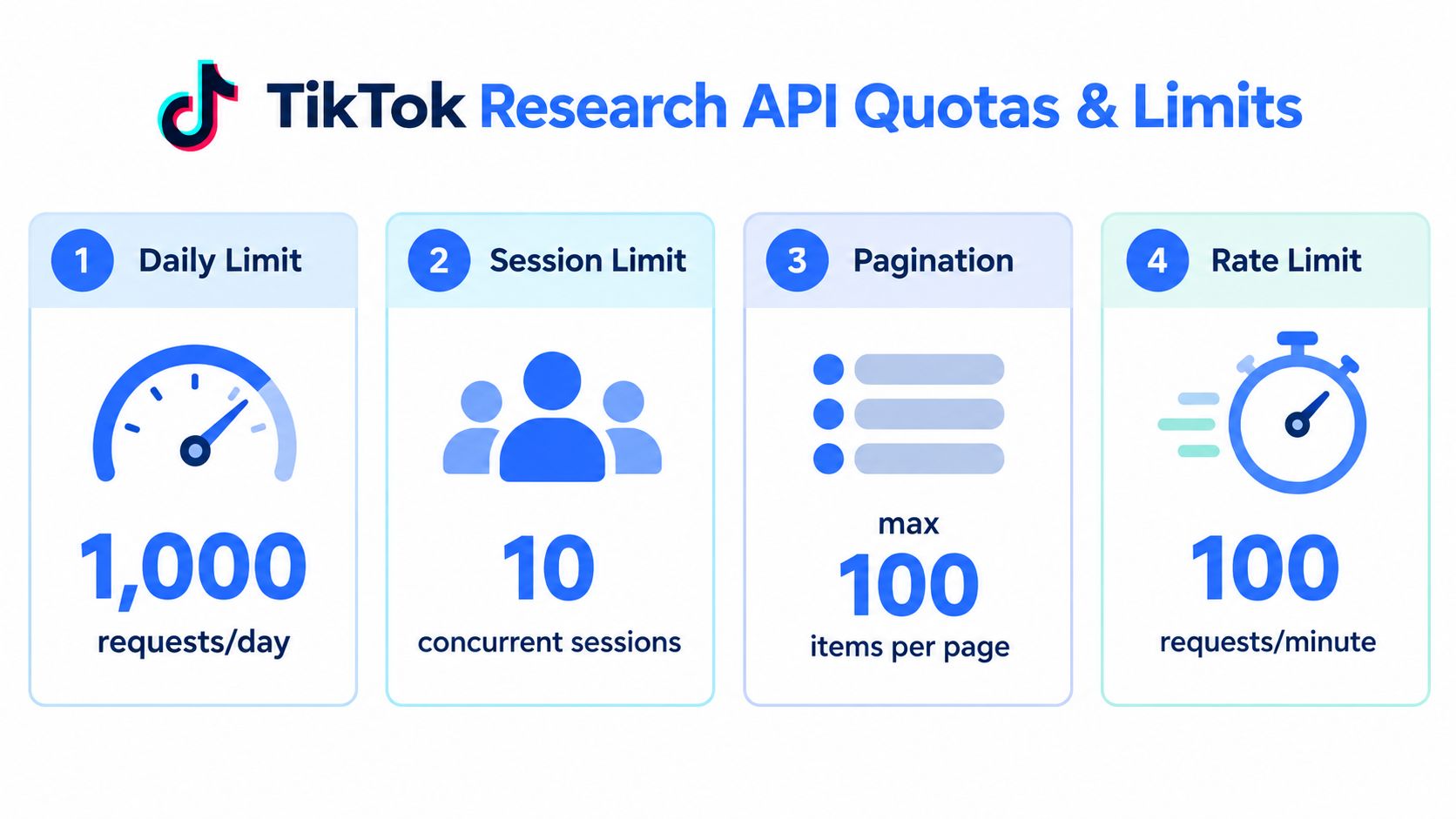
Two quota profiles
Followers and Following Lists use a separate allowance. Researchers can make up to 20,000 calls per day and retrieve up to 2 million records daily, with the same maximum of 100 records per call. Researchers approved for TikTok's Virtual Compute Environment have a smaller Test Stage allowance of up to 5,000 records per day.
The quota resets at 00:00 UTC. That reset is not a minor operational detail. A job that assumes local-midnight replenishment can either underuse its allocation or schedule requests at the wrong time.
| Surface | Daily request allowance | Daily record allowance | Records per call |
|---|---|---|---|
| Video and Comments APIs | 1,000 | 100,000 | 100 |
| Followers and Following Lists | 20,000 | 2 million | 100 |
| Virtual Compute Environment Test Stage | Not stated in the documented baseline | 5,000 | Not stated in the documented baseline |
A collector that survives the limits
Partition video periods into 30-day windows, then store a checkpoint for every window, filter combination, and page cursor. Persist each successful page before requesting the next one. On failure, retry only the failed unit, with backoff and a clear distinction between authentication errors, quota exhaustion, validation failures, and transient transport errors.
Use the quota reset as a scheduling boundary, not as an excuse to run an uncontrolled burst. The API rate-limit guidance for production systems is relevant here because the general principle is the same: measure consumption, make retries idempotent, and keep collection state outside the worker process.
Data Completeness and Reliability Concerns
An approved response isn't automatically a complete ground-truth record. A 2025 arXiv study found that the Research API failed to provide metadata for one in eight videos obtained through data donations, including official TikTok videos, advertisements, and content from particular accounts. The study reported no apparent explanation for the missing metadata, creating a direct reliability concern for researchers who assume API coverage is uniform.
That matters most when missingness is systematic. If missing records cluster around certain account types, content categories, advertisements, or regions, a model or audit can produce a confident result from a biased sample. Randomly missing rows are inconvenient. Patterned missingness changes the question being answered.
Build validation into ingestion
A solid research pipeline should treat completeness as a measured property of each field and collection run.
- Field-level checks: Record whether identifiers, timestamps, captions, engagement counts, subtitles, and voice-to-text values are present.
- Missingness reports: Break missing data down by query window, account, content type, region, and endpoint rather than reporting one aggregate figure.
- Independent comparison: Compare API responses with donated datasets, manually verified public records, or another approved observation source.
- Retry and requery rules: Requery transient failures, but preserve the original response status and don't replace nulls with later values.
- Deletion handling: Mark content that disappears, becomes restricted, or changes availability instead of treating it as an ordinary extraction failure.
A validation layer also needs provenance. Store request parameters, retrieval time, API status, parser version, and the reason a field is absent. That metadata lets a research team distinguish “not returned,” “not available,” “request failed,” and “content no longer accessible.”
Research discipline: Report uncertainty where coverage is uncertain. A clean table can still represent a selective view of the platform.
For ML training, moderation analysis, and cross-market comparisons, this work is part of the method, not optional observability. The API can provide valuable structured data, but the team must test how that data differs from the platform experience it intends to study.
Third-Party TikTok Data Alternatives
For many teams, the decision is not whether TikTok data matters. It is whether they can get it into production without building and maintaining their own scraping, rendering, parsing, and anti-breakage stack. That is where third-party providers earn attention. They package public TikTok data behind stable endpoints, which changes the engineering work from extraction mechanics to vendor review, schema control, rate handling, and legal sign-off.
Captapi is one example of that model. Its published materials describe API access across TikTok, YouTube, Instagram, and Facebook, with endpoints for public videos, comments, channel details, transcripts, summaries, and search-oriented data. The integration pattern is straightforward: API-key authentication, provider-managed collection, and a service contract your team can test against.
Official and commercial paths
| Decision factor | Official Research API | Commercial third-party API |
|---|---|---|
| Primary audience | Approved academic, nonprofit, and independent research teams | Commercial developers, analysts, agencies, and product teams |
| Access model | Project application and approval | Provider account and API credentials |
| Main strength | Sanctioned structured research access | Practical integration for broader commercial workflows |
| Main constraint | Eligibility, quotas, date windows, and completeness uncertainty | Provider terms, source coverage, pricing, and dependency risk |
| Engineering burden | Query planning, quota scheduling, validation, and governance | Provider evaluation, schema contracts, retries, and compliance review |
The trade-off is operational, not theoretical. Third-party APIs can be a better fit when a product team needs public creator posts in an internal dashboard, when a marketing analytics group needs comment and engagement feeds, or when an AI workflow needs transcripts and summaries as inputs. In those cases, the hard problems shift. You are no longer asking how to page through an official endpoint. You are asking how often the provider refreshes data, how schema changes are announced, how missing records are reported, and what happens when TikTok changes page structure or access patterns.
One warning matters more than feature breadth. Check authorization, retention rules, and permitted use before you ship anything. A clean JSON response does not remove the obligation to avoid collecting restricted, private, or unnecessary personal data.
If your team is comparing vendor options, this overview of Tikapi alternatives is a practical starting point for reviewing integration model, data scope, and dependency trade-offs.
Building Production Pipelines with TikTok Data
A reliable TikTok pipeline separates collection, validation, normalization, and downstream analysis. That separation matters because the official API has bounded windows and quotas, while third-party services may have different authentication, caching, latency, and scaling behavior.
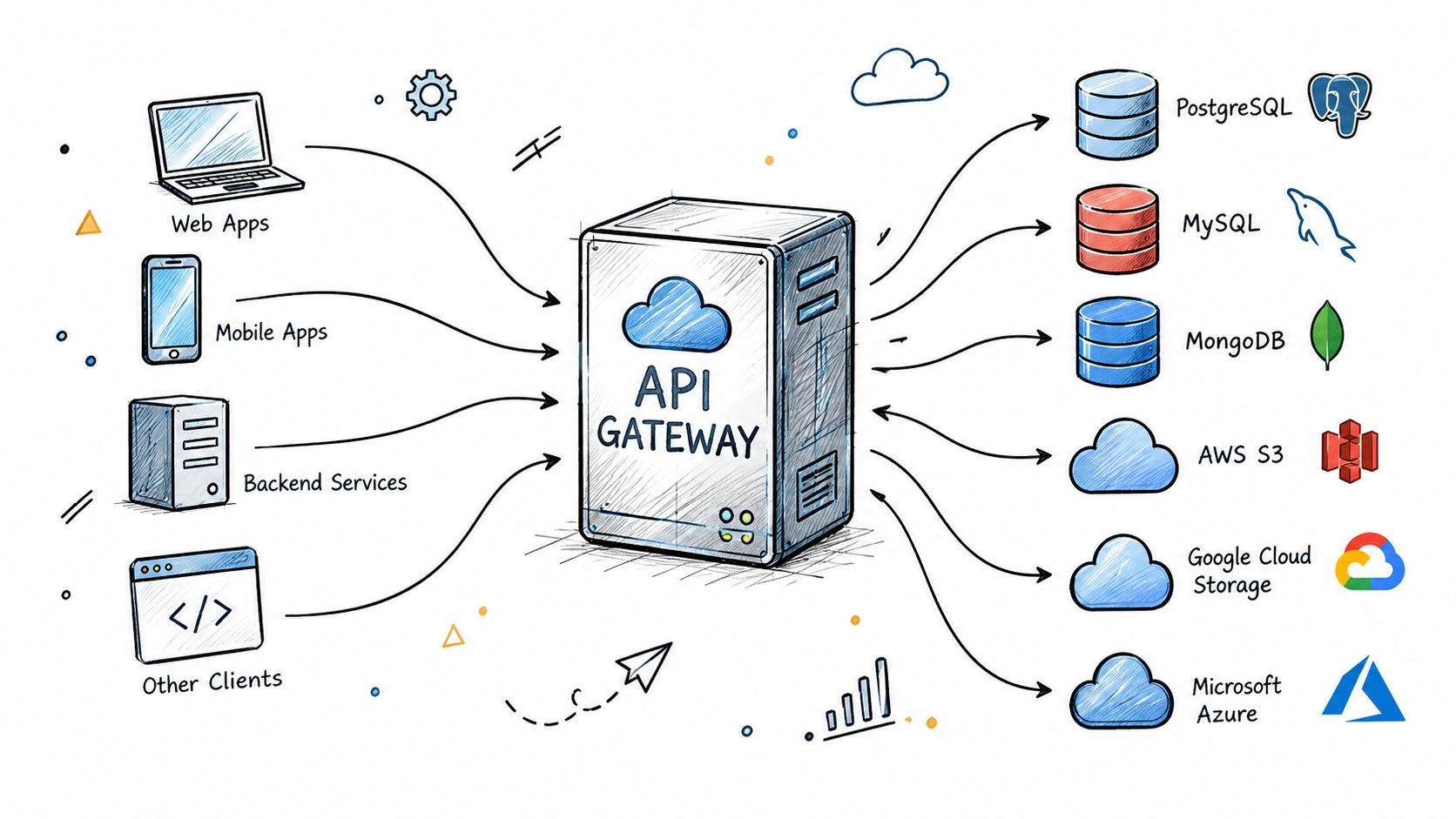
A durable ingestion design
Use an API gateway or ingestion service as the single entry point. It should accept a collection job, validate its date range and filters, then create work units for each time window and page. Workers can process those units independently while a durable store tracks status, cursor, response metadata, and retry count.
A practical flow looks like this:
- Plan windows: Split video queries into permitted date ranges and assign stable job identifiers.
- Fetch pages: Request no more than the documented page size, then persist each page before advancing.
- Validate records: Check identifiers, expected field types, timestamps, and completeness indicators.
- Normalize schemas: Convert official and third-party responses into a common internal model without discarding source-specific fields.
- Deduplicate: Use stable video and comment identifiers where available, and retain source provenance.
- Publish derived data: Send only the fields required by search, dashboards, ML, or reporting systems.
For official access, credentials should stay in a secrets manager and never travel to browser clients. For third-party access, API keys need the same protection. The difference is mostly in the authentication contract, not in the need for disciplined secret handling.
Failure handling and observability
Retry transient transport failures with bounded backoff. Don't retry invalid scopes, rejected projects, malformed dates, or exhausted quotas as if they were temporary network errors. At the data layer, distinguish a missing field from a missing record and a failed request.
A cache can reduce repeated retrieval, but it shouldn't erase research provenance. Keep the source timestamp, request parameters, and cache status so analysts know whether they are comparing fresh observations or reused responses. Teams implementing the gateway in TypeScript may also benefit from this practical guide on how to deploy a TypeScript API, especially when the service needs repeatable deployment and environment-specific configuration.
For broader operational patterns, data pipeline automation provides useful context on scheduling, retries, and maintaining ingestion workflows without tying business logic to one worker run.
Choosing the Right Approach for Your Use Case
The choice is organizational before it's technical. Start by identifying who owns the project, whether the work is non-commercial, which data surfaces are necessary, and how much operational uncertainty the team can absorb.
| Your situation | Practical choice | Why |
|---|---|---|
| Academic or nonprofit team conducting approved public-interest research | Official Research API | The access model and governance requirements match the project |
| Commercial analytics or marketing product | Commercial third-party provider | The team generally won't fit the Research API's non-commercial approval model |
| Creator-owned account integration | TikTok's creator-authorized product path | The data belongs to the connecting creator and doesn't require broad public collection |
| Large research program with strict reproducibility requirements | Official API plus independent validation | Sanctioned access needs completeness testing and provenance controls |
| Product team needing cross-platform social data | Third-party unified API | One internal schema can reduce platform-specific integration work |
| Mixed academic and commercial organization | Separate systems or a carefully governed hybrid | Research credentials and commercial workloads shouldn't share an ambiguous purpose |
When the official route wins
Choose the official Research API when the institution qualifies, the proposal serves a defensible public-interest purpose, and the team can work within its quotas, windows, approval terms, and retention obligations. It offers a sanctioned route for structured analysis, but it demands methodological discipline around missing data.
When a third-party route is more practical
Choose a commercial provider when the project needs public TikTok data for a product, customer workflow, competitive analysis, content automation, or cross-platform intelligence. Evaluate source coverage, response fields, retry behavior, cache policy, retention, support, and terms before writing your internal data model.
When hybrid architecture makes sense
A hybrid can work when an academic research unit needs the official API while a separate commercial product uses a third-party service. Keep credentials, datasets, purposes, and governance boundaries explicit. Don't use research approval as a blanket justification for unrelated commercial collection.
The costly mistake is choosing the API before defining the project. Confirm eligibility and data requirements first, then run a small technical validation that tests completeness, pagination, latency, error behavior, and downstream usefulness. That process will tell you whether the official channel, a third-party service, or a split architecture fits the work.
Captapi provides structured access to public TikTok data alongside other social platforms, including endpoints for video details, comments, creator information, transcripts, and search workflows. If your team needs a commercial alternative to the academic-only model, visit Captapi to review the available API options and test the integration against your pipeline requirements.