
Social Listening for Agencies That Wins Clients
A client calls at 9:15 a.m. because a competitor's launch is already dominating TikTok, while a frustrated customer's YouTube comment has started attracting replies. Your team discovers that the complaint appeared hours earlier, but nobody was watching the right query, channel, or alert queue. By the time the account team opens its dashboard, the conversation has moved beyond monitoring and into reputation management.
This is the operating challenge behind social listening for agencies. Clients don't need another chart showing mention volume. They need a reliable way to find meaningful signals, explain what those signals mean, assign an owner, and show whether anyone acted. The system must work across uneven data from YouTube, TikTok, Instagram, Facebook, forums, reviews, and news without pretending that every platform measures the same thing.
Table of Contents
- Why Agencies Cannot Afford to Miss Conversations
- How Social Listening Works for Client Accounts
- Setting Objectives Data Sources and Queries That Work
- Making Fragmented Social Data Decision Ready
- Choosing Dashboards Suites or APIs for Scale
- Real Agency Use Cases From Alerts to Action
- Proving Value and Turning Insights Into Revenue
Why Agencies Cannot Afford to Miss Conversations
A missed conversation rarely looks important at first. One customer posts that a product arrived damaged. A creator compares two competing services. Several people repeat the same objection under an influencer video. None of these items may trigger a traditional media alert, yet together they can reveal a service problem, a positioning gap, or a campaign opportunity.
An agency lead usually encounters the problem during a client call. The client asks why the team didn't flag the complaint, competitor announcement, or emerging phrase earlier. The answer is often not that the agency lacked effort. The team had too many channels, inconsistent searches, unclear ownership, and reports built around whatever each platform happened to expose.
Social listening became a mainstream business practice during the early 2020s. In a 2022 survey of more than 650 professionals, nearly 61% of businesses had a social-listening system, while more than 82% considered social listening important for planning, as reported by Social Media Today's 2022 social listening survey coverage. That shift changed the agency opportunity. Listening moved from occasional media clipping and manual community management toward continuous intelligence about customers, competitors, campaigns, and market language.
Core idea: A listening service creates value when it turns public conversation into a decision, not when it produces the largest possible mention count.
The agency system clients actually need
A useful program has six connected parts:
- Objectives: What business question should the account answer?
- Sources: Where do customers, creators, competitors, and journalists speak?
- Queries: Which brand names, product terms, hashtags, handles, and exclusions capture the right conversation?
- Workflow: Who reviews, classifies, escalates, and responds?
- Metrics: Which signals show activity, attention, quality, and commercial relevance?
- Proof: What changed after the client acted?
That last step separates a report from a service. Agencies can use resources such as social listening examples from Captapi to help account teams explain possible applications, but the stronger client conversation focuses on ownership and outcomes. For example, the report should show not only that a complaint appeared, but also who received it, how quickly the client responded, and whether the issue continued.
Commercial measurement belongs in the same conversation. When a listening insight influences content, landing pages, paid media, or service recovery, the team should document how tracks conversions so the path from conversation to business result remains visible. The rest of the operating model is about making that path credible.
How Social Listening Works for Client Accounts
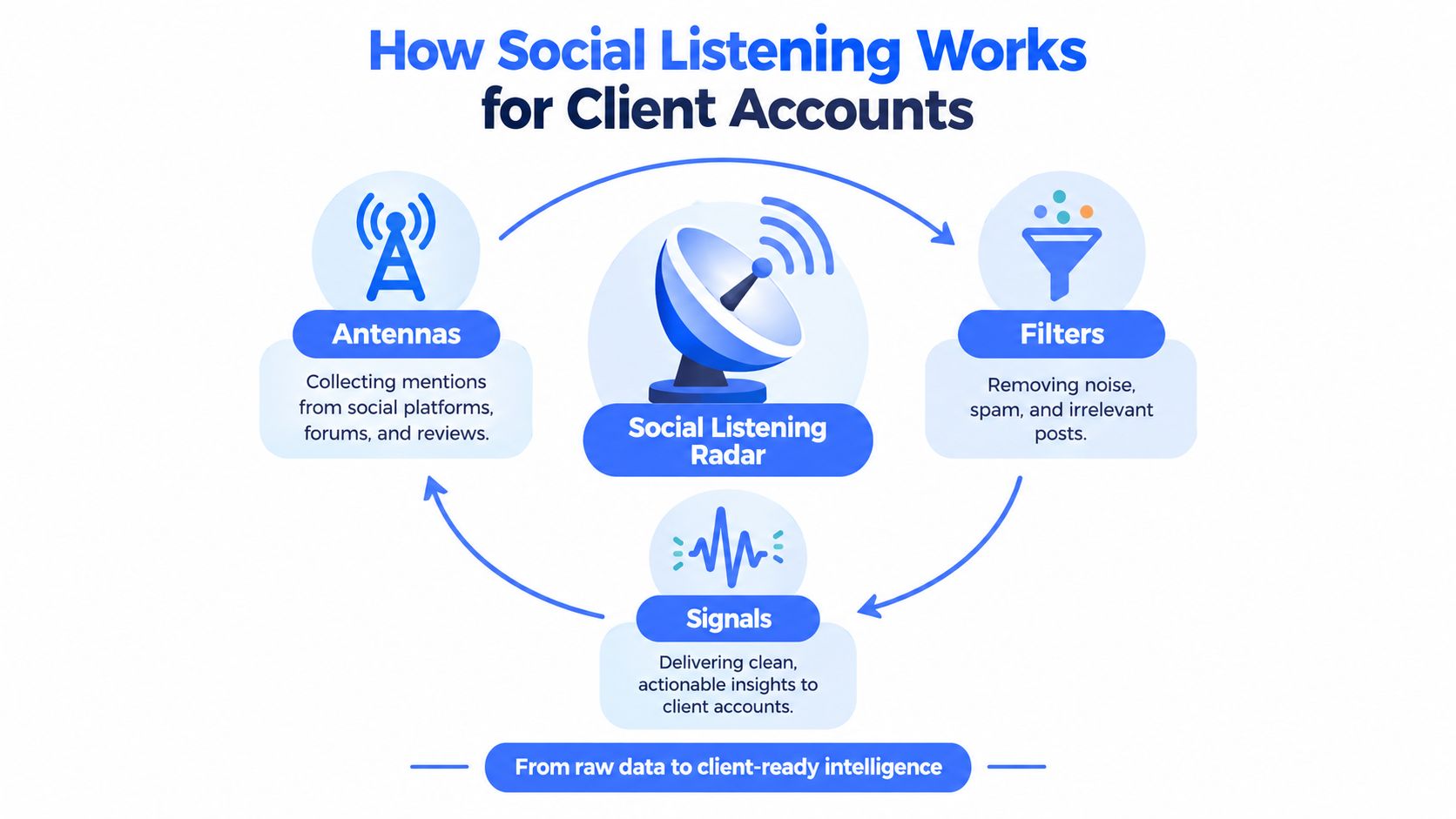
Think of a listening system as a radar installation.
The antennas collect public conversation from relevant platforms, forums, reviews, and news. The filters remove noise, duplicate items, spam, irrelevant uses of a brand term, and conversations outside the client's market. The signals are the patterns that deserve attention, such as a recurring product objection, a sudden competitor surge, or a new phrase customers use to describe a need.
Monitoring and listening are related, but they aren't identical. Monitoring asks, “What is being said right now?” It helps a community manager find a direct mention and respond. Listening asks, “What does this pattern mean for the client?” It groups conversations over time and connects them to brand health, creative decisions, customer care, product feedback, or competitor strategy.
Build the radar in layers
Start with the client's identity layer. Include the official brand name, product names, abbreviations, common misspellings, executive names, campaign tags, and relevant handles. Add an exclusion layer for unrelated meanings. A software brand with a common dictionary word in its name may need exclusions for ordinary conversations that have nothing to do with the company.
Next, create topic layers. One query might collect complaints about delivery, another might track competitor comparisons, and a third might capture category language without naming the client. Customers often describe a problem without using the brand's preferred vocabulary.
Then add context fields:
- Author: customer, creator, journalist, competitor, employee, or unknown
- Topic: price, quality, availability, support, design, or campaign
- Tone: positive, negative, neutral, mixed, or uncertain
- Reach and engagement: useful for prioritisation, not automatic proof of importance
- Location and language: essential for accounts operating across markets
A reusable agency setup stores these rules as templates, then adjusts them for each account. That gives the team a consistent starting point without forcing every client into the same taxonomy. Teams considering what social listening means in practice should keep this distinction clear: raw posts are inputs, while structured interpretation is the service.
Automated sentiment can help sort large volumes, and an AI-powered sentiment analysis platform may support that workflow. It still shouldn't be treated as ground truth. Sarcasm, slang, mixed emotions, translation issues, and platform-specific language require validation and human review, especially when an alert could affect a crisis response.
The client-facing explanation can stay simple: we collect the right conversations, remove the noise, classify what remains, identify patterns, and route decisions to the people who can act. That language is clearer than presenting a list of platform features.
Setting Objectives Data Sources and Queries That Work
The first question isn't “Which tool should we open?” It's “What decision should this account make with the information?”
A brand-health objective needs broad category coverage and a stable baseline. A competitor objective needs consistent searches for rival brands, launches, offers, and customer comparisons. A campaign objective needs a defined time window, campaign language, creator references, and a way to separate campaign conversation from ordinary brand activity. Issue detection needs urgency terms, service language, product names, and escalation rules.
Start with the question, then map the evidence
Write the objective as a question a client could answer in a meeting:
- Brand health: How are customers describing the brand and its main weaknesses?
- Competitor tracking: Which competitor messages are attracting attention from the same audience?
- Campaign feedback: What language appears after creators and paid media publish?
- Issue detection: Which complaints require customer care, communications, or legal review?
- Product insight: What requests or frustrations recur across customer conversations?
Each question implies a different source mix. YouTube may reveal detailed product reviews and comment threads. TikTok can expose fast-moving language and creator reactions. Instagram may provide campaign responses and visual creator activity. Facebook can contain community discussion and service questions. Forums, review sites, and news add context that social feeds may miss.
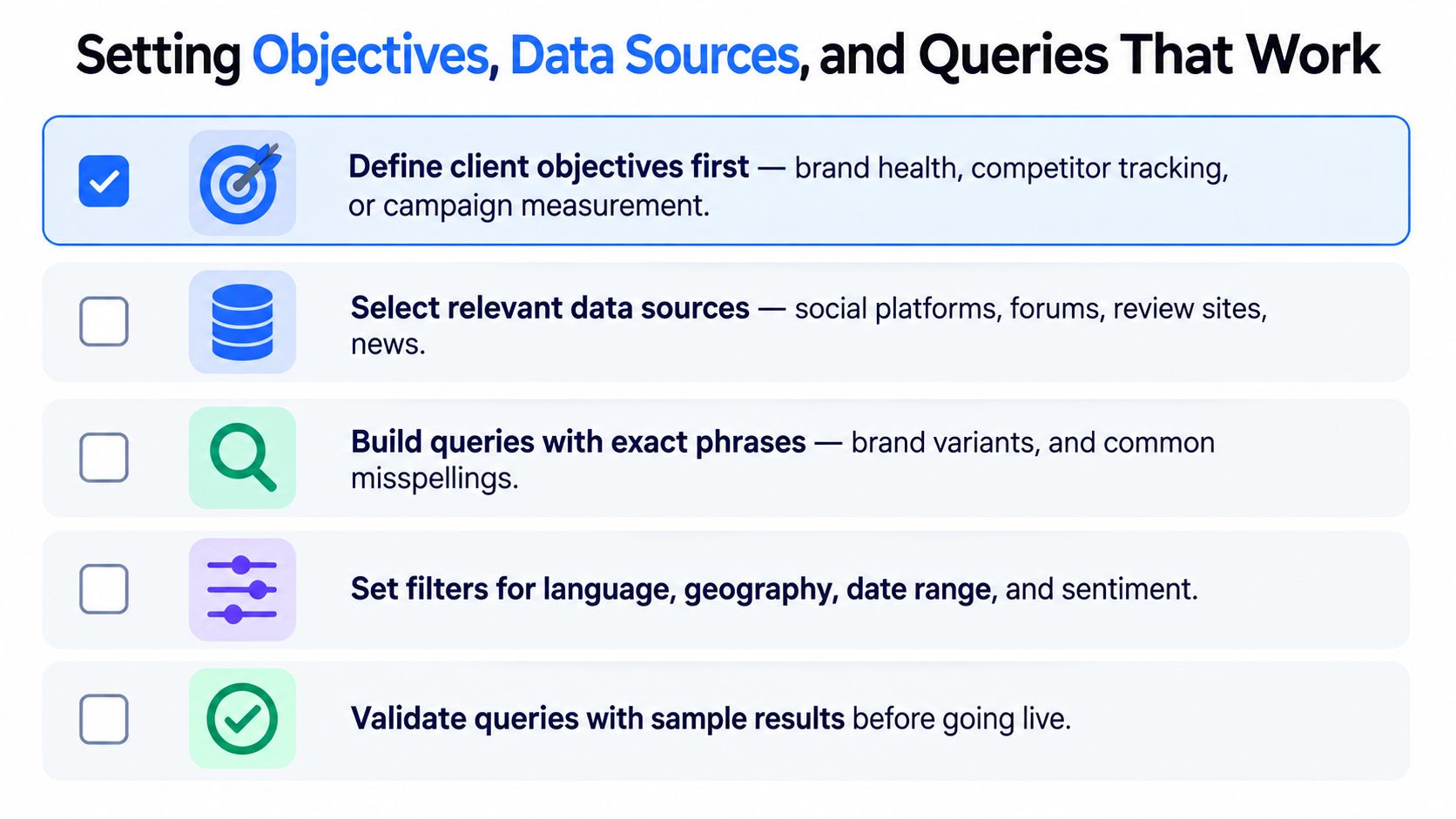
Queries should include exact phrases, handles, hashtags, product variants, common misspellings, and competitor references. They also need exclusions. Without exclusions, a brand term that doubles as a common word can fill the account with irrelevant posts. Without category terms, the agency may miss conversations where customers discuss the problem but never mention the client.
Test recall before trusting precision
A query can fail in two ways. Low recall misses relevant conversations. Low precision returns too much irrelevant material. Account teams should review sample results before the query goes live, record false positives, add missing language, and test the search again.
Document the test. Save the query version, source coverage, languages, geography, date range, exclusions, and known gaps. If a platform exposes only partial data, say so in the report instead of presenting the result as a complete view of the market.
The same discipline applies across languages. Translate core terms, but don't assume a literal translation captures slang, local product names, or negative expressions. Ask a native speaker or market specialist to review important queries, especially for crisis and sentiment work.
A simple source audit can ask:
- Is this platform available for the client's audience and market?
- Can the team collect the fields needed for the objective?
- Are public comments, captions, video titles, and engagement signals included?
- What isn't accessible, and how will that limitation affect interpretation?
- Will duplicate content appear across sources?
A practical guide to how to do social listening can help teams establish the operating sequence, but the account plan still needs client-specific decisions. A query isn't finished when it returns data. It's finished when the team knows what the data can support.
Making Fragmented Social Data Decision Ready
A client report becomes fragile when it places YouTube views beside TikTok views, Instagram reach, and Facebook engagement as though those figures were interchangeable. Each platform defines and exposes metrics differently. Some values are public estimates, some are platform-native counts, and some are unavailable altogether.
Measurement governance gives the agency a defensible way to work with those differences. Define each unit, preserve the source, record the collection window, and label whether a figure is observed, estimated, modelled, or unavailable. Deduplicate cross-posted content where possible, screen suspicious activity, and retain enough metadata for an analyst to inspect an unusual shift.
Use a decision matrix, not a forced universal score
When two platforms measure different things, the agency has three choices:
- Normalize: Use a clearly defined transformation when the underlying concepts are sufficiently similar.
- Compare directionally: Discuss movement or patterns without claiming exact equivalence.
- Caveat: Keep the figures separate when the difference could mislead the client.
| Platform | Reliable signals | Limitations to document |
|---|---|---|
| YouTube | Public video details, comments, visible engagement, and transcript-related content where available | Some audience and exposure measures are not public, and a view doesn't equal attentive viewing |
| TikTok | Public content, comments, visible engagement, and recurring language in captions or replies | Access and coverage can vary, and fast-moving content may be difficult to sample consistently |
| Public posts, captions, comments, and visible engagement where accessible | Private activity and some audience details aren't available, and formats may expose different fields | |
| Public page content, comments, and visible interaction on accessible posts | Group, privacy, and access restrictions can create coverage gaps | |
| Forums and news | Written discussion, article context, author details, and recurring themes | Source populations differ from social audiences, and duplicate syndication can inflate volume |
Sentiment requires the same caution. A reported multi-platform study covering more than 1.5 million posts and reviews across six months found an ensemble classifier with an average F1 score of 0.89, while multilingual translation combined with ensemble classification produced an F1 score of 0.85. The study also reported correlations of 0.76 with Net Promoter Score and 0.69 with monthly sales revenue, as described in the multiplatform sentiment analysis study. Those findings support sentiment as a useful signal, not as proof of causation.
For agency reporting, store the original text, language, platform, timestamp, taxonomy label, model version, confidence, and review status. Escalate sarcasm, mixed sentiment, crisis terms, high-reach authors, and low-confidence classifications to a person. For a broader quality-control process, teams can consult data quality assurance for social data workflows, then adapt the checks to each client's sources and risk level.
Choosing Dashboards Suites or APIs for Scale
Tool selection should follow the agency's operating model. A small account with a narrow question may work well with a dashboard suite. A global account with multiple markets may need specialist sources, custom classification, and a data pipeline that feeds an existing reporting environment.
Three practical routes
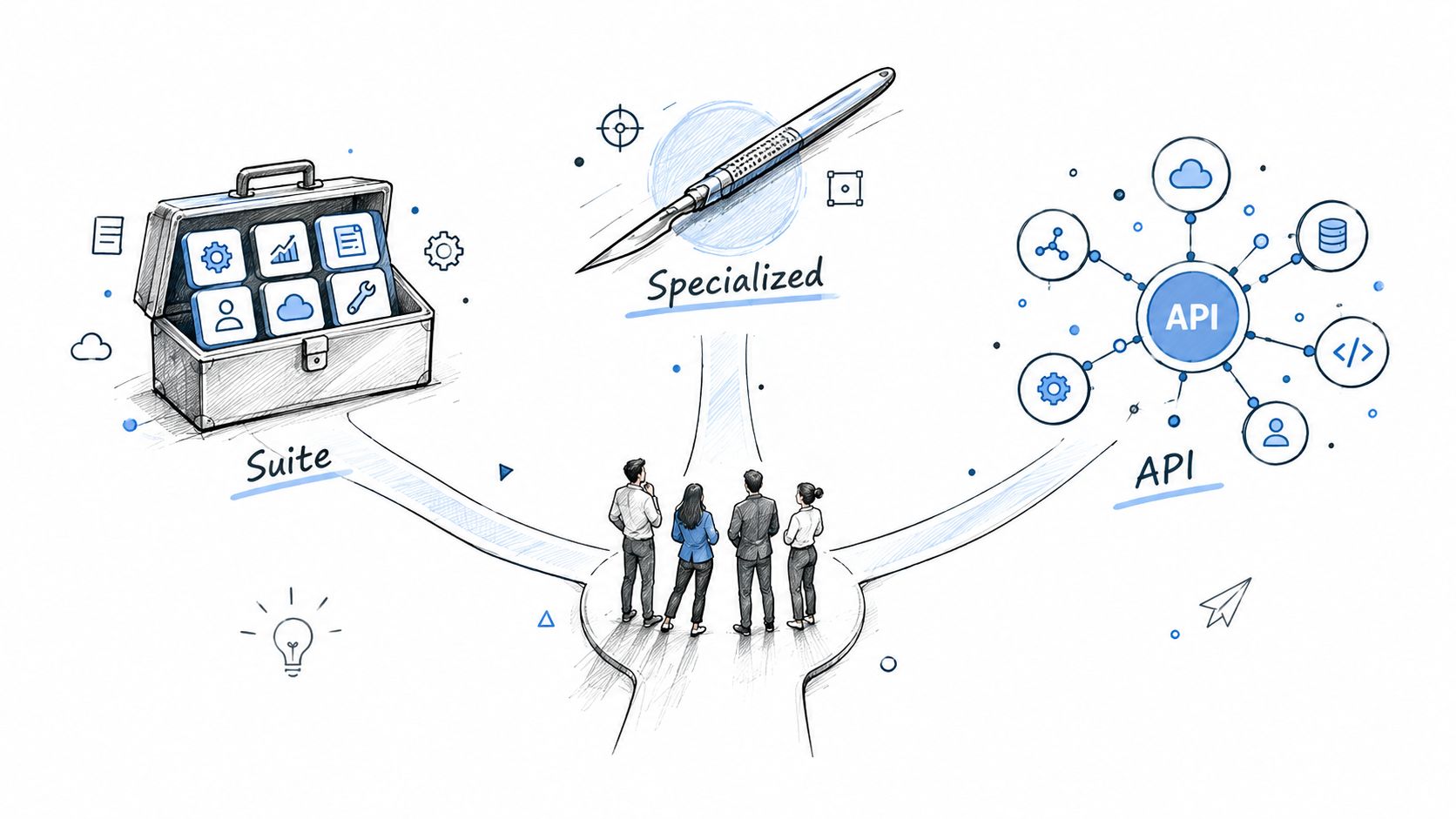
An all-in-one suite is useful when the team needs ready-made dashboards, alerts, saved queries, user permissions, and scheduled reporting. It reduces setup work and gives account managers a familiar interface. The trade-off is less control over collection logic, data structure, and custom workflows.
Specialist tools make sense when the account has a difficult source, language, industry, or use case. One tool may be stronger for media monitoring, another for creator discovery, and another for customer-care triage. That flexibility can improve coverage, but it creates more reconciliation work and more opportunities for definitions to drift.
An API-led approach suits agencies that need to combine data with internal systems, client dashboards, retrieval-augmented generation, competitor monitoring, or bulk comment analysis. It gives engineers control over schemas and reuse, but the agency must own storage, validation, permissions, rate planning, and reporting logic.
A comparison of the top social listening software for 2025 can help an agency build an initial shortlist. The buying decision should still be based on client volume, required sources, customization, engineering capacity, and the cost of maintaining the workflow.
A platform such as Captapi offers public social-data endpoints for YouTube, TikTok, Instagram, and Facebook, including transcripts, comments, search results, engagement fields, summaries, and related account or page details. In an agency pipeline, those structured responses can feed a central warehouse or report, subject to source availability and the agency's data-handling responsibilities.
A useful technical evaluation includes cache behavior, rate limits, retries, authentication requirements, export formats, and failure handling. Captapi's documented model includes a shared cache and credit-based access, which may be relevant when teams repeat collection or build recurring jobs. The agency should test real client queries rather than choosing from a feature list. A practical overview of social listening software architecture can help frame that evaluation.
The key question is simple: does the selected route help the agency preserve consistent definitions while delivering insight quickly enough for the client's decisions?
Real Agency Use Cases From Alerts to Action
A listening service becomes easier to sell when the client can see the handoff. The report is only one stage. The valuable sequence is signal, triage, owner, action, and follow-up.
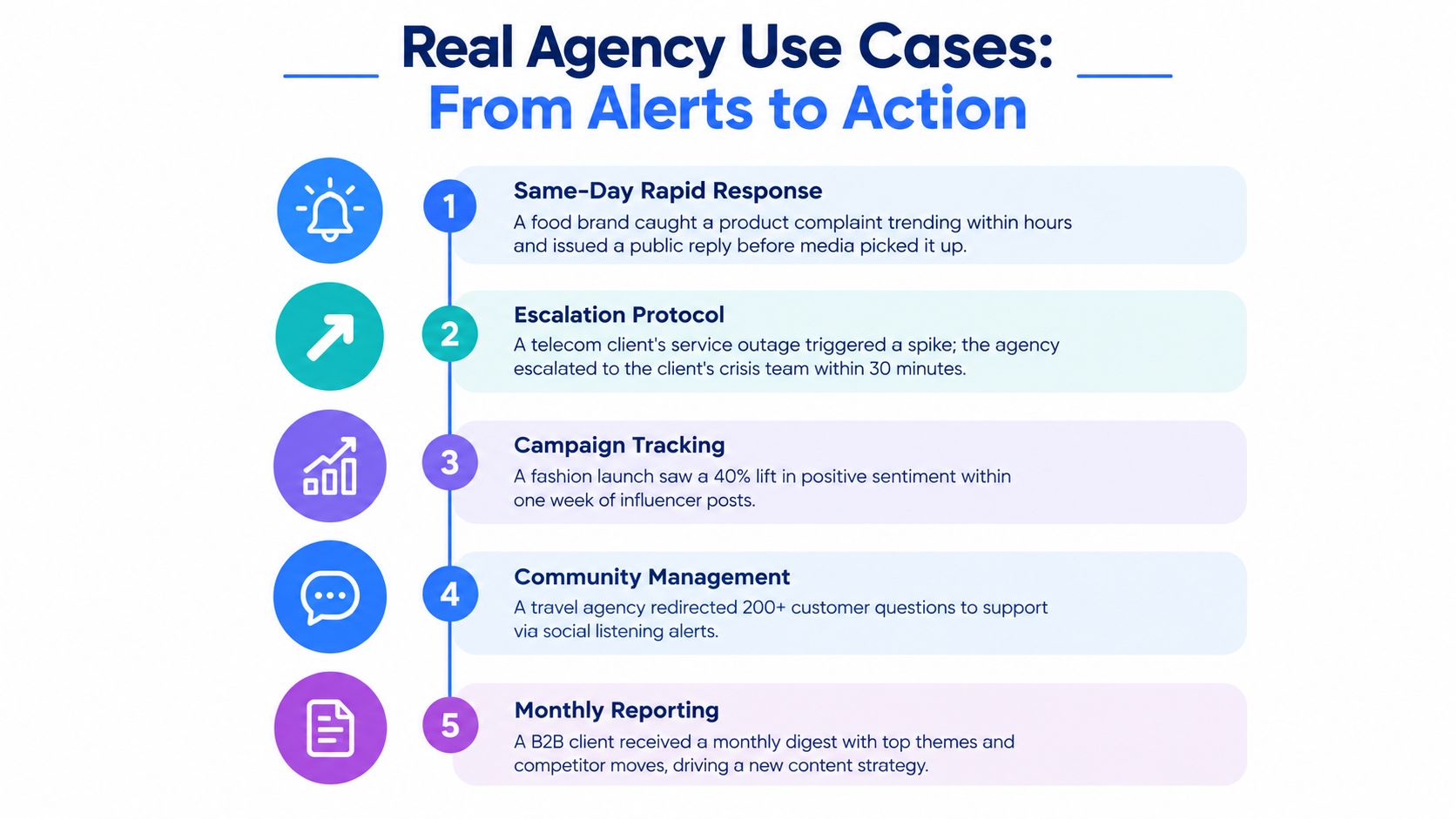
Consider a food brand with a product complaint spreading across public posts. The analyst checks whether the posts describe the same issue, verifies the product and market, marks the signal as urgent, and routes it to customer care and communications. The client responds publicly, while the agency continues watching for repeated complaints and misleading claims.
A telecom account needs a different path. A service-outage query detects a sudden cluster of customer frustration. The analyst doesn't send the raw feed to everyone. They attach representative posts, classify the issue, notify the account lead, and escalate through the client's crisis process. Later, the report records the timeline and the client's response, not just the spike.
Five sellable jobs for an agency team
- Rapid response: Find high-risk complaints and route them to the correct owner before the issue becomes a wider communications problem.
- Competitor intelligence: Track a rival's launch language, customer reaction, and unanswered objections, then brief strategy and creative teams.
- Campaign pulse checks: Compare campaign-related conversation with the established brand baseline, review qualitative reactions, and recommend message adjustments.
- Creator discovery: Identify authors whose language, audience context, and conversation quality fit the brief, rather than selecting creators from reach alone.
- Product insight mining: Group recurring requests and frustrations, then send a concise evidence pack to product, research, or customer care.
The closed loop matters in every case. If creative changes a headline, the agency should monitor the next conversation. If customer care publishes a service explanation, the team should check whether confusion persists. If product receives a recurring request, the agency should record whether it became a test, research question, or roadmap input.
A useful client story doesn't claim that listening caused every later result. It shows the evidence chain, the decision made, the owner involved, and the signals reviewed afterward. That standard makes a quarterly business review more credible and gives the sales team a concrete service to describe.
Proving Value and Turning Insights Into Revenue
Agencies often begin with mention volume because it is easy to display. It is rarely enough to justify a retainer. A large number of mentions can reflect complaints, controversy, duplicated posts, or coordinated activity. A smaller conversation can matter more if it identifies a serious product issue or a high-value customer segment.
A stronger measurement model separates four classes:
- Activity: publishing frequency and content output
- Interaction: likes, comments, replies, and other responses
- Performance: conversions, qualified actions, and return on investment
- Network: reach, audience growth, and connectivity
Map those classes to the client objective. An awareness program might pair conversation volume and unique reach with sentiment, topic quality, referral activity, and conversion evidence. A service program might focus on urgent mention routing, response time, resolution status, and repeated complaints. A product program might measure insight-to-test conversion and whether the tested change affects later conversation or customer behavior.
Turn listening into an operating offer
Assign an owner to every signal type. Define escalation thresholds, response expectations, and the destination for each finding. Then track:
- Action rate: Which findings produced a documented client action?
- Time to escalation: How quickly did a high-priority signal reach the right person?
- Insight-to-test conversion: Which findings became creative, product, service, or media experiments?
- Post-action movement: Did conversation volume, sentiment, support demand, retention, or conversion change afterward?
These measures let the agency package listening in several ways. A retainer can include daily monitoring, weekly insight briefs, and monthly governance reviews. A campaign sprint can cover query design, live pulse checks, creator reaction, and a post-campaign analysis. Crisis cover can provide defined alert rules, escalation paths, and response monitoring.
Clients don't need a promise that every social signal will produce revenue. They need a transparent account of what the agency collected, what it couldn't observe, what it recommended, what the client did, and what changed afterward. That is how fragmented platform data becomes a defensible service rather than another dashboard.
Captapi gives agencies one API for public data across YouTube, TikTok, Instagram, and Facebook, including comments, transcripts, search results, summaries, and engagement fields that can feed listening workflows and client reports. Visit Captapi to evaluate how a consistent data layer could support your next monitoring, competitor intelligence, or insight-to-action project.