
8 Social Listening Examples: Tactics, KPIs and Templates
A product problem often appears in public comments before it reaches the support queue. A customer posts a frustrated review, another person confirms the same issue, and a creator mentions it in a video. The support team may not see the pattern for days, while the conversation keeps spreading across platforms.
That's where social listening earns its place. The useful question isn't just, “How many times was the brand mentioned?” It's “What are people saying, where is the conversation moving, and what decision should follow?” A foundational academic study analyzed 7,565 user-posted comments collected over 15 months, from June 2009 through August 2010, showing how public brand conversations could be collected, classified, and analyzed systematically (academic research on online brand conversations).
The social listening examples below focus on execution. Each one shows what to configure, which KPI indicates progress, and how to turn the workflow into a reusable template for brand monitoring, crisis detection, competitor intelligence, creator discovery, product feedback, content optimization, and SEO research.
Table of Contents
- 1. Brand Mention Tracking and Reputation Management
- 2. Competitive Intelligence and Market Analysis
- 3. Influencer and Creator Identification and Vetting
- 4. Trend Detection and Viral Content Forecasting
- 5. Customer Feedback and Sentiment Analysis
- 6. Content Strategy and Performance Optimization
- 7. Crisis Management and Early Warning Systems
- 8. Content Research and SEO or Algorithm Optimization
- 8 Social Listening Use Cases Compared
- Turn These Examples Into Your First Listening Sprint
1. Brand Mention Tracking and Reputation Management
Brand tracking starts with a query that's broader than the official account name. Include the brand, product names, executive names, campaign phrases, hashtags, common misspellings, and category terms that customers use when they don't tag the company. Separate queries by product line, geography, and language so a regional service issue doesn't disappear inside a global total.
For a consumer brand, monitor public comments and mentions across YouTube, TikTok, Instagram, and Facebook. Capture the surrounding text, not just the post title or author. A short comment such as “same issue here” becomes useful only when it's connected to the original product, location, or complaint.
Configure the workflow
Create priority levels before the alerts start. A direct complaint about a safety or payment issue deserves a faster route than an untagged product mention. Engagement can help prioritize visibility, but it shouldn't replace context. A low-engagement complaint may reveal the same operational problem as a widely shared post.
Useful fields include:
- Mention source: Record the platform, account, URL, region, and content type.
- Conversation label: Classify praise, question, complaint, feature request, comparison, or potential crisis.
- Response status: Track whether the team acknowledged, escalated, resolved, or intentionally left the mention unanswered.
- Ownership: Route product complaints to product or support, not only to social media.
Practical rule: A reputation dashboard should show what requires action, not just what creates the most noise.
The KPI is response time for priority mentions, paired with the frequency of recurring complaint themes. For a detailed implementation pattern, see this brand tracking example. A developer can use a social listening tools overview for additional context, then connect extracted comments and metadata to a CRM or internal dashboard.
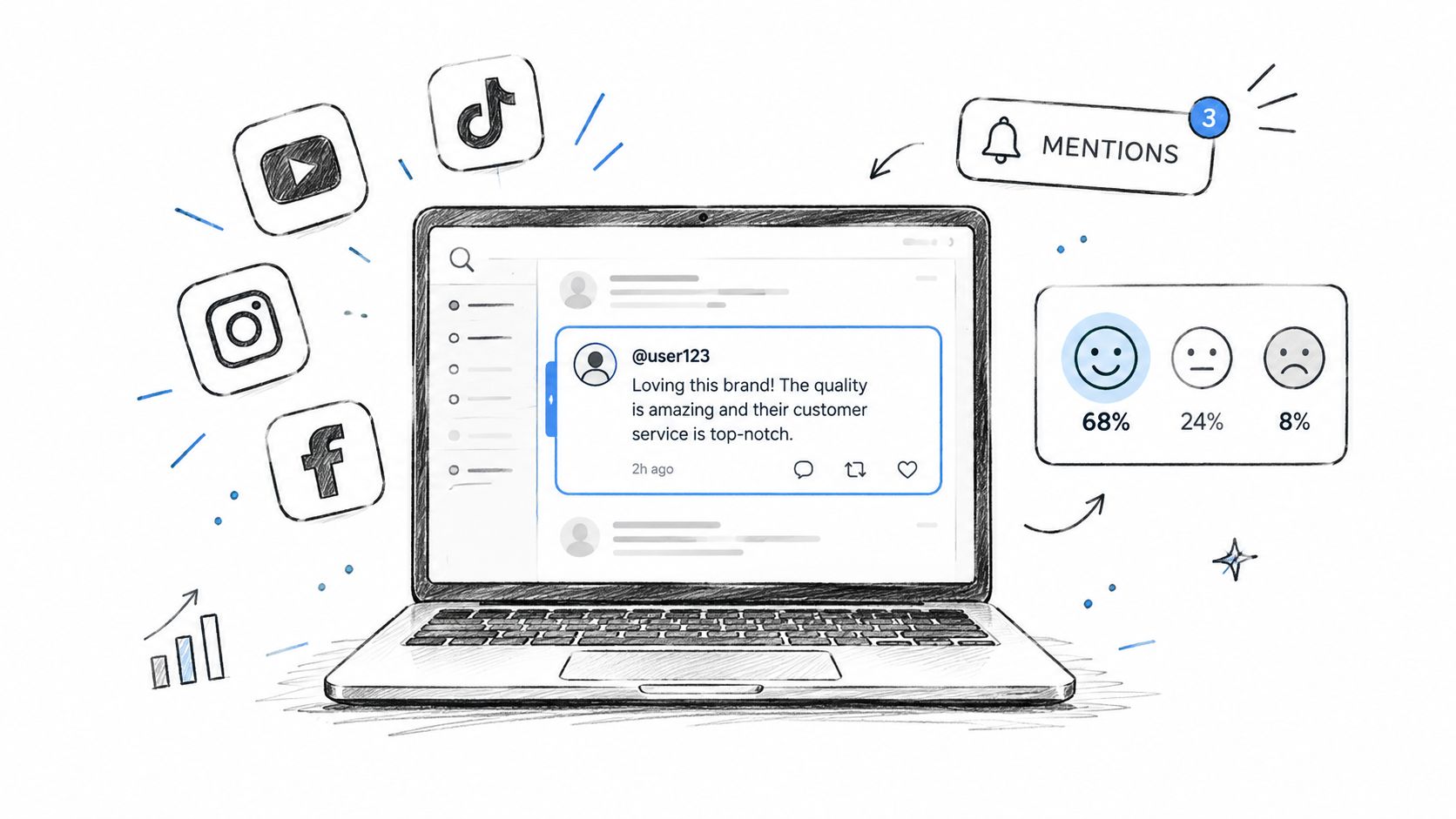
Reusable template: Query brand and product terms, collect public comments, label the issue and urgency, route priority mentions, and report response time plus recurring themes.
2. Competitive Intelligence and Market Analysis
A competitor's campaign can look successful until its comments reveal confusion, unmet needs, or direct comparisons with your product. Set up listening to examine both sides of that exchange. The post shows the intended message. Replies show how audiences interpret it, challenge it, and connect it to alternatives.
Start with one query for each competitor. Add product names, campaign hashtags, executive accounts, category terms, and common misspellings. Capture posts, replies, platform, region, content format, and publication date. Keep paid and organic content separate, since their reach and audience intent may differ.
The strategic value comes from finding a customer need your competitor discusses poorly or leaves unanswered.
Use a comparison matrix rather than forcing every platform into one score. Record comparable signals such as comments per post, recurring objections, content format, and the share of comments expressing a clear opinion. Treat views, reactions, and comments as different forms of attention. A high-volume post may produce little actionable insight, while a smaller discussion may expose a sales objection worth addressing.
Review the matrix for four decisions:
- Message choice: Which benefits and objections recur for each brand?
- Audience interpretation: Where do people ask questions, praise the offer, express confusion, or report frustration?
- Opportunity gap: Which customer need receives repeated discussion but little visible response?
- Timing: Which campaign or product conversation is gaining attention across platforms?
The KPI is change in your strategic response. Record whether a finding changed your positioning, comparison page, sales enablement asset, campaign concept, or objection playbook. Mention volume alone cannot show business value.
For the analytical foundations, use this guide to understand competitive intelligence. This guide to competitor insights can help structure the workflow, while your queries should reflect the markets and platforms that matter to your business.
Reusable template: Choose competitors, capture posts and replies, classify themes and objections, compare equivalent signals, and log the decision linked to each finding. Revisit the same query set monthly so changes remain visible.
3. Influencer and Creator Identification and Vetting
A creator may already influence buying conversations before appearing in an influencer database. They might recommend a product category, answer questions in comments, or publish useful content without a partnership label. Listening surfaces these signals, but discovery is only the first filter.
Configure searches around category keywords, competitor mentions, product use cases, and audience questions. Review video and social platforms, then record the creator or channel, public engagement signals, recurring topics, and comment context. Follower count provides context, not proof of influence. A smaller specialist account may generate more relevant discussion than a large generalist.
The strategic point is audience fit: choose creators whose conversations match the questions your product can answer.
Examine the audience behind the reach
Review several posts, including ordinary ones rather than only a viral result. Check whether comments contain specific questions, product experiences, or useful discussion. Search earlier branded mentions for undisclosed conflicts, repeated sponsorships, direct-competitor partnerships, and claims that could create brand-safety problems.
A useful record captures:
- Topic fit: Does the creator consistently cover the category?
- Audience relevance: Do commenters raise needs your product can address?
- Interaction quality: Are replies specific and conversational, or limited to generic reactions?
- Partnership history: Has the creator promoted similar products, and how did the audience respond?
- Risk review: Do recurring complaints, misleading claims, or conduct concerns appear?
Use qualified creator rate as the discovery KPI: the share of identified creators who pass relevance, authenticity, and brand-safety checks. After activation, measure qualified comments, saves where available, referral activity, or assisted conversions. These outcomes show more than visible likes, though each favors a different stage of the campaign.
A structured method to identify relevant influencers can support discovery. Keep approved and rejected records, including the reason for each decision, so later campaigns can monitor changes instead of rebuilding the list.

Reusable template: Search category and competitor conversations, rank creators by topic and audience fit, inspect comment quality across several posts, review partnership and risk signals, then retain the decision and its evidence in a monitored creator database.
4. Trend Detection and Viral Content Forecasting
Trend listening is a timing problem. By the time a hashtag becomes obvious to everyone, the useful creative window may be closing. A better workflow watches for changes in mention velocity, comment themes, recurring sounds, emerging phrases, and cross-platform movement.
Start with a broad set of category terms and hashtags. Add exclusions for unrelated meanings, then collect search results at a consistent cadence. A rising volume signal matters, but it doesn't explain why the topic is spreading. Read comments to determine whether people are participating in a joke, asking for information, criticizing a brand, or repeating a format without strong intent.

Separate momentum from relevance
A trend can be popular and still be wrong for your brand. Before joining, check whether the audience overlaps with your target market, whether the brand can contribute something useful, and whether the tone creates reputational risk. Don't force a product message into a conversation that has no natural connection.
The KPI is time from trend detection to approved content, followed by performance against your normal baseline for the same format. Track the decision as well. A trend you consciously reject can be a successful listening outcome if the conversation carries clear safety, legal, or brand-fit concerns.
A cross-platform workflow should label each signal by platform, timestamp, visibility, source, and confidence. The social media trend analysis workflow provides a useful starting point for organizing those inputs.
Reusable template: Monitor category terms and hashtags, measure velocity, inspect the comment reason behind the trend, score brand relevance, approve or reject quickly, and compare resulting content with a rolling format baseline.
5. Customer Feedback and Sentiment Analysis
A customer says an app is “frustrating.” That label is too broad for a product decision. Tag the sentiment with the specific object involved, such as price, onboarding, delivery, interface, feature, customer segment, use case, or requested outcome. The same negative tone can point to very different fixes.
Start with product reviews, creator videos, tutorials, and comments on brand posts. Group statements that describe the same friction, even when the wording differs. A single complaint may remain anecdotal, while recurring comments across sources justify investigation. Engagement can help rank urgency, but it should not decide the product roadmap by itself.
The strategic point: sentiment becomes actionable only when each emotion is tied to a theme, owner, and potential response.
Turn themes into decisions
Route each high-value theme to the team that can act on it. Product managers need issue clusters and representative comments. Support leads may need response guidance. Marketing may need to clarify a feature or revise a claim. Preserve the original URL, post context, and surrounding replies so an analyst can check an automated classification.
Record four fields for every priority theme: the observed problem, the likely cause, the requested change, and the business owner. Add a follow-up signal, such as the theme's frequency or sentiment after the intervention. This separates what customers explicitly said from the interpretation and the action that follows.
For a historical example of public conversation analysis, the academic study cited in the introduction treated individual comments as units linked to brands, topics, reactions, and recurring themes. Use social sentiment analysis guidance to structure classification, then check automated summaries against source comments before sharing them.
Measure frequency of priority feedback themes over time as the primary KPI. Track resolution status as a secondary measure, since a theme can decline, persist, or shift after a product change.
Reusable template: Capture comments, classify sentiment and topic, cluster repeated feedback, preserve evidence, assign an owner, record the decision, and monitor the theme after intervention.
6. Content Strategy and Performance Optimization
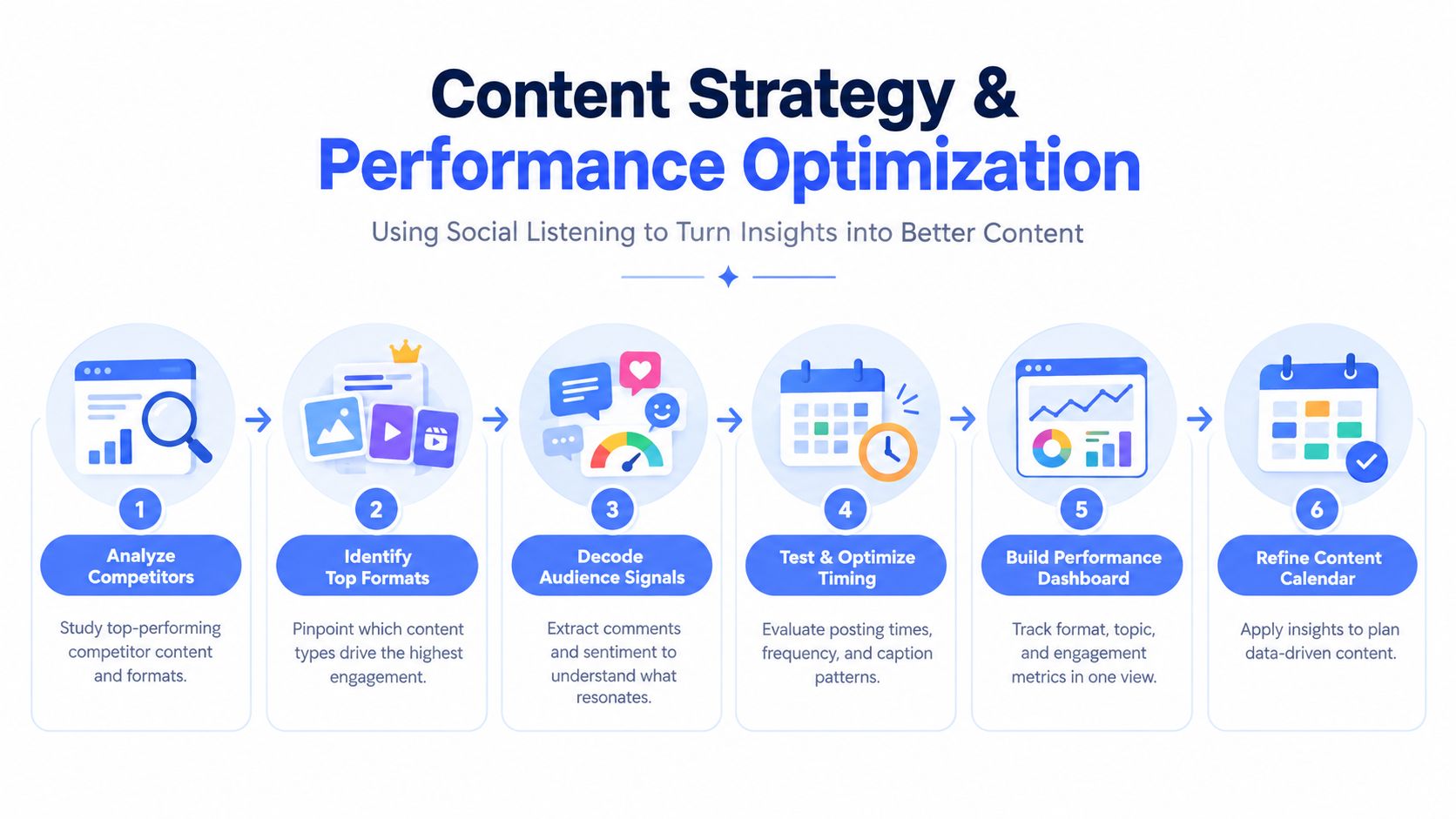
A post can collect reactions while missing the audience's real need. Comments often explain whether a strong result came from practical value, surprise, controversy, timing, or easy sharing. Social listening connects those reasons to the topic, hook, format, caption, call to action, platform, and publication time recorded in your content library.
Build a comparison set with competitor and industry content, then treat it as context rather than a direct benchmark. Different audiences can produce very different results from similar creative.
The strategic point is to identify the response pattern behind performance, then reproduce the useful element without copying the post.
For each high-performing post, sample comments and label what people do with the content. Separate follow-up requests, objections, repeated wording, and peer explanations. A request for an example can support the next post. A recurring objection may require a clearer claim or a different landing page. Users explaining an idea to one another may reveal a strong teaching angle.
Run focused tests by changing one major variable at a time:
- Topic: Compare two audience problems in the same format.
- Format: Test short video against a carousel or text post.
- Hook: Open with a question, result, objection, or practical instruction.
- Call to action: Ask for a reply, save, click, or follow-up question.
- Distribution: Compare publication windows while keeping the creative standard consistent.
Keep the test record tied to the content objective. For educational content, comment questions and saves may matter more than raw reactions. For demand generation, referral behavior and lead quality carry more weight. Public engagement also misses some meaningful interactions, including certain direct messages, saves, and shares, according to its analysis of visible and private engagement.
Measure qualified engagement tied to the content objective, then compare the result with the variable changed. A reusable workflow is: catalog content attributes, extract and tag comments, identify the reason for strong response, test one variable, and record the KPI that reflects the content's job.
7. Crisis Management and Early Warning Systems
A product complaint can become a crisis before the support team sees it. Set up listening before that moment, with alerts for sudden increases in negative mentions, new issue phrases, high-risk product terms, executive names, and unusual conversation velocity. Separate queries for service interruptions, safety concerns, misinformation, employee issues, and legal or regulatory topics make routing more precise.
Route the first alert to someone who can verify the signal. Automated sentiment can misread sarcasm, jokes, mixed-language comments, or a viral positive story containing a negative word. An analyst should review representative posts, identify the actual concern, and decide whether it is isolated or spreading.
The first strategic decision is whether the signal represents a real incident, not whether an automated score looks negative.
Build the response loop around ownership
Assign the person who confirms the incident, the person who approves the public response, the team handling customer replies, and the owner reporting progress. Prepare factual response frameworks, then adapt them to the verified issue. Publishing a generic statement before understanding the problem can make the response look disconnected.
A crisis panel should track five signals:
- Mention velocity: Is conversation accelerating?
- Issue concentration: Which product, location, or event appears most often?
- Source distribution: Is discussion staying on one platform or spreading across several?
- Audience impact: Which creators, communities, or accounts are amplifying it?
- Response reaction: Do sentiment and comment themes change after the update?
Use time from first verified signal to approved response as the primary KPI. Track the change in the dominant concern as a secondary KPI. The Chick-fil-A barbecue sauce example reports more than 5,000 fan messages, followed by a shift from 73% negative to 92% positive within days after active monitoring and a coordinated relaunch campaign (the industry summary of the example). The source does not show that listening alone caused the change, so use the case to demonstrate measurement design rather than sole causation.
Reusable template: Define risk queries, set velocity alerts, verify the signal, assign an incident owner, publish an evidence-based response, and measure response time alongside the dominant issue theme.
8. Content Research and SEO or Algorithm Optimization
A customer's comment can expose a content gap before it appears in keyword research. People describe problems in their own words, ask questions before searching, and compare products with phrases your team may not have considered. Those patterns can shape topics, headings, video scripts, product copy, and FAQs.
Start with comments on relevant videos and posts. Capture questions, comparison phrases, objections, use cases, and recurring terminology. Classify each item by intent. “How does this work?” points to educational content. “Is this better than X?” supports a comparison page. “Why does this stop working?” may justify a troubleshooting article or a product explanation.
The strategic value comes from converting repeated audience language into content decisions, then validating those decisions before publication.
Connect social signals to search decisions
Repeated social phrasing is a research lead, not proof of search demand. Validate it against first-party search data, customer-support records, sales calls, or keyword tools. Social listening reveals language and intent, while organic demand and rankings show whether that language can attract qualified visits.
For platform optimization, record the format, topic, title or caption, publication timing, and audience response. Compare results within each platform. YouTube, TikTok, Instagram, and Facebook use different recommendation and ranking conditions, so a pattern on one platform may not transfer to another. Comments can also identify questions for a follow-up video, an updated article, or clearer product instructions.
The primary KPI is the number of validated audience questions converted into useful content. Track organic engagement or qualified visits as a secondary measure where available. Captapi's public-data workflow can support this process through Captapi's comment extraction API, while its product documentation can help developers evaluate how to connect comments, search results, and content records. Use one documented integration path, preserve source URLs, and record the validation decision for each topic.
Reusable template: Extract audience questions, classify intent, validate language against independent demand signals, create or update content, and track which questions remain unresolved.
8 Social Listening Use Cases Compared
| Use Case | 🔄 Implementation Complexity | ⚡ Resource Requirements / Efficiency | ⭐ Expected Effectiveness | 📊 Expected Outcomes / Impact | 💡 Ideal Use Cases & Key Advantages |
|---|---|---|---|---|---|
| Brand Mention Tracking & Reputation Management | High, real-time multi-platform monitoring, sentiment pipelines | High, continuous API streaming, filtering, NLP; resource‑intensive | ⭐⭐⭐⭐⭐ | Faster issue detection; reputation protection; prioritized customer response | Marketing, comms, customer service; rapid response, influencer ID, competitor benchmarking |
| Competitive Intelligence & Market Analysis | Medium‑High, systematic tracking + manual analysis for deep insights | Medium, multi-source data + analyst time; periodic reporting is efficient | ⭐⭐⭐⭐ | Benchmarking, strategy refinement, gap identification | Product managers, strategists; uncover competitor tactics and market opportunities |
| Influencer & Creator Identification & Vetting | Medium, discovery plus authenticity checks and audience analysis | Medium, follower/engagement data, bot detection tools, manual vetting | ⭐⭐⭐⭐ | Higher ROI partnerships; reduced fraud risk; better audience fit | Agencies, brand managers, PR; discover authentic creators and verify alignment |
| Trend Detection & Viral Content Forecasting | Medium, velocity metrics and cross‑platform correlation, predictive modeling | Medium, real‑time volume tracking; time‑sensitive but not always heavy compute | ⭐⭐⭐ | Early trend capture; increased organic reach; timely content opportunities | Content creators, social managers; first‑mover advantage and trend-informed calendars |
| Customer Feedback & Sentiment Analysis | High, large‑scale comment extraction, advanced NLP and topic clustering | High, scalable extraction, robust NLP models, integration with PM systems | ⭐⭐⭐⭐ | Actionable product insights; prioritized feature backlog; improved CSAT | Product, CX, UX teams; capture unsolicited feedback and prioritize improvements |
| Content Strategy & Performance Optimization | Medium, ongoing A/B testing and cross‑content analysis | Medium, engagement analytics, dashboards; efficient with automation | ⭐⭐⭐⭐ | Improved engagement and content ROI; optimized posting and formats | Content managers, growth teams; data‑driven format/topic optimization |
| Crisis Management & Early Warning Systems | High, 24/7 monitoring, alerting logic, root‑cause clustering | High, continuous monitoring, fast alerting, dedicated response resources | ⭐⭐⭐⭐ | Early containment of issues; reduced reputational damage; measured recovery | PR, corporate comms, execs; rapid alerts, escalation workflows, response measurement |
| Content Research & SEO / Algorithm Optimization | Medium, keyword/topic extraction and platform signal analysis | Medium, comment and keyword extraction, iterative testing for signals | ⭐⭐⭐⭐ | Better discoverability; content gap identification; improved organic traffic | SEO specialists, content strategists; surface user intent and platform‑specific keywords |
Turn These Examples Into Your First Listening Sprint
You don't need to launch every workflow at once. Pick the example that matches the business problem already consuming your team's time. If support keeps discovering recurring complaints too late, start with brand mention tracking or customer feedback analysis. If campaign decisions depend on competitor moves, start with competitive intelligence. If your content team struggles to explain why posts succeed, start with content performance optimization.
Write the first query in plain language before translating it into platform-specific filters. Include the brand or category term, products, common misspellings, relevant hashtags, competitor names, and exclusion terms. Then decide what counts as a priority alert. A simple rule might combine a sensitive topic, rapid conversation growth, or a high-relevance account. The threshold should trigger human review, not automatically publish a response.
Choose one primary KPI for the first sprint. Brand monitoring can use response time. Crisis detection can use time from verified signal to approved response. Feedback analysis can use the frequency of a priority theme. Creator discovery can use qualified creator rate. Trend detection can use time from detection to approved content. Content strategy can use qualified engagement. SEO research can use validated audience questions converted into content.
Keep the reporting cadence small enough to maintain. Review urgent alerts as they arrive, inspect the dashboard daily when the topic is active, and produce a weekly summary with three parts: what changed, what evidence supports it, and what someone will do next. A report that only describes conversation volume will create activity without accountability.
The strongest social listening examples follow a clear chain:
- Signal: A public comment, mention, search result, or engagement pattern appears.
- Interpretation: The team classifies the context, audience, topic, and confidence.
- Decision: Someone changes a response, product priority, campaign, creator list, or content plan.
- Measurement: The team checks whether the selected KPI moved.
- Iteration: The query, threshold, or action changes based on what the team learned.
Captapi can provide raw public data for several of these workflows through comment and search endpoints, alongside platform-specific social data for YouTube, TikTok, Instagram, and Facebook. Use it as an input layer for a workflow that preserves context, records uncertainty, and sends findings to the people who can act.
Start this week with one query, one alert threshold, one owner, and one reporting date. By the end of the sprint, you should be able to point to a specific public signal, the decision it informed, and the KPI that shows whether the decision helped.
Use Captapi to collect public comments, search results, transcripts, engagement signals, and platform data through a unified API for social listening workflows. Connect those inputs to your brand monitoring, competitor research, feedback analysis, or content pipeline, then start with one focused query and a measurable reporting cadence.