
How to Do Social Listening That Actually Drives Decisions
Your team's listening dashboard is full. Mentions are grouped by sentiment, competitor names sit in a neat chart, and someone exports the report every Friday. Yet product still hears about recurring complaints from support, campaign teams still argue from instinct, and no one can say which alert should trigger a decision.
That's the failure mode of social listening without an operating model. The useful question isn't “How many people mentioned us?” It's “What decision could this signal change, who owns that decision, and what outcome will tell us whether the action worked?”
Table of Contents
- What Social Listening Actually Means in 2026
- Set a Decision Goal and Build a Query Set
- Choosing Where to Collect the Data
- Collecting, Deduplicating, and Storing Mentions
- Classifying Mentions Without Lying to Yourself
- From Mentions to a RAG-Ready Pipeline
- Alerts, Baselines, and Closing the Loop
What Social Listening Actually Means in 2026
Social listening is a decision pipeline, not a counter for likes, comments, or brand mentions. A practical workflow moves through five stages: monitor relevant media, collect posts and conversations, classify the material, process and analyze it, then report findings for decisions. That structure is described in the research-based social listening workflow.
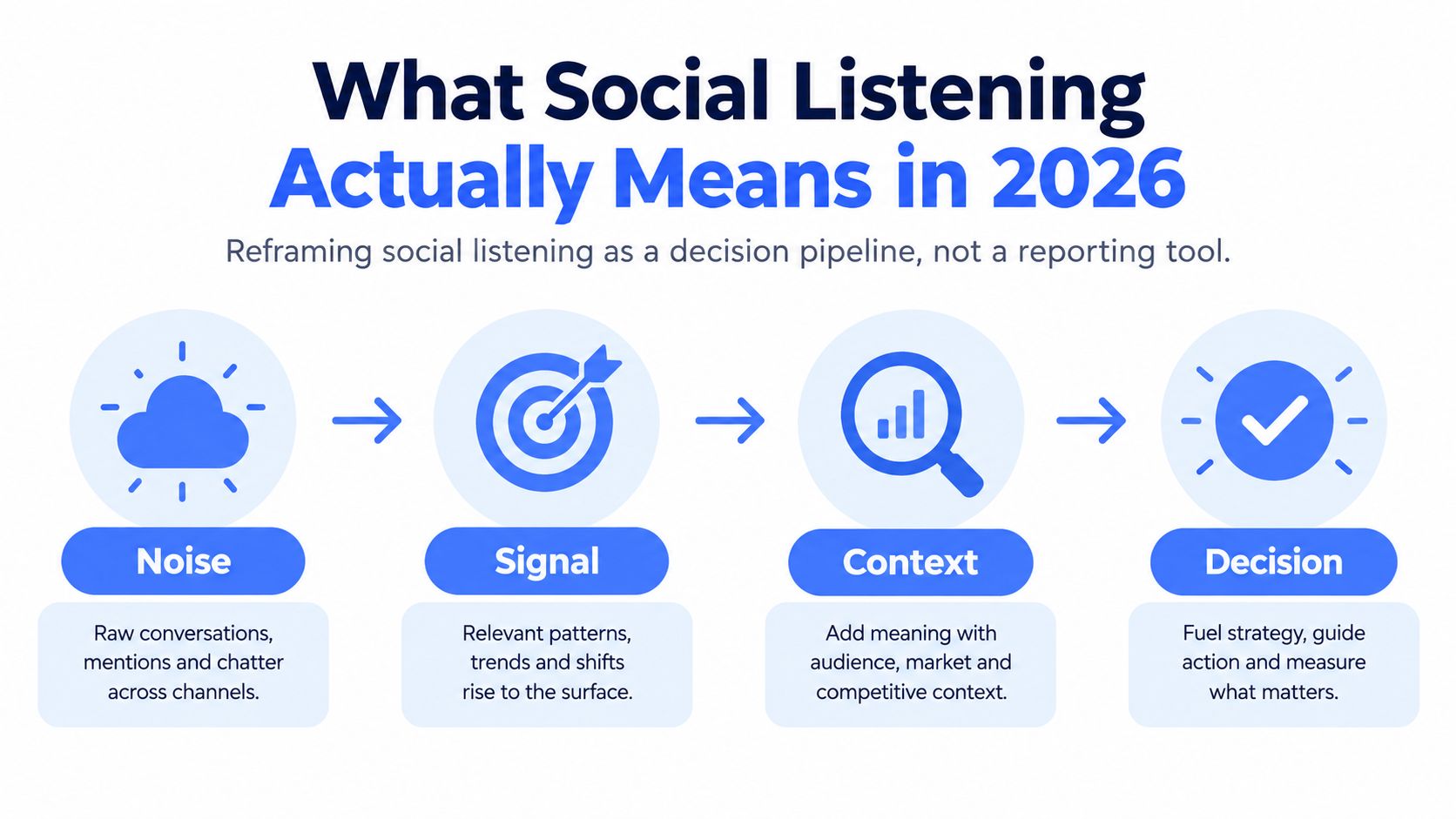
A monitoring program might tell you that negative mentions increased. A listening program investigates the posts behind that movement, identifies the recurring issue, checks whether the issue appears in another operational dataset, and routes a concrete recommendation to the person who can act. The output might be a support escalation, a product ticket, a campaign adjustment, a competitor alert, or a decision to gather better evidence before doing anything.
Start by writing one sentence:
Decision rule: “We listen to [conversation] so [owner] can decide [action] when [validated signal] appears.”
For example, a product team might monitor complaints about a new release so engineering can investigate when a recurring failure theme appears across relevant platforms and is supported by support-ticket data. A brand team might compare competitor positioning so marketing can adjust messaging when a theme consistently appears in competitor conversations but is absent from its own positioning.
Social data also has a hard limitation. Posts come from self-selected, uneven audiences, so mention volume isn't a measure of customer prevalence. Use listening for early signals, issue discovery, and language research. Validate material conclusions with customer-support data, structured research, sales data, product analytics, or experiments.
A multi-platform view matters because audiences and conversation styles vary by network. A practical social media API guide can help engineers think about collection as infrastructure rather than a dashboard integration.
Your first deliverable shouldn't be a chart. It should be a decision statement with an owner, a trigger, and an outcome.
Set a Decision Goal and Build a Query Set
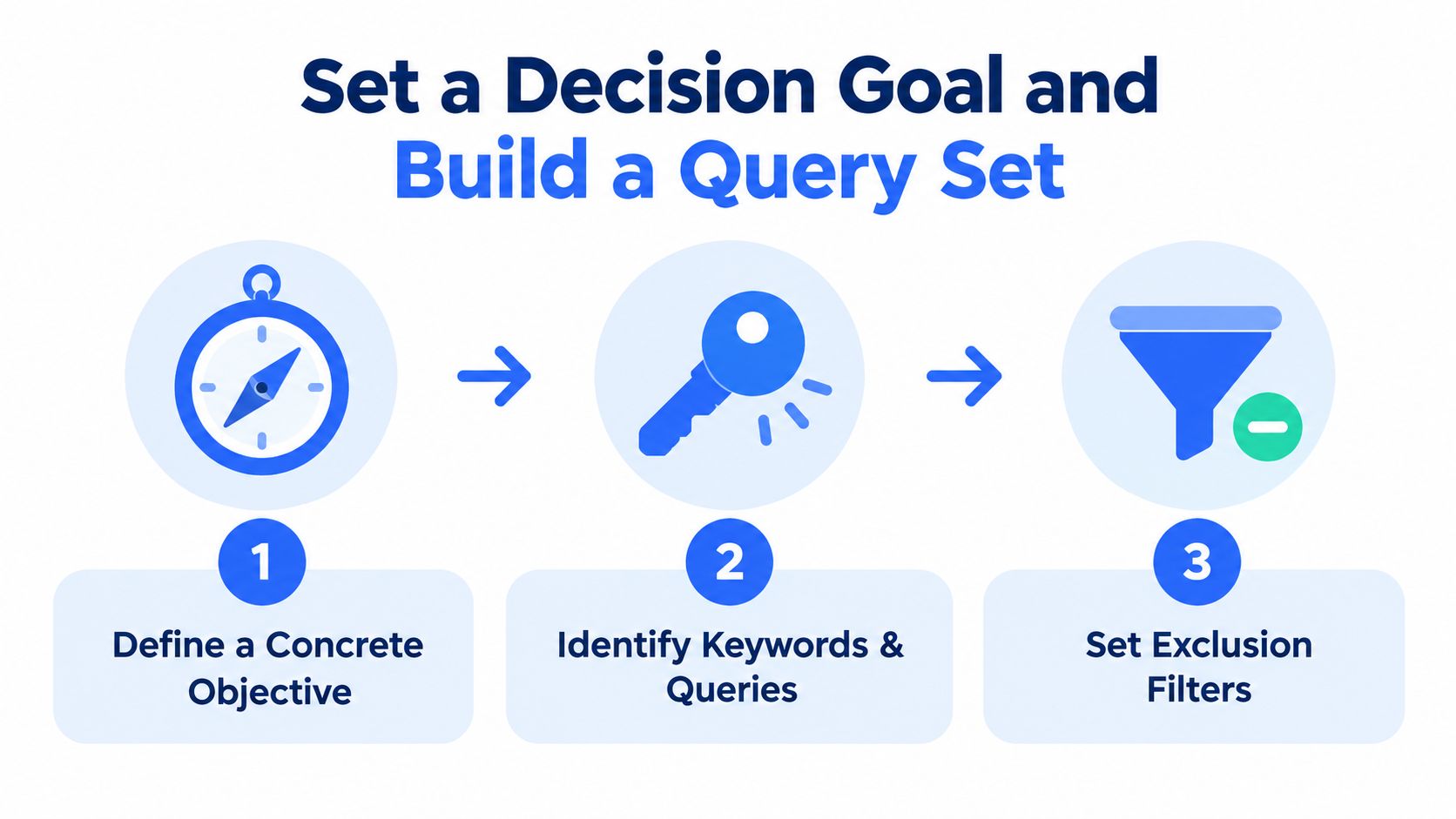
Before choosing a tool, define the decision. “Monitor our brand” is too broad to configure, prioritize, or evaluate. “Detect recurring checkout complaints and route validated issues to customer care” gives you a population, a topic, a threshold to investigate, and an owner.
Write the objective in operational terms:
- Complaint detection: Find product, delivery, billing, or service failures that need escalation.
- Competitive positioning: Compare the language people use for your offer and competing offers.
- Emerging-topic discovery: Identify new problems, use cases, or category language before the next planning cycle.
- Campaign diagnosis: Determine whether a message creates confusion, enthusiasm, objections, or irrelevant attention.
Then build a query set, not a single keyword. Include the formal brand name, product names, variants, abbreviations, common misspellings, campaign terms, hashtags, executive names, competitor terms, and category language. Add exclusions for unrelated meanings, job listings, support documentation, or other entities that share your name.
A consumer-brand query could look conceptually like:
("BrandName" OR "Brand Name" OR #BrandName OR "BrandNmae") AND (delivery OR damaged OR refund OR "doesn't work") NOT (jobs OR careers)
For a developer product, the terms need to reflect how technical users write:
("ProductName" OR "product-name" OR "prodctname") AND (API OR SDK OR latency OR docs OR integration) NOT (stock OR token price)
Treat the query as versioned configuration. Record why each term exists, what it excludes, which platforms and languages it covers, and what decision it supports. Review representative results before trusting the output. The most expensive query errors are often quiet omissions, not noisy false positives. Teams forget product variants, local spellings, creator language, competitor aliases, or the terms customers use instead of the official feature name.
A one-page query brief
Keep the setup short enough that a marketer, analyst, and engineer can review it together:
- Decision: What business choice could change?
- Owner: Who receives and acts on the signal?
- Target population: Which customers, creators, prospects, or category conversations matter?
- Query families: Brand, product, competitor, problem, campaign, and category terms.
- Exclusions: Irrelevant meanings, duplicated sources, and known noise.
- Coverage: Platforms, languages, geography, and time window.
- Validation: Which records will humans inspect?
- Outcome: What action and post-action measurement will close the loop?
For topic discovery, use a separate workflow for finding trending topics, because a fixed brand query and an open-ended trend query answer different questions.
A query that can't be tied to a decision is probably collecting data for its own sake.
Choosing Where to Collect the Data
A brand team investigating a sudden complaint spike may need public posts, video comments, reviews, and community discussions. Each source exposes different context, identifiers, and collection constraints. Choose sources according to the decision the listening program must support, not the number of platforms a vendor lists.
Direct platform APIs provide structured access and clear authentication. They also require separate integrations, platform-specific limits, and handling for uneven fields. Scrapers can offer broader flexibility, but terms, privacy, access stability, maintenance, and data quality need review before they enter a production pipeline.
A unified social-data API can reduce integration work across supported networks. Captapi provides a REST interface covering YouTube, TikTok, Instagram, and Facebook, with normalized responses and shared caching, according to its API reference. That can simplify ingestion for brand monitoring, competitor research, and RAG pipelines. It does not replace query validation, retention controls, provenance tracking, or lawful data handling.
| Source Type | Setup Effort | Platform Coverage | Compliance Risk | Best Fit |
|---|---|---|---|---|
| Direct platform APIs | High, because each platform has its own authentication, schema, and operational rules | Strong where access is available, uneven across platforms | Requires platform-by-platform review and governance | Products with a narrow platform focus and an engineering team that needs first-party access |
| Third-party scrapers | Moderate to high, with maintenance and failure handling | Potentially broad, depending on the provider | Higher scrutiny around terms, privacy, provenance, and permitted use | Research or internal prototypes where the collection method has been reviewed |
| Unified social-data APIs | Moderate, with one integration and normalized responses | Multiple supported platforms through one interface | Still requires review of source permissions, retention, and downstream use | Brand monitoring, RAG ingestion, competitor research, and multi-platform pipelines |
A research project may prioritize reproducible sampling and documented ethical safeguards. A brand-monitoring program may care more about stable collection, metadata, and alert latency. A RAG product needs clean text, stable identifiers, provenance, and repeatable retrieval. A polished sentiment dashboard cannot compensate for missing source context or an owner who has no action rule.
Platform mix also changes interpretation. A conclusion from one network may reflect its audience, algorithmic distribution, and conversation format rather than the wider market. Video comments, short posts, reviews, and community discussions carry different levels of context. Document included and unavailable sources explicitly, then assign each source a decision, owner, and expected outcome.
For implementation considerations, the guide to social media data gathering can help engineers compare collection patterns. The final choice still requires a governance review covering permissions, retention, access, and downstream use.
Collecting, Deduplicating, and Storing Mentions
Collection jobs should preserve enough context that another analyst can reproduce the result later. For every record, capture the raw text or transcript, platform, permalink, timestamp, language, author type where ethically appropriate, engagement fields, query identifier, collection timestamp, and source-specific identifier.
Don't overwrite the original text with a cleaned version. Store normalized text separately. The raw record is needed when a classifier changes, a reviewer disputes a label, or a query is updated. Store the query version too. Without it, you can't explain why a record entered the dataset or compare results after a query change.
A minimal record model
A practical schema can include:
- Identity: Platform, post or video ID, permalink, and parent-record ID.
- Content: Raw text, transcript, normalized text, detected language, and media type.
- Context: Author category, publication timestamp, collection timestamp, and query version.
- Engagement: Available reactions, comments, shares, views, or reach fields.
- Analysis: Topic, intent, entity, sentiment estimate, confidence, reviewer status, and model version.
- Governance: Retention class, access group, redaction status, and provenance notes.
Deduplication needs more than matching URLs. Reposts and syndicated content may share text but have different engagement and authorship. Cross-posted content may be nearly identical while carrying distinct platform context. Use platform IDs first, then canonicalize URLs, normalize whitespace, compare fingerprints, and retain links between source records rather than deleting every near-duplicate blindly.
Normalize timestamps to a common standard while retaining the source timestamp. Keep the original language and preserve the original text alongside translations. A translated copy helps search and analysis, but it shouldn't replace the words reviewers need to inspect.
The governance layer is part of pipeline quality. UK government guidance says researchers should minimize intrusion, respect privacy, protect participant identities throughout the data lifecycle, and obtain consent when conducting primary data collection involving participants. Public availability doesn't automatically make every downstream use appropriate. Store only necessary fields, limit access, anonymize exports where possible, and document collection dates, search terms, inclusion rules, exclusions, and blind spots.
Teams that need a practical framework for turning unstructured records into repeatable categories can use content analysis with a clear workflow as a complementary reference. The important engineering principle is traceability: every derived label should point back to the source record, the method, and the version that produced it.
For database planning, social media database design offers useful implementation context. The database shouldn't become a warehouse of everything the crawler can find. It should hold the evidence needed for the decisions your team has agreed to make.
Classifying Mentions Without Lying to Yourself
Automated classification is valuable because humans can't inspect every record. It becomes dangerous when a confident label is treated as ground truth. Social language includes sarcasm, quoted complaints, mixed sentiment, slang, emojis, domain terminology, code-switching, dialects, and meaning carried only by video or image context. These are documented challenges in recent social-listening analysis research.
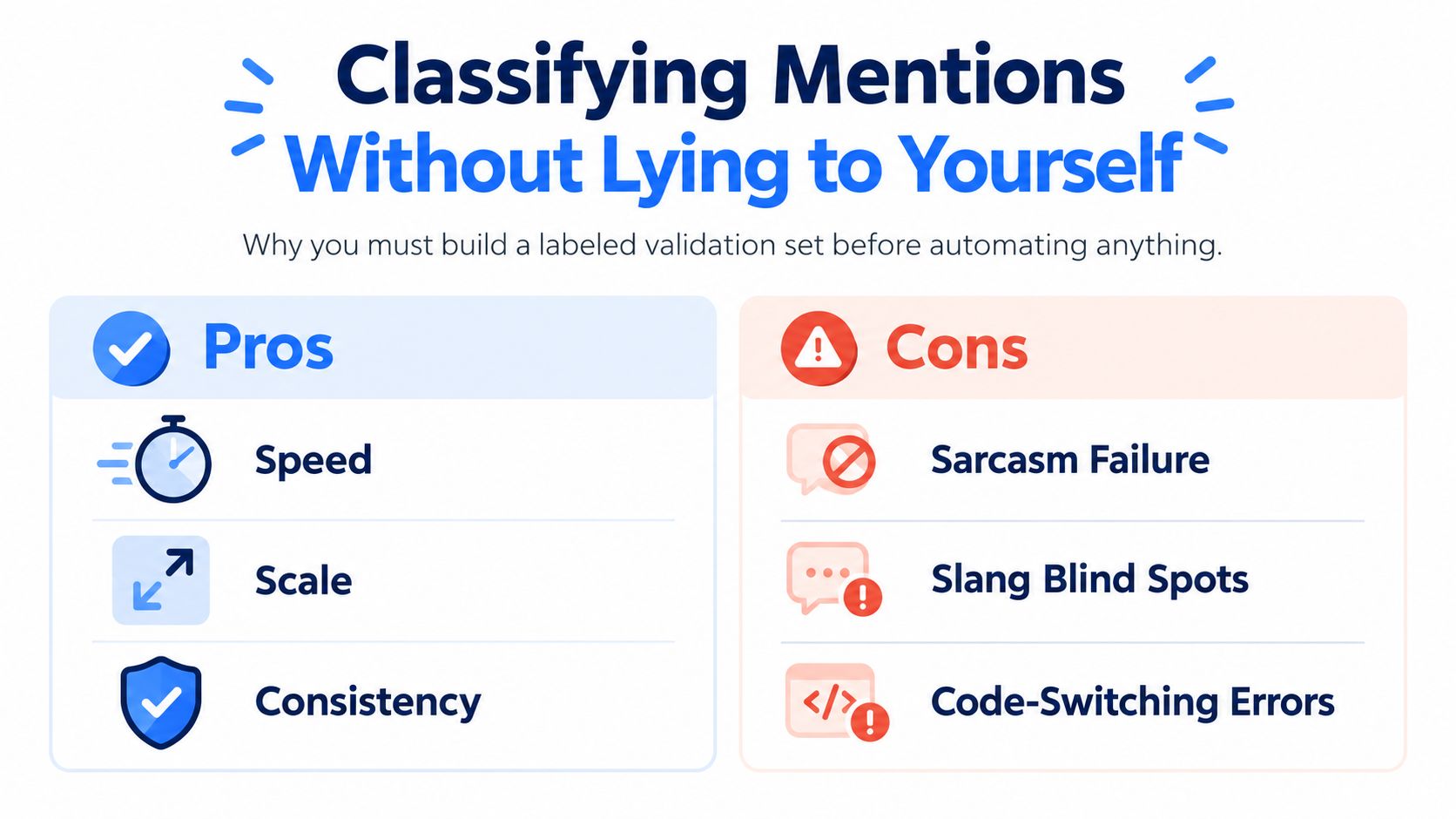
Build a labeled validation set before you automate the full corpus. Sample records across platform, language, topic, sentiment, engagement tier, and content type. Have reviewers assign labels using written definitions, then compare model output against those labels.
Quality control that survives contact with real language
Start with a taxonomy that reflects decisions, not abstract linguistic theory. “Negative” is often too broad for action. Product defect, billing problem, delivery delay, feature request, competitor comparison, purchase intent, and general category discussion can route to different owners.
Then measure the model where it fails:
- Precision by label: Of the records classified as a topic or sentiment, how many are correct?
- Recall by label: Of the records humans assigned to a topic or sentiment, how many did the model find?
- Confusion by language: Which labels collapse or drift in each language?
- Confusion by topic: Which categories the model repeatedly mixes?
- Human-review rate: How many high-impact or ambiguous records require review?
One aggregate accuracy score can hide a serious failure in a smaller language or a high-risk topic. Keep a review queue for high-reach posts, potential safety issues, crisis indicators, mixed sentiment, and low-confidence classifications. Preserve the reviewer's decision as a separate field so you can use it to improve the taxonomy and test set.
Contrarian rule: A smaller validated dataset is more useful than a large collection of confident labels nobody has checked.
Sentiment should remain an estimate. A post saying “great, another outage” may look positive to a keyword model. A quoted customer complaint may be assigned to the account publishing the quote rather than the original speaker. Emojis can reverse the apparent tone, while a translated phrase can lose the cultural meaning that made it sarcastic.
For teams dealing with reviews and comments, turning scattered feedback into priorities can complement the classification workflow. The output still needs representative examples and a human decision owner.
From Mentions to a RAG-Ready Pipeline
A CSV emailed to marketing is an endpoint. A RAG corpus is infrastructure. The difference is provenance, retrieval quality, update behavior, and the ability to answer a future question without rerunning the entire investigation.
A workable pipeline looks like this:
- Define the query and decision metadata. Store the objective, query version, platform, language, and collection window.
- Fetch source material. Collect posts, comments, transcripts, summaries, timestamps, engagement fields, and permalinks.
- Clean and classify. Deduplicate records, preserve raw content, add topics and intent, and mark uncertain labels.
- Chunk documents. Split transcripts and long threads by topic or speaker turn, keeping source IDs and timestamps in every chunk.
- Embed and index. Store vectors alongside metadata such as platform, language, date, author type, topic, and validation status.
- Retrieve with filters. Let the downstream application restrict results by brand, competitor, language, time, topic, or confidence.
- Generate with citations. Return the source permalink, timestamp, and collection context with every answer.
For example, a video-research service can fetch YouTube transcripts and comments through a unified interface, summarize relevant material, chunk the transcript, embed each chunk, and place the vectors in a database used by a product or analyst assistant. The retriever should return evidence, not only a generated conclusion.
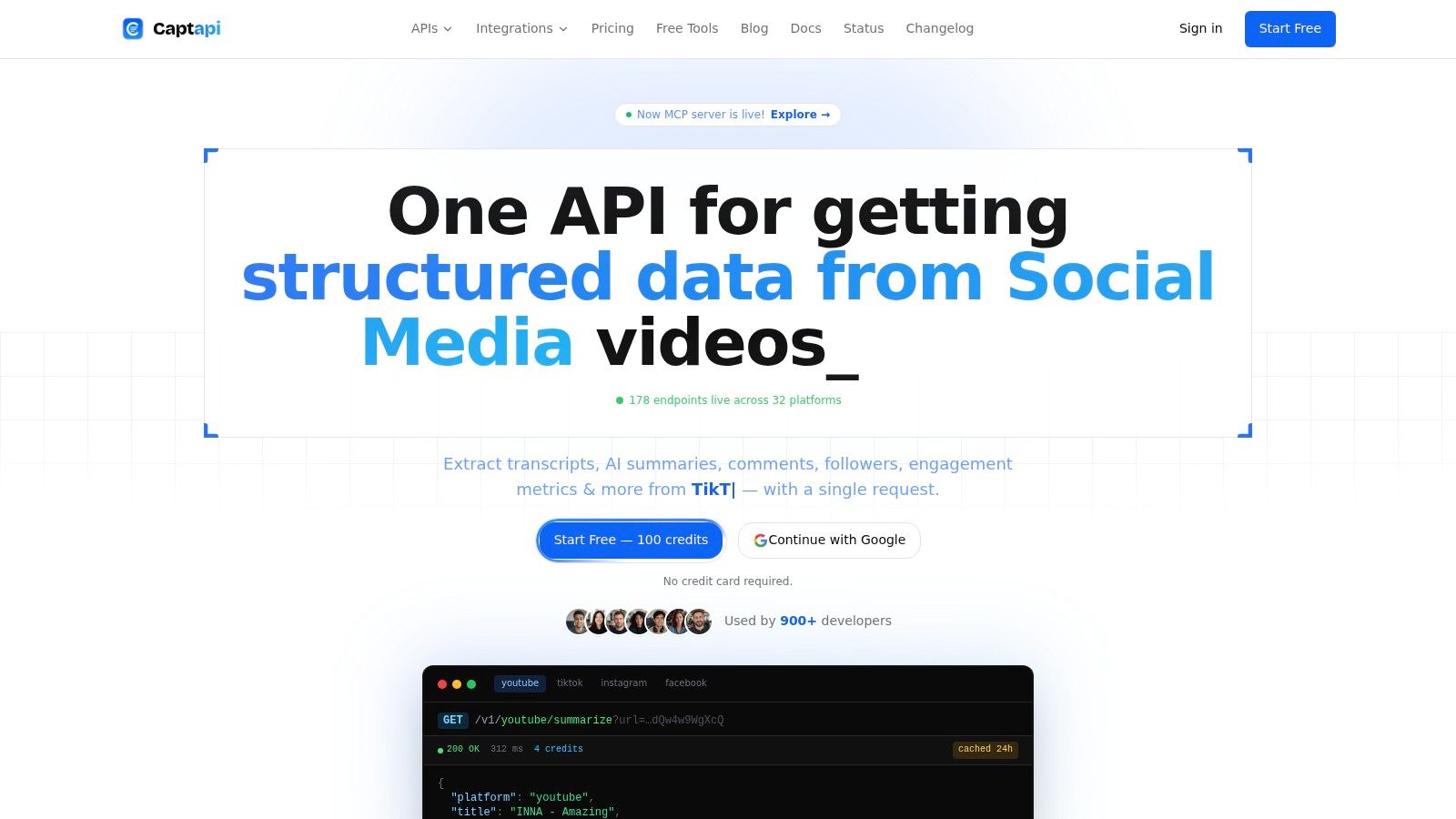
Captapi exposes endpoints for public content across YouTube, TikTok, Instagram, and Facebook, including transcripts, comments, engagement signals, searches, and GPT-4o-mini powered summaries. Its shared cache can make repeated requests cheaper to operate, while rate limits up to 600 RPS can support higher-throughput collection, subject to plan and endpoint conditions. Treat those as pipeline parameters, not promises that every source will respond identically.
A useful RAG pipeline explanation helps connect the retrieval layer to the listening workflow. Add freshness metadata, model versions, deletion handling, and source-access controls from the start. Otherwise, your assistant may answer a current question with stale conversation or expose records the user shouldn't see.
Alerts, Baselines, and Closing the Loop
An alert matters only when someone knows what to do with it. Establish a rolling baseline for each relevant platform and language, then compare equivalent time windows rather than reacting to an isolated count. A sudden increase in complaints may reflect a genuine issue, a viral post, a platform outage, a query change, or a collection failure.
Attach every alert to four fields: owner, response SLA, decision rule, and closure criterion. For example, customer care owns a service-failure alert, reviews representative posts, confirms the pattern against ticket data, and closes it when the root cause is assigned or the signal is disproven. Product owns a recurring defect theme, while marketing owns a campaign-message confusion alert.
Use a report that makes uncertainty visible:
| Field | What to record |
|---|---|
| Metric | Volume, unique authors, reach, sentiment distribution, topic frequency, share of voice, or rate of change |
| Baseline | Comparable historical window and platform mix |
| Validation status | Automated estimate, manually reviewed, triangulated, or unresolved |
| Evidence | Representative positive, negative, and neutral examples with source links |
| Likely cause | Current working explanation, clearly marked as provisional |
| Recommended action | Specific change, investigation, escalation, or decision to defer |
| Owner | Named team or person |
| Outcome | What changed after the action and when it was checked |
That structure follows the reporting guidance that a useful social-listening template should include the metric, baseline, confidence or validation status, representative examples, likely cause, recommended action, owner, and post-action outcome, as described by social listening measurement guidance.
Three failures recur in production. A sentiment spike may be caused by sarcasm or a classifier change, so inspect examples before escalating. A platform outage may look like a drop in demand, so monitor collection health and compare source availability. An unread alert means the owner, channel, or SLA is wrong, so change the workflow rather than adding another dashboard. Teams considering real-time monitoring on X can also review XBurst for growth teams on X for operational ideas, while keeping the same validation and ownership discipline.
A practical rollout starts small. Define one decision, build one query family, collect a reviewable sample, document the schema, validate labels, connect one alert to one owner, and record the post-action result. Expand coverage only after the first workflow produces an outcome the business can inspect.
Captapi provides a developer-first REST interface for collecting public social data, including transcripts, comments, engagement signals, searches, and summaries across YouTube, TikTok, Instagram, and Facebook. Use it to feed a traceable listening or RAG pipeline instead of another abandoned CSV, then visit Captapi to start building.