
What Is Ai Summary
An AI summary is a model-generated short version of a source document, video, or transcript that condenses, rewords, or extracts the most important information. The phrase “condenses” hides three different technical paths: selecting original sentences, generating new wording, or combining both approaches.
You probably use one before you think about it. An email thread becomes a few bullet points, a long video gets a short description, or a research paper is reduced to its findings before you decide whether to read the full text. The convenience feels harmless because the output is brief, fluent, and usually aligned with the topic.
But an AI summary isn't a neutral shrink ray. It creates a new interpretation of the source, and that interpretation can omit context, change emphasis, merge separate ideas, or introduce a claim that the original never supported. Understanding what happens between source and summary helps you decide when a quick overview is enough and when you need evidence, timestamps, or the original document.
Table of Contents
- What an AI Summary Actually Is
- How Extractive and Abstractive Summaries Differ
- Inside the Summarization Pipeline
- Where AI Summaries Are Used in Practice
- How to Measure Whether a Summary Is Actually Good
- The Memory and Faithfulness Risk Most Articles Skip
- Evaluating and Trusting AI Summaries Going Forward
What an AI Summary Actually Is
An AI summary is a short piece of text generated from a longer source, such as a document, email conversation, transcript, podcast, video, or web page. The system identifies information it considers salient and presents that information in a more compact form. Depending on the method, it may copy sentences, rewrite them, or use a mixture of both.
That definition differs from a search snippet. A snippet usually displays selected text to help you judge whether a result is relevant. A summary attempts to represent the source itself. It also differs from a human-written abstract, where a person is responsible for deciding what matters, preserving qualifications, and checking the final wording.
The distinction matters when you read a summary of a long interview. The original speaker might separate evidence from opinion, qualify a conclusion, and correct an earlier statement. A generated summary may preserve the general subject while losing those boundaries. You could receive a polished account that sounds authoritative but doesn't show which source passages support each sentence.
Three routes from source to short text
An extractive summary selects sentences or phrases that already appear in the source. An abstractive summary generates new language that represents the source's meaning. A hybrid summary combines extraction with rewriting, often using source passages as evidence for a model-generated answer.
A practical guide such as the Zemith Document Assistant guide can help explain common document-summary workflows, but a product label doesn't tell you how the system handles unsupported claims. For that, you need to inspect the pipeline, evaluation method, and evidence returned with the text.
The useful question isn't "What is an AI summary?" Ask instead: What did the system select, what did it rewrite, and how can I verify the result? The answers determine whether the output is a reading aid, a searchable index, a research input, or a risky source of structured facts.
How Extractive and Abstractive Summaries Differ
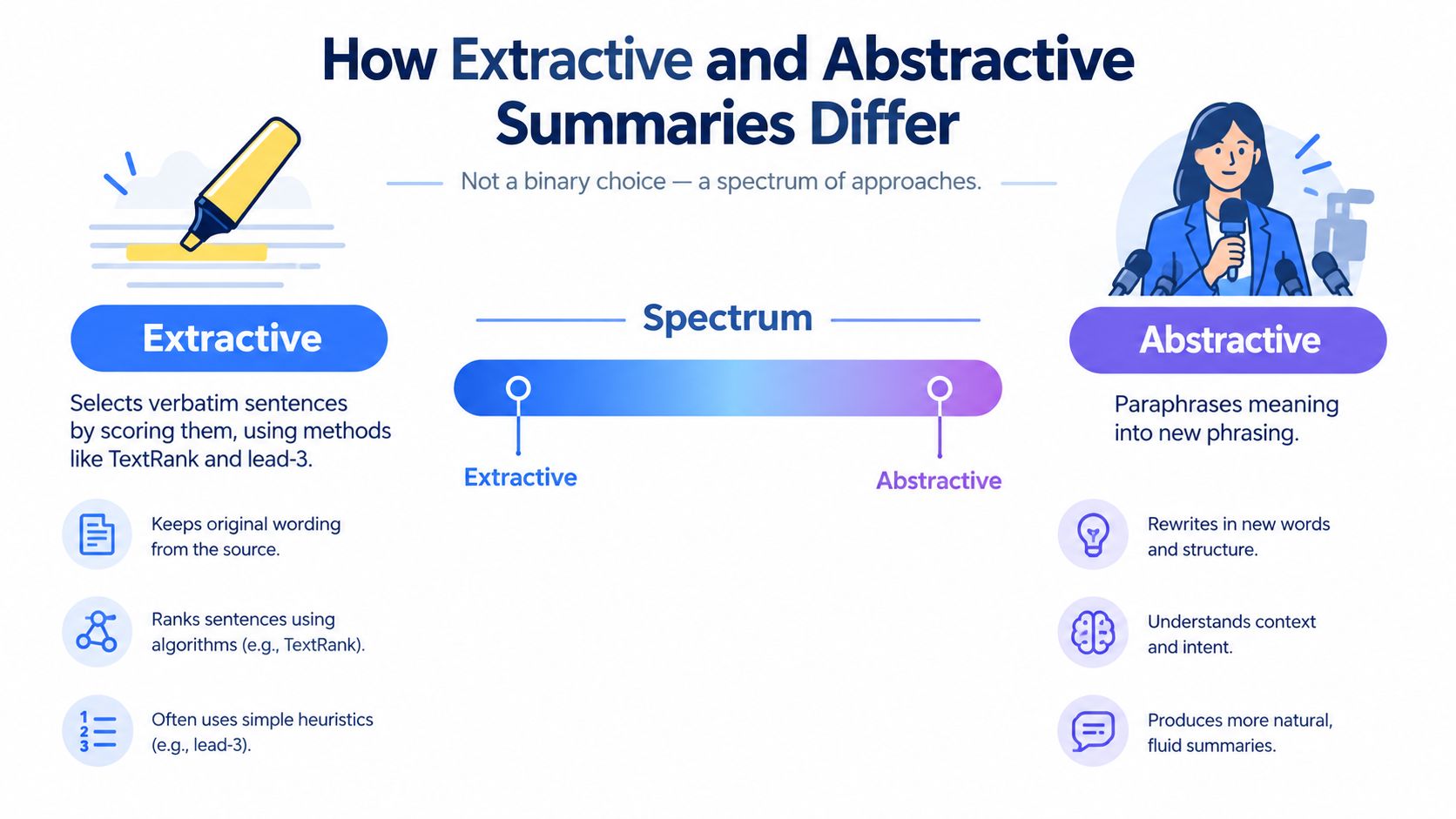
Think of an extractive system as a highlighter. It scans a transcript, scores sentences for relevance, and returns the strongest candidates without changing their wording. An abstractive system behaves more like a reporter at a press conference. It listens to several statements, decides what they mean together, and writes a new account.
Neither approach is automatically correct. Extraction reduces the chance of inventing wording, but a selected sentence can still be misleading when removed from its surrounding context. Abstraction produces smoother prose and can combine scattered points, but the new phrasing may alter entities, quantities, chronology, or causal relationships.
Traditional extractive methods include sentence scoring, TextRank, and the lead-3 baseline, which selects the opening sentences of a source. These methods can work well for articles with a clear inverted-pyramid structure. They may work less well for a 90-minute podcast, where the key conclusion could appear near the end and important context may be distributed across the conversation.
Abstractive systems commonly use encoder-decoder architectures or modern large language models guided by prompts. They can produce a requested format, such as a short paragraph, action list, or topic overview. Their flexibility comes with a stronger need for verification because fluent language can conceal unsupported content.
Extractive vs Abstractive Summaries at a Glance
| Dimension | Extractive | Abstractive |
|---|---|---|
| Faithfulness | Preserves selected source wording, but can lose context | Can preserve meaning, but may change or invent details |
| Fluency | May read like disconnected excerpts | Usually produces smoother, more cohesive prose |
| Length control | Controlled by the number or size of selected passages | Controlled through instructions, decoding, or output limits |
| Hallucination risk | Lower risk of newly generated wording, though selection can mislead | Higher risk of unsupported claims and altered relationships |
| Best fit for a 90-minute podcast | Evidence snippets, quotations, and timestamped highlights | A readable overview, provided claims are checked |
The best production choice is often a point on the spectrum rather than a strict binary. You might extract timestamped passages first, then ask a model to draft a concise overview using only those passages. That design keeps the reporter's readability while giving reviewers a trail back to the highlighter's evidence.
Practical rule: Choose abstraction for readability, extraction for auditability, and a hybrid when users need both.
Inside the Summarization Pipeline
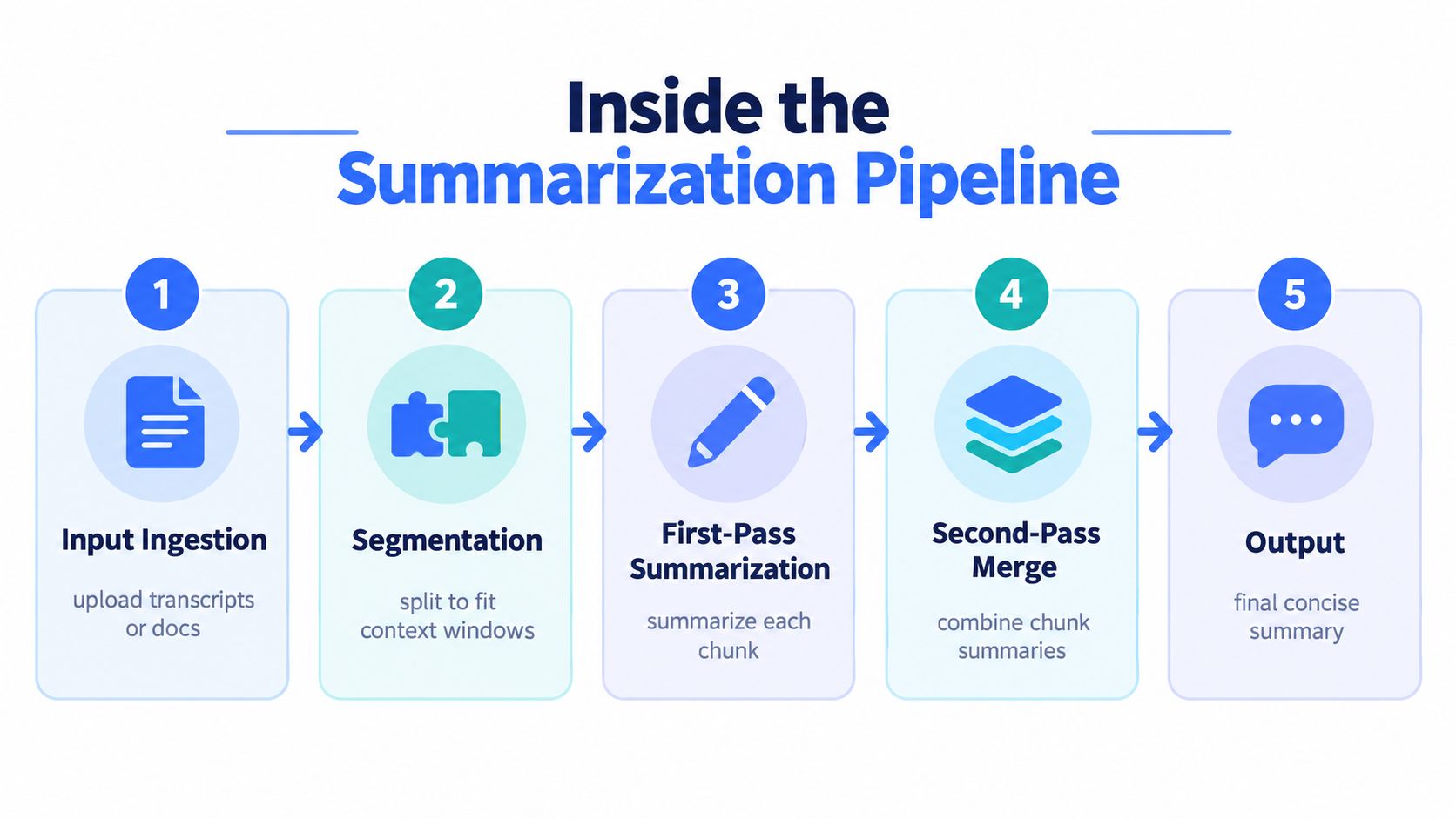
A production system rarely sends an entire long transcript to a model and treats the returned paragraph as finished. A more dependable design resembles a 300-page report process: several junior analysts handle individual chapters, a senior editor merges their notes, and a reviewer checks the final claims against the report.
From raw input to chunk summaries
The first stage ingests the document, audio transcript, captions, or video metadata. For spoken content, preprocessing may include speaker labels, timestamps, punctuation repair, and removal of obvious transcription noise. These transformations affect the summary, so a system should retain the original transcript rather than keeping only the cleaned version.
Next, the system segments the source into units that fit the model's context window. A 90-minute interview, earnings call, or tutorial usually needs multiple segments because the model can't reliably reason over unlimited material in a single pass. Good segmentation respects topic boundaries where possible, rather than cutting blindly through a speaker's explanation.
Each chunk then receives a first-pass summary. The prompt might request key claims, decisions, open questions, or evidence spans instead of polished prose. Structured intermediate notes make it easier to compare chunks and detect when two parts of the source describe the same event differently.
A practical example of how transcript data can support downstream video workflows appears in this video transcript example. The important engineering principle is separation: retain the source, the intermediate output, and the final text as distinct artifacts.
Synthesis, records, and verification
A second-pass model synthesizes the chunk summaries into a coherent result. It needs instructions about duplication, chronology, uncertainty, and the difference between a speaker's statement and a verified fact. Without those constraints, the synthesis stage can amplify an error that appeared in only one intermediate chunk.
The final verification stage checks for duplicated, contradictory, or unsupported claims. It can retrieve source passages for each atomic claim and mark the result as entailed, contradicted, or unsupported. Low-confidence content shouldn't flow directly into a database, RAG index, analytics table, or training set as though it were established fact.
Record the model version, prompt version, source identifier, segmentation choices, timestamps, evidence spans, and verification results. A returned paragraph without this provenance may be convenient for a reader, but it's difficult for a product team to debug, reproduce, or audit.
Where AI Summaries Are Used in Practice
A support team might feed customer-call transcripts into a RAG system so an internal assistant can answer questions about recurring issues. The desired output is a compact, searchable representation of the conversation, but the accepted risk is that a mistaken summary could cause retrieval to surface an inaccurate product detail. For this use case, claim evidence and source passages matter more than elegant prose.
A creator may turn a YouTube interview into a description, chapter outline, captions, or social posts. A marketer might ask for the central argument and several promotional angles. The input includes more than spoken words, especially when demonstrations, captions, slides, edits, or on-screen labels carry important meaning.
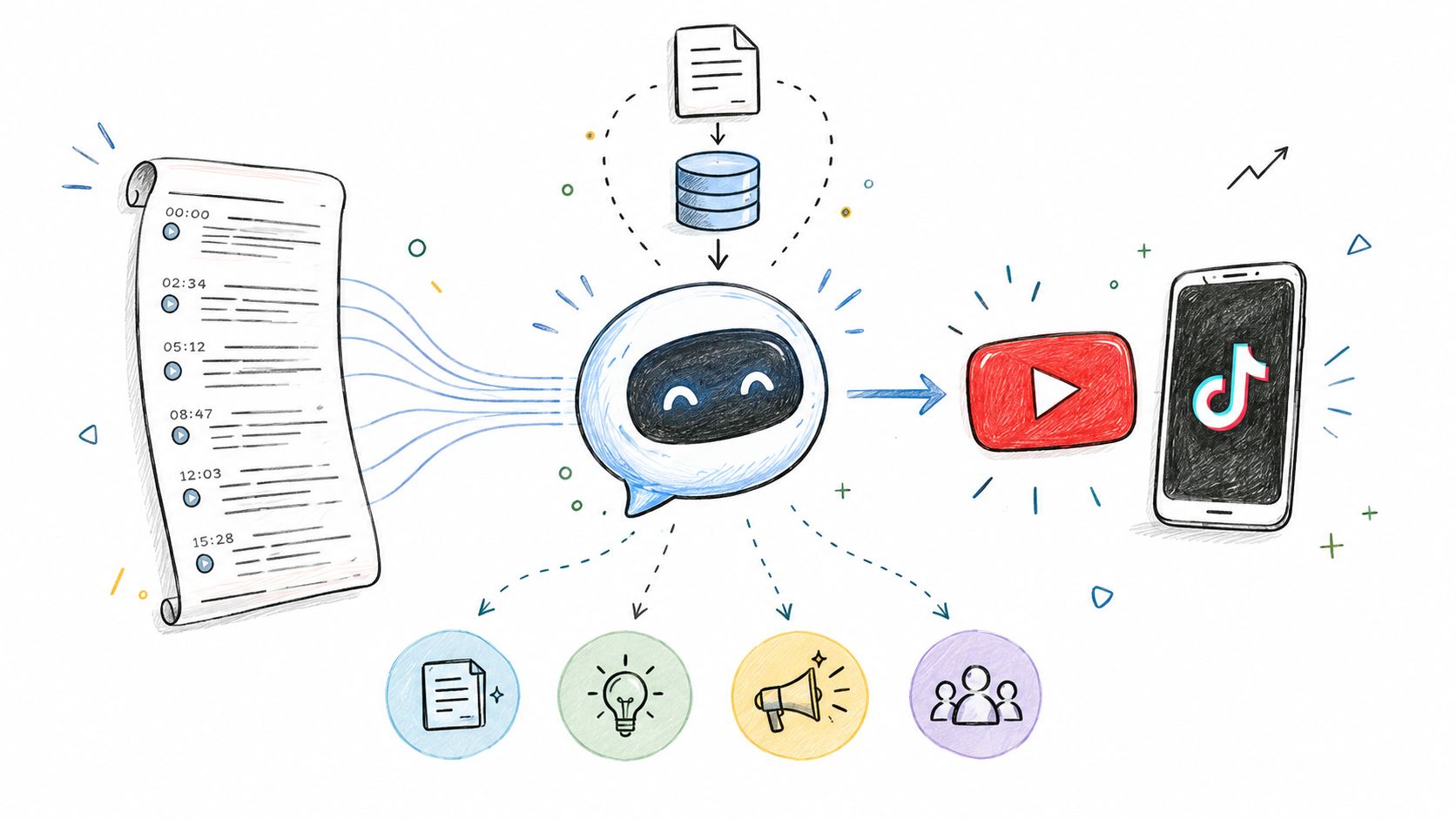
For a social-video pipeline, a transcript-level summary can miss visual evidence, tone, sarcasm, code-switching, comments, and text embedded in the frame. A concise output may still be useful for discovery, but it shouldn't automatically become the final public caption or a factual record. A specialized YouTube video summarizer illustrates the basic flow of transcribing video before generating a summary, while a product team still needs to decide how it will preserve and expose the underlying evidence.
Competitive listening creates a different constraint. An analyst may summarize brand mentions across social platforms to identify themes, complaints, or emerging narratives. The desired output is a trend view across many items, but the risk is that the model may flatten disagreement, mistake sarcasm for praise, or treat repeated claims as verified facts.
Accessibility and OSINT workflows add another layer. A summary can help someone decide which recording, report, or interview deserves closer attention, and it can make dense material easier to follow. For legal, health, financial, safety, or public-interest content, however, users need a path back to the original source rather than a summary presented as ground truth.
Teams designing user-facing AI experiences may also find broader interface patterns in this discussion of AI interfaces for 2026. The interface should make verification visible, not hide it behind a small disclaimer.
How to Measure Whether a Summary Is Actually Good
A summary can use the same words as the source and still misrepresent it. Surface-overlap metrics such as ROUGE and BERTScore compare generated text with a reference summary or source wording, but matching language doesn't prove that every substantive claim is supported. Research on abstractive summarization found substantial hallucinated content even when models achieved strong ROUGE scores, and textual-entailment measures aligned better with human judgments of faithfulness than surface overlap alone. The findings are documented in the ACL research on abstractive summarization faithfulness.
Fluency is not faithfulness
Linguistic quality asks whether a summary is coherent, relevant, readable, and appropriately concise. Faithfulness asks whether its substantive claims follow from the source. These are independent dimensions. A fluent sentence can be unsupported, while an awkward extractive sentence can be faithful to a passage.
Useful evaluation methods include:
- Textual entailment: Test whether the source supports the generated claim.
- Question-answering checks: Ask questions about the source and compare answers derived from the summary.
- Claim-level verification: Break the summary into atomic claims, retrieve supporting spans, and label each claim as entailed, contradicted, or unsupported.
- Human review: Inspect difficult cases, especially where context, chronology, opinion, or ambiguity matters.
Resources such as SummaEval and FRANK were created to test whether automated metrics can detect factual errors in abstractive summaries. More recent work shows why teams should resist reducing quality to one reassuring score. In SummExecEdit, the best reported model achieved a joint score of 0.49 for detecting factual errors and explaining them, with separate detection and explanation scores of 0.67 and 0.73, respectively, as reported in the SummExecEdit benchmark.
Evaluate by content type
A meeting transcript, a news report, a sales call, and a multilingual social video place different demands on the system. Speech quality, slang, speaker overlap, captions, and domain terminology can change the kinds of errors that appear. Stratify evaluation by content type instead of assuming that a strong result on clean documents transfers to every input.
For implementation details, treat data quality assurance as part of the summary feature rather than as a later reporting exercise. Store the claim, confidence, evidence span, timestamp, and unsupported state so reviewers can investigate failures instead of seeing only a final paragraph.
The Memory and Faithfulness Risk Most Articles Skip
The usual convenience story says that a summary saves time. A more difficult question is whether a wrong summary can change what a person remembers, even after that person watched the original content.
Recent experimental evidence examined 328 U.S. adults who watched traffic-accident videos and later read either accurate or misleading summaries. Among participants who read misleading summaries, 44.8% correctly recalled a key traffic-sign detail, compared with 83.6% of those who read accurate summaries, according to the reported memory study. The effect persisted when participants were told the summary was AI-generated, and it didn't depend significantly on their prior trust in or use of AI.
That result changes the product question. A summary isn't merely a compressed copy waiting in a sidebar. It becomes a new artifact that may guide later recall, especially when the original source is long, inconvenient, or no longer available.

Safeguards that should travel with the text
- Source spans: Show the passage supporting each major claim.
- Timestamps: For video and audio, let users open the relevant moment.
- Confidence labels: Distinguish strongly supported content from uncertain interpretation.
- Unsupported states: Allow the system to say that it couldn't verify a sentence.
- Context markers: Separate what a speaker said, what the source supports, and what the model inferred.
This is especially important when a summary feeds a RAG system. Teams learning what retrieval augmented generation is should treat summarized text as an indexed representation with provenance, not as a replacement for source documents. A retrieved sentence without its evidence can spread a small summarization error into many downstream answers.
The governance implication is practical rather than abstract. A review of responsible AI governance should specify which content requires human approval, which claims need citations, and when the system must block automatic publication. Users need verification habits because a warning label alone doesn't prevent a confident summary from becoming their remembered version of an event.
Evaluating and Trusting AI Summaries Going Forward
Use a compact checklist whenever you produce, buy, or read a summary:
- Separate brevity from faithfulness. A short output isn't necessarily an accurate one.
- Attach evidence to major claims. Use a source link, passage, or timestamp.
- Record model and prompt versions. Reproducibility matters when outputs change.
- Evaluate by input type. Test interviews, news, calls, podcasts, and multilingual video separately.
- Keep an unsupported state. Don't force uncertain text into a factual database.
- Review high-impact content. Verify claims involving safety, law, health, finance, or public understanding.
A RAG system also needs more than a summary field. The RAG pipeline guide is useful context for thinking about how retrieval, source documents, and generated answers connect, but the durable design principle is simple: keep the source close to the interpretation.
The next default for AI summaries should be provenance, timestamps, confidence labels, and claim-level evidence. Those fields turn a convenient paragraph into an inspectable product component.
Captapi provides APIs that extract social-media transcripts and generate summaries for supported content, which can help teams build video search, RAG, monitoring, or repurposing workflows with source data available for downstream checks. Visit Captapi to explore the API and decide whether its transcript and summary endpoints fit your pipeline.