
10 Best Dataset Social Media Sources for Researchers
The most popular advice about a dataset social media project is often the least useful: collect as much as possible from as many platforms as possible. Volume doesn't fix access bias, missing metadata, unclear reuse rights, or a collection method that can't be reproduced. The right source depends on the research question and on what the source provides.
A trend study may need dated historical snapshots. Network analysis may be better served by Stanford SNAP's graph collections, while a live monitoring system may require an official research program or an operated collection tool. Decide first whether you need historical data, real-time events, full text, engagement metadata, network structure, or an operational feed. Then check eligibility, license, freshness, deletion policies, and whether the data can be retained or shared. For a practical starting point, browse the social media API.
These sources aren't interchangeable. Some provide governed research access, some publish reusable datasets or identifiers, and others provide infrastructure or collection services. That distinction matters: a ready-to-query archive can still be incomplete, while a live feed can be reproducible only if your team records its collection and transformation steps.
Table of Contents
- 1. Meta Content Library via SOMAR Virtual Data Enclave
- 2. TikTok Research API and Virtual Compute Environment
- 3. Bluesky and AT Protocol Firehose via Jetstream
- 4. Reddit for Researchers Program
- 5. GWU TweetSets
- 6. Bright Data Social Media Datasets Marketplace
- 7. Apify Store
- 8. Stanford SNAP Social Media Network Collections
- 9. Exorde Multi-Source Social Media Datasets
- 10. Global YouTube Trending Dataset and YouTube Data API
- Top 10 Social Media Dataset Resources Compared
- Choose for Provenance, Not Just Volume
1. Meta Content Library via SOMAR Virtual Data Enclave
For researchers who need public Facebook, Instagram, or Threads content in a controlled environment, Meta Content Library through SOMAR is a governed research-access route, not a public download. The service is hosted through ICPSR's Social Media Archive, with researcher onboarding, documentation, and training provided through SOMAR. Applicants need to submit a project for review, so the timeline and eligibility requirements belong in the project plan, not in a last-minute data request.
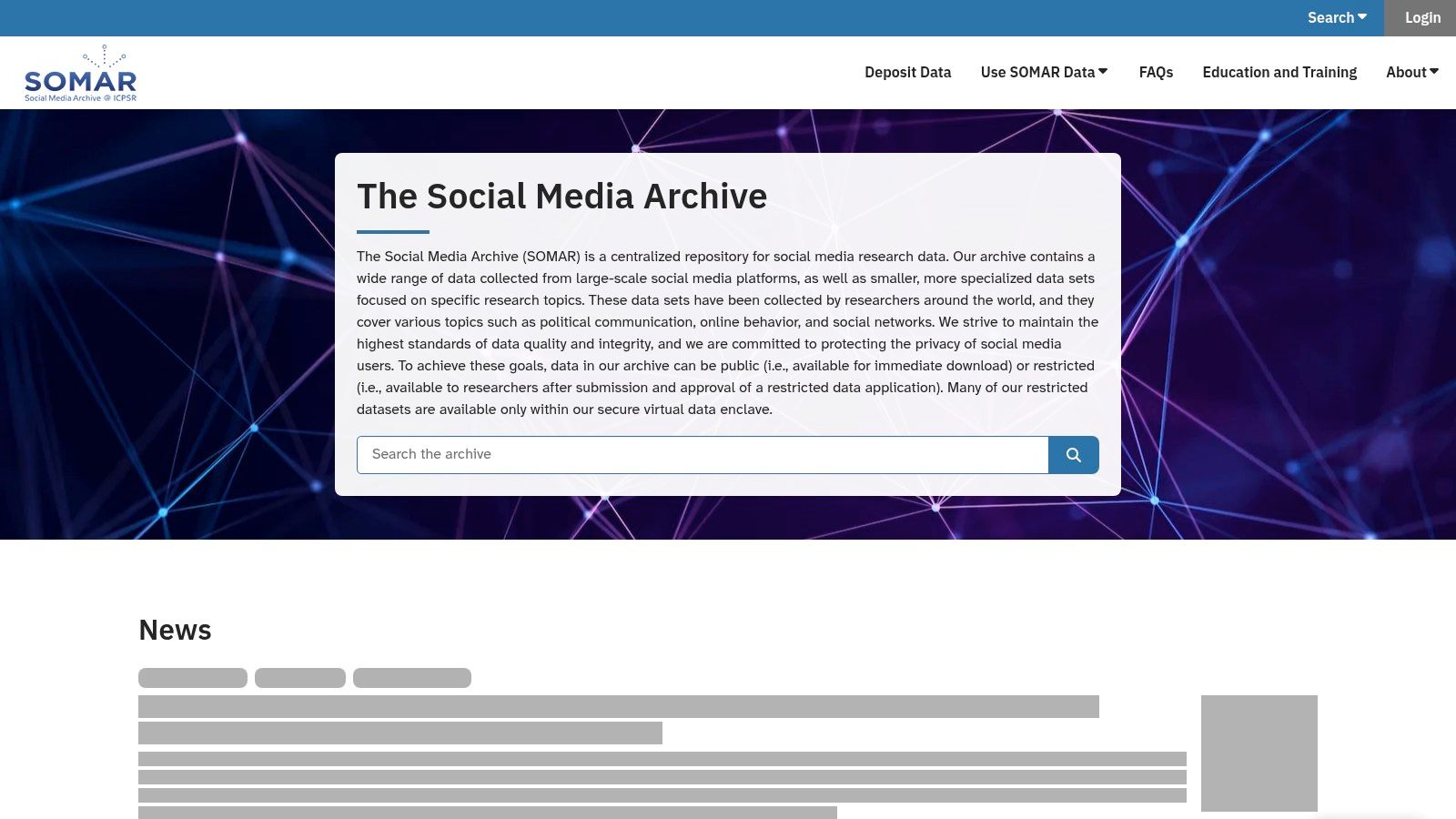
The main advantage is the combination of first-party research access and a Secure Virtual Data Enclave with auditing. That setup can suit compliance-sensitive projects that need to analyze public content at scale without moving the underlying data into an ordinary local workspace. But enclave controls can constrain code execution and data export, and fees may apply, including team and project-start fees. Confirm the project's budget and analytical requirements before assuming the environment supports a planned workflow.
Best for governed academic analysis
SOMAR is a poor fit for teams that need unrestricted exports or immediate collection. It's more compelling when institutional oversight, an established environment, and supported onboarding matter more than operational flexibility. Review the SOMAR program and Meta Content Library access information before shaping a protocol around the source.
2. TikTok Research API and Virtual Compute Environment
TikTok's Research API is a first-party access program for eligible researchers studying public videos and accounts. It offers REST endpoints, token-based authentication, documentation, and usage quotas, with a secure Virtual Compute Environment for querying and analysis. That makes it structurally different from a scraper: access depends on application approval and eligible research use, and the API's public-content scope defines what the resulting dataset can represent.
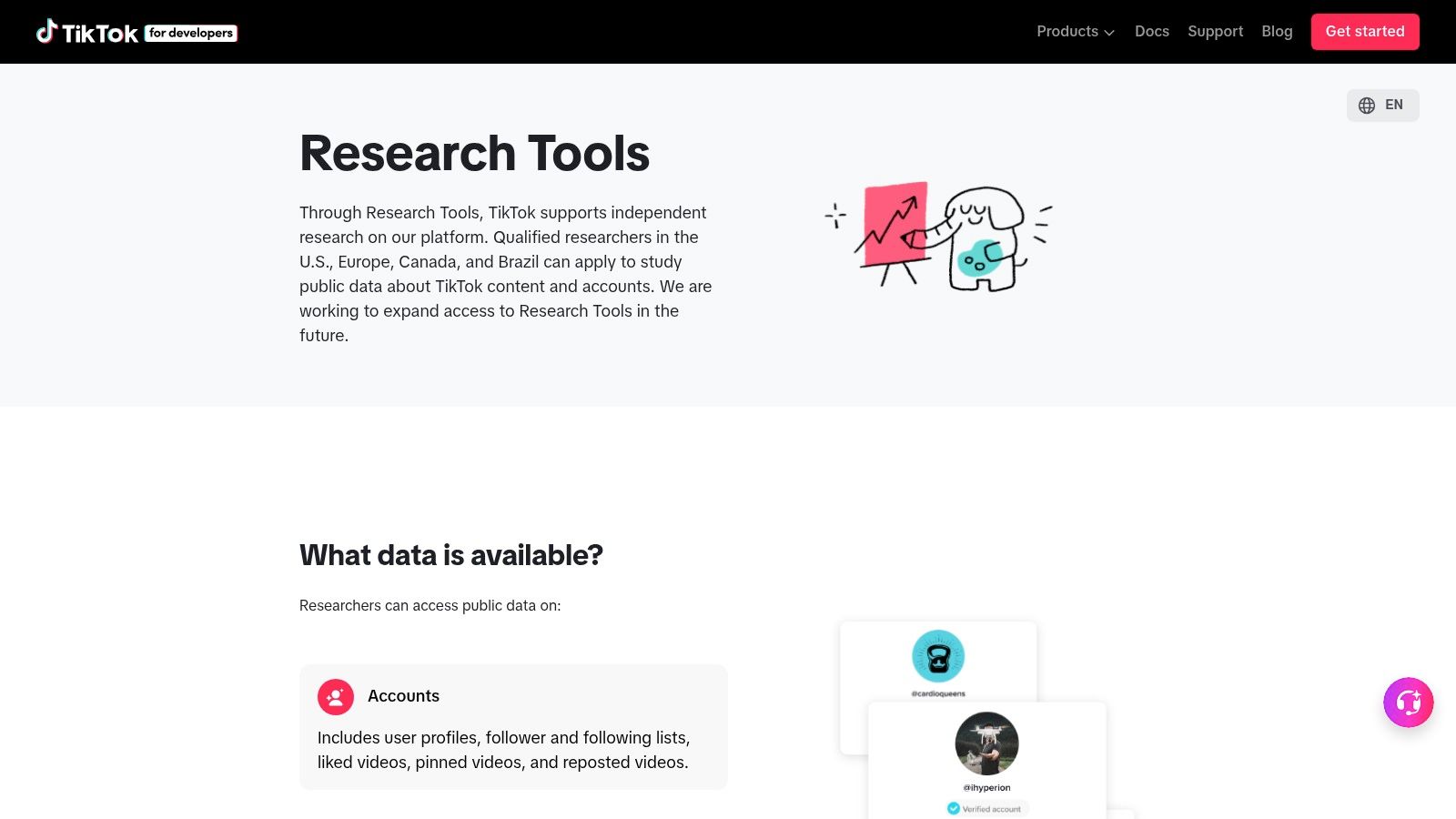
The stable, documented interface is valuable for repeatable collection, but quotas may limit the depth or pace of a study. Approval times can vary, so the API isn't a dependable shortcut for a project with an immediate launch date. Approved academic researchers have no listed per-request fee, but that doesn't eliminate the operational cost of designing queries, validating coverage, and analyzing what the program makes available.
Practical rule: Treat eligibility and access approval as research dependencies. Don't build a study around fields or collection schedules until you've verified them in the program's documentation.
Teams evaluating TikTok's access workflow can also consult this guide to the TikTok Research API. The primary reference is TikTok's Research API documentation.
3. Bluesky and AT Protocol Firehose via Jetstream
Bluesky's AT Protocol offers public event streams that researchers and developers can collect into their own corpora. Jetstream and the firehose support real-time monitoring and longitudinal collection, while snapshotting and public HTTP read APIs can help with retrieval. The openness is useful, but a public stream isn't a finished research dataset: the team still has to build ingestion, storage, deduplication, and backfill processes.
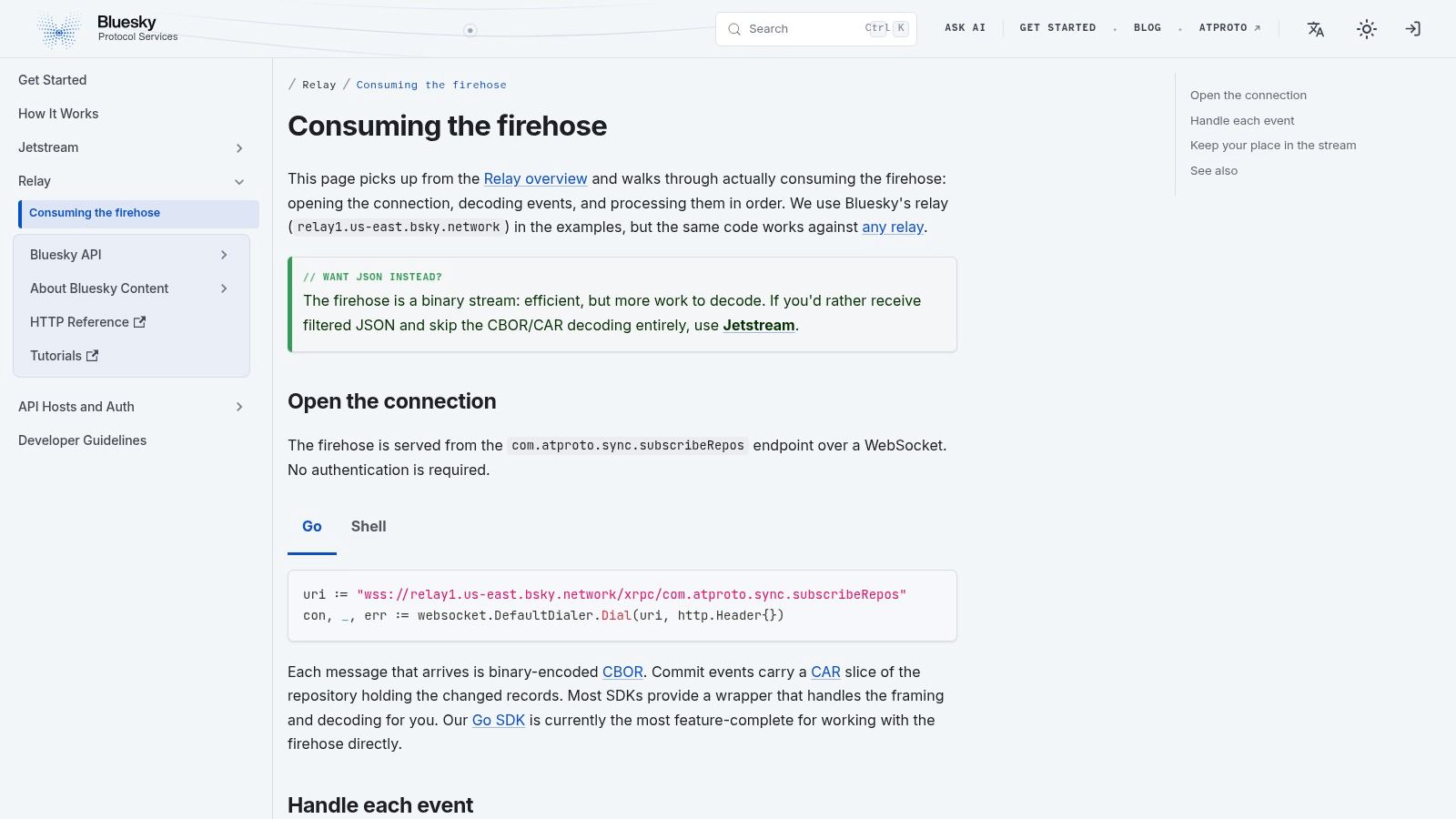
Public endpoints and open-source tooling reduce the barrier to experimentation. They don't remove the need to monitor stream continuity or preserve enough metadata to interpret events later. Teams unfamiliar with CBOR or CAR formats may also face an implementation learning curve, so a prototype should test the complete path from event capture through queryable storage.
Strong for teams that can operate the pipeline
Jetstream makes sense when the project needs ongoing public-event collection and can support its own infrastructure. It's less suitable for a researcher seeking a curated, historical corpus ready for analysis. Compare the Bluesky API collection overview with the AT Protocol firehose documentation before selecting an ingestion approach.
4. Reddit for Researchers Program
Reddit for Researchers provides eligible researchers with SQL access to curated public posts and comments through Google BigQuery Analytics Hub. Its governed access and query-based workflow can suit projects that need structured analysis without running a collection system themselves. The program requires an application, and the available content and schema remain subject to Reddit's policies and exclusions.
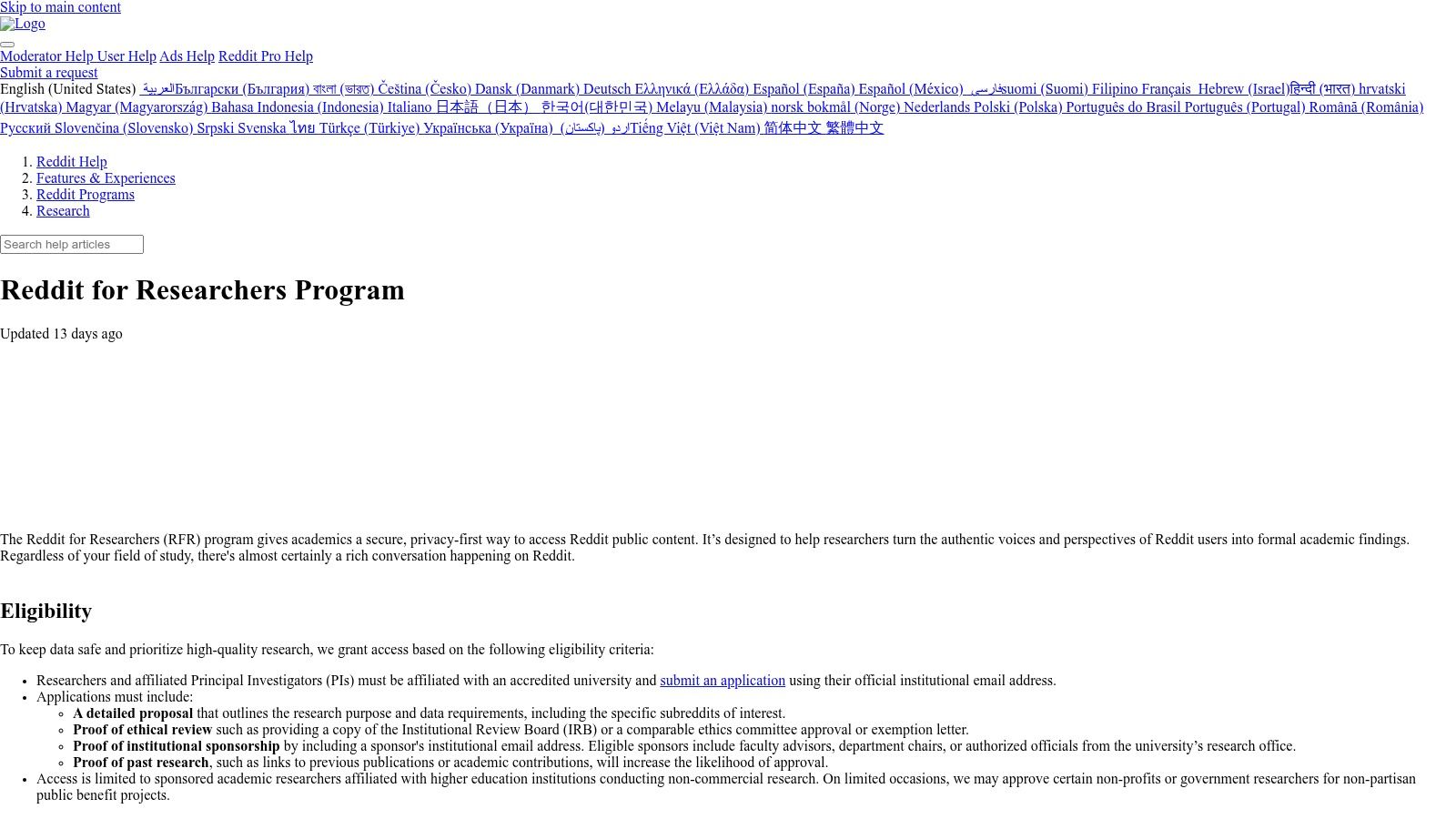
The SQL interface is a practical advantage for analysts already using BigQuery, but the service isn't a general-purpose commercial scraping channel. Google Cloud usage may be billed to the researcher's project, so a governed dataset can still carry infrastructure costs. Researchers should also verify the fields and exclusions relevant to their question instead of assuming that public posts and comments are complete or uniformly represented.
A governed alternative to ad hoc collection
This program is useful when academic eligibility, policy compliance, and queryable tables align with the project. It's a weaker fit when the team needs unrestricted reuse, custom collection logic, or a fast path that bypasses application review. Read the Reddit for Researchers program requirements and this Reddit API guide for researchers before committing to a BigQuery workflow.
5. GWU TweetSets
GWU TweetSets is an academic resource for exploring curated collections of tweet IDs tied to topics and events. Researchers can search collections by keywords or hashtags, export IDs for compliant rehydration, and use available mention-network nodes and edges. Many collections include academic provenance and Dataverse references, making the resource particularly useful as a documented starting point for Twitter/X research.
The important operational distinction is that TweetSets distributes identifiers, not a ready-to-use corpus of full tweet text. Researchers need their own approved X API access to rehydrate IDs, and some posts may no longer be available when collection occurs. Consequently, an exported ID list is a seed or sampling frame, not a guarantee that every original record can be recovered.
A reproducible study should preserve the collection's provenance and record rehydration outcomes. An ID archive alone doesn't tell future readers which records remained accessible.
TweetSets can help researchers find historical event collections without building an initial query set from scratch. Coverage depends on the collections available, so assess whether the archive matches the research question before treating it as representative. Explore the GWU TweetSets research collections.
6. Bright Data Social Media Datasets Marketplace
Bright Data's marketplace offers prebuilt or refreshable social datasets, with options for custom builds and scheduled delivery. Its listed platform coverage includes Instagram, Facebook, TikTok, LinkedIn, Reddit, X/Twitter, Pinterest, Quora, and Bluesky. For teams that need data without building their own scrapers, a managed commercial service can reduce collection engineering and support recurring workflows.
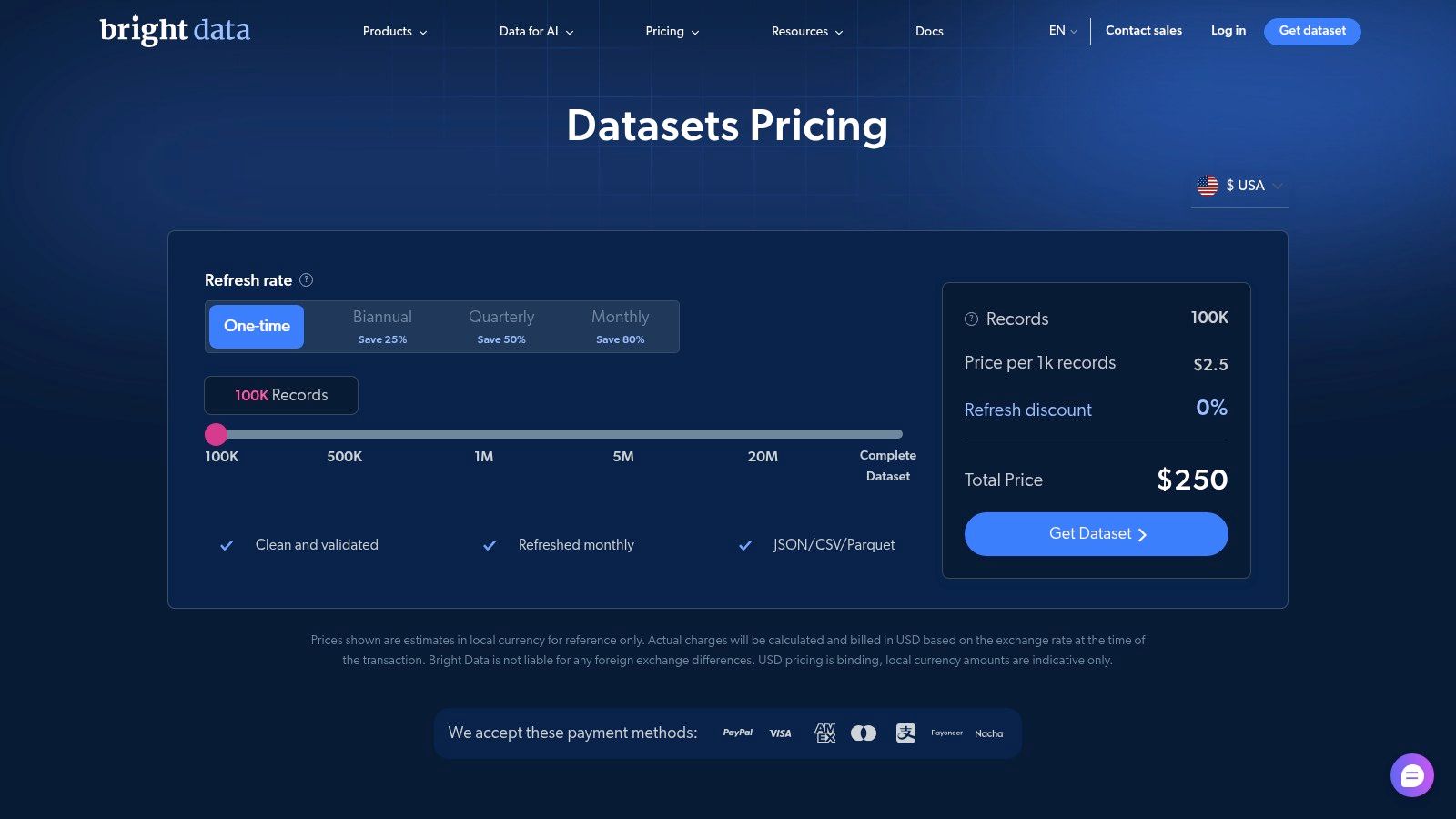
Marketplace coverage isn't a substitute for validating the actual dataset. Freshness, fields, and collection feasibility can vary by platform and policy, while pay-per-record costs can rise as a project scales. Request and inspect a sample before purchase, paying attention to timestamps, identifiers, missing fields, duplicate records, and how the service documents provenance.
Commercial convenience still needs governance
A commercial feed can be operationally convenient, but the buyer remains responsible for deciding whether its collection and license support the intended research or product use. Clarify permitted retention, redistribution, refresh expectations, and service commitments in writing. Review the Bright Data datasets marketplace and pricing information against your required schema before treating a catalog entry as a research-ready source.
7. Apify Store
Apify is a developer platform where users run social media scrapers, called Actors, to collect and export data. Actors support no-code runs as well as API automation across platforms such as Instagram, TikTok, YouTube, and Facebook Pages. Exports can feed into data pipelines in formats including JSON, CSV, Excel, XML, and JSONL, with integrations for tools such as Sheets, Make, Zapier, and n8n.
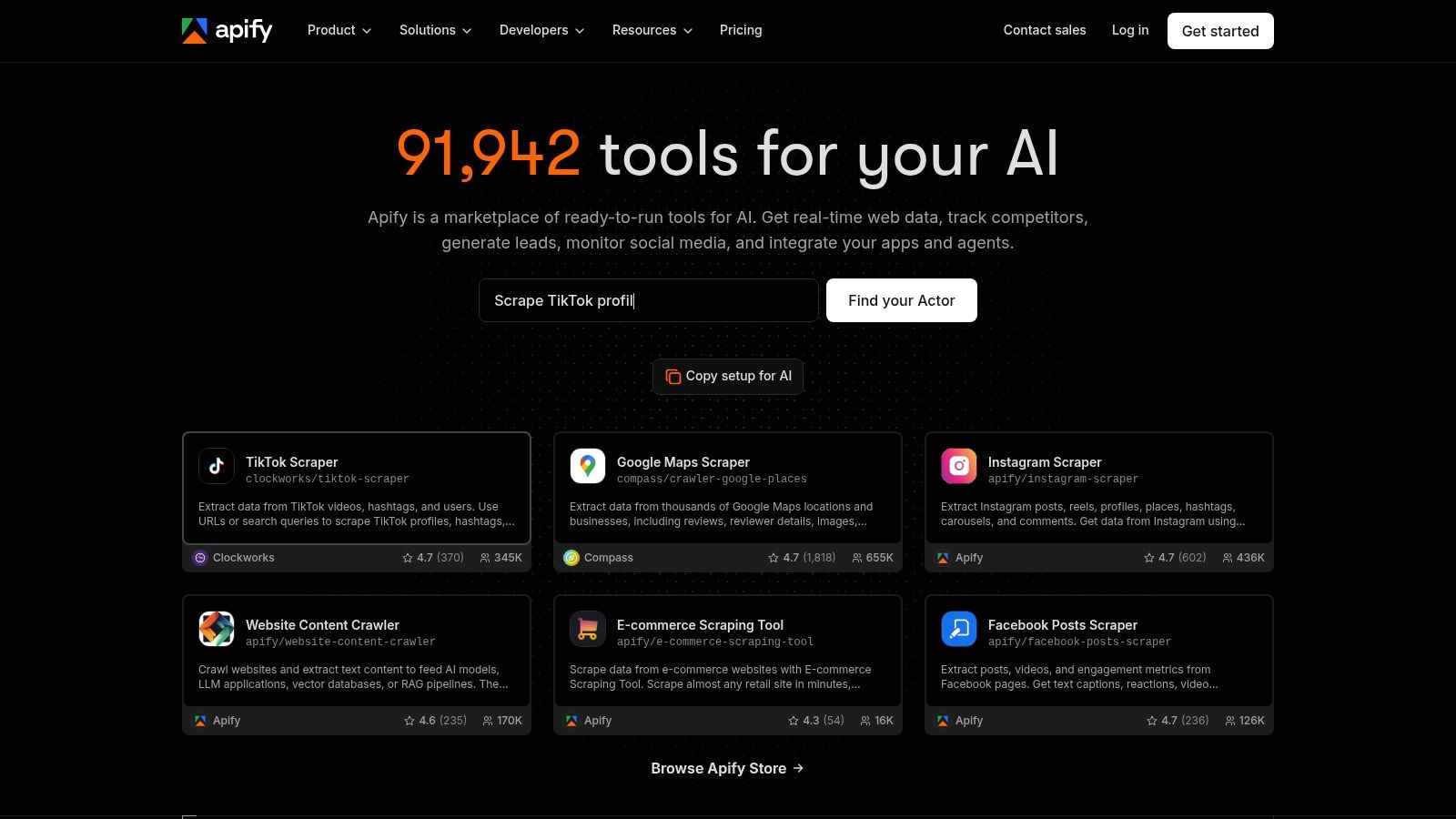
This is a collection tool, not a curated archive or official research-access program. The user chooses an Actor and query, runs the collection, and owns the resulting operational decisions, including compliance checks and cost monitoring. Actor pricing and result volume vary, so test a limited run before automating a broad or recurring collection.
Flexible collection, with responsibility attached
Apify can be useful when a team needs a dataset quickly and has the engineering capacity to validate the collector. But an Actor's availability doesn't by itself establish that a particular collection is permitted, complete, or stable. Check the Actor's documentation, output schema, and current platform constraints, then monitor changes rather than assuming a working run will remain unchanged. Browse the Apify Store and developer platform to assess the available collection options.
8. Stanford SNAP Social Media Network Collections
Stanford SNAP is a free academic repository of social and online-community network datasets. Its collections include Twitter circles and ego networks, Twitch data, and Reddit hyperlink and interaction networks. The repository is especially useful for graph mining, community detection, influence modeling, and reproducible method comparisons, rather than live monitoring or broad text analysis.
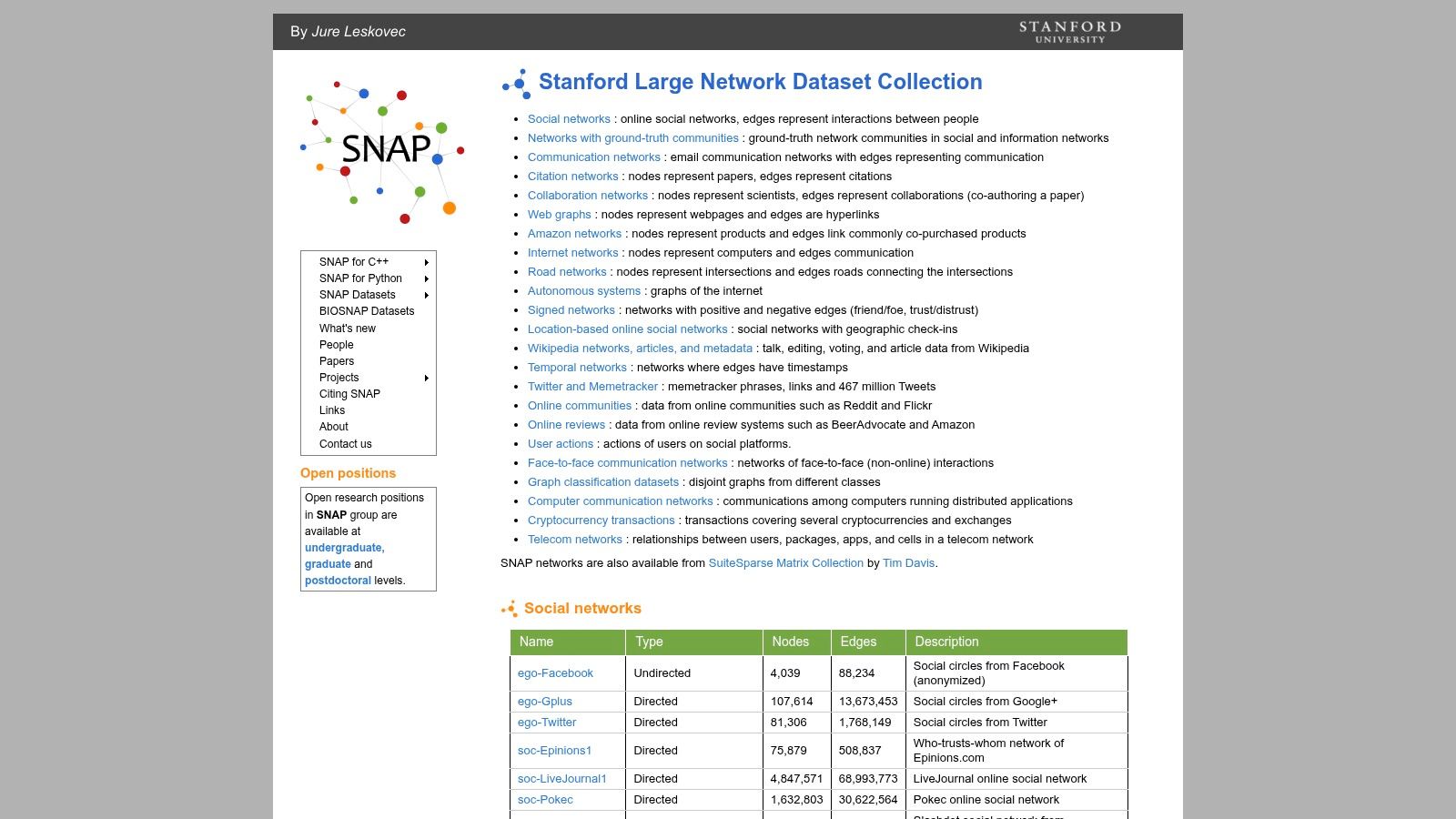
SNAP's strength is also its boundary: many datasets emphasize network structure rather than post text, and some are anonymized or limited to structural fields. Historical snapshots can support reproducible experiments, but they shouldn't be mistaken for current platform behavior. Researchers comparing graph methods can use the documented collections as consistent inputs; researchers studying contemporary discourse may need a separate source for content and timestamps.
Research fit: Choose SNAP when the unit of analysis is the relationship or graph. Choose a text-bearing source when the question depends on what users said.
For context on methods that use these kinds of data, see this guide to social media data mining. Browse the Stanford SNAP dataset repository and consider social data aggregation options when combining sources.
9. Exorde Multi-Source Social Media Datasets
Exorde takes a different approach than the platform-specific programs above: it publishes periodic multilingual samples of public posts from several platforms at once through Hugging Face Datasets. Releases can cover X/Twitter, Reddit, Bluesky, YouTube, Mastodon, Lemmy, and forums, with timestamps and metadata fields. For cross-platform NLP experiments, trend detection prototypes, or OSINT work that needs a corpus rather than a managed feed, that breadth is the point.
The catch is variability. Each release is a sample rather than an archive, and coverage, language mix, and schema can shift between releases. A multi-platform label does not make records comparable across platforms. Before training a model or comparing platforms, inspect the specific release for field consistency, missing metadata, and changes in collection method, then pin the release identifier in your pipeline so later analysis can separate source drift from real changes in online activity.
Useful for prototyping, not a coverage guarantee
Licensing deserves the same scrutiny as schema. Check the license and platform terms attached to the exact release before redistributing records or feeding them into a commercial workflow, and document every transformation applied downstream. Find the Exorde dataset releases on Hugging Face and verify the release you intend to use rather than assuming continuity between snapshots. Community threads such as this r/data discussion of the release can add context on how practitioners have applied the data, though they are no substitute for the dataset card itself.
Research fit: Choose Exorde when one corpus spanning several platforms matters more than depth on any single one. Choose a platform-specific program when coverage and schema stability are the constraint.
10. Global YouTube Trending Dataset and YouTube Data API
Historical YouTube Trending datasets can support cross-national and longitudinal analysis, while the official YouTube Data API provides a route to ongoing collection of video, comment, channel, and search data. The historical snapshots are useful for studying the records they contain; the API can support a separate, current collection pipeline. Combining them requires care because a curated historical dataset and a live API feed don't necessarily share the same sampling method or schema.
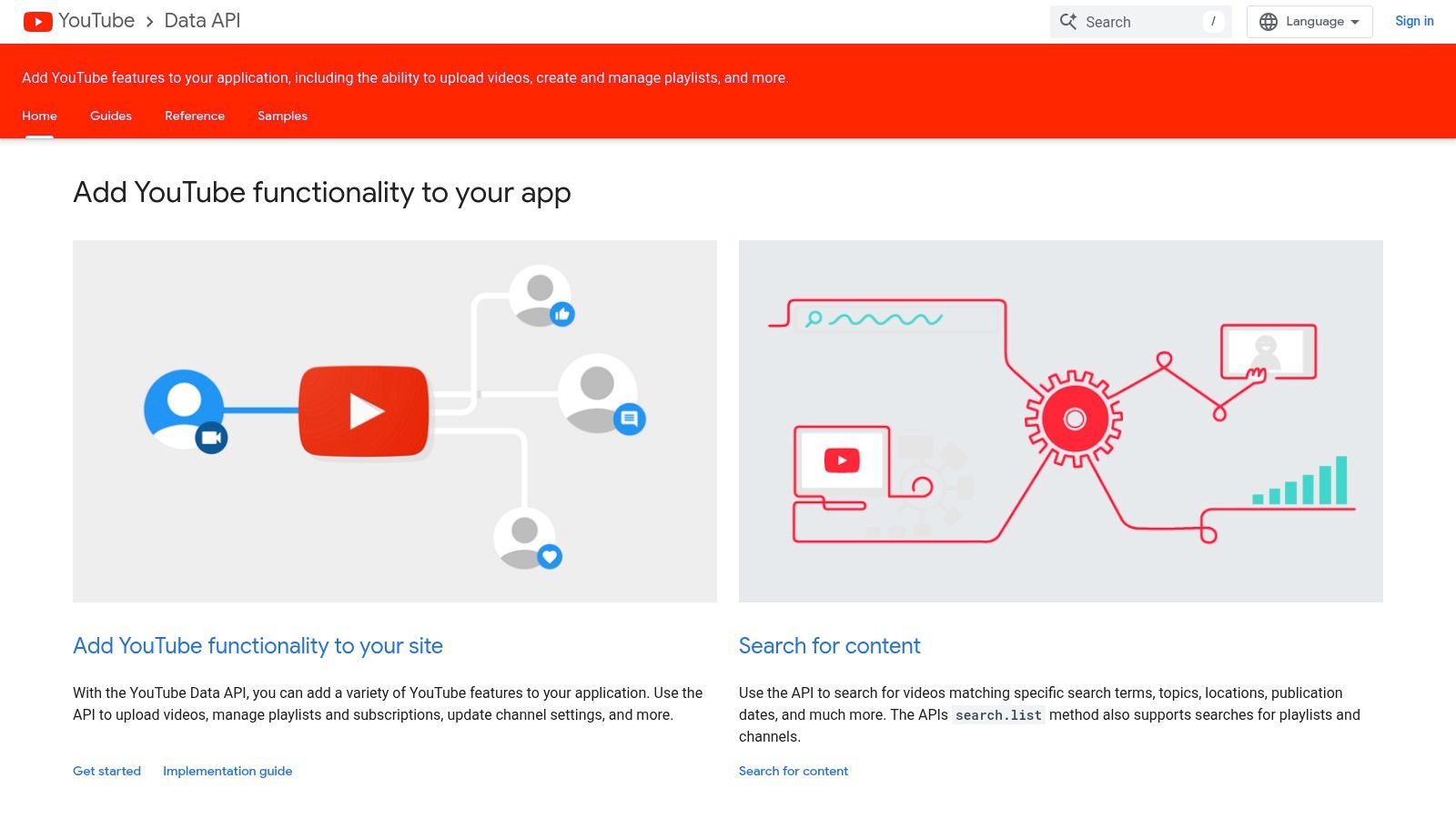
YouTube retired its public Trending page in July 2025, which limits later curated snapshots. The Data API has quotas, and transcripts depend on whether captions are available for a video. Teams should separate fields collected directly through the API from fields in a third-party historical corpus, then record the source and collection date for each record.
For projects combining video metadata with transcripts, comments, and search results, the key question is whether the available fields match the analysis and whether the collection can be sustained within quota. Review the YouTube Data API documentation and this YouTube Data API collection guide.
Top 10 Social Media Dataset Resources Compared
No two entries on this list solve the same problem. They span governed institutional programs, an open streaming protocol, historical archives, commercial marketplaces, and collection platforms, so comparing them by record count alone misleads. The useful comparison is access model: who can get in, what the schema looks like, how fresh the records are, and what licensing and infrastructure costs sit underneath.
| Tool | Coverage & Core Features | Experience & Distinctive Value | Best For | Pricing / Access |
|---|---|---|---|---|
| Meta Content Library (SOMAR VDE) | Public Facebook, Instagram, and Threads content; searchable research API | ★ Governed first-party access; audited research enclave | 👥 Approved academics and nonprofits | 💰 Approval required; enclave fees may apply |
| TikTok Research API & VCE | Public TikTok video and account data; secure analysis environment | ★ Official API with documented schema and quotas | 👥 Eligible researchers | 💰 No listed per-request fee for approved academic use |
| Bluesky / AT Protocol Firehose | Public real-time events, snapshots, and read APIs | ✨ Open protocol and streaming; users manage collection infrastructure | 👥 Developers and researchers building datasets | 💰 Free public endpoints; infrastructure costs are yours |
| Reddit for Researchers | Curated public posts and comments via BigQuery SQL | ★ Governed, SQL-native access with roughly five-year lookback | 👥 Eligible academic researchers | 💰 Application required; Google Cloud charges may apply |
| GWU TweetSets | Curated tweet IDs, search, and mention-network data | ✨ Academic seed collections; full content requires rehydration | 👥 Researchers studying Twitter/X | 💰 Free; requires approved X API access to rehydrate |
| Bright Data Social Media Datasets | Multi-platform ready-made or customized datasets | 🏆 Broad coverage, refresh options, and commercial support | 👥 Businesses and data teams | 💰 Commercial pricing; verify costs, coverage, and freshness |
| Apify Store | Social media Actors, exports, and API automation | ✨ Flexible no-code and developer workflows; user manages compliance and costs | 👥 Developers and teams needing custom collection | 💰 Varies by Actor and volume |
| Stanford SNAP Collections | Curated historical social and online-community network datasets | ★ Well-documented graph data for reproducible analysis | 👥 Researchers, educators, and graph analysts | 💰 Free; primarily historical snapshots |
| Exorde Multi-Source Datasets | Periodic multilingual samples across social platforms and forums | ✨ Hugging Face access for cross-platform NLP experiments | 👥 NLP, trend-analysis, and OSINT prototypers | 💰 Free samples; check release coverage and terms |
| YouTube Trending Datasets & Data API | Historical trending snapshots plus current video, comment, channel, and search data | ★ Combines longitudinal data with official API collection | 👥 YouTube researchers and analytics teams | 💰 Free datasets; API quotas apply and extra usage may incur billing |
Read the Best For column before the coverage column. Eligibility gates rule out the governed programs for many teams, while the open and commercial options trade that gatekeeping for operational burden: running a firehose, managing Actor costs, or auditing a purchased corpus for coverage gaps. The Exorde row deserves a caveat of its own. Its samples circulate through Hugging Face, so verify release dates and licensing terms on the dataset page itself rather than relying on secondary community posts.
Choose for Provenance, Not Just Volume
A defensible dataset social media workflow begins with a documented question, then chooses a source whose access model matches the work. Governed institutional programs such as Meta Content Library, TikTok Research API, and Reddit for Researchers may suit eligible academic projects that need policy-controlled access. Open protocols such as Bluesky's firehose give teams more control over collection, but they must operate the pipeline. Historical collections such as GWU TweetSets and Stanford SNAP support specific forms of reproducible analysis, while commercial marketplaces and scraping platforms offer flexible collection with different costs and compliance obligations.
Don't compare these resources by record count alone. A larger corpus can still give a distorted picture if platform access omits content or metadata in non-random ways. One analysis found that researchers could access only about 75% of posts shown in TikTok's For You feed and 50% of posts shown in Instagram's Explore feed, while receiving only 17% of the metadata transmitted to users on TikTok and 42% on Instagram (analysis of recommendation-feed data access). That gap makes coverage reporting part of the method, not a footnote. Stratify checks by platform, language, account size, content type, recommendation surface, and time where possible, and distinguish records collected from the population you hoped to study.
Freshness also depends on the research question. In a 2025 Sprout Social survey of consumers who follow at least five brands, 27% said a trend is effective for only 24–48 hours; 81% reported that social media drives impulse purchases, and 73% said they would buy from a competitor if a brand failed to respond on social (Sprout Social's consumer research). Those findings help explain why a commercial listening system may require frequent refreshes, while a historical network analysis may not. Match refresh cadence to the phenomenon, and preserve event time and collection time separately.
Before publishing or deploying results, record the collection date, query or sampling method, available fields, missing data, platform terms, license, retention limits, and every transformation or deduplication step. Keep provenance attached to the data, and document whether identifiers can be rehydrated or whether deleted content changes what later researchers can reproduce. For projects involving sensitive content or vulnerable users, assess privacy and research-ethics obligations rather than assuming that public visibility settles the question.
Captapi is one option for developers seeking structured public data from YouTube, TikTok, Instagram, and Facebook through a REST API. Its outputs can include profiles, posts, comments, transcripts, search results, and engagement metrics; customers remain responsible for how they handle and use collected data.
Captapi provides a unified REST API for collecting structured public social media data, including comments, transcripts, search results, and engagement metrics, for analysis and pipeline integration. If that fits your research or product workflow, explore Captapi and assess its available fields and access conditions against your requirements.