
Social Media Data Mining for ML Pipelines
You've got a promising social listening prototype. The first API calls work, the JSON looks structured, and a language model can summarize a handful of posts. Then production arrives: each platform needs a different authentication flow, rate limits interrupt collection, deleted posts leave gaps, comments use slang your classifier hasn't seen, and a public dataset raises questions nobody documented.
That's the practical reality of social media data mining. The hard part isn't sending a request. It's building a dependable system that collects changing, platform-specific data, preserves enough context for machine learning, and handles privacy obligations before the output reaches a dashboard, vector database, or customer.
Table of Contents
- The Reality of Modern Social Media Data Mining
- Building the Extraction and NLP Pipeline
- Navigating Privacy and Compliance Risks
- Moving Beyond Text to Video and Visual Analytics
- Evaluating Custom Scrapers Versus Unified APIs
- Executing a RAG Pipeline Integration Workflow
- Scaling Your Social Data Infrastructure
The Reality of Modern Social Media Data Mining
Social media data mining is often reduced to search, extraction, and analysis. That description misses the engineering burden. You're working with fragmented platforms, inconsistent identifiers, changing permissions, incomplete search results, rate limits, deleted content, and user-generated language that rarely resembles clean training data.
The field became formal in the early 2010s, when researchers defined social media mining as the representation, analysis, and extraction of actionable patterns from social data. Its foundations combine computer science, machine learning, social network analysis, sociology, statistics, and mathematics, because social content is large, linked, noisy, and unstructured in ways traditional data sources usually aren't. The field's academic consolidation is described in the Cambridge overview of social media mining.
The infrastructure problem grew alongside the platforms. Social networking sites appeared in the 1990s, including GeoCities and SixDegrees, then expanded into a global stream of text, images, and video. Today, the commonly cited estimate of about 2.5 quintillion bytes of data created globally each day illustrates why manual review and one-off scripts cannot support industrial-scale analysis, as outlined by EBSCO's background on social media mining.
Practical rule: Treat collection as a product dependency, not a setup task.
A production system needs a source registry, retry behavior, observability, schema versioning, and a clear policy for missing or stale records. It also needs to distinguish an empty result from a failed request. Those states look similar in a dashboard but lead to very different decisions.
Why ad-hoc scraping fails
A custom scraper can be useful for exploration, but it couples your pipeline to page structure and access conditions you don't control. A silent markup change may return valid-looking responses with missing fields. A permission change can reduce coverage without producing an obvious error. A platform's search endpoint may prioritize relevance rather than completeness, which makes a result set unsuitable for historical or exhaustive analysis.
The right abstraction is a durable ingestion layer. Store raw responses immutably, normalize platform-specific fields into a common schema, retain provenance, and make downstream jobs tolerant of partial coverage. Social media data mining becomes useful when the pipeline can explain what it collected, what it missed, and why.
For teams still clarifying terminology, this practical explanation of social media data helps separate the source material from the processing system built around it.
Building the Extraction and NLP Pipeline
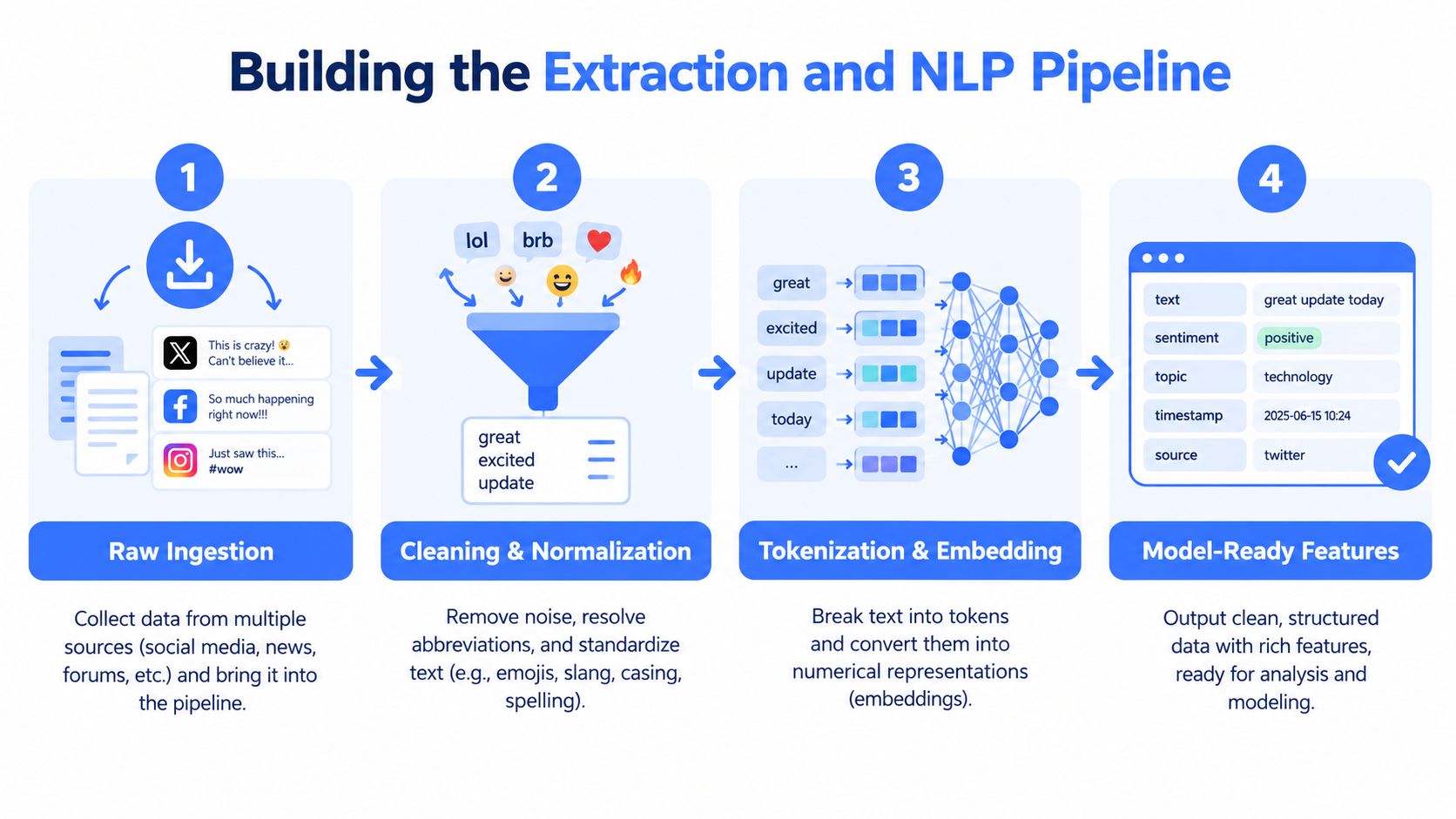
Raw posts aren't model-ready documents. They contain abbreviations, hashtags, emojis, URLs, mentions, duplicated text, language switching, platform-specific conventions, and context spread across replies or media attachments. A reliable NLP pipeline makes those irregularities explicit instead of hiding them behind a single model call.
Start with raw ingestion
Capture the original payload before transforming it. Keep the platform name, source identifier, collection timestamp, URL when permitted, author metadata needed for the use case, engagement fields, parent-child relationships, and media references. A normalized record might include text, language, created_at, platform, content_id, author_id_hash, parent_id, and media_type, but the exact schema should reflect your retention and privacy decisions.
Separate ingestion from enrichment. The collector should remain useful even when transcription, language detection, embeddings, or classification services are unavailable. Queue enrichment jobs, make them idempotent, and record model versions with every output.
Normalize before you classify
Cleaning isn't cosmetic. It determines whether equivalent messages become comparable features. Normalize Unicode, resolve or preserve emojis according to the task, standardize whitespace, expand selected abbreviations, identify URLs, and decide how hashtags should be represented. Don't automatically remove punctuation or repeated characters, because those signals can carry sentiment, emphasis, or intent.
Create platform-aware preprocessing rules rather than forcing every source through one tokenizer. A short-form post, a video transcript, and a comment thread have different boundaries and context windows. Keep both the original text and the cleaned representation so analysts can inspect classification errors.
Traditional models still earn a place here. A 2024 review of social media mining methods identifies SVM, Naive Bayes, and Decision Trees among the widely applied classifiers. They're fast, interpretable, and practical for triage, baseline evaluation, and feature-engineering-heavy workflows.
Use domain adaptation where it matters
Start with a baseline before introducing a larger model. Establish precision, recall, F1, confusion matrices, and performance by language or platform. Then test whether a domain-specific transformer improves the errors that matter to your application.
The 2023 SMM4H shared tasks offer a useful benchmark example. One benchmark classifier achieved an F1-score of 0.938, and 5 of 7 participating teams used classifiers based on COVID-Twitter-BERT, according to the shared-task paper. The practical lesson isn't that every project needs that model. It's that pretraining on platform-native language can help when informal wording and specialized vocabulary dominate the task.
A production workflow should therefore look like this:
- Ingest and preserve: Store raw payloads, provenance, and collection status.
- Clean selectively: Normalize text without destroying task-relevant signals.
- Label deliberately: Document annotation rules, ambiguity, and weak-label sources.
- Benchmark rigorously: Compare a simple baseline with a domain-adapted model on representative data.
- Monitor drift: Track changes in vocabulary, platform mix, label distribution, and error types.
For a broader operating model, see this guide to social media content analysis. It's useful to distinguish descriptive metrics from NLP outputs that require validation.
Navigating Privacy and Compliance Risks
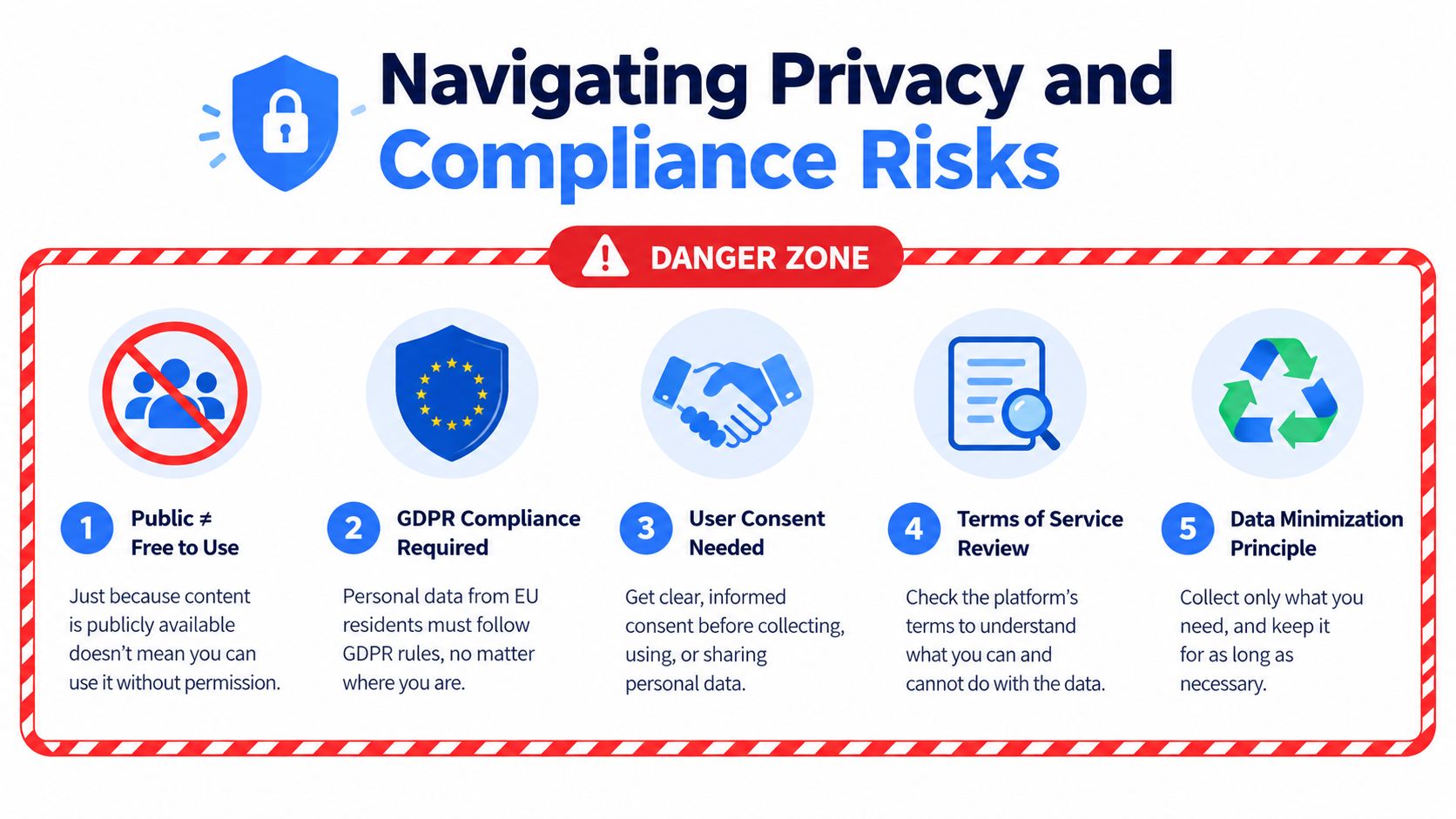
Public visibility doesn't grant unlimited permission. A post can be visible to anyone and still carry platform restrictions, contextual expectations, personal information, or obligations that affect collection, storage, analysis, and publication.
The most dangerous implementation pattern is collecting first and asking compliance questions later. That approach creates a dataset whose provenance may be unclear, whose retention may be excessive, and whose outputs may expose individuals even after the original text has been transformed.
Build controls into the pipeline
Recent research identified 11 privacy risks across collection, processing, storage, and publication. The same review found that only 35% of reviewed papers mentioned anonymization, availability, or storage practices, as reported in this privacy framework for social media research. Those findings point to a documentation gap that commercial teams can avoid.
Use a data-use register before collection. It should state the purpose, permitted sources, fields collected, retention period, access roles, deletion process, and publication rules. If you can't explain why a field is necessary, don't ingest it.
A practical control set includes:
- Minimize collection: Keep only fields needed for the defined task.
- Pseudonymize identifiers: Hash or tokenize identifiers where individual identity isn't required.
- Protect raw payloads: Restrict access and separate raw data from derived features.
- Record provenance: Store the endpoint, collection time, transformation version, and policy decision.
- Plan deletion: Support removal requests and source-driven deletion workflows where applicable.
- Review outputs: Check summaries, embeddings, exports, and alerts for re-identification risk.
Don't confuse anonymization with safety
Removing a username doesn't necessarily make a record anonymous. Text can contain names, locations, employers, health details, or distinctive phrases. Embeddings can also preserve semantic information that deserves access controls, especially when a vector store feeds an internal assistant.
Teams should apply the same discipline to RAG systems as to the source database. Define who can retrieve content, filter sensitive fields before embedding, log retrieval events, and prevent a model from returning raw personal data only because it was present in the context window.
This overview of social media compliance provides a useful starting point for reviewing platform terms and internal handling procedures. Legal review still matters, particularly when the project involves sensitive categories, monitoring individuals, or publishing findings.
Moving Beyond Text to Video and Visual Analytics
Text-first mining creates a convenient illusion of coverage. Posts are easy to tokenize, classify, and index, so teams often build around them even when the audience and competitive signals have moved into video and visual formats.
A recent review describes social media data as biased toward English and Twitter-centric sources, with noisy annotation and weak cross-platform generalizability across demographic groups. That limitation can hide behavior specific to YouTube, TikTok, Instagram, and Facebook, as discussed in this review of social media data mining limitations.
Model the media object, not only the caption
A video record should contain more than a title and description. Depending on the use case, collect the transcript, timestamps, comments, author or channel details, engagement fields, language, detected entities, and a concise summary. For visual analysis, add scene-level descriptions, on-screen text, detected products, and moderation-relevant signals only when the purpose justifies them.
Transcripts create searchable text, but they don't replace the video. A transcript may miss visual demonstrations, text overlays, gestures, product placement, or music-driven context. Store timestamp references so retrieval can point an analyst or model to the relevant segment rather than returning an undifferentiated block of text.
Keep platform behavior in the evaluation set
Cross-platform comparisons require more than mapping fields with similar names. A view, like, comment, share, or follower metric may have different meanings and visibility rules depending on the source. A content format that performs well on one platform may depend on recommendation mechanics that don't exist elsewhere.
Use stratified evaluation data across platforms, languages, media types, and creator categories. Compare classifier errors and retrieval quality by source instead of reporting one blended score. If your training corpus is dominated by one platform, describe the model as platform-specific until testing demonstrates broader transfer.
For practical video workflows, this guide to video content analysis covers the data layer needed for transcripts, summaries, and engagement context. The engineering principle is simple: multimodal inputs need multimodal provenance.
Evaluating Custom Scrapers Versus Unified APIs
Custom scrapers offer control, but that control includes every operational burden. Your team owns browser automation, proxy behavior, authentication, parsing, retries, monitoring, breakage response, and the question of whether a successful request returned complete data.
A unified API changes the boundary. You still need to validate coverage, follow applicable platform terms, and manage your own storage and compliance, but the collection layer presents a consistent interface to the application.
Compare the operating model
| Feature | Custom Scraper Fleet | Unified API, e.g. Captapi |
|---|---|---|
| Platform integration | Separate code paths and maintenance | One REST interface across supported platforms |
| Authentication | OAuth flows, session handling, or browser state | API-key integration without juggling multiple SDKs |
| Breakage response | Your team detects and repairs parser failures | Provider maintains extraction and retry behavior |
| Data shape | Platform-specific payloads unless you normalize them | Consistent endpoint patterns with structured responses |
| Scaling | You manage workers, proxies, queues, and concurrency | Service-level limits and usage plans define capacity |
| Caching | Build and operate your own cache | Shared cache can reduce repeated collection work |
| Cost profile | Engineering time plus infrastructure and operational incidents | Credit-based usage plus integration and governance work |
| Control | Maximum control over collection logic | Less control over extraction internals |
The table hides an important distinction. A scraper may appear cheaper when the workload is small and stable. Once multiple platforms, media types, and refresh schedules enter the system, maintenance becomes a recurring engineering responsibility rather than a one-time build.
Choose based on failure ownership
Custom extraction makes sense when you need unusual collection logic, have permission to operate it, and can support the maintenance burden. It also gives you direct control over request scheduling and raw capture. The trade-off is that every platform change becomes your incident.
A unified service is useful when the application needs consistent access to public content across sources. Captapi, for example, exposes 34 REST endpoints for data such as transcripts, comments, summaries, engagement metrics, search results, and profile details, with built-in retries and a shared cache described as 24 hours in the publisher brief. Those product details should be validated against current documentation before implementation.
Architecture decision: Buy the unstable integration surface when your differentiator is the analysis, retrieval, or product experience built on top of the data.
Don't treat a unified API as a compliance shortcut. You remain responsible for selecting appropriate data, limiting retention, protecting outputs, and checking that the service fits your use case. Before committing, test representative URLs, missing-content behavior, pagination, freshness, error responses, and schema stability.
Executing a RAG Pipeline Integration Workflow
A useful RAG pipeline starts with a narrow retrieval question, not a giant social archive. Suppose the task is to answer questions about a set of public videos and ground every answer in transcript segments and viewer comments. The first design decision is to preserve enough metadata for retrieval to return source, timestamp, content type, and collection context with every chunk.
Extract and normalize the source
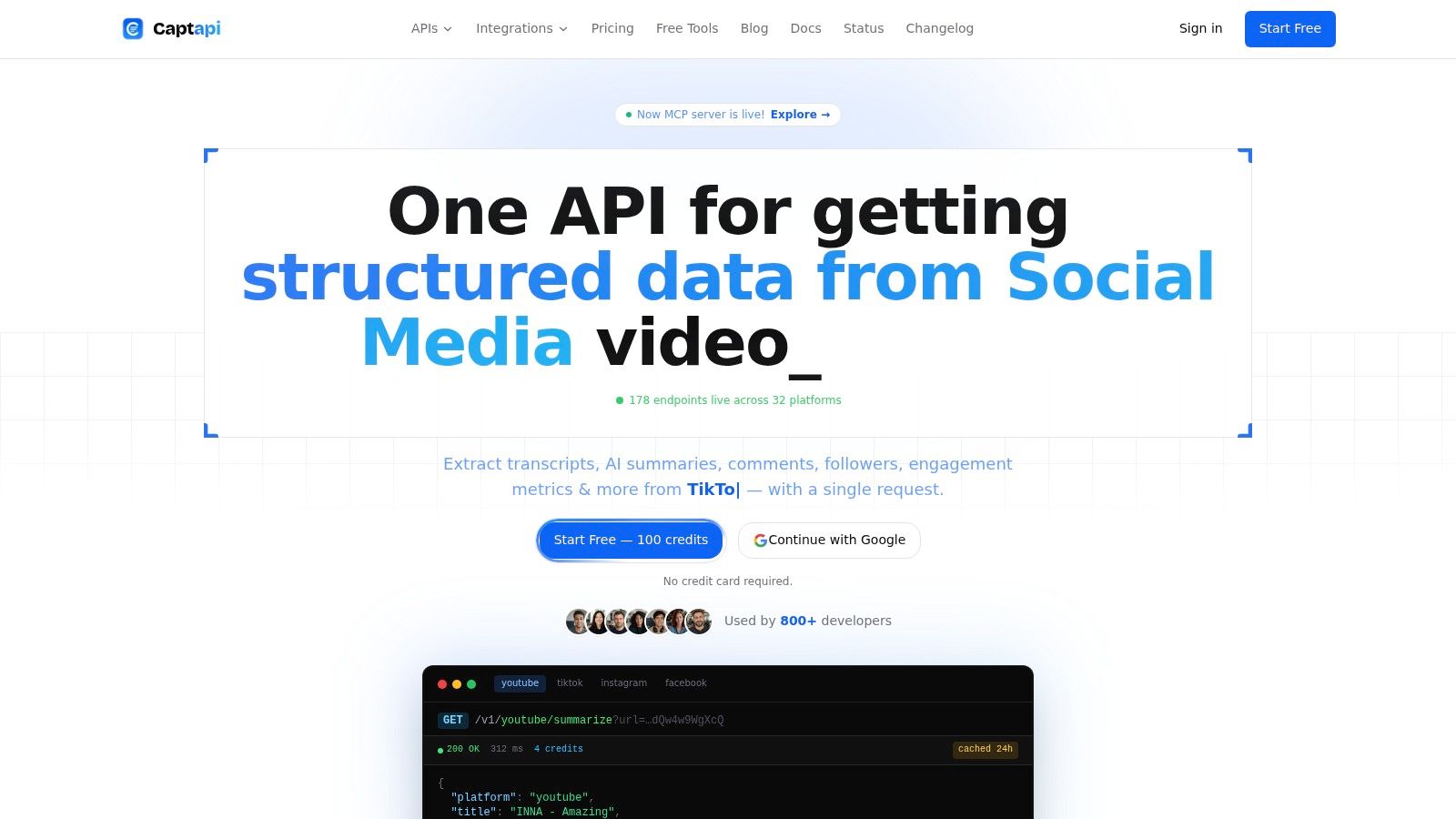
Create an API key, select the endpoint for the content type, and submit a public video or channel reference. A summary endpoint such as /v1/youtube/summarize can return a structured summary, while transcript and comment endpoints provide the text needed for evidence retrieval. Keep the source URL and platform identifier in your internal record even when the API returns a normalized response.
Transform each response into a canonical document:
- Identity: Platform, content ID, source URL, title, author or channel.
- Content: Transcript text, summary, comment text, and media type.
- Position: Timestamp or segment boundaries for transcript chunks.
- Context: Parent comment, language, collection time, and available engagement fields.
- Provenance: Endpoint, response version, processing status, and model version for generated text.
Chunk transcripts around semantic boundaries rather than cutting at arbitrary character limits. Preserve timestamp start and end values, then attach them to the embedding metadata. Comments usually need separate chunks, because mixing a comment with a transcript paragraph can make retrieval return a plausible but misleading answer.
This guide to RAG pipelines explains the broader retrieval pattern. The social-specific requirement is provenance. A generated summary can improve discovery, but the answer should cite the underlying transcript or comment whenever the user needs verification.
Index, retrieve, and evaluate
Generate embeddings for transcript chunks, summaries, and comments using a consistent model. Store searchable metadata alongside vectors so you can filter by platform, channel, date, language, or content ID before similarity search. Use hybrid retrieval when exact terms matter, because names, product codes, and hashtags can be poorly represented by semantic similarity alone.
The generation prompt should require citations to retrieved chunk IDs and timestamps. Reject answers when retrieval returns weak or conflicting evidence, and expose the source segments to reviewers. Evaluate retrieval separately from generation, because a fluent answer can hide a poor candidate set.
A typical flow is:
- Submit source references to the extraction API.
- Validate response status and required fields.
- Normalize transcript and comment objects.
- Split content into timestamped chunks.
- Generate embeddings and write metadata to the vector store.
- Retrieve candidates using metadata filters and semantic search.
- Ask the language model to answer only from retrieved evidence.
- Log the question, candidates, answer, and citations for review.
After the data transformation step, show the workflow to the team before adding more sources.
Scaling Your Social Data Infrastructure
Scaling social media data mining means controlling repetition, uncertainty, and operational cost. A pipeline that works for a small experiment can become wasteful when it repeatedly requests unchanged videos, re-embeds identical comments, or sends every raw post to an expensive model.
Start with an ingestion ledger. For each source, record the last successful collection, response checksum, schema version, enrichment state, and deletion or failure status. Use content hashes to avoid duplicate processing, and separate refresh policies for relatively stable metadata, fast-moving comments, and generated summaries.
Use capacity deliberately
The publisher describes Captapi as offering rate limits up to 600 RPS, credit-based pricing, a free tier of 100 lifetime credits, and plans for different workload sizes. These are product claims from the provided brief, not universal performance guarantees, so confirm current limits and pricing before sizing a production system.
A scalable architecture should include:
- Queue isolation: Keep collection, transcription, embedding, and generation in separate worker pools.
- Backpressure: Slow enrichment when the vector store or model provider is saturated.
- Cache discipline: Cache stable responses and invalidate content when freshness requirements change.
- Budget controls: Assign credit and model budgets by project, endpoint, and customer.
- Observability: Track latency, error classes, empty responses, field completeness, and source coverage.
- Recovery paths: Make every job retryable without duplicating records or embeddings.
Production check: A successful request isn't proof of a complete dataset. Monitor field presence and source coverage, not just HTTP status.
Before moving beyond a prototype, audit the pipeline for source permissions, personal data, retention, deletion handling, provenance, model evaluation, and retrieval access controls. Then test the system with missing transcripts, deleted content, multilingual comments, duplicate URLs, malformed responses, and partial platform coverage.
The sustainable design keeps the unstable collection layer replaceable. Your normalized schema, feature store, evaluation suite, and RAG contracts should continue working if an endpoint changes or a source becomes unavailable. That separation lets the team improve models and product behavior without rewriting every connector.
Captapi provides a unified REST API for public social data across YouTube, TikTok, Instagram, and Facebook, including transcripts, comments, summaries, search results, and engagement fields. If you're building an ML, social listening, or RAG workflow, visit Captapi to review the current endpoints and start testing an integration.