
10 Web Scraping API Tools Compared for 2026
The popular advice is to pick the web scraping API with the biggest proxy pool or the simplest GET request. That approach fails because these tools don't solve the same problem. A social-data API, a structured extraction service, a browser-rendering endpoint, and a scraping platform with queues can all return data from a URL, but they differ sharply in output shape, target coverage, rendering, unblocking, throughput, billing units, and operational ownership.
This comparison evaluates each service by the developer job it helps complete. The list starts with a specialized option for unified social data, then moves through schema-led extraction, browser-heavy access, batch orchestration, and anti-bot workflows. Use the descriptions to narrow the architecture first, then validate representative URLs, usable responses, effective costs, and failure handling before committing to a vendor.
Table of Contents
- 1. Captapi
- 2. Zyte API
- 3. Oxylabs Web Scraper API
- 4. Bright Data Web Scraper API
- 5. ScraperAPI
- 6. Apify Platform and API
- 7. ScrapingBee
- 8. Crawlbase Crawling API
- 9. ZenRows
- 10. Decodo Web Scraping API and Site Unblocker
- Top 10 Web Scraping APIs Comparison
- Match the API to Your Data Pipeline
1. Captapi
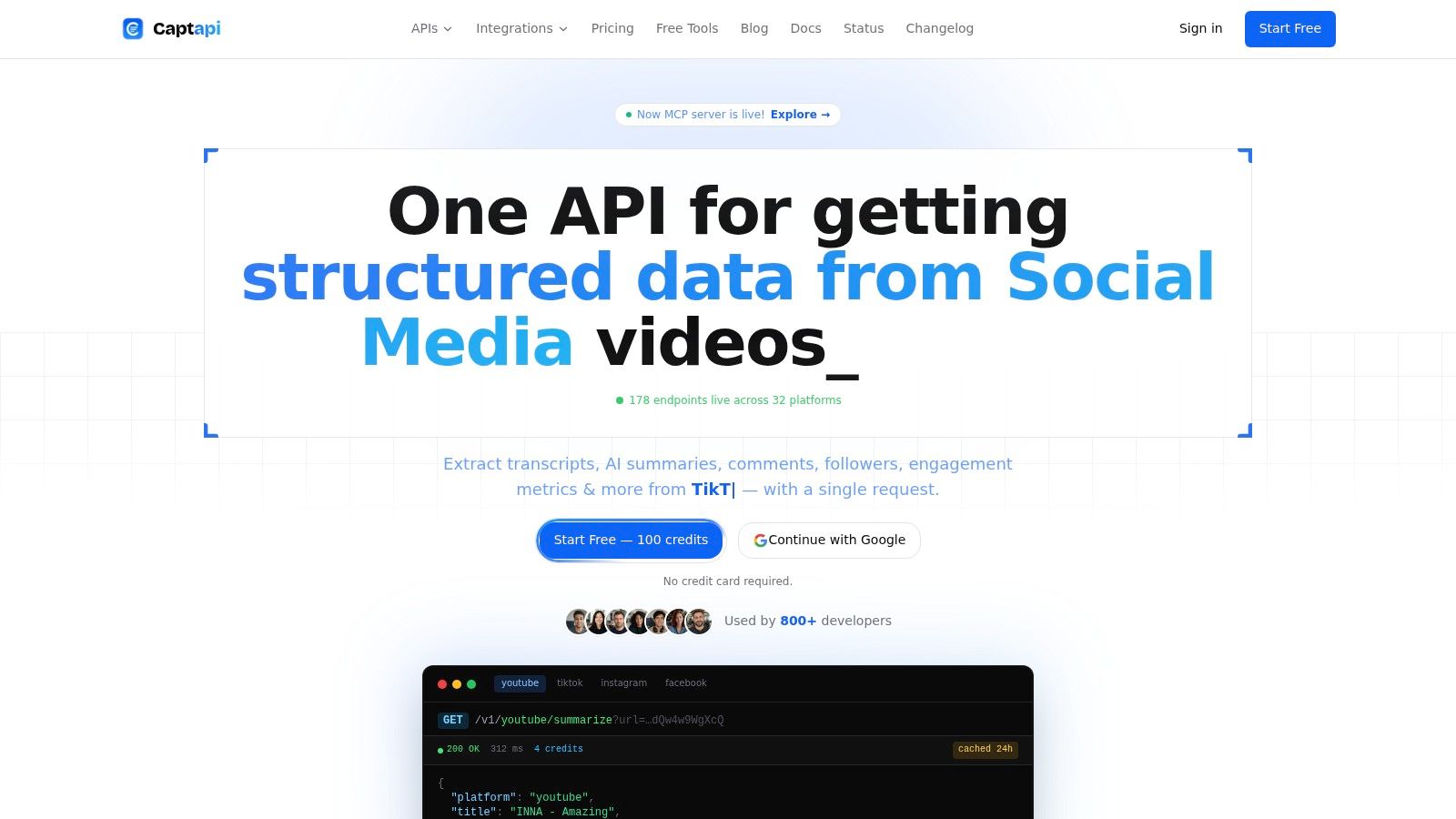
Captapi is purpose-built for unified public social-media data rather than generic HTML collection. Its developer-first REST API presents one interface for transcripts, comments, engagement metrics, channel and page details, search results, ad-library data, and GPT-4o-mini summaries from public content on YouTube, TikTok, Instagram, Facebook, X, Reddit, and LinkedIn. The practical advantage is a normalized response model. Applications can process cross-platform metrics without maintaining separate OAuth flows, SDKs, parsers, and exception lists for each network.
The API exposes 34 endpoints across the major social platforms, covering videos, posts, comments, commerce, and other public data surfaces, according to Captapi's product site. That scope suits RAG pipelines, video question answering, social listening, competitor monitoring, caption generation, timestamp creation, and bulk comment research. It is a focused social-data layer, not a general-purpose page extraction service.
Where the implementation is simpler
Captapi uses Apify-backed scrapers with automatic retries and offers an optional shared cache. Repeated requests can therefore return stored results without another live extraction, although teams should still test freshness and failure behavior for production workloads. Integration starts with an API key and endpoints such as /v1/youtube/summarize, avoiding platform-specific authentication and SDK work. An MCP server, n8n node, Make app, and Apify actor provide additional integration paths.
Pricing is credit-based. The free tier includes 100 lifetime credits. Listed paid plans include Starter at $9 per month for 2,000 credits, Pro at $27 per month for 6,000 credits, and Business at $90 per month for 20,000 credits. The Business plan advertises limits up to 600 RPS and priority support details on the product site. Model expected endpoint usage and response complexity before committing to bulk workloads.
Practical rule: Choose Captapi when the unit of work is a social record, transcript, comment set, or normalized metric. Choose a general web scraping API when the unit of work is an arbitrary page.
The trade-off is clear. Captapi focuses on public, read-only data and does not replace an official platform API for private or authenticated content. Credits are consumed by endpoint usage and response complexity, so bulk exports need a usage model before production launch. Customers remain responsible for appropriate downstream data handling and lawful use.
2. Zyte API
Zyte API suits teams that want one request surface for unblocking, rendering, and structured extraction. Instead of forcing developers to decide in advance whether a target needs plain HTTP, browser rendering, or a different proxy class, the service selects an appropriate stack for the target. That reduces branching in application code, particularly when a product collects data from sites with different technical profiles.
Its extraction layer is the main reason to consider it over a raw proxy or HTML endpoint. Zyte provides maintained schemas for common categories such as products, articles, lists, and jobs, while its custom-attributes feature converts less predictable pages into typed JSON. Developers can request geo-targeting and session management when regional content or continuity matters. Details are documented on the Zyte API website.
Best fit for schema-led extraction
Zyte bills by 1,000 requests, with costs varying by target and processing mode. The pricing model is more deliberate than a single flat request price because plain HTTP, browser rendering, and site-specific complexity can have different economics. Zyte provides a target-specific pricing calculator, so teams should model the exact domains and response modes they expect to use.
The advantage is reduced parser ownership. A product catalog, job board, or article-monitoring pipeline can request a structured record instead of receiving HTML and maintaining selectors internally. That doesn't remove validation work. Pages change, fields can be absent, and extraction results still need type checks and quality monitoring.
Zyte is a good choice when the business requirement is already expressed as a stable entity schema. It is less attractive when a project needs maximum browser control, unusual multi-step interactions, or a simple predictable credit balance across many unrelated tasks. AI custom attributes also require cost and token-limit planning, especially when teams extract broad free-form fields from long pages.
3. Oxylabs Web Scraper API
Oxylabs Web Scraper API targets teams collecting data from large, dynamic, or protected websites. Its headless browser can execute JavaScript, while adaptive unblocking addresses targets that don't behave like ordinary server-rendered pages. The Custom Parser, also called Oxy Parser, returns structured JSON, which lets a team avoid building and hosting a complete parsing layer for supported workflows.
The service is particularly relevant to e-commerce intelligence and SERP collection. Developers can use a scheduler, batch scraping, and result webhooks to move beyond synchronous one-URL requests. Those controls matter when a data pipeline needs jobs to continue independently of an application request, notify downstream systems, and retrieve results after processing. The feature set is described on the Oxylabs Web Scraper API page.
A production workflow, not just a fetch call
Oxylabs uses success-based pricing that varies by target and rendering mode. That aligns spend more closely with usable results, but it means a budget estimate must account for the actual domains, JavaScript requirements, and parser configuration. Browser rendering consumes more of the results budget than simpler requests, so a prototype that only tests static pages can understate production cost.
The platform's enterprise orientation is useful when a team needs mature documentation, scheduled jobs, and structured delivery in one service. It can be excessive for a small project that only needs occasional HTML or Markdown. The implementation burden also shifts rather than disappearing. Your team still needs to define fields, handle missing records, monitor target-specific success, and decide when to fall back from browser rendering.
Proxy architecture is only one part of that decision. Developers comparing residential routing options can use this backconnect proxy explanation to understand why rotation strategy and target behavior belong in the test plan, not just the vendor checklist.
4. Bright Data Web Scraper API
Bright Data is less useful as a bare URL-to-HTML endpoint than as a system for starting from a catalog of maintained scrapers. Its pre-built datasets cover popular sites, while the Web Scraper IDE, also called Scraper Studio, gives developers a cloud workspace for creating and maintaining custom scrapers. Results can be delivered as JSON, NDJSON, or CSV through an API or webhook.
That setup targets a specific job: moving from a data requirement to a structured dataset without implementing every target from scratch. A ready-made scraper can shorten initial delivery, and the IDE gives the team a place to adapt fields or behavior when the standard output falls short. The Bright Data Web Scraper product page documents related capabilities, including unblocking, proxy rotation, datasets, and other APIs.
Strong coverage, more billing interpretation
Bright Data's main advantage is breadth across collection jobs. A team can combine scraping, proxy, SERP, and unblocking capabilities through one vendor rather than assembling separate services. API triggers, scheduling, webhooks, and multiple output formats also support batch orchestration and downstream ingestion.
Pricing needs to be mapped to the actual workflow. Developers should establish whether a given product is billed per request, per record, or through another product-specific unit before comparing it with a simple request-based API. That distinction matters when one request can return multiple records, since request volume and dataset volume may produce different cost profiles.
A lightweight project fetching a few stable pages may gain little from this broader system. Bright Data fits better when target variety, maintained site-specific logic, and operational scale outweigh the smallest possible integration. Teams should also separate a ready-made dataset from a custom scraper, since each affects field control, refresh behavior, and maintenance differently. For a broader look at how managed scraping services are structured, see this web scraping service overview.
5. ScraperAPI
ScraperAPI fits the job of turning a URL into a usable response without requiring the application to operate proxy infrastructure or a browser stack. Its single-endpoint integration covers proxy handling, retries, JavaScript rendering, and CAPTCHA-solving layers. SDKs and cURL examples reduce setup work, while a request parameter enables JavaScript rendering and asynchronous jobs handle larger batches. That makes it closer to a managed fetch layer than a platform for building custom browser workflows.
A cost-estimation endpoint helps connect implementation choices to billing. Credit consumption can vary by domain and enabled features, so developers can test a representative request before placing a large queue in production. The ScraperAPI website provides the service documentation and product details.
Good for prototypes and straightforward collectors
ScraperAPI is suited to a developer-friendly fetch layer for prototypes, simple collectors, and applications that need anti-bot access without managing rotating proxies or browser infrastructure. Its free monthly tier supports testing and smaller workloads. Asynchronous jobs also allow batch collection without keeping every application connection open.
The trade-off is control over the collection process. Teams have less direct influence over fingerprinting strategy, browser sessions, and low-level anti-bot behavior; this guide to rotating IP addresses explains what those layers control. That reduced control is acceptable for ordinary targets, but protected sites requiring persistent state, custom interaction sequences, or careful session reuse may need a browser-oriented service.
ScraperAPI's pricing should be evaluated by usable response cost, not nominal request cost. Premium targets and rendering can consume more credits than basic requests, so test the pages the application needs. Check that responses contain the expected content rather than an interstitial, then record latency, retry behavior, and batch completion rates.
The practical choice is direct: use ScraperAPI when fast integration and managed anti-bot access matter more than session-level customization. Move to a service with deeper browser controls when interaction state, repeatable fingerprints, or complex page behavior determines data quality.
6. Apify Platform and API
Apify is the best match when the job is owning a repeatable scraping workflow, rather than making a single fetch call. Its serverless Actors can run scrapers and automations, while the REST API controls runs, queues, datasets, storage, schedules, and webhooks. Developers can use Node.js or Python SDKs, retrieve results programmatically, and select ready-made Actors from the Apify Store.
That architecture gives the team more ownership over the process. An Actor can be versioned, rerun, logged, scheduled, and connected to storage as an independent job. A queue can coordinate URLs, and a webhook can notify another system when the run reaches a useful state. Apify describes these capabilities through its platform and API.
Choose it when reproducibility matters
Apify's free plan includes recurring credits for experimentation, but production cost depends on compute units and Actor-specific fees. Estimating spend therefore requires reviewing both platform billing and the implementation chosen inside the Actor. A simple HTTP Actor and a browser-heavy Actor can have very different resource profiles.
The platform's flexibility is also its learning curve. A developer must understand Actor inputs, run lifecycle, dataset retrieval, storage, logging, scheduling, and failure recovery. That work pays off when scraping is a core product capability or when the team wants to own the scraper logic instead of delegating every behavior to a single opaque endpoint.
Apify is especially suitable for scheduled catalog collection, multi-stage crawls, data products, and reproducible research. It isn't the fastest route for an application that needs one normalized response from a public social URL. Teams comparing a platform with a simpler API can use this overview of Apify alternatives to frame the trade-off around control, maintenance, and integration speed.
7. ScrapingBee
ScrapingBee is built for developers who need usable page assets rather than raw HTML alone. Its API supports JavaScript rendering, geotargeting, rotating and premium proxies, the mechanics of which are covered in this IP rotation explainer, screenshots, CSS and XPath extraction, Markdown output, and dedicated scrapers for targets such as Amazon, Walmart, and YouTube. These capabilities map to several jobs: structured field extraction, browser-rendered collection, visual capture, and readable content ingestion.
The Markdown Scraper can reduce cleanup before content enters an LLM or search index. Screenshot capture serves a separate operational purpose, preserving visual evidence, supporting page-change monitoring, and helping developers diagnose rendering failures. The ScrapingBee website documents these API surfaces and integrations.
A clear choice for bounded workloads
ScrapingBee presents monthly credit and concurrency plans in straightforward tables, so initial capacity planning is relatively direct. The trade-off is the billing unit: lower tiers use fixed monthly credit buckets, and unused credits do not roll over on those tiers. Projects with uneven demand should compare that model with usage-based or success-based services before committing.
The service fits products that need rendered pages, screenshots, or selector-based fields without maintaining a browser fleet. Its implementation is simpler than building browser execution and proxy management internally, although high-friction targets may require a stronger unblocking solution than ordinary rotation and rendering provide.
Choose CSS or XPath extraction when the page structure is stable and fields are explicit. Use Markdown when downstream systems need readable content instead of a rigid record. For changing targets, test selectors continuously and validate extracted fields, because a successful HTTP response does not confirm that the content is correct.
8. Crawlbase Crawling API
Crawlbase is valuable when the job is detecting whether a response is usable, especially on pages that return a challenge or CAPTCHA inside an apparently successful HTTP response. Its Crawling API can return HTML or JSON, supports JavaScript rendering and geo-routing, and includes anti-bot handling.
The distinctive operational signal is the separation between cb_status and original_status. That gives application code more context than a single status code. A target can return a technically successful response while the page body contains an interstitial, so checking both statuses helps prevent a pipeline from storing challenge pages as valid records. Crawlbase documents the API on its Crawling API website.
Useful signals for automated recovery
Crawlbase also exposes a unified token across its APIs, with SDKs, queues, and storage available as the workflow expands. That creates a gradual path from request-level crawling to more operationally managed collection. Geo-routing helps when the same URL produces different content by location.
JavaScript rendering may require account enablement or contact with support, which adds a setup dependency for teams that need browser execution immediately. Pricing also uses domain complexity levels, so costs can vary by target rather than following one universal request rate.
Crawlbase makes sense for teams that care about response verification and programmatic recovery. The status distinction can feed retry rules, quarantine invalid pages, and alerting. It doesn't eliminate the need for content-level validation. A page can have a normal status and still contain incomplete data, stale markup, or a changed layout, so your pipeline should validate required fields before marking a crawl successful.
9. ZenRows
ZenRows brings fetch, automatic extraction, batch jobs, and long-lived Browser Sessions into one platform. It suits teams whose scraping work ranges from ordinary public pages to stateful browser flows that need cookies, continuity, or more persistent automation. Anti-bot fingerprinting bypass, residential routing, and a recovery engine address the access layer, while the extraction surface focuses on turning pages into records.
The unified credit balance makes it easier to think about a mixed pipeline than separate subscriptions for fetch, extract, and batch operations. ZenRows also offers an MCP server, SDKs, and a CLI, which gives both application code and AI-agent workflows a route into the same service. Product details are available on the ZenRows website.
Stateful sessions change the cost model
ZenRows' browser sessions are the key differentiator for workflows that can't be represented as independent URL requests. A long-lived session can support multi-step navigation and preserve browser state, but it also introduces resource monitoring that a simple fetch doesn't need. Browser Sessions bill bandwidth alongside per-minute credits, so long automations require careful observation.
Credit multipliers for JavaScript rendering, premium proxies, and sessions mean that a nominal credit balance isn't enough for a realistic estimate. Build a small cost matrix around the exact mode combinations your workflow uses. Compare a static request, a rendered request, a premium-proxy request, and a stateful session if all four might appear in production.
ZenRows is a strong candidate when one vendor must support simple extraction and browser-based recovery. It may be more complexity than a social-data integration or stable, low-friction page collector requires. Its agent-friendly tooling is most useful when the team already has a controlled orchestration layer and can monitor both credits and session duration.
10. Decodo Web Scraping API and Site Unblocker
Decodo, formerly Smartproxy, separates access by job rather than presenting one universal endpoint. Its Web Scraping API supplies templates for popular targets and JSON delivery, while Site Unblocker handles dynamic or anti-bot-protected pages without requiring customers to manage a headless browser. Proxy access and integrations sit alongside both products, letting developers choose structured extraction or access recovery based on target behavior.
For a mixed pipeline, this division can reduce unnecessary browser work. A template and structured response may suit a common site, while a difficult page may require Site Unblocker. The trade-off is an additional product boundary to configure and monitor. Product details are available on the official website.
Confirm the billing surface before coding
The Web Scraping API uses success-based billing per request, while Site Unblocker uses a different pricing unit. Treating them as interchangeable can distort estimates. Identify whether each workflow needs a target template, JSON extraction, or anti-bot access, then model spending against the endpoint that will process each request. This also makes retries and failures easier to attribute.
Visible free-start options and global proxy coverage support early testing, but they do not remove setup work. The Smartproxy rebrand and separate product surfaces can add orientation overhead across documentation, account settings, and invoices. Test representative targets in each product before choosing a production path.
Decodo fits developers seeking simple request billing and a vendor that combines scraping APIs, an unblocker, and proxy types. It is less suitable when the core job is normalized social analytics, a fully owned Actor workflow, or broad browser automation. Teams should record the endpoint for every record and review the legal constraints in this website scraping legality guide. That keeps cost analysis and compliance checks tied to the service that generated the data.
Top 10 Web Scraping APIs Comparison
| Service | Core features | Quality & Performance | Pricing & Value | Target audience | Unique selling points |
|---|---|---|---|---|---|
| Captapi 🏆 | Unified Social Media Data API, transcripts, comments, engagement, GPT-4o-mini summaries, 34 endpoints | Apify-backed scrapers, retries + optional 24h shared cache, up to 600 RPS, ★★★★★ | 💰 Free forever (100 lifetime credits); Starter $9/mo (2k), Pro $27/mo (6k), Business $90/mo (20k); credit-based, scales | 👥 Developers, analytics teams, RAG pipelines, researchers | ✨ Single normalized schema; zero-OAuth; GPT summaries; sub-second cached hits |
| Zyte API | Auto-selects stack (HTTP/browser/residential), AI structured extraction, geo targeting | Robust unblocking & browser rendering, ★★★★ | 💰 Pay-per-1K / per-target pricing; transparent calculator | 👥 Teams needing strong unblocking + structured extraction | ✨ LLM customAttributes; auto-stack selection |
| Oxylabs Web Scraper API | Headless browser, Oxy Parser (custom parser), scheduler, webhooks | Enterprise-grade for protected sites; mature tooling, ★★★★ | 💰 Success-based per-target & rendering mode; free trial | 👥 Large-scale e‑commerce & SERP scraping teams | ✨ Oxy Parser returns structured JSON; scheduler/batch support |
| Bright Data Web Scraper API | Pre-built scraper datasets, Scraper Studio IDE, proxy rotation, JSON/CSV outputs | Large catalog of maintained scrapers, ★★★★ | 💰 Multiple pricing metrics (per-request vs per-record); enterprise focus | 👥 Teams wanting ready-made scrapers & cloud IDE | ✨ Large dataset catalog + Scraper Studio IDE |
| ScraperAPI | One-call JS rendering, async jobs, cost-estimation endpoint, SDKs | Low-friction onboarding; good for prototypes, ★★★ | 💰 Credit model with free monthly tier; credits vary by domain/feature | 👥 Developers prototyping or low-volume scrapers | ✨ Simple integration + cost estimator endpoint |
| Apify (Platform + API) | Serverless Actors, runs/datasets/storage, SDKs, marketplace | Reproducible production workflows, versioned Actors, ★★★★ | 💰 Compute units & per-Actor fees; free plan with recurring credits | 👥 Teams that want owned, schedulable automation & customization | ✨ Serverless Actors + marketplace of ready-made scrapers |
| ScrapingBee | JS rendering, rotating/premium proxies, screenshots, CSS/XPath extraction, dedicated scrapers | Clear concurrency and plan tables, ★★★ | 💰 Monthly credit buckets with defined concurrency | 👥 Teams wanting transparent plans and extra outputs | ✨ Markdown Scraper, screenshot API, dedicated domain scrapers |
| Crawlbase (ProxyCrawl) | Full JS rendering, anti-bot handling, geo-routing, cb_status signals | Operational signals reduce false positives, ★★★★ | 💰 Pricing by domain complexity; JS rendering may need enablement | 👥 Pipelines needing challenge detection & geo-targeting | ✨ cb_status vs original_status for challenge detection |
| ZenRows | Fetch/Extract/Batch, long-lived Browser Sessions, anti-bot bypass, residential routing | Unified credit balance; agent-friendly tooling, ★★★ | 💰 Unified credit model; multipliers for JS/premium proxies | 👥 Teams wanting unified billing + long sessions | ✨ Long-lived browser sessions + recovery engine |
| Decodo (Smartproxy) | Web Scraping API + Site Unblocker, templates for popular targets, JSON delivery | Simple per-1K request model; unblocker for protected sites, ★★★ | 💰 Success-based per-1K pricing; visible free starts | 👥 Teams needing site unblocker + scraping API | ✨ Site Unblocker without running full headless browser |
Match the API to Your Data Pipeline
There isn't one universal winner because a web scraping API is part of a larger data pipeline. The right choice depends on what your application considers a successful result. For a social analytics product, success may mean a normalized engagement record and transcript. For an e-commerce system, it may mean a typed product object. For a browser workflow, it may mean completing an interaction and preserving session state.
Choose Captapi when the requirement is normalized public social-media data and fast cross-platform integration. It removes platform-specific OAuth and SDK plumbing, returns structured data for transcripts, comments, summaries, and metrics, and provides developer integrations around a consistent REST interface. Its public-data focus is a benefit when the use case matches it, but it also defines the boundary. Private or authenticated content still requires a different access strategy.
Choose Zyte API, Oxylabs, or Bright Data when structured extraction is more important than owning every parser. Zyte is suited to schema-led records with automatic stack selection. Oxylabs is a strong candidate for large-scale protected targets with browser rendering, scheduling, webhooks, and structured output. Bright Data is attractive when a maintained catalog of scrapers and a cloud IDE reduce target-specific development.
Choose ScraperAPI, ScrapingBee, Crawlbase, or Decodo when the pipeline starts with a relatively direct request and needs managed rendering, proxies, extraction, or response signals. ScraperAPI emphasizes low-friction integration and asynchronous jobs. ScrapingBee adds Markdown, screenshots, and selector extraction. Crawlbase offers useful status distinctions for detecting interstitials. Decodo separates a general scraping API from a Site Unblocker, which can be helpful when target difficulty varies.
Choose ZenRows when browser sessions, anti-bot handling, and mixed fetch or extraction workflows must live under one credit model. Choose Apify when your team needs owned, scheduled, versioned, reproducible workflows with queues, storage, logs, and Actor-level control. That flexibility comes with more platform work, but it can be the better long-term architecture when scraping logic is part of the product rather than a small utility.
Performance should be tested, not inferred from marketing claims. Independent benchmarks have shown a substantial spread between providers on protected sites. One benchmark reported 98.87% success for Bright Data, 98.61% for Scrape.do, and about 68.95% for ScraperAPI, while another controlled test reported 98.44% for Bright Data with a 10.6-second average response time and 70.95% for ScraperAPI with a 15.7-second average response time. These results come from Scrape.do's benchmark coverage, and they should be treated as a reason to test target-specific pages, not as a universal ranking.
Use this validation sequence before production:
- Test representative URLs: Include static pages, JavaScript-rendered pages, regional variants, pagination, and known challenge-prone targets.
- Measure usable responses: Count records that contain the required fields, not merely HTTP responses that returned successfully.
- Record effective cost: Separate request, credit, compute, rendering, proxy, browser-session, and per-record charges where applicable.
- Verify output stability: Run the same extraction repeatedly and check field names, types, null behavior, ordering, and parser drift.
- Set recovery controls: Configure retries, backoff, response validation, quarantine for suspicious pages, and alerts for target-specific failures.
- Confirm data governance: Review the intended use, source terms, privacy obligations, retention, access controls, and downstream processing responsibilities.
The broader market context reinforces why architecture matters. The web scraping API market was measured at about US$1.03 billion in 2024 and is projected to reach about US$1.286 billion by 2031, with a modest 1.5% CAGR across that forecast period, according to the Valuates market framing. A separate market estimate places the category at $1.03 billion in 2025 and projects approximately $2.0 billion to $2.23 billion by 2030, reflecting different market definitions and forecasts in Zyte's 2026 API overview. The practical conclusion isn't that one forecast is correct. Buyers are moving toward managed layers that combine access, rendering, parsing, retries, and structured delivery.
Start with the data object your application needs, then choose the smallest service that can deliver it reliably. If that object is public social content, Captapi is the direct route. If it is an arbitrary protected page, a schema-led record, a stateful browser result, or a reproducible scheduled dataset, the other tools earn consideration for different reasons.
Captapi gives developers one REST interface for public social data across platforms, including transcripts, summaries, comments, engagement metrics, search results, and profile details, with Apify-backed retries and optional shared caching. If your web scraping API project needs normalized social records without separate OAuth flows and SDK integrations, Captapi is a practical place to test representative URLs and build the first pipeline.