
10 Social Media OSINT Tools for Investigations

One analyst needs a clean stream of public posts, comments, transcripts, and engagement data. A second needs to connect accounts, domains, people, and posts into a relationship map. A third needs an alert the moment a location-sensitive event starts developing. They may all search for social media OSINT tools, but they aren't solving the same problem.
The right choice depends on the workflow layer: collecting normalized data, enriching entities, mapping communities, detecting events, monitoring narratives, or producing defensible reports. This comparison weighs coverage, analysis depth, automation, verification, deployment, pricing transparency, and compliance responsibility rather than treating every platform as an interchangeable feature list. Public availability doesn't remove the need to handle data carefully under applicable law and platform terms.
That distinction matters because social media became central to modern OSINT as Web 2.0 expanded. One review describes OSINT 2.0 as the stage associated primarily with social media, while a recent OSINT development review also describes the movement from manual review toward username enumeration, media verification, metadata inspection, and cross-platform analysis. If your team already compares publishing workflows, the same principle applies here: choose the layer first, then compare the best social media scheduling tools or investigation platforms against the job.
Table of Contents
- 1. Captapi
- 2. Maltego
- 3. SpiderFoot and SpiderFoot HX
- 4. Echosec by Flashpoint
- 5. Dataminr
- 6. Brandwatch
- 7. Meltwater
- 8. Talkwalker
- 9. Pulsar Platform
- 10. Awario
- Top 10 Social Media OSINT Tools Comparison
- Build a Defensible Social OSINT Workflow
1. Captapi
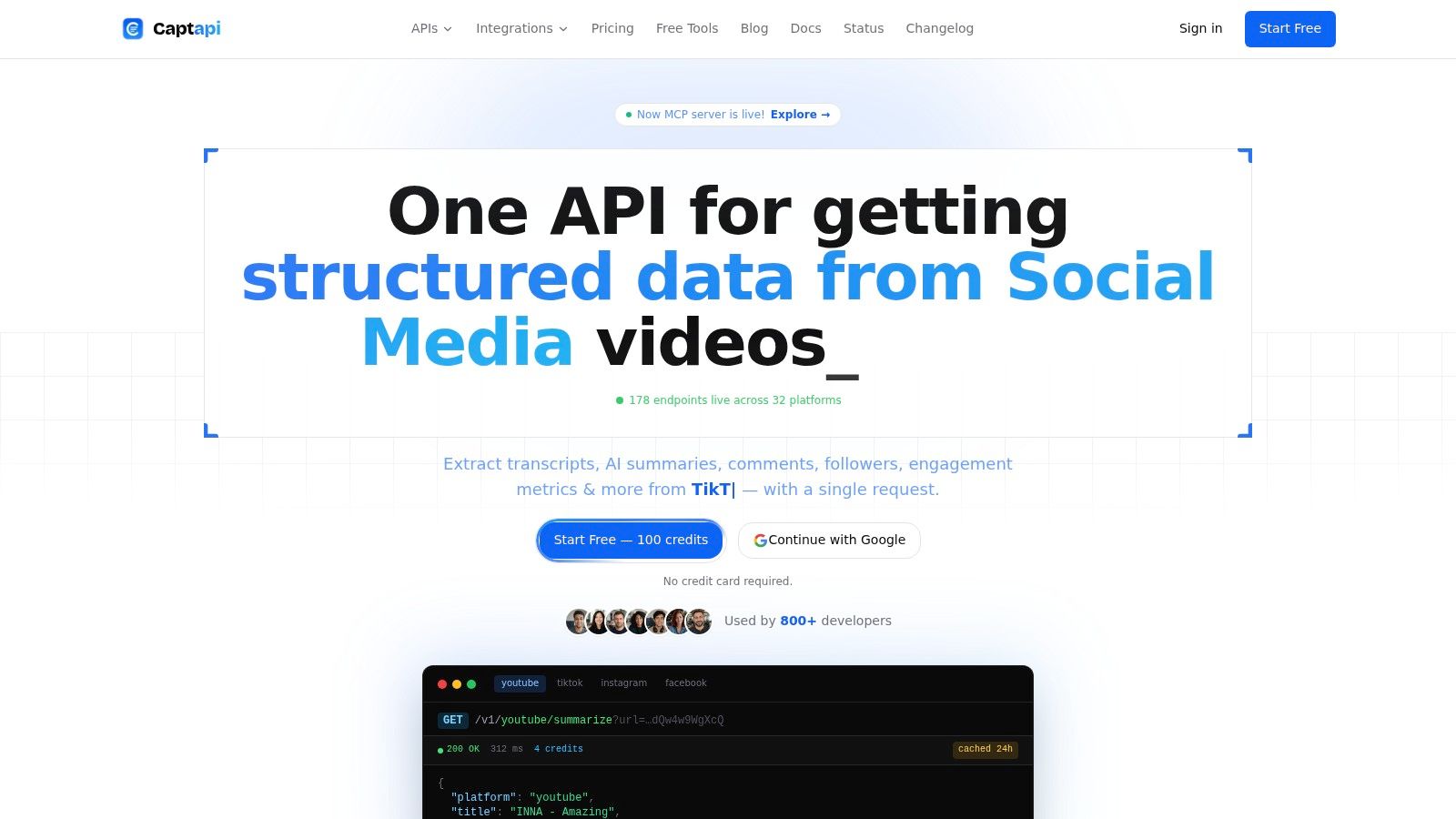
An investigator preparing a cross-platform dataset may spend more time reconciling fields than examining the evidence. Captapi fits that first workflow step: programmatic collection across multiple public platforms. Its developer-focused REST API provides a consistent interface for public data from YouTube, TikTok, Instagram, and Facebook, including transcripts, comments, engagement metrics, channel or page details, search results, and AI-generated summaries. The value is a normalized intake layer before analysts compare entities, posts, or narratives.
A shared schema reduces translation work caused by different platform fields, authentication flows, response formats, and failure modes. Captapi uses Apify-backed scrapers with automatic retries, provides an optional shared cache for repeated requests, and connects with n8n, Make, an MCP server, and an Apify actor. Its credit-based plans include 100 lifetime credits on the free tier, Starter at $9 per month for 2,000 credits, Pro at $27 per month for 6,000 credits, and Business at $90 per month for 20,000 credits. Rate limits range from 40 RPM on the free tier to 600 RPS on Business, according to the Captapi pricing page.
Where Captapi fits best
Captapi suits teams feeding public social data into a RAG pipeline, exporting comments for research, monitoring competitors, generating timestamps, or building internal search and enrichment workflows. GPT-4o-mini summaries and sentiment outputs can speed triage. Analysts should still review source material when a finding could affect a person, organization, or operational decision.
Practical rule: Use Captapi for collection and normalization, then store the original post, retrieval time, platform context, and analyst interpretation as separate evidence fields.
The trade-off is operational responsibility. Captapi is read-only and limited to publicly accessible data, so customers must make decisions about storage, retention, privacy, GDPR, and platform terms. REST-first integration also requires teams to map endpoint costs and validate schemas before scaling a pipeline. Review current coverage and plans at Captapi.
2. Maltego
Maltego earns its place when the investigation depends on explainable relationship mapping, not merely finding more mentions. Its Graph environment lets analysts pivot between entities such as people, accounts, domains, and posts, while recording how those entities connect. That makes it a better match for cases where the question is, “What is connected to this account, and how strong is the evidence?” rather than, “What was said about this topic today?”
The platform's Data Hub includes 120+ connectors for OSINT and commercial data, including social and dark-web sources, as described by Maltego's official platform information. Analysts can enrich a graph, inspect provenance, and preserve a visual explanation of the path from an initial lead to related entities. Higher tiers add monitoring and evidence-management capabilities, which can help teams turn exploratory pivots into repeatable case work.
The procurement and validation trade-off
Maltego is powerful precisely because its graph can combine many sources, but that ecosystem adds operational overhead. The Community Edition has limits, and many useful transforms depend on paid data or separately configured connectors. Teams also need to maintain transforms, understand the provenance of each result, and avoid treating a graph edge as proof of identity or intent.
For analysts designing an investigation workflow, social media OSINT research tools can supply collection options, but Maltego is where the collected evidence becomes an interpretable relationship model. It's particularly suitable for complex investigations that require a defensible visual record of pivots, assumptions, and source paths.
3. SpiderFoot and SpiderFoot HX
SpiderFoot is a broad automated collection platform for teams that want to run OSINT locally or connect discovery to their own scripts. The open-source edition can be self-hosted, while SpiderFoot HX provides a hosted browser-based environment with more convenient team workflows and correlation. Its module-based design covers social sites alongside signals such as DNS and breach data, so it can function as an initial discovery layer rather than a specialist social listening suite.
The platform offers 200+ modules, according to the product plan, and can extract and correlate entities across the sources those modules reach. That breadth is useful when a social account is only one clue in a wider investigation. A username, domain, email address, or organization can lead to related infrastructure and public records, after which an analyst can triage the social findings in context.
Collection is not confirmation
SpiderFoot's main weakness is also a consequence of its breadth. Automated modules can produce a large body of leads, but analysts still need to validate identity, recency, duplicates, and source quality. Some modules require separate API keys, and availability can change as platforms alter access rules. The hosted HX experience also needs commercial evaluation because availability and pricing may differ from the self-hosted edition.
Teams building an internal pipeline can pair SpiderFoot with social media OSINT workflow guidance, using SpiderFoot for broad discovery and a separate system for normalized exports, review, and reporting. It's a practical choice for security teams that value self-hosting and automation over polished consumer-intelligence dashboards.
4. Echosec by Flashpoint
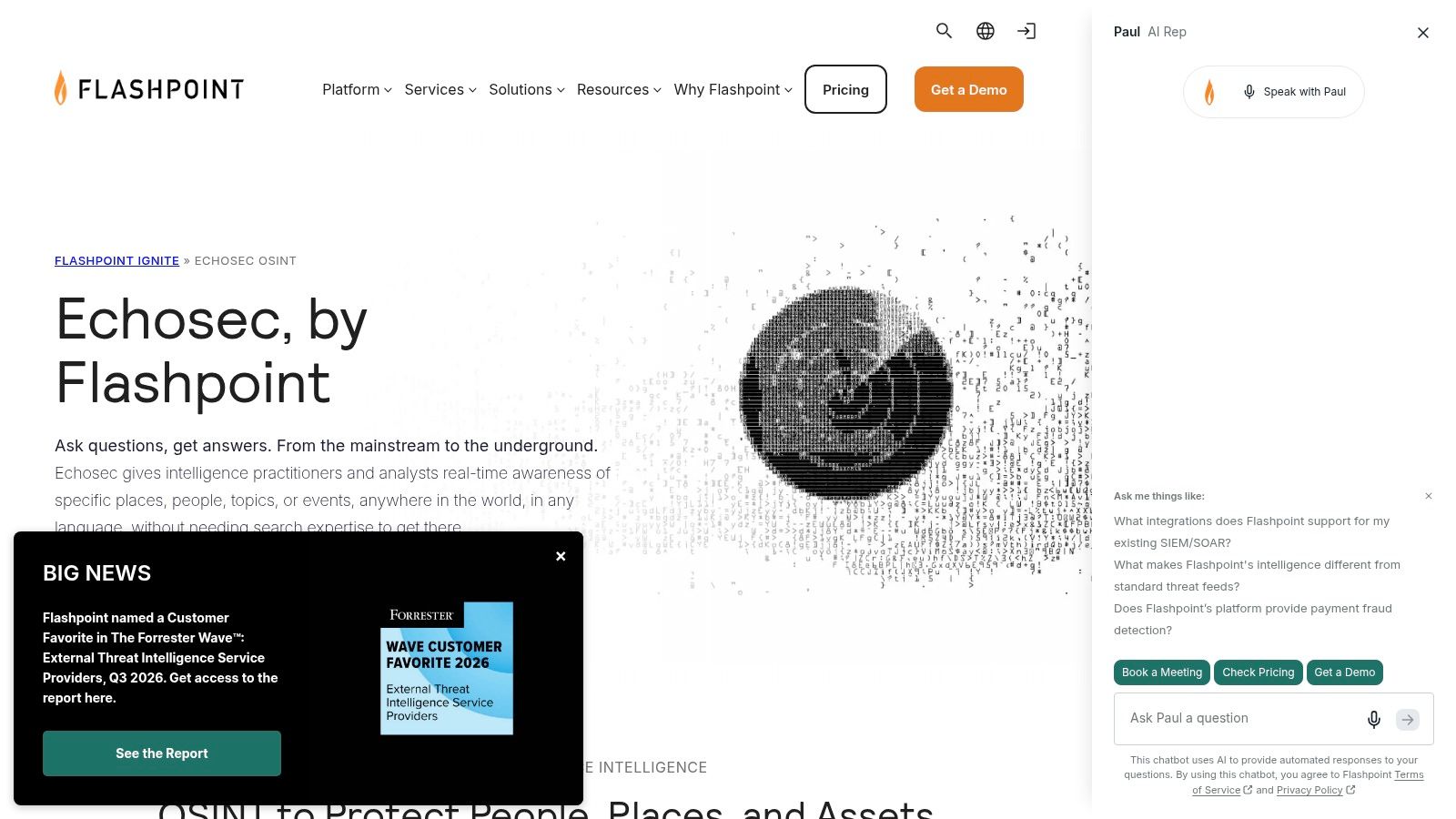
Echosec is designed around a different question: What is happening in a particular place, and how quickly can an analyst understand it? Its geospatial orientation gives public social content location context, making it relevant to public safety, crisis intelligence, threat detection, and situational awareness. That focus separates it from general-purpose listening tools that may identify a topic but provide less useful regional context.
The platform aggregates public social content and niche or defense forums, then applies filtering and summarization to reduce noise during fast-moving events. Its enterprise API can support programmatic access, while the interface is intended for analysts who need to investigate a developing situation rather than build a general-purpose content archive. Coverage still needs to be tested by region and network because sourcing and availability can vary.
Choose it for geography, not generic volume
Echosec makes more sense when location changes the meaning of a signal. A local event, transport disruption, public-safety concern, or regional narrative may require geographic filtering before an analyst can decide whether a cluster is meaningful. Its AI filtering can accelerate triage, but the analyst still needs to inspect the underlying public posts and assess whether location is explicit, inferred, stale, or incorrectly assigned.
For teams building a broader discovery process, social media search methods can complement Echosec's situational focus. The main procurement friction is its enterprise orientation. Smaller teams may find that the platform's value appears only when they have a recurring need for geospatial awareness, operational alerts, and regional source coverage.
5. Dataminr
Dataminr is built for the moment when speed matters more than exploratory depth. It monitors public data from global and regional social media as well as advisories, blogs, sensors, and other sources, then uses multimodal AI to identify early signals in text, images, video, and audio. Its product positioning covers breaking events, cyber risk, public-sector First Alert deployments, and newsroom leads.
The platform is described as covering more than 1 million public data sources and detecting signals across 150+ languages, figures provided in the product brief. Those figures indicate breadth, not guaranteed relevance for every investigation. A procurement team still needs to test alert precision, regional coverage, escalation workflows, and the quality of evidence attached to each alert.

The alerting trade-off
Dataminr fits organizations that need early warning integrated into operational workflows and collaboration systems. It isn't a lightweight research utility. There's no self-serve tier, procurement is sales-led, and premium pricing means buyers must justify the value of faster detection against existing monitoring and human escalation processes.
An alert is also not a finished finding. The best workflow records when it arrived, what public evidence supported it, how the event changed, and which analyst confirmed or rejected it. Teams can use alert-creation guidance for social monitoring to design escalation logic around the signal, while Dataminr supplies the enterprise detection layer.
6. Brandwatch
Brandwatch is most suitable for enterprise social listening and consumer intelligence, especially when the investigation needs structured monitoring, audience analysis, visual recognition, and reporting. Its data access through official partnerships with major platforms is a meaningful procurement consideration because coverage and licensing can be more predictable than relying on fragile unofficial collection. The platform also spans forums, review sites, news, and social networks.
Its analysis layer includes image and video recognition, audience analysis, classifiers, and integrations with publishing, engagement, and analytics systems. That makes Brandwatch useful for reputation monitoring, competitor intelligence, and research teams that need more than raw posts. It can help analysts organize recurring queries and present findings to stakeholders who won't work directly with an API or graph database.
Enterprise depth can become excess
Brandwatch's strength becomes a weakness when the task is narrow. If an analyst needs a small set of public posts, raw comments, or a custom extraction pipeline, a large listening suite may introduce unnecessary licensing, onboarding, and configuration. Pricing is quote-only and typically enterprise-level, so buyers should request a source-by-source coverage explanation rather than accepting a broad platform count as proof of investigative fit.
Social listening software comparisons can help teams distinguish mention monitoring from OSINT collection. Brandwatch is a strong choice when the deliverable includes recurring dashboards, visual signals, audience segmentation, and executive-ready interpretation.
7. Meltwater
Meltwater sits at the intersection of social monitoring, news intelligence, and executive reporting. It's useful when a team needs to connect a social narrative with editorial coverage, broadcast or print sources, alerts, dashboards, and exports. That combined view can prevent a social signal from being interpreted in isolation, particularly for communications, reputation, and media-intelligence teams.
The platform provides social and news monitoring, reporting, alerting, API access, and data export. Optional broadcast and print coverage can extend the source mix beyond digital social channels. Its dashboards are designed for stakeholders who want a concise view of volume, sentiment, coverage, and emerging issues rather than a raw investigative workspace.
Match the platform to the deliverable
Meltwater's value increases when the output is a recurring report, leadership briefing, media response workflow, or communications dashboard. It's less compelling as a standalone relationship-mapping environment because the core strength is monitoring and reporting rather than graph-based entity investigation. Analysts should test historical access, source licensing, export fields, and alert configuration before signing.
Pricing is custom and sales-led, with costs shaped by sources, seats, and features. That makes a clear requirements document essential. Define the networks, news sources, languages, retention needs, users, exports, and escalation paths first. Otherwise, the demonstration may showcase capabilities that don't belong in the final workflow.
8. Talkwalker
Talkwalker is an enterprise listening and analytics platform for teams that need large-scale monitoring, multilingual analysis, visual intelligence, and anomaly detection. Its Lumen AI engine supports trend detection and classification, while image and video recognition can identify logos or objects that text-only monitoring would miss. That matters when a narrative travels through visual content, not just captions and searchable phrases.
The platform also supports real-time alerts, competitor tracking, campaign analysis, paid social analytics options, and enterprise integrations. Multilingual sentiment and emotion classification can help global teams organize monitoring across markets, but classification quality still needs validation against the languages, topics, and cultural contexts that matter to the investigation.
Test interpretation, not just ingestion
Talkwalker's enterprise orientation makes it a candidate for organizations comparing large vendors such as Brandwatch and Meltwater. Pricing isn't published, procurement is sales-led, and smaller teams may find the platform unnecessarily heavy for tactical collection. A buyer should ask to see how the system handles ambiguous language, sarcasm, duplicate content, visual reposts, deleted posts, and regional gaps.
The central decision is whether the team needs an analytics and reporting environment or a source-controlled investigative pipeline. Talkwalker is stronger for the former. If analysts need to preserve raw records, perform custom enrichment, or build their own correlation logic, they may need an API-oriented collection layer alongside it.
9. Pulsar Platform
Pulsar is the best fit on this list for community mapping and narrative diffusion. Rather than stopping at mention counts, its Audience Intelligence and Social Listening products combine social, forums, search, and news to help analysts identify communities, understand who drives conversations, and follow how narratives move across channels. That makes it relevant to journalists, researchers, strategists, and investigators studying discourse rather than only monitoring a brand term.
The platform supports cross-source collection across 190+ countries, according to the product plan, with audience and community detection, trend analytics, research-oriented reports, and enterprise deployment options. Geographic breadth can support comparative research, but it doesn't remove the need to examine local language, platform behavior, source availability, and the difference between a detected community and a real-world group.

Use it when relationships are social
Pulsar is more appropriate than a basic mention tracker when the research question concerns who participates, which themes connect them, and how a narrative spreads. It can help analysts compare communities, identify recurring themes, and distinguish isolated posts from coordinated or organically connected discussion. Those interpretations still require restraint. Audience clusters are analytical outputs, not automatic proof of coordination, identity, or intent.
Pricing is not public and onboarding is sales-led, so the evaluation should focus on sample data from the regions and topics the team studies. Ask for export formats, provenance fields, historical depth, and the ability to reproduce a report after query changes.
10. Awario
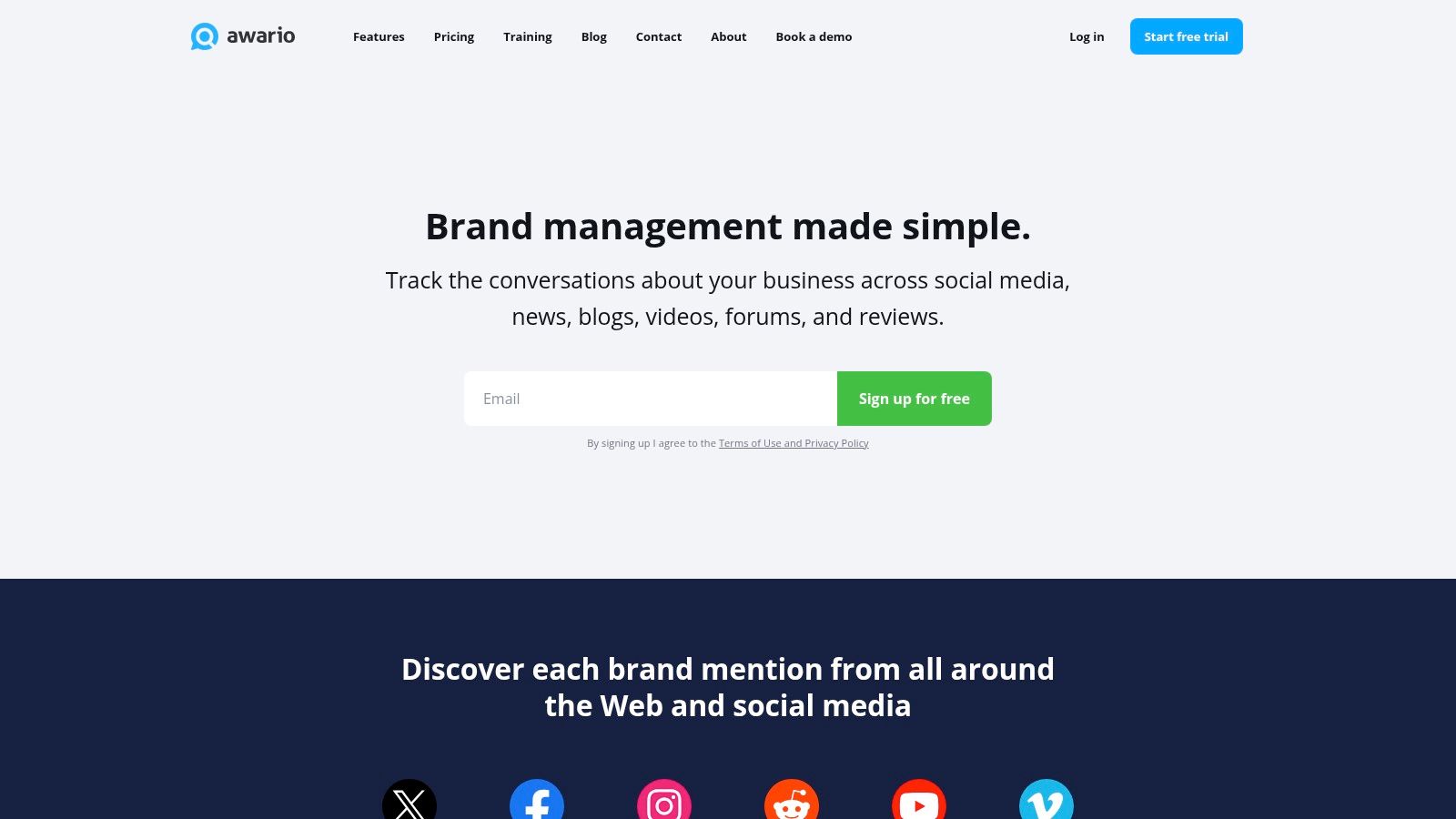
Awario is the most approachable option for smaller teams and self-serve monitoring. It tracks mentions across major social networks, news, blogs, and the wider web, with Boolean search, multilingual coverage, topic limits by plan, CSV export, and transparent quotas. That combination makes it useful for a brand-monitoring prototype, competitor scan, journalist watchlist, or recurring research task that doesn't justify an enterprise contract.
The platform's main advantage is deployment friction. A team can start with a defined query, review incoming mentions, export results, and refine the search without building an API pipeline or arranging a large procurement process. That makes Awario a sensible first layer for teams still learning what signals they need.
Know when to graduate
Awario isn't designed to replace an enterprise archive, a graph-analysis environment, or a custom collection system. Historical depth, advanced visual AI, and high-volume research requirements may exceed its plan limits. Analysts should also confirm whether the exact platforms, languages, query syntax, and export fields they need are available before treating a result set as complete.
Its transparent pricing is valuable for a pilot because the team can connect expected query volume to an actual budget. If the workflow grows into automated enrichment, normalized cross-platform data, or repeatable RAG and analysis pipelines, an API-first tool such as Captapi may become a better complement.
Top 10 Social Media OSINT Tools Comparison
| Product | Core features | Quality / UX (★) | Value & Pricing (💰) | Target audience (👥) | Unique strengths (✨) |
|---|---|---|---|---|---|
| Captapi 🏆 | Unified REST API across major platforms (transcripts, comments, engagement, GPT‑4o summaries); Apify-backed scrapers | ★★★★☆ sub‑second cache hits, reliable retries | 💰 Free (100 credits) → $9/$27/$90 tiers; credit‑based + PAYG | 👥 Developers, product teams, researchers | ✨ Single normalized schema, GPT‑4o summaries, 24h shared cache, no OAuth |
| Maltego | Visual link analysis, 120+ Data Hub connectors, pivoting & provenance | ★★★★☆ explainable graphs, mature UI | 💰 Community free; paid tiers for connectors/data | 👥 SOCMINT analysts, investigators | ✨ Deep, explainable graphing and provenance |
| SpiderFoot (OSS & HX) | 200+ modules for automated OSINT (breaches, social, DNS); self‑hosted + hosted HX | ★★★☆☆ flexible self‑hosted; needs triage | 💰 OSS free; HX hosted pricing varies | 👥 Security researchers, ops teams | ✨ Broad modular coverage; self‑hostable automation |
| Echosec (Flashpoint) | Geospatial social aggregation, AI filtering & summarization, API | ★★★★☆ strong situational awareness | 💰 Enterprise pricing (sales‑led) | 👥 Public‑safety, crisis & threat teams | ✨ Geo‑aware social + niche forum coverage |
| Dataminr | Real‑time multimodal AI across 1M+ sources (text/image/video/audio) | ★★★★★ fastest early‑warning alerts | 💰 Enterprise only; premium pricing | 👥 Newsrooms, public sector, large enterprises | ✨ Early‑warning multimodal detection at scale |
| Brandwatch | Enterprise social listening, visual recognition, audience analysis, APIs | ★★★★☆ deep datasets, robust classifiers | 💰 Quote‑only, enterprise (high) | 👥 Enterprise marketing, reputation teams | ✨ Official platform partnerships & visual AI |
| Meltwater | Social + news monitoring, dashboards, alerts, exports & API | ★★★★☆ executive reporting & onboarding | 💰 Custom pricing; sales‑led | 👥 PR, communications, enterprise analysts | ✨ Combined social + editorial intelligence |
| Talkwalker | Real‑time ingestion, Lumen AI, image/video recognition, anomaly detection | ★★★★☆ strong multilingual sentiment | 💰 Enterprise pricing (not public) | 👥 Brands, agencies, analytics teams | ✨ Multilingual sentiment & visual analytics |
| Pulsar Platform | Audience intelligence (TRAC/TRENDS/CORE), cross‑source collection, trend analytics | ★★★★☆ research‑grade insights | 💰 Sales‑led, enterprise | 👥 Researchers, academics, community analysts | ✨ Audience mapping & narrative diffusion analysis |
| Awario | Self‑serve social listening, Boolean search, CSV exports, multi‑language | ★★★☆☆ easy & fast to deploy | 💰 Transparent, affordable plans | 👥 Small teams, startups, marketers | ✨ Clear pricing, quick setup for prototypes |
Build a Defensible Social OSINT Workflow
The best social media OSINT tools don't all perform the same job. Captapi and SpiderFoot are the practical starting points for programmatic collection, but they serve different technical preferences. Captapi is better when a developer needs normalized public social data in a repeatable REST workflow. SpiderFoot is better when a security team wants broad, self-hosted discovery across social, DNS, breach, and related sources.
Use Maltego when the investigation depends on explainable relationship mapping. Its graph is valuable because it makes pivots visible and lets analysts inspect how entities connect. Use Echosec when geography and situational awareness shape the question, and Dataminr when the priority is fast, location-sensitive alerts from a broad public-data stream. The latter two are enterprise-oriented choices, so procurement should test regional coverage, alert quality, escalation paths, and evidence retention rather than relying only on product demonstrations.
For discourse research, Pulsar is the clearest choice for communities, audience structures, and narrative diffusion. It goes beyond counting mentions by helping analysts study who participates and how themes travel. Brandwatch, Meltwater, and Talkwalker are better for enterprise listening, reporting, and executive communication. Brandwatch emphasizes classifiers and visual intelligence, Meltwater combines social with news and editorial monitoring, and Talkwalker brings multilingual analytics, visual recognition, and large-scale enterprise workflows.
Awario remains the sensible option for smaller self-serve scans, especially when a team needs transparent quotas, Boolean search, and CSV exports without a sales-led deployment. It won't provide the same depth as a custom pipeline or enterprise intelligence suite, but its lower operational friction can make it easier to test a monitoring hypothesis before committing to a larger system.
Whatever the tool, important findings need a defensible evidence process. Validate material claims against primary public sources, preserve provenance and timestamps, distinguish automated signals from analyst judgments, and record what the system did not collect. Check regional and language coverage, review retention and access controls, and document how the team handles personal data, GDPR obligations, and platform terms before operational use.
The wider market context reinforces the need for this discipline. One market estimate places social media analytics at 42.60% of OSINT technology usage in 2025 and social media streams at 45.70% of OSINT data sources in that year, according to Mordor Intelligence's OSINT market analysis. Another estimate projects the OSINT market from USD 11.75 billion in 2025 to USD 76.81 billion by 2035, with social media analytics at 46.0% in 2025, as reported by Market Research Future. Those figures describe market direction, not proof that a particular tool will produce reliable intelligence. Reliability still comes from matching the collection layer to the question, validating the output, and documenting the reasoning.
Captapi gives developers one REST interface for public social data across platforms such as YouTube, TikTok, Instagram, and Facebook, including transcripts, comments, search results, engagement data, and AI summaries. If your OSINT workflow needs normalized collection, bulk comment exports, or a direct feed into research and RAG pipelines, visit Captapi to evaluate the current endpoints and plans.