
OSINT Social Media Investigation Playbook

You've opened a platform search page, found a promising account, and started clicking. An hour later, the search results have changed, a post has disappeared, the same username appears on several networks, and your notes contain screenshots with no reliable timestamps or collection context. That workflow can produce leads, but it rarely produces a repeatable evidence trail.
OSINT social media now demands more than browser persistence. Investigators work across fragmented platforms, inconsistent search tools, changing APIs, deleted content, and noisy engagement signals. The practical answer is a structured intelligence cycle supported by automated collection, normalized records, deliberate validation, and transparent documentation.
Table of Contents
- The Modern Reality of Social Intelligence
- Architecting Scalable Data Collection Pipelines
- Processing and Enriching Raw Social Signals
- Validating Evidence and Avoiding False Positives
- Navigating Legal Boundaries and Ethical Documentation
- Building Your Repeatable Investigation Workflow
The Modern Reality of Social Intelligence
A username search may begin on X, shift to Instagram, and end on TikTok, Reddit, or a regional platform. Each service exposes different metadata, search operators, visibility rules, and historical coverage. A promising lead can become difficult to reproduce once a platform changes its interface or removes a search feature.
Open-source intelligence predates social networks. Historical accounts trace OSINT to U.S. military usage in the late 1980s, while the CIA's 1994 creation of the Community Open-Source Program Office marked a formal institutional milestone for open-source collection (historical account of OSINT's development). Social platforms then expanded the volume and variety of publicly accessible posts, comments, location clues, and engagement patterns. Facebook's rapid user growth from 2006 to 2008 shows how quickly social networks became intelligence-rich environments. The scale of that expansion is documented in Facebook user growth data from 2006 to 2008.

SOCMINT is a different operating problem
Social Media Intelligence, or SOCMINT, is a focused subset of OSINT. It covers conversations, profiles, relationships, media, comments, hashtags, timestamps, and engagement signals on social platforms. The distinction matters because social records change quickly, depend on platform context, and often show interaction rather than verified fact.
Research describes social activity at a scale that makes manual review impractical. One summary cites roughly 500 million tweets per day, while another dataset recorded 31.62 billion views, 936.56 million likes, 180.3 million retweets, and 53.3 million replies (research summary on social-media-scale intelligence data). High volume makes collection easier to justify, not interpretation. Analysts still need to establish relevance, provenance, and evidentiary quality.
Practical rule: Treat every social investigation as a question-driven intelligence cycle, not as an extended session in a search bar.
The cycle starts with a collection question and continues through public-data acquisition, normalization, correlation, analysis, dissemination, and source-quality review. A 2023 review describes related work involving keyword research, image analysis, correlation, and exploitation. It also emphasizes validation and analysis as the steps that turn open data into actionable intelligence (review of OSINT methods and social-media evidence).
Manual browsing remains useful during discovery. It helps analysts learn platform language, identify seed accounts, and spot unusual clues. As a production method, however, it is slow, difficult to audit, and exposed to interface changes. Repeated browser searches also make collection context inconsistent, especially when teams need to compare records across fragmented platforms.
Teams that need recurring collection should move repeatable tasks into API-driven pipelines, while keeping human judgment for scoping, interpretation, and validation. That division preserves analyst judgment where ambiguity matters and gives routine acquisition a consistent, reviewable process. For sensitive identity research, tracing agents London can provide context on how professional investigative practice differs from casual online searching.
Architecting Scalable Data Collection Pipelines
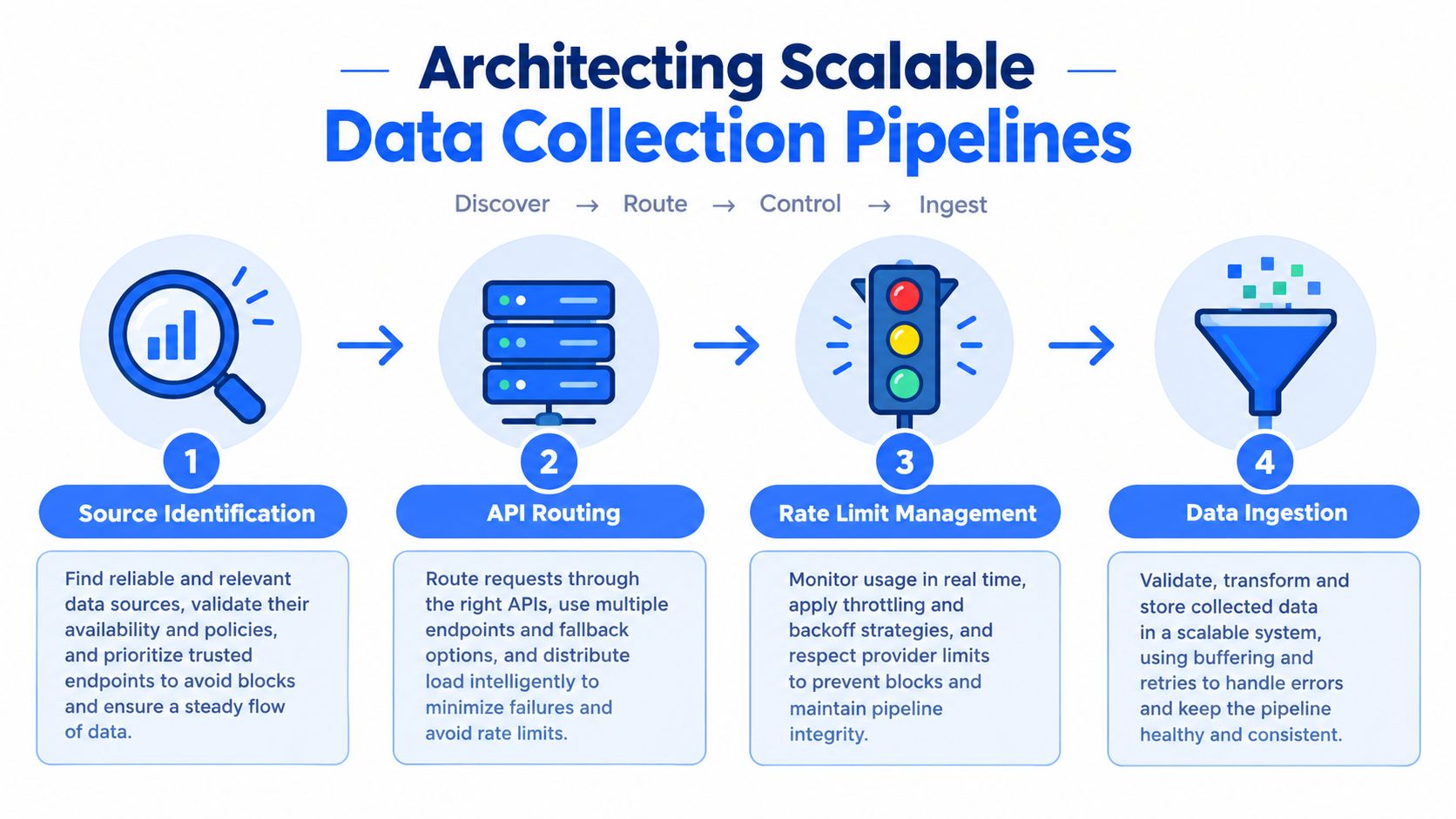
The first design decision isn't which scraper to use. It's what you're collecting and why. Define the question, source boundaries, time window, target entities, fields, and stopping condition before sending requests. Without that scope, an API merely turns an unfocused browser search into a faster stream of irrelevant records.
Start with a collection contract
Write a short collection specification containing:
- Target objects: profiles, posts, videos, comments, transcripts, pages, or search results.
- Required fields: canonical URL, platform identifier, handle, text, media reference, timestamp, engagement values, and collection time.
- Query logic: exact terms, aliases, hashtags, language variants, image clues, and known URLs.
- Evidence limits: public content only, permitted endpoints, retention rules, and exclusions.
- Output format: structured records that downstream analysts can compare without platform-specific cleanup.
This contract prevents a common failure. An analyst may save a display name from one platform and a username from another, then treat them as equivalent. Your ingestion layer should preserve the original value while also creating normalized fields for handles, URLs, timestamps, and platform names. Keep both the raw response and the transformed record. Normalization improves analysis, but it must never erase the source representation.
Use routing, caching, and controlled retries
A unified REST interface can reduce the operational burden of maintaining separate SDKs for YouTube, TikTok, Instagram, and Facebook. Captapi, for example, provides endpoints for public transcripts, comments, engagement data, profiles, search results, and summaries through one interface. It can be evaluated alongside direct platform APIs, specialist collection tools, or carefully governed scrapers. The right choice depends on the platform, permitted access, required fields, and your organization's compliance position.
A resilient pipeline should route each request to the appropriate source adapter, record the request status, and retry transient failures without duplicating results. Rate-limit handling belongs in the transport layer, not in an analyst's browser routine. Shared caching is useful when several analysts or processes request the same public object, but cache entries need collection timestamps and freshness rules so an old response isn't mistaken for a live observation.
For a practical implementation perspective, Captapi's guide to data pipeline automation covers the kind of routing and ingestion decisions that matter when social collection becomes a recurring process.
Design for platform failure
Assume search features will change. Assume historical views will become incomplete. Assume a platform will return different metadata for the same object under different access conditions. Store stable identifiers where available, canonical URLs, response payloads, hashes or checksums for preserved files, and an audit record showing when and how each item entered the system.
The pipeline shouldn't promise that every platform exposes identical data. It should make those differences explicit. A missing Instagram field and a missing YouTube field may have entirely different meanings, so analysts need a schema that distinguishes not available, not collected, not applicable, and collection error. That small distinction prevents false comparisons later.
Processing and Enriching Raw Social Signals
Raw collection is only the beginning. A folder of exports, screenshots, and API responses isn't intelligence. It's an evidence inventory that still needs structure, quality checks, and context.
Social platforms produce different objects with different meanings. A like may indicate approval, curiosity, habit, or automated behavior. A comment can provide useful context, but it can also be copied, ironic, coordinated, or detached from the original event. The processing layer should preserve those ambiguities instead of turning every engagement event into a conclusion.
Normalize before you interpret
Build a canonical record for each item. Keep the source platform, native identifier, original URL, author handle, display name, text, language, media type, native timestamp, normalized timestamp, engagement fields, parent object, and collection timestamp. Convert timestamps to a consistent standard while retaining the original timezone or display format. If the platform provides edited status, capture it separately rather than overwriting the publication time.
Deduplicate cautiously. The same video may appear through several URLs, while two posts may share identical text but come from different accounts. Match on platform identifiers first, then use URL and content fingerprints as supporting signals. Never collapse records solely because their text looks alike.
Transcripts and comments can then become searchable text assets. A transcript may reveal names, locations, claims, or recurring terminology that doesn't appear in a title. Automated summaries can help analysts triage long media, but the summary should link back to the transcript and original object. It's a prioritization aid, not a replacement for source review.
Enrich without manufacturing certainty
Useful enrichment includes language detection, entity extraction, topic labels, sentiment indicators, image or video keyframes, and relationship edges between accounts and objects. For market or narrative monitoring, a specialist guide on how to analyze crypto sentiment with Qoory illustrates the broader principle that sentiment outputs need a defined corpus and interpretive boundaries.
The same principle applies to OSINT. Sentiment is not intent. High engagement isn't representative public opinion. A burst of replies might reflect coordinated activity rather than broad interest. Enrichment should add fields such as model used, processing version, confidence, and review status, allowing an analyst to separate observed data from machine-generated interpretation.
The processing sequence should look like this:
- Preserve: Store the raw response and acquisition metadata.
- Normalize: Standardize identifiers, URLs, timestamps, and field names.
- Enrich: Add transcripts, entities, topics, language, or relationship data.
- Quality-check: Flag duplicates, missing fields, malformed dates, and suspicious activity.
- Stage: Send review-ready records into search, graph, or analytical systems.
For implementation ideas around separating raw, transformed, and analytical layers, see Captapi's data transformation techniques. That separation makes it possible to improve a parser or enrichment model without losing the original collection.
Validating Evidence and Avoiding False Positives
More data doesn't automatically create better intelligence. In social investigations, more data can increase confidence without increasing accuracy, especially when a search returns many accounts that share a name, image, phrase, or recycled handle.
The most dangerous conclusion often begins with one plausible match. A username resembles the target, a profile photo appears similar, and a post mentions a familiar place. Those observations may justify further research. They don't establish identity, account ownership, physical presence, or intent.
Apply the three-signal rule
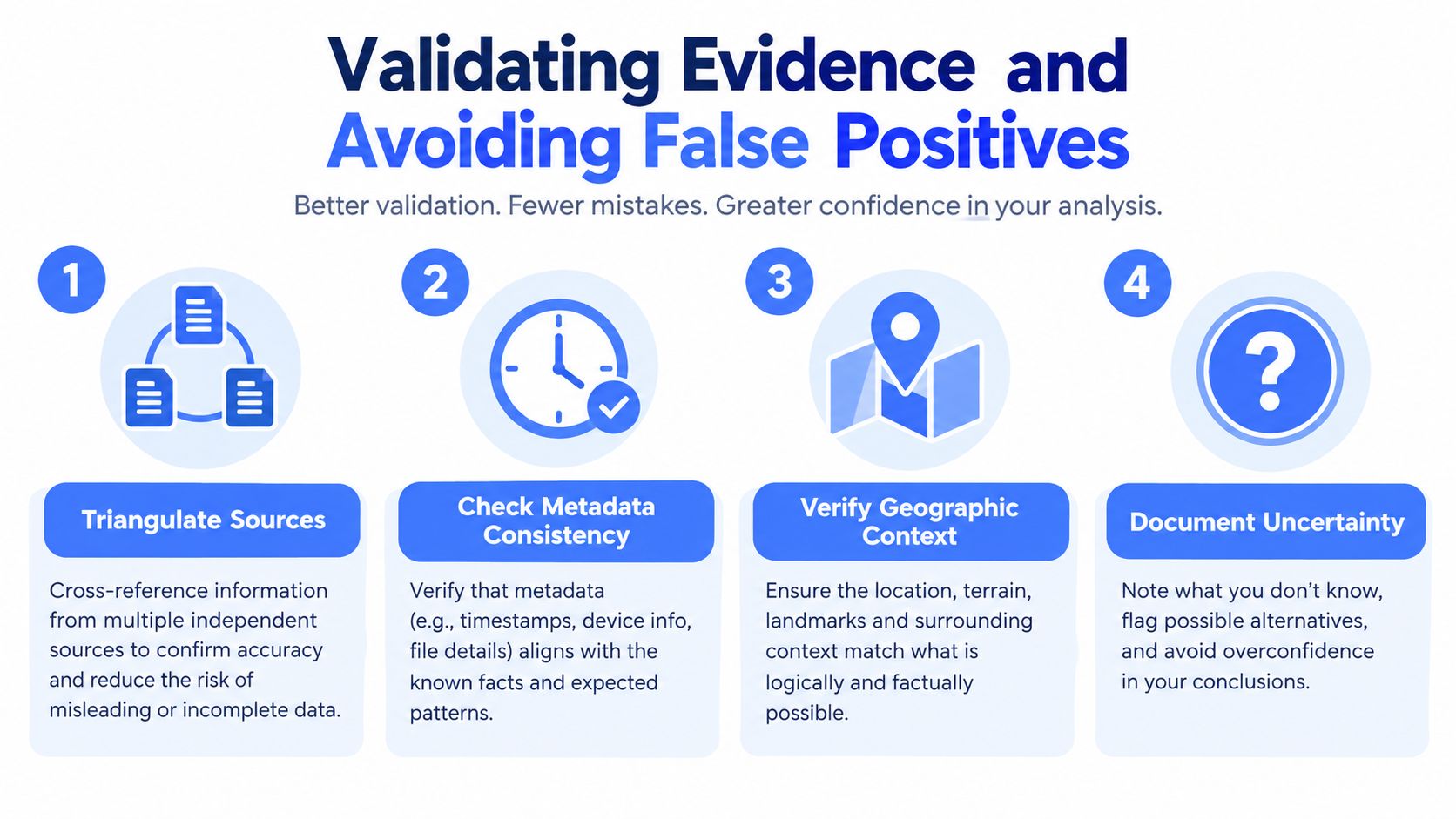
Practitioners commonly use a three-signal rule. Before declaring a positive identification, require at least three independent, matching signals (practitioner guidance on the three-signal rule). The signals should come from meaningfully different attributes, not three copies of the same repost.
For example, a stronger account-linkage hypothesis might combine:
- Handle continuity: A distinctive username appears consistently across platforms.
- Temporal alignment: Posts and activity fit the relevant timeline.
- Geographic context: Locations, landmarks, language, or local references align.
- Media continuity: The account uses recurring images, visual styles, or source material.
- Network consistency: Public relationships connect to known entities without relying on a single follower link.
Three matching signals still don't eliminate uncertainty. They create a defensible basis for a qualified assessment, provided you record alternatives and explain why each signal is independent.
Test the hypothesis against disconfirming evidence
Don't only collect material that supports the first theory. Search for contradictions. Does the supposedly linked account post from incompatible time zones? Does its language differ consistently? Is the image actually an older profile picture copied by unrelated users? Does the location clue come from a repost rather than firsthand activity?
A useful validation record separates observation, interpretation, and confidence. “The account posted a photograph tagged with a location” is an observation. “The account holder was physically present there” is an interpretation that requires additional support. “The location tag may be inherited from a repost” is an uncertainty note that keeps the conclusion proportionate.
Evidence standard: A matching attribute is a lead. Independent convergence is what makes it useful.
Social-media content also needs source criticism. Posts can be deleted, edited, recirculated, or detached from their original context. Comments and user-generated descriptions may help explain an event, but they shouldn't be treated as verified evidence without corroboration. The NIH review cited earlier emphasizes collection, correlation, and critical evaluation as part of the OSINT process (review of validation in social-media OSINT).
Finally, document what you couldn't establish. A professional report can say that an account is possibly associated, consistent with, or not attributable on available evidence. That language isn't evasive. It prevents an uncertain digital trace from becoming an overconfident real-world claim. For the audit trail behind those judgments, Captapi's explanation of data provenance provides a useful model for recording origin and transformation history.
Navigating Legal Boundaries and Ethical Documentation
Public availability doesn't remove responsibility. An investigator can access a post without having the right to republish it, profile a person indefinitely, or combine unrelated data points for a purpose the subject couldn't reasonably anticipate. OSINT social media work needs a defined purpose, a lawful basis where required, and controls around retention, access, and disclosure.
Start by writing the investigation mandate. Identify the client or internal owner, the question being answered, the permitted sources, the expected output, and the point at which collection must stop. If the work involves personal data, sensitive categories, minors, vulnerable people, or high-impact decisions, escalate the review before collection begins.
Preserve the chain, not just the screenshot
A screenshot is a visual copy, not a complete provenance record. Preserve the canonical URL, platform, native identifier, account name, collection timestamp, timezone, visible context, response metadata, and the collector or process that obtained the item. Save the raw response when permitted, and record whether the content was public at collection time.
A defensible evidence package should let another reviewer answer:
- What question prompted collection?
- Which source and endpoint produced the record?
- What transformations were applied?
- Which fields came from the platform, and which came from an enrichment model?
- What was unavailable or changed?
- Who reviewed the finding, and when?
This documentation helps with reproducibility, but it also limits misuse. Analysts should avoid collecting unrelated personal information just because an API exposes it. Minimize fields, restrict access, and set deletion or review dates appropriate to the investigation.
Respect platform and privacy requirements
Use compliant extraction methods and public data boundaries. Don't bypass access controls, misrepresent identity, or treat a platform's visibility setting as a universal permission to redistribute content. Platform terms and local privacy rules can differ, so legal review should be specific to the jurisdiction and use case. A practical starting point for teams comparing obligations is this resource on how to comply with GDPR and CCPA, though it shouldn't replace advice for a particular investigation.
Your technical process should reflect those decisions. Captapi's social media compliance guidance is relevant when evaluating how an automated collection service handles public data, access controls, and customer responsibilities. The objective isn't merely to avoid penalties. It's to ensure that a conclusion remains credible because the organization can explain how it was produced and why the collection was proportionate.
Building Your Repeatable Investigation Workflow
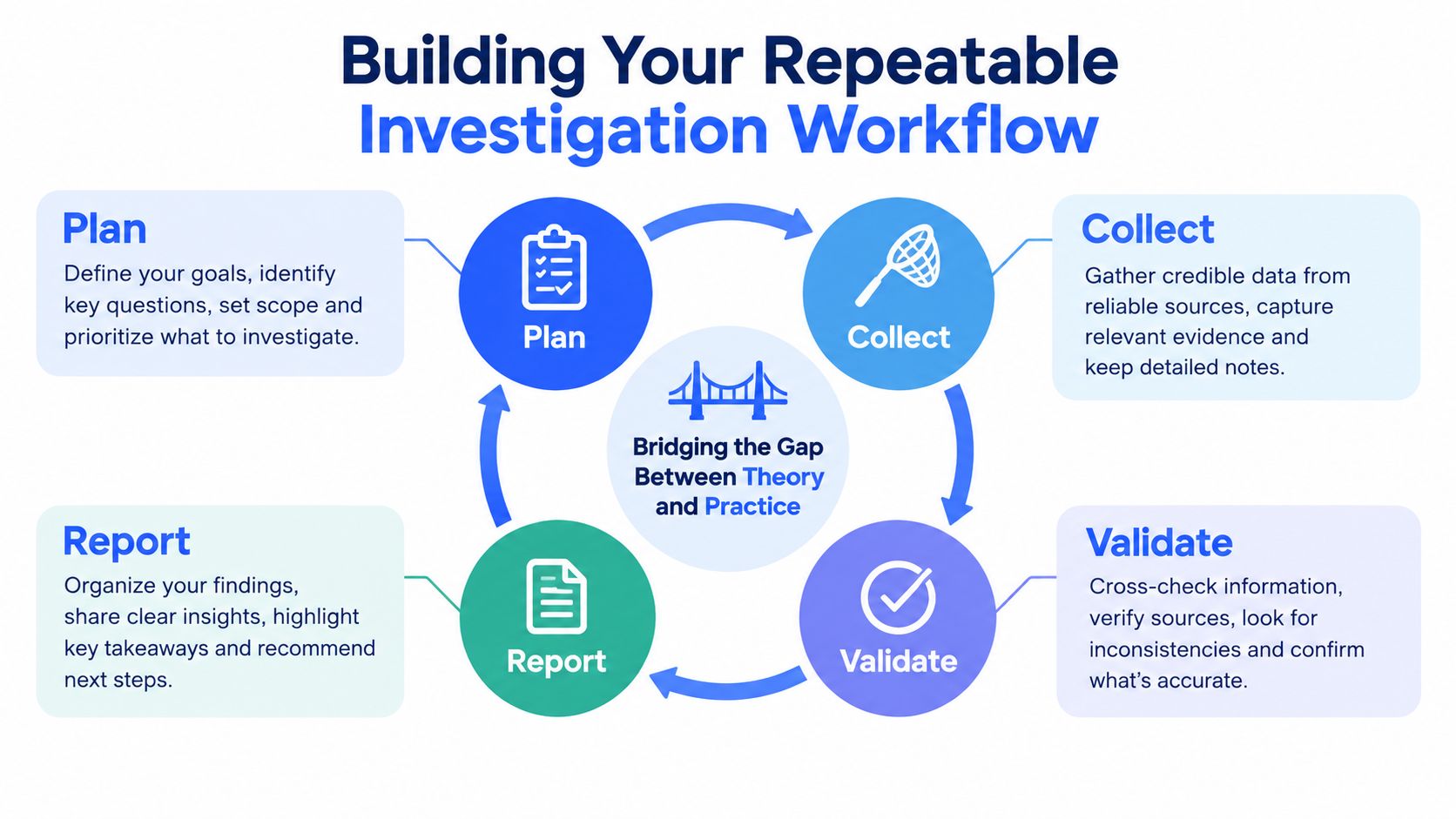
A repeatable investigation starts before the first query. Write the question in a form that can be tested, define what would count as supporting or conflicting evidence, and decide which platforms are relevant. Platform richness varies sharply. One investigative-data rubric scores Facebook at 95, Instagram at 82, X/Twitter at 78, Reddit at 70, TikTok at 62, and Discord at 55, based on metadata availability, public-data volume, API access, and historical archiving (platform comparison for investigative data). Those differences should influence source selection, not become an excuse to treat one platform as complete.
Plan the collection
Create a source matrix before you collect:
| Investigation need | Candidate signal | Main limitation |
|---|---|---|
| Account discovery | Handles, bios, profile URLs | Names and handles can be reused |
| Timeline building | Posts, comments, publication times | Timezones, edits, and deletions complicate sequence |
| Event verification | Media, captions, geolocation clues | Reposts may obscure origin |
| Network analysis | Replies, mentions, public relationships | Interaction doesn't prove affiliation |
| Narrative monitoring | Text, transcripts, engagement | Engagement can be noisy or coordinated |
Then choose API endpoints by object type. Don't collect every available field by default. Request what answers the question, while preserving enough metadata to reproduce the finding.
Collect and stage
Run discovery queries first, then narrow the collection around relevant accounts, objects, and time windows. Save raw responses, assign internal record identifiers, normalize platform fields, and send failures into a review queue rather than discarding them without a record. A pipeline that reports missing data is more trustworthy than one that returns a clean but incomplete dataset.
Social-media use remains inconsistent in professional investigations. The State of OSINT 2025 reports that 36% of financial-services respondents used social media in only 0–25% of investigations, while only about half reported using it at all (State of OSINT 2025). That gap suggests teams need decision rules for when social data is evidentiary, when it is merely contextual, and when it's too biased or incomplete to support a conclusion.
Validate, report, and re-evaluate
Apply independent signals, test contradictions, preserve uncertainty, and distinguish facts from assessments. Your report should include the question, collection scope, source inventory, methodology, key observations, confidence levels, alternative explanations, and known gaps.
For a concise overview of how OSINT fits into a practical workflow, Captapi's guide to using OSINT can serve as a reference point while you adapt the process to your own legal, technical, and investigative requirements. The final step is re-evaluation. Review whether the source remains available, whether platform context changed, and whether new information weakens or strengthens the assessment.
Captapi provides a unified REST interface for public social data across YouTube, TikTok, Instagram, and Facebook, including transcripts, comments, profiles, search results, and engagement data. If you're replacing manual collection with a documented OSINT social media pipeline, visit Captapi to evaluate the available endpoints and build a repeatable integration.