
Social Media Monitoring API: A Developer's Guide
You've been asked to add brand-safety alerts to a product. The requirement sounds simple: collect public posts, detect risky language, and notify the right person before a conversation becomes a crisis. Then you open the platform documentation and discover separate authentication flows, different pagination rules, uneven access to comments, and quotas that can interrupt collection at the exact moment activity spikes.
That's the problem a social media monitoring API solves, or at least helps you solve. It gives your application a programmatic path to social posts, comments, profiles, and engagement signals, but production monitoring depends on much more than making a successful request. You need a data model, retry behavior, coverage checks, storage, alert delivery, and a plan for the day a platform changes its rules.
Table of Contents
- What a Social Media Monitoring API Actually Does
- The Core Architecture Behind Monitoring Pipelines
- Common Endpoints and What They Return
- Rate Limits and Platform Instability as Engineering Problems
- How Different Teams Choose the Right API
- Practical Use Cases for AI, Marketing, and Research
- Shipping Your First Integration and What Comes Next
What a Social Media Monitoring API Actually Does
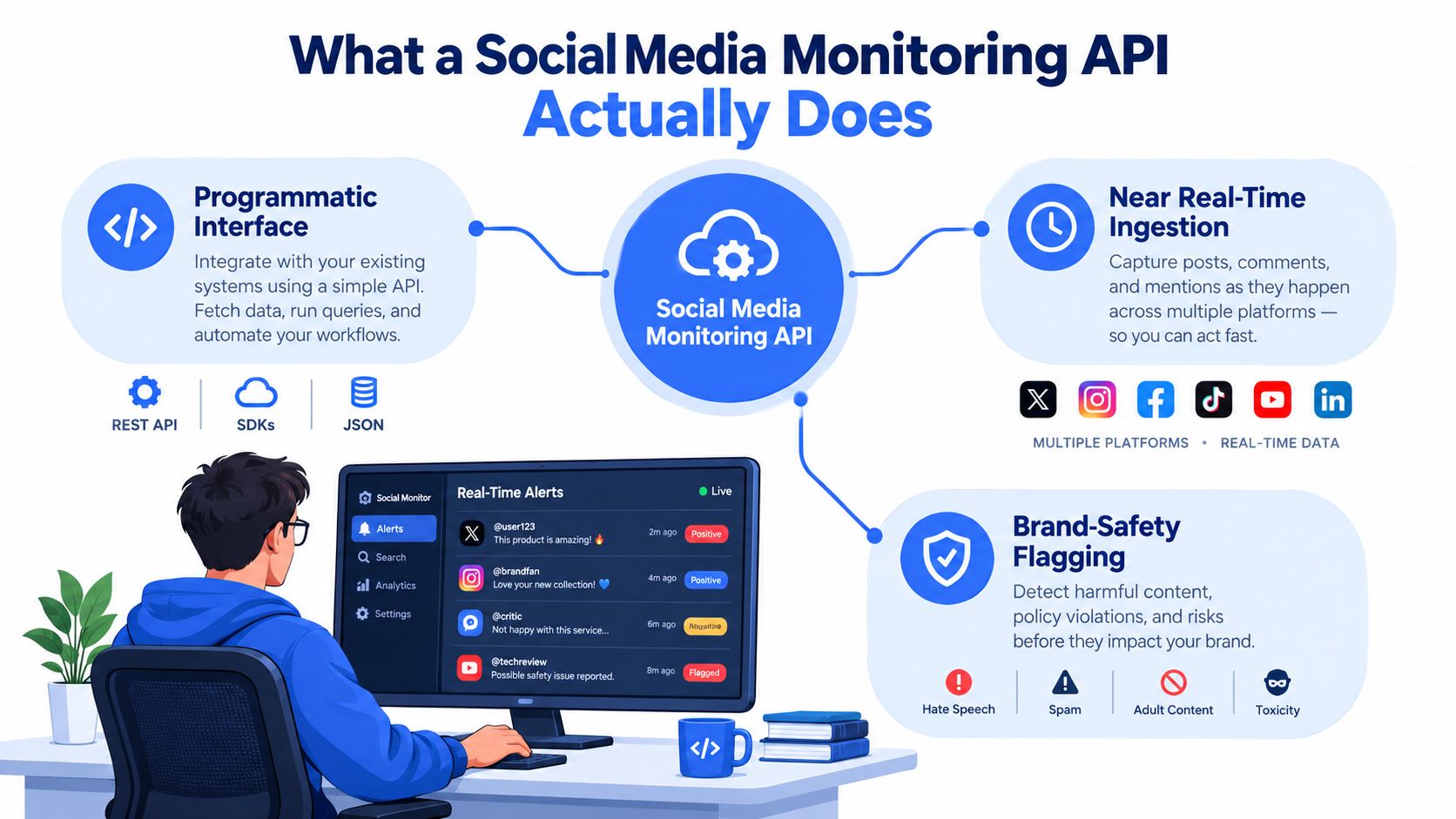
A social media monitoring API is a programmatic interface for collecting social data and making it usable inside your own software. Instead of opening separate dashboards, your application can request posts matching a query, retrieve mentions of an account or brand, inspect public profile metadata, and pass the resulting records to search, analytics, moderation, or AI systems.
The useful distinction is between dashboard listening and API-first listening. A dashboard gives a human a finished view, such as a trend chart or sentiment panel. An API typically returns raw or lightly enriched JSON. Your team then decides where to store it, how to query it, which fields to retain, and what should happen when a record triggers an alert.
A monitoring API usually handles three jobs:
- Collecting relevant content: Search for keywords, hashtags, phrases, accounts, or URLs. The query language matters because a noisy query creates unnecessary ingestion, storage, and enrichment work.
- Adding useful context: Attach language, sentiment, entities, topics, author information, or engagement fields where the provider supports them. Treat these labels as signals, not unquestionable truth, especially for sarcasm and slang.
- Delivering normalized records: Push events into a queue, webhook, warehouse, search index, dashboard, or AI pipeline instead of forcing every consumer to understand every platform's response format.
Suppose a Reddit post arrives with a title, body, author, subreddit, creation time, and comment count. Your connector converts it into the same internal shape as a post from another network. An enrichment service detects the language and extracts product names. An alert worker checks policy rules, while a search index makes the record available to an analyst.
Practical rule: Treat the API as a contract between an external platform and your system, not as a complete monitoring product.
That contract determines what you can legally and technically collect, how fresh the data can be, and how much context each event carries. Before choosing a provider, clarify what counts as social data in your project. This guide to social media data helps separate posts, comments, profiles, interactions, and derived signals, which prevents vague requirements from becoming an expensive integration.
The Core Architecture Behind Monitoring Pipelines
A reliable pipeline separates platform-specific work from everything your application wants to do with the data. If your alerting code knows how Instagram pagination differs from Reddit listings, the connector boundary is in the wrong place.
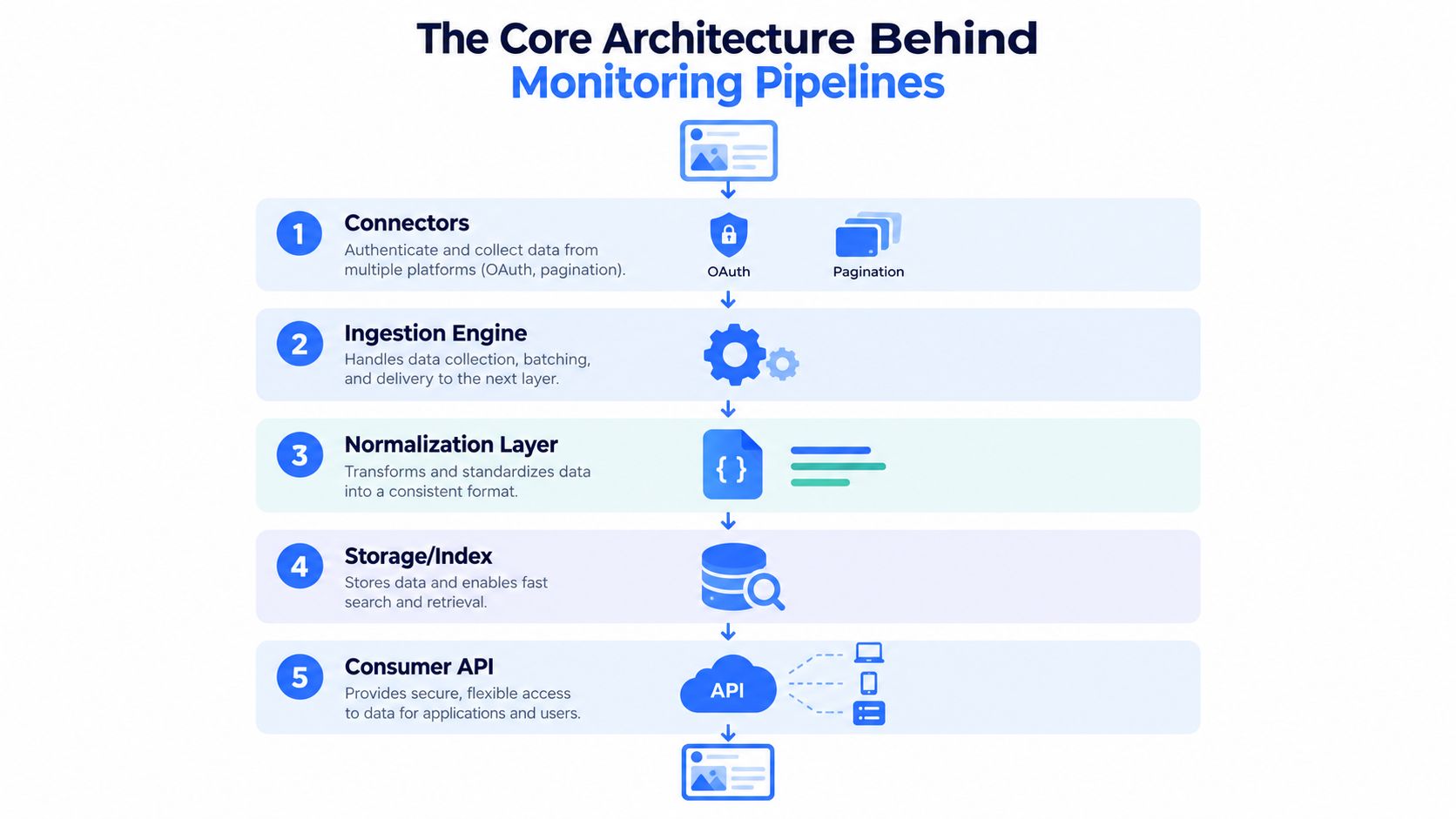
Five layers that keep the system maintainable
Connectors handle OAuth, tokens, pagination, endpoint selection, and platform-specific response shapes. One connector might use a search endpoint, another a stream, and another a mentions endpoint. Each connector should expose a small internal interface such as fetch_page, fetch_thread, or ack_event, while hiding vendor details from downstream services.
Ingestion receives records through polling, streaming, or webhooks. It records the request, response status, cursor, retrieval time, and connector version. Keep the raw payload whenever terms and retention rules allow it. Raw data is your evidence when a normalized field looks wrong after a connector update.
Normalization creates a stable internal model. Convert timestamps to ISO 8601 UTC, case-fold usernames where appropriate, and map reply, repost, and quote relationships into one post_type field. Preserve the original platform values too. A normalized field helps queries, while the original value helps debugging.
Enrichment adds language detection, sentiment, named entities, topic labels, and other derived fields. You can buy some of this processing from a provider or run it in your own service. Store the enrichment model or ruleset version, because a later reprocessing job should explain why two labels differ.
Storage and delivery usually serve different needs. Put searchable fields in an index, preserve raw events in object storage, and use a durable queue to fan records out to alerting, dashboards, analytics, and AI consumers. A stable key such as platform_post_id plus the platform name supports idempotent writes.
One post, end to end
A Reddit thread enters through a connector and lands in the ingestion queue. The worker stores the raw response, maps the author and timestamps into the internal schema, attaches a sentiment result, and indexes the thread for search. A delivery event then sends the normalized record to a retriever used by a RAG pipeline.
That flow can happen quickly, but speed alone isn't enough. If the queue retries a message, the storage layer must recognize the same identity and avoid creating a duplicate. If enrichment fails, the record should remain searchable with an explicit enrichment status rather than disappearing from the system.
A monitoring pipeline should make partial success visible. “Collected but not enriched” is a useful state. Silent loss is not.
Teams designing repeatable ingestion workflows can also review this overview of data pipeline automation. The important design choice is to keep collection, transformation, and consumption loosely coupled. You'll then be able to replace one connector or enrichment service without rewriting the alert engine and every downstream consumer.
Common Endpoints and What They Return
Most monitoring APIs expose similar endpoint families, even when their names differ. Learn the job each family performs before you compare vendor feature lists.
A search endpoint accepts a query, time range, and often a language or source filter. It returns matching posts, comments, or articles. Strong Boolean syntax is the key parameter. You want to express inclusion, exclusion, exact phrases, language, and source conditions without downloading irrelevant material.
A mention or stream endpoint focuses on references to a handle, URL, keyword, or brand string. It suits reputation monitoring and customer-success workflows. The most important parameter is a stable matching pattern. A brand may appear as a handle, a domain, a product name, or a misspelling, so one literal string rarely covers the actual conversation.
A profile endpoint returns account metadata such as a username, biography, verification state, and audience-related fields where permitted. Cache these responses aggressively. Profile data changes more slowly than posts, and repeated lookups waste quota while increasing the chance of throttling.
An engagement endpoint returns likes, shares, replies, views, or similar interaction signals. Some providers include these values with the post, while others require a separate request because metrics update after publication. Batch these lookups and record the retrieval time, since engagement is not a permanent property of the original event.
A thread or conversation endpoint reconstructs replies, reposts, and quote chains. It often requires recursive pagination. Without it, a classifier may see an angry reply without the post that explains the context, or a quoted statement without the original claim.
| Endpoint Family | Returns | Key Parameter | Common Use |
|---|---|---|---|
| Search | Matching posts, comments, or phrases | Boolean query syntax | Keyword research and trend detection |
| Mentions or streams | References to handles, URLs, or brand terms | Stable matching pattern | Reputation and support alerts |
| Profiles | Account metadata and audience fields | Cache policy and account identifier | Audience analysis and account classification |
| Engagement | Likes, shares, replies, views, and related signals | Batch size and metric timestamp | Performance analysis |
| Threads or conversations | Replies, quotes, and conversation relationships | Recursive pagination cursor | Context-aware AI and moderation |
Endpoint naming isn't universal, so read the response examples rather than relying on labels. This explanation of API endpoints is useful when you're translating a vendor's documentation into an internal contract. For video-heavy products, a developer may also compare a specialized option such as the Klap developer API, then check whether its returned objects match the monitoring fields the rest of the system expects.
Rate Limits and Platform Instability as Engineering Problems
The first production incident often has nothing to do with sentiment accuracy. It starts with a quota response. A monitoring service can appear healthy during a quiet test and fail when a launch, crisis, or viral post creates a sudden burst of matching content.
Platform quotas may apply at the application, user, and token level. Meta's Graph and Instagram APIs use limits tied to those identities, while TikTok documentation described in a university guide includes per-endpoint ceilings and an overall 100,000 requests per day cap across its APIs, as summarized by this social listening API analysis. That means a unified layer must normalize different limits and schedule work adaptively rather than assuming one global request budget.
Read rate-limit headers, but don't worship them. Retry-After and reset timestamps can be delayed, rounded, scoped to a different token, or inconsistent with the behavior you observe. Use per-connector token buckets, bounded exponential backoff, and a queue that separates urgent streams from lower-priority profile refreshes.
| Failure Mode | Symptom | Mitigation |
|---|---|---|
| Quota exhaustion | 429 responses and growing lag | Token buckets, adaptive scheduling, and priority queues |
| Endpoint retirement | Requests fail after a platform change | Versioned connectors, endpoint health checks, and fallback logic |
| Schema drift | Parsers reject valid responses or fields change meaning | Contract tests, raw payload retention, and migration monitoring |
| Duplicate delivery | The same event triggers repeated alerts | Idempotency keys and deduplicated writes |
| Out-of-order webhooks | A newer state is overwritten by an older event | Event timestamps, version checks, and monotonic updates |
| Poison payloads | One malformed record blocks retries | Dead-letter queues and bounded retry counts |
Access also changes over time. Independent analysis notes that unexpected API changes and authentication-policy shifts can impair or disable monitoring workflows, while some functions remain unavailable because of platform restrictions, as discussed in this review of social listening API risks. Build connector maintenance into the operating budget. Monitor endpoint health separately from application health, and alert when coverage drops even if requests still return successful status codes.
Failure planning: Prefer a clearly marked stale record to an empty dashboard that looks current.
A circuit breaker can stop a failing connector from consuming every worker. A dead-letter queue can hold malformed events for inspection. Idempotency keys let you replay a time window safely after an outage. These are ordinary backend patterns, but monitoring systems need them because missed content can change the conclusion your users draw from the data. For a broader explanation of throttling behavior, see this guide to API rate limits.
How Different Teams Choose the Right API
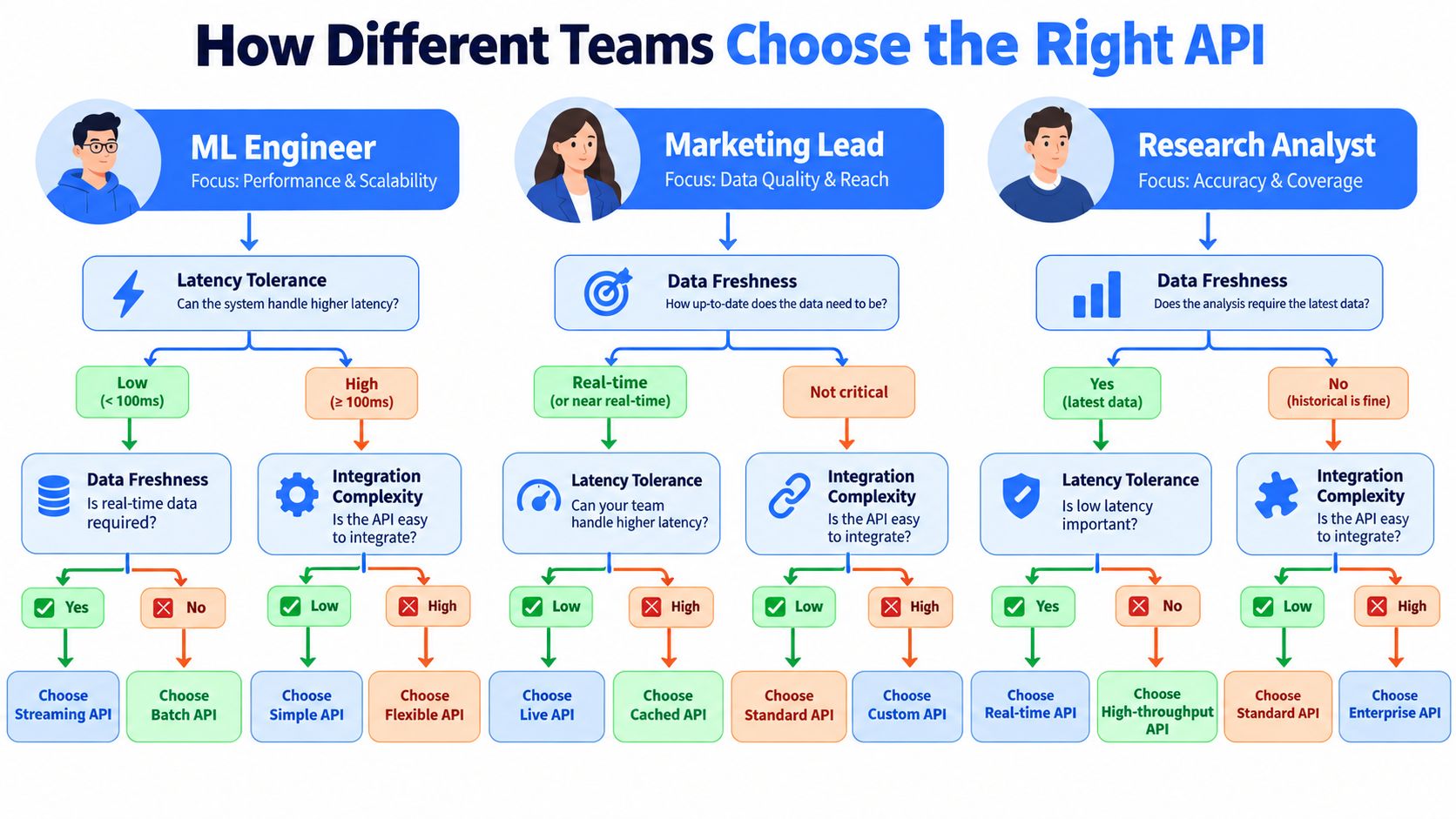
The right provider depends on who will operate the resulting data. A machine-learning engineer, a marketing lead, and an academic researcher can evaluate the same API and reach different conclusions without either person being wrong.
The ML engineer
An ML engineer building a RAG corpus will usually ask about historical depth, query coverage, thread completeness, stable identifiers, and payload structure. A polished dashboard matters less than whether the API returns enough context to chunk documents, attach metadata, and reprocess embeddings later.
The engineer should test pagination, deletion behavior, duplicate events, and the availability of raw text. They should also check whether the provider returns source URLs, author identifiers, timestamps, language, and engagement fields consistently across networks.
The marketing lead
A marketing lead may prioritize fresh brand mentions, sentiment labels, alert routing, and summaries that can reach Slack or a customer-support workflow. The marketing team may never call the SDK directly, so setup, query management, permissions, and operational visibility matter as much as endpoint breadth.
A provider that requires engineers to build every alerting screen may be a poor fit for a team that needs controlled workflows quickly. Conversely, a dashboard-first product may frustrate a product team that needs to embed records in its own application.
The researcher
A researcher needs reproducibility. Stable identifiers, exportable raw JSON, documented sampling, timestamp semantics, retention rules, and a clear record of query changes matter more than a visually impressive trend panel.
Across all three roles, inspect criteria vendors often under-explain:
- Connector reliability: Ask how the provider measures uptime and how it reports partial coverage.
- Migration effort: Find out how schema changes are announced and whether old response versions remain available.
- Operational transparency: Look for a public status page, changelog, incident history, and support escalation path.
- Cost shape: Separate the cost of collected posts from the cost of enriched records, storage, and repeated retrieval.
- Lock-in risk: Identify which fields are portable if an endpoint disappears or you change providers.
A two-week pilot against your own workload is more informative than a synthetic benchmark. Run the real queries, include quiet and busy periods, inspect missing fields, replay failures, and ask a second developer to integrate from the documentation. If you need to compare an API with an integration platform, this guide to iPaaS and low-code tools provides useful context, especially for teams deciding how much connector logic to own.
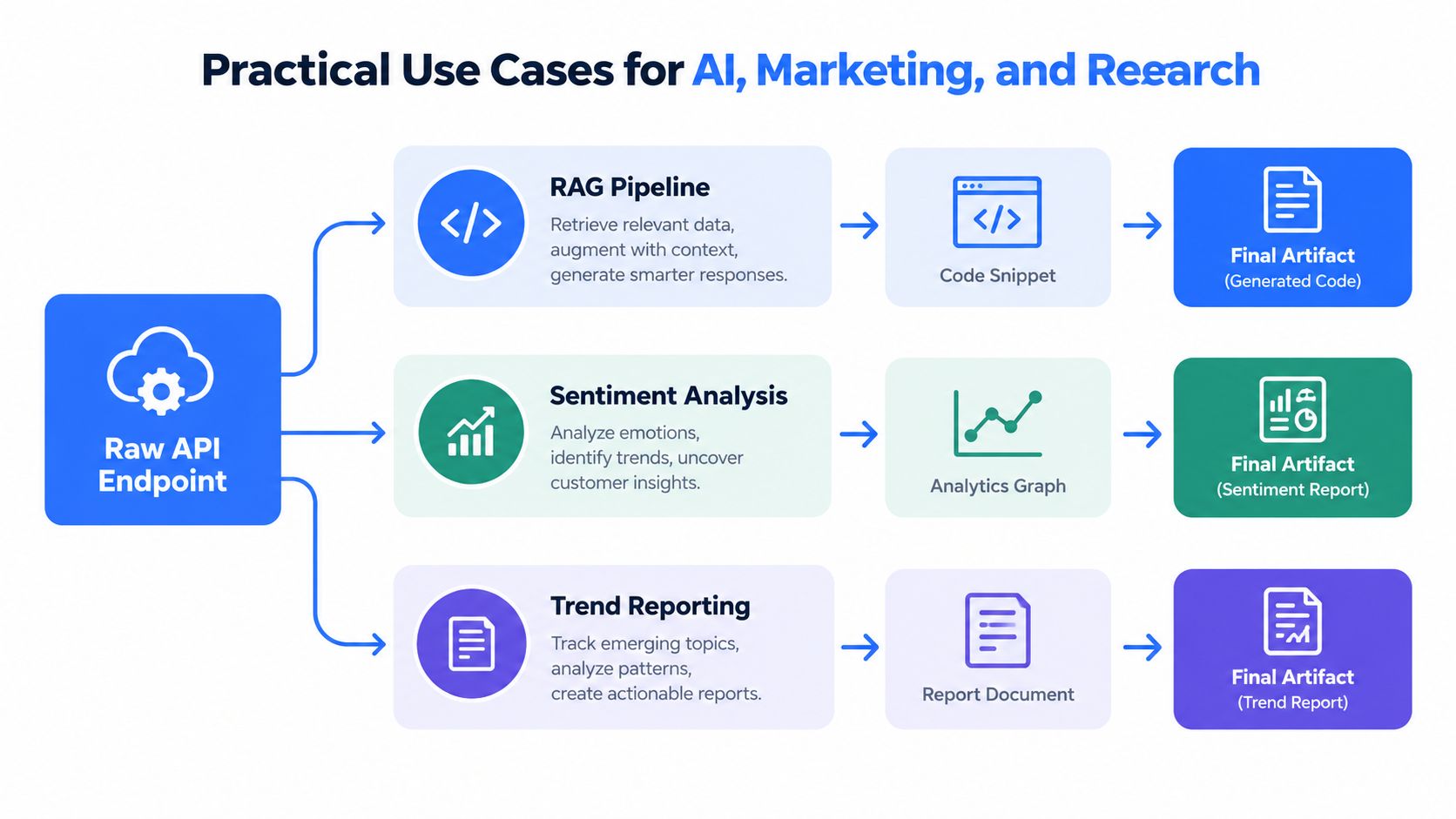
Practical Use Cases for AI, Marketing, and Research
The same post endpoint can support very different products. The difference comes from what you do after ingestion, how you weight records, and which errors your users can tolerate.
RAG pipelines need context, not just volume
A RAG workflow can send search results through a chunker, an embedding service, and a vector store. The useful record includes the text, source, author, timestamp, platform, thread relationships, and retrieval metadata. Recency and source authority often matter more than collecting every possible snippet.
The API supplies documents and identifiers. It doesn't decide whether a sarcastic reply contradicts the original post, whether two accounts represent the same organization, or whether an old thread remains authoritative. Your retrieval layer needs filters, deduplication, freshness rules, and a way to show citations back to the source record.
Trend detection depends on event handling
A streaming mentions endpoint can feed a rolling aggregation service. That service groups records by keyword, hashtag, source, language, or topic and emits an alert when activity changes materially relative to the configured baseline.
Dashboards are useful for inspection, but an API-first workflow can send the event directly to an alert engine. The engine may apply suppression windows, require multiple signals, attach representative posts, and route the alert to a response team. Without deduplication and rate-aware ingestion, a popular term can create a flood of duplicate notifications instead of a useful warning.
Competitive monitoring is longitudinal
Scheduled author-post requests for a list of competitor handles create a longitudinal feed. Analysts can then examine campaign cadence, creative themes, recurring formats, and audience responses without manually collecting posts from each account.
This workflow benefits from stable author and post identifiers, consistent timestamps, and snapshots of changing engagement fields. It still won't explain the full strategy by itself. Multimedia meaning, sarcasm, private activity, and unexposed audience data remain outside what a typical public monitoring API can reliably provide.
Cross-platform completeness is the difficult part. There isn't a universal monitoring API with complete, real-time access across every network. Public search, comments, and streams vary by platform, with TikTok, Instagram, LinkedIn, and Facebook especially constrained, as explained in this overview of cross-platform monitoring coverage. A platform-agnostic schema can make records consistent, but it can't create access that the source platform doesn't provide.
For teams working with public video and social records, social media content analysis offers a useful way to think about the transformation layer. The shared architectural lesson is simple: the monitoring API is an ingestion layer. Your retrieval, alerting, analysis, and reporting systems create the product value.
Shipping Your First Integration and What Comes Next
Start smaller than your requirements document suggests. Choose one platform, one narrow query, one delivery method, and one normalized record shape. A focused slice exposes authentication, pagination, freshness, quota behavior, and duplicate handling before you multiply those problems across networks.
A practical first version looks like this:
- Define the event: Store the platform, post ID, source URL, author ID, text, created time, retrieved time, post type, and raw payload reference.
- Choose delivery: Use a webhook if the provider offers dependable events. Otherwise, poll with a cursor and persist the cursor after each successful page.
- Make writes idempotent: Key records by platform and post ID. Treat replays as normal rather than exceptional.
- Add staging controls: Test queries, limits, retry behavior, and malformed responses outside production. Keep a small fixture set for connector regression tests.
- Prove freshness: Run a short backfill, compare returned timestamps with retrieval timestamps, and record where gaps appear.
- Scale deliberately: Add another query or platform only after you can observe coverage, latency, quota use, failed enrichment, and queue depth.
This approach also clarifies whether you need a unified provider or direct platform connectors. A unified provider reduces integration surface area, while direct access may expose deeper platform-specific data. Either choice still requires monitoring for connector rot, missing fields, and policy changes.
API-first ingestion is becoming more important for AI workflows because teams need structured, post-level records inside products rather than insights trapped in a dashboard. Recent industry coverage describes growing demand for low-latency alerts, normalized data, retries, caching, and outputs suitable for RAG and agent pipelines. One 2026 estimate places the social-listening market at $12.15 billion and projects a 17.1% CAGR, as reported by Phyllo's social listening analysis. Treat that as a projection, not a guarantee about your own workload or provider.
The next vendor decision should therefore include maintenance capacity. Ask who owns connector updates, how quickly schema migrations arrive, how raw events are preserved, and what happens when a source removes an endpoint. Feature lists attract attention, but dependable ingestion, transparent failures, and portable records determine whether the system survives production.
Captapi provides a developer-first REST interface for public data from YouTube, TikTok, Instagram, and Facebook, including search results, comments, transcripts, engagement metrics, and summaries. Use it as one possible ingestion layer for monitoring, RAG, competitive research, or comment analysis, then visit Captapi to review the available endpoints and start testing with your own workload.