
What Is Social Media Data: The Complete Guide
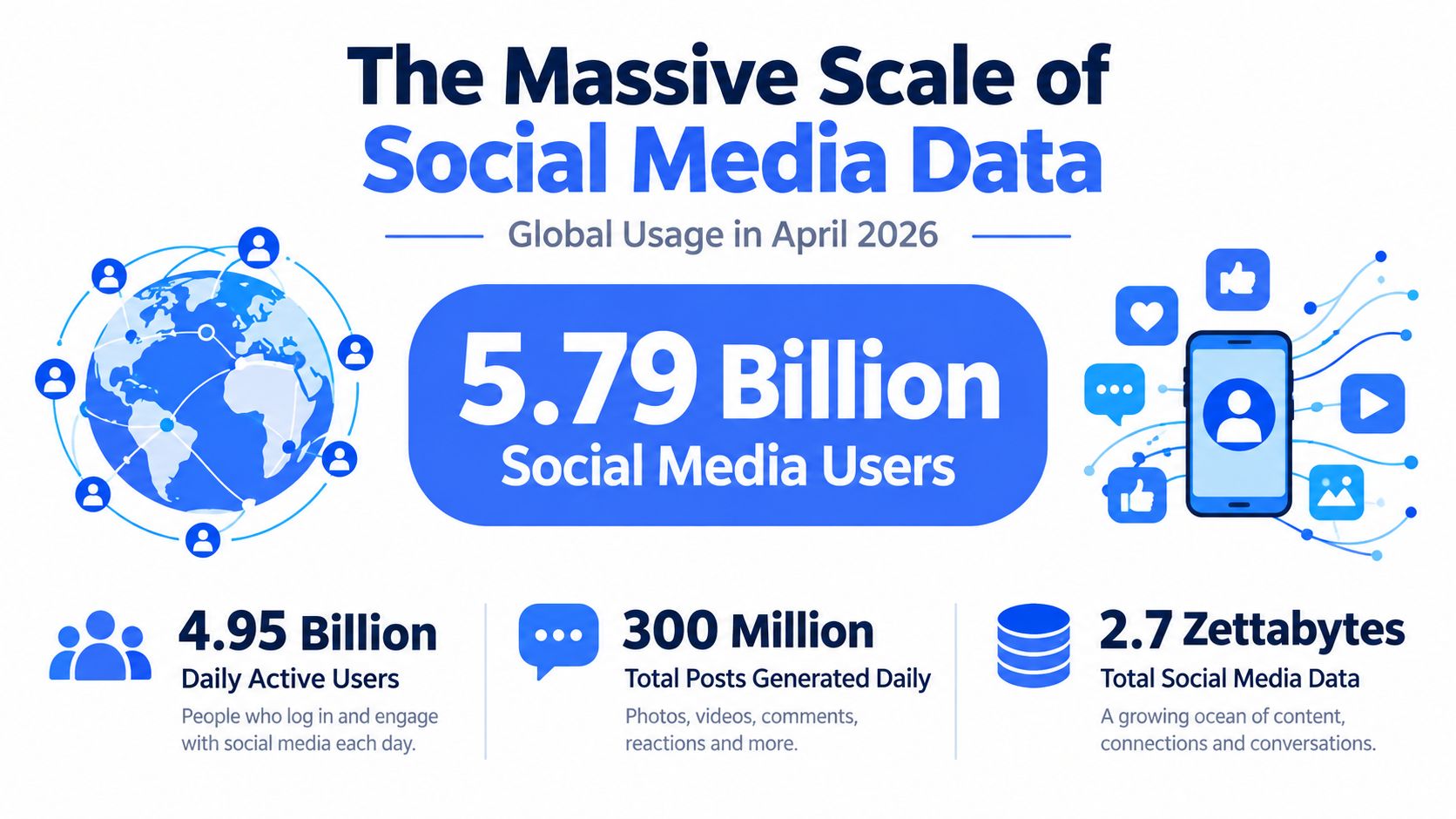
Social media data includes public posts, comments, videos, profiles, metadata, and engagement signals created across platforms. In April 2026, it covered 5.79 billion social media user identities, equal to 69.9% of the world's population.
That number changes how you should think about the subject. Social media data isn't a small collection of posts from a narrow online community. It's a constantly changing record of conversations, media, relationships, reactions, and behavioral signals produced across many networks.
For a data engineer, the important question isn't only “What did someone publish?” It's also when was it published, who interacted with it, how did it spread, and which fields can a production system legally and reliably use? Understanding those layers helps marketers build better listening systems, researchers interpret evidence carefully, and AI teams create RAG pipelines without treating public visibility as unlimited permission.
Table of Contents
- The Massive Scale of Social Media Data
- Anatomy of Social Media Data
- Primary Use Cases for Social Data
- The Multi-Platform Reality
- Common Misconceptions About Social Data
- Legal and Ethical Boundaries
- Conclusion and Key Takeaways
The Massive Scale of Social Media Data
In April 2026, analysis from DataReportal and We Are Social estimated 5.79 billion social media user identities worldwide, representing 69.9% of the world's population. The same analysis reported annual growth of 5.4%, with about 9.3 new user identities added every second.
Consider a product team monitoring a new category, such as home energy equipment. A single post might mention a product. Comments can reveal objections, replies can expose recurring questions, and shares can show which communities are carrying the discussion forward. The value comes from the combined record, not from one isolated message.
The broader global social media user base grew from 970 million in 2010 to 5.79 billion in 2026, a more than fivefold increase over roughly sixteen years, according to the same global digital update. That expansion made social media data useful for trend detection, consumer research, brand tracking, and large-scale content analysis.
A practical definition
Social media data is the collection of content, metadata, interactions, and network signals generated through social platforms. Content includes text, photographs, video, audio, captions, and links. Interactions include reactions, comments, shares, follows, and other visible activity. Metadata describes the surrounding context, such as timestamps, authorship, hashtags, mentions, and location fields when available.
A useful analogy is a busy public market. The posts are the conversations and products on display. The metadata is the market ledger, showing when activity happened, which stall attracted attention, and how visitors moved between conversations. You need both views to understand what occurred.
Anatomy of Social Media Data
A social platform doesn't produce one flat spreadsheet. It produces related records, much like a parcel delivery system stores the package, the sender, the destination, the route, and each delivery scan separately.
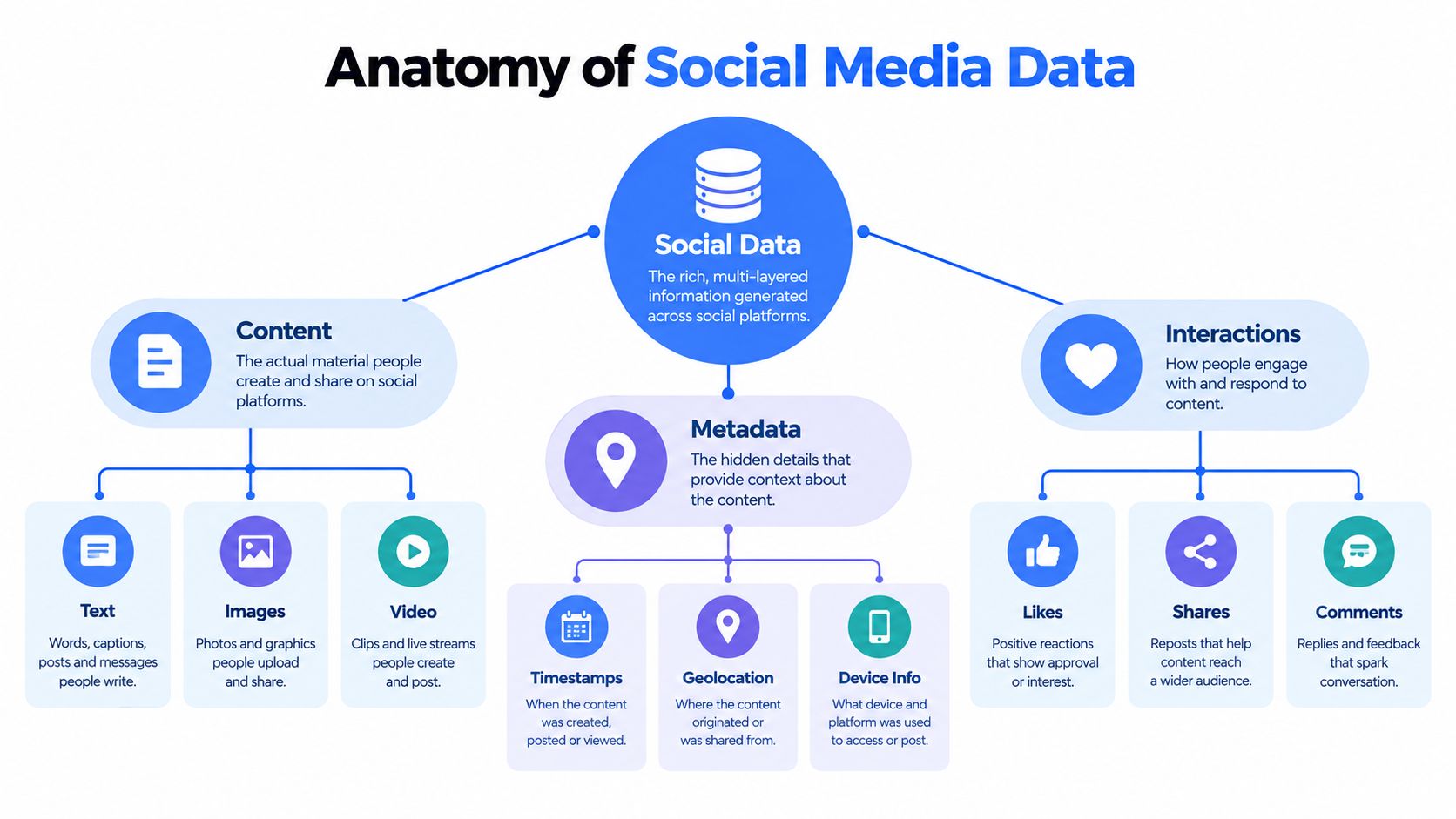
Technical analyses commonly distinguish between content objects and metadata fields, including timestamps, author identity, resharing frequency, geography, hashtags, and mentions, as described in this technical analysis of social media data.
The content layer
The content layer is what people usually notice first:
- Text: Posts, captions, comments, replies, transcripts, and profile descriptions.
- Visual media: Images, videos, thumbnails, and image captions.
- Audio and speech: Recorded audio, spoken video content, and machine-generated transcripts.
- Reactions: Likes and other response objects attached to a post or media item.
- Links and tags: URLs, hashtags, mentions, and references to other accounts or entities.
This layer answers questions about meaning. What topics appear? What language do people use? Which complaints, ideas, or requests occur repeatedly?
The context layer
Metadata provides the surrounding structure. A timestamp places a message on a timeline. An author identifier connects activity to an account or profile. A geography field can support regional analysis when the platform exposes it. Resharing frequency, mentions, and hashtags help systems trace relationships and propagation.
Without that context, two identical posts look identical even if one appeared in a private community and the other spread through a large public network. Metadata helps analysts distinguish content volume from content movement.
You can use a social media engagement metrics guide to explore how interaction fields become measurable indicators, but engagement remains only one part of the dataset. A production pipeline should preserve the original content and its context rather than reducing everything to a score.
The following video offers another visual explanation of how social data can be organized and interpreted:
Primary Use Cases for Social Data
Social media data fits the common definition of big data because it combines scale, variety, and speed. A platform can produce text, video, reactions, profile records, and relationship signals at the same time, while users and algorithms continually change what appears next. Research-oriented definitions describe it as user-driven platform data created for interaction, with applications in machine-learning pipelines and social listening systems, as outlined in this research discussion of archived social media data.
Retrieval-augmented generation
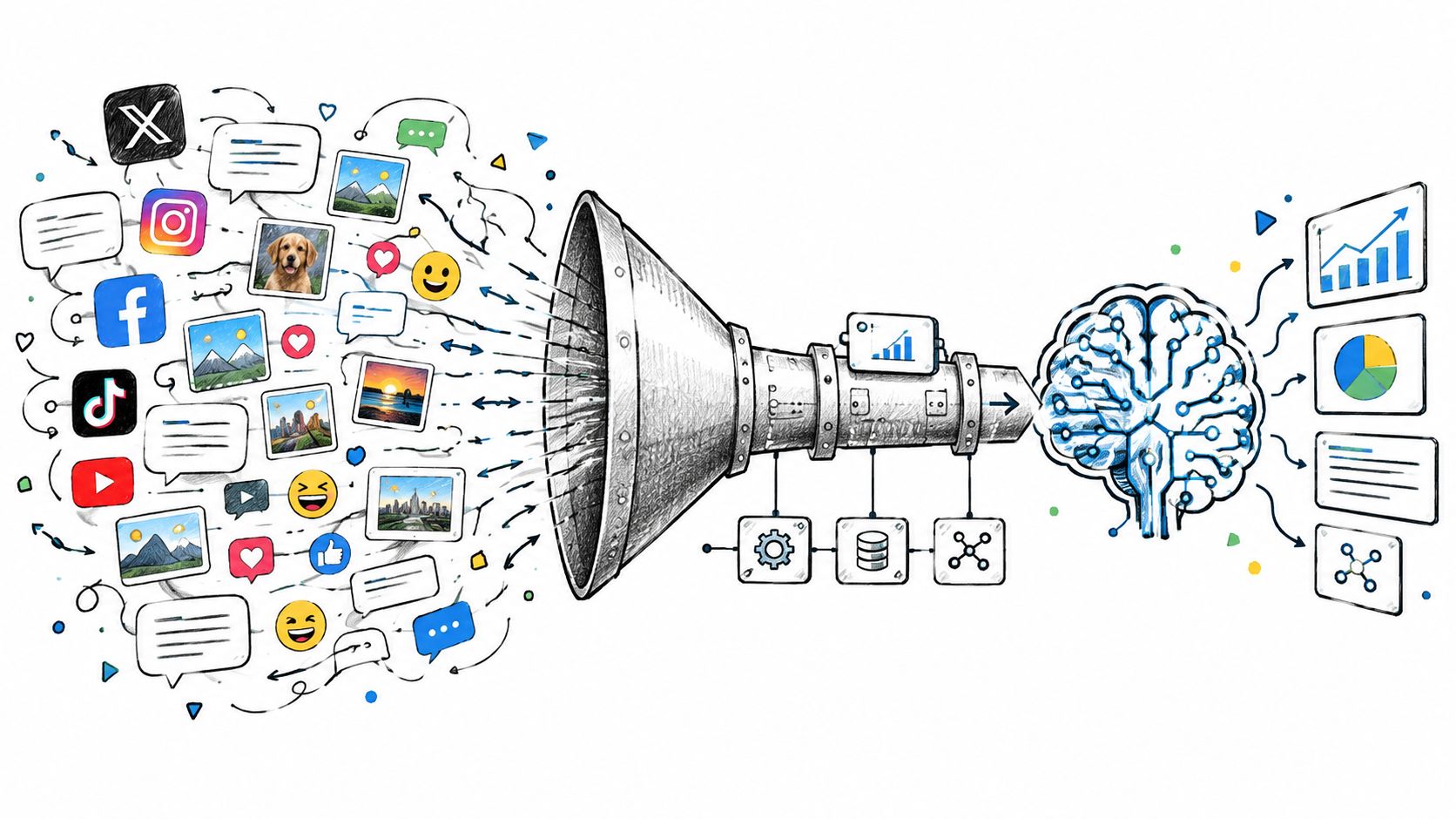
For an AI team, social data can become a retrieval corpus. A RAG system might retrieve public video transcripts, comments, captions, or posts before generating an answer about audience questions or current discussion themes.
The workflow resembles a reference librarian:
- Ingestion: Collect permitted public records through an approved source.
- Normalization: Convert different platform formats into a consistent schema.
- Chunking: Split long transcripts or posts into useful retrieval passages.
- Indexing: Store text and selected metadata in a search or vector system.
- Retrieval: Find relevant records for a user query.
- Generation: Produce an answer grounded in the retrieved material.
The metadata matters here. A timestamp can help the system prefer recent material. A platform field can prevent unsupported comparisons. A content URL can help an evaluator trace an answer back to its source.
Teams working specifically with creator performance may also benefit from this practical Twitter analytics guide for creators, especially when deciding which engagement fields belong in a reporting or retrieval workflow.
Social listening and content analysis
A social listening system monitors terms, entities, topics, and sentiment-related language across selected sources. It can group brand mentions, identify recurring complaints, compare content themes, and surface unusual changes in conversation. Analysts may combine reach, impressions, engagement, follower growth, and conversion fields to evaluate how content characteristics relate to outcomes.
That doesn't mean the system proves causation automatically. A post can receive attention because of timing, controversy, a recommendation system, or an unrelated news event. A reliable analyst treats metrics as evidence to investigate, not as a complete explanation.
For a deeper workflow, social media content analysis can help teams think beyond counting posts and toward classifying themes, extracting entities, and preserving context.
The Multi-Platform Reality
A user's social data is distributed across services with different interfaces, identifiers, formats, and rules. In 2026, the average user was reported to visit about 6.75 social networks per month and spend roughly 2 hours and 40 minutes per day on social media apps, according to Sprout Social's social media statistics overview.
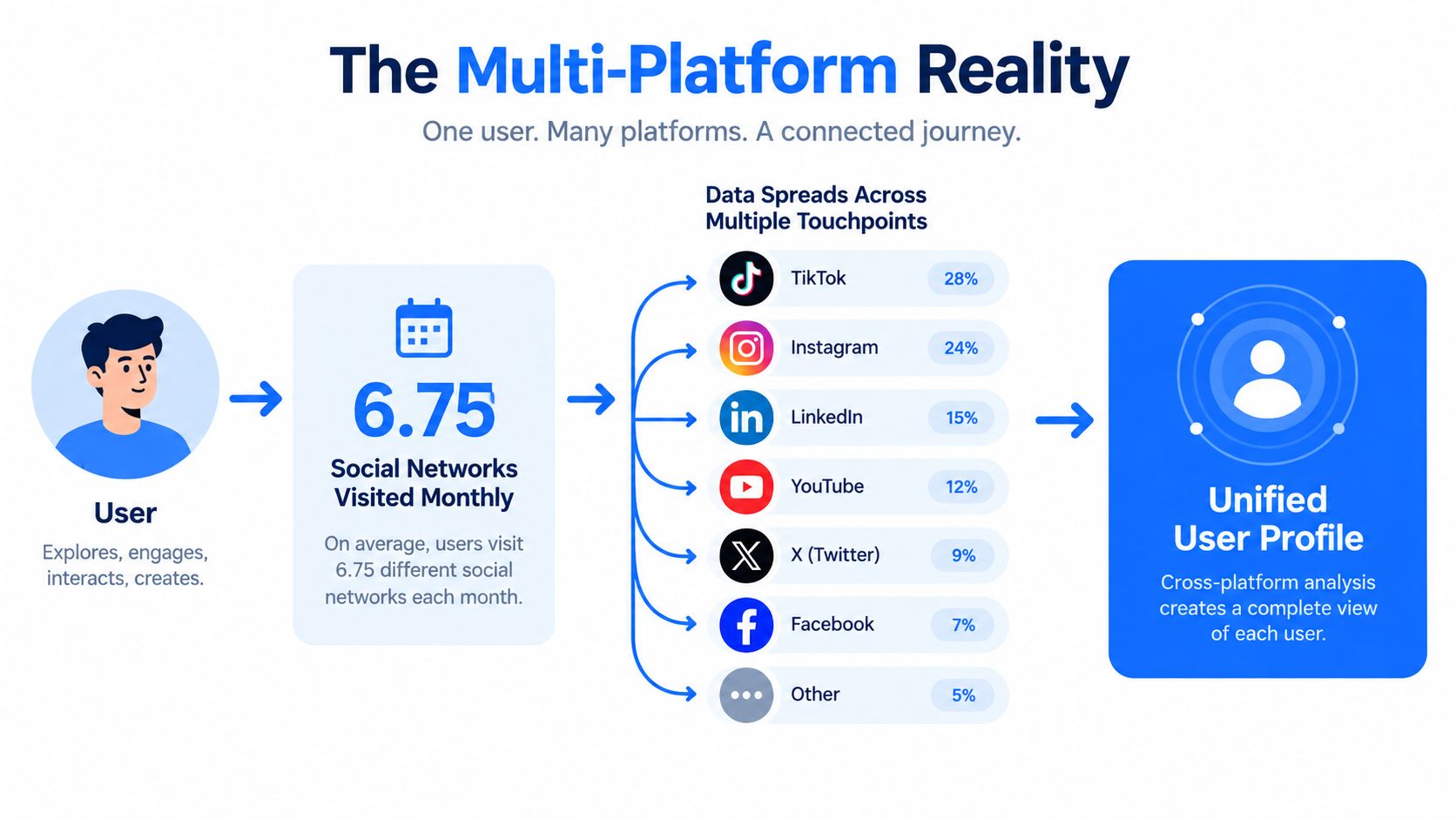
A person might discover a product on TikTok, watch an explanation on YouTube, discuss it in an Instagram comment, and share a link through Facebook. Those events don't automatically form one clean customer record. Each platform may expose different fields, use a different account identifier, and represent interactions in its own way.
Why unification is difficult
Cross-platform analysis requires more than combining exports. Engineers need a canonical schema that separates shared concepts from platform-specific fields. For example, “comment” may exist everywhere, but the available author information, parent relationship, moderation status, and timestamp precision can differ.
A practical normalized record might include:
| Common field | Purpose |
|---|---|
| Platform | Identifies the originating network |
| Object type | Distinguishes a post, comment, video, profile, or reply |
| Published time | Supports chronological analysis |
| Author reference | Connects activity where permitted |
| Text or transcript | Enables search and language analysis |
| Interaction fields | Preserves visible response signals |
| Source URL | Supports traceability |
The objective isn't to pretend every platform is equivalent. It's to build a shared analytical layer while retaining the original platform context. Analysts exploring collection options may find this overview of the best YouTube scraper useful for comparing approaches and tradeoffs.
A social media APIs overview can also help teams evaluate whether they need separate integrations or a unified interface. Either way, cross-platform results should be labeled carefully. A “high engagement” event on one network may not be directly comparable to the same label elsewhere.
Common Misconceptions About Social Data
The first misconception is that social media data means posts and likes. Those are visible, but they represent only the surface. A fuller dataset can include profile fields, timestamps, hashtags, mentions, network relationships, and resharing patterns, as explained in this social data glossary.
Think of a social post as a book in a library. The words are the book's content. The catalog record tells you who published it, when it entered the collection, which subjects it covers, and which other books cite it. Removing the catalog record makes the book harder to find and almost impossible to place in a larger research history.
Misconception one, more volume means more insight
Counting mentions can show activity, but it can't explain intent by itself. A sudden rise may reflect genuine interest, a coordinated campaign, repeated reposting, a platform recommendation, or a news event. Analysts need to inspect content, authorship patterns, timing, and network behavior together.
Misconception two, public means unrestricted
A post can be visible in a browser while still being subject to platform rules, access conditions, privacy expectations, and limits on reuse. Visibility answers the question “Can someone see this?” It doesn't automatically answer “Can my application copy, store, enrich, redistribute, or use this material for model training?”
Misconception three, social data represents everyone equally
Social platforms aren't neutral polling systems. The observed audience is shaped by platform design, moderation, recommendation systems, account activity, and population changes. A conversation can be meaningful for the community producing it without representing people who aren't present or active on that platform.
That distinction matters in research and marketing. Treat platform signals as situated evidence, not a universal measurement of public opinion. Compare sources cautiously, document collection conditions, and avoid turning platform-specific behavior into broad claims about an entire population.
Legal and Ethical Boundaries
The compliance boundary begins before data reaches your database. A developer must decide not only whether content is publicly visible, but also whether collection, storage, processing, and downstream use are authorized under the relevant platform rules, contracts, and laws.
Public accessibility is a technical condition. Permission to reuse is a governance condition. Confusing the two creates fragile products that may stop working when an API changes, a platform removes a field, or a user deletes content.
Build the boundary into the pipeline
A production RAG system should treat provenance and permissions as first-class fields, not as notes in a separate document. Store the source platform, retrieval time, source URL, collection method, permitted use, retention requirement, and deletion handling where your governance process requires them.
Use a checklist such as:
- Source rules: Confirm the platform's current terms, API conditions, robots guidance where relevant, and access requirements.
- Data minimization: Collect only the fields required for the stated use case.
- Sensitive information: Avoid unnecessary personal, sensitive, or inferred attributes.
- Retention controls: Define when records expire and how deleted or restricted material is removed.
- Access control: Limit internal access to raw content and identifiable metadata.
- Model isolation: Decide whether content can enter prompts, embeddings, fine-tuning data, or evaluation sets.
- Auditability: Keep enough provenance to explain where a retrieved passage came from.
Platforms change APIs, permissions, and retention rules, so a pipeline that works today may not remain compliant tomorrow. A social media compliance guide can help teams frame these questions before implementation, but it shouldn't replace legal review for a specific jurisdiction or product.
Ethics also extends beyond formal compliance. Redact information that isn't needed, avoid profiling people from weak signals, and give reviewers a way to challenge automated classifications. A system that produces impressive summaries but can't explain its sources or honor removal requests isn't production-ready.
Conclusion and Key Takeaways
Social media data works like a distributed archive with several connected layers. Posts, videos, comments, and transcripts carry meaning. Metadata records context, including timestamps, platform, object type, and provenance. Interactions and relationships show how information circulates and how audiences respond.
That distinction matters in production. A RAG system may retrieve public text to support an answer, while a social listening workflow groups conversations and recurring themes. Researchers can examine digital communities, and marketers can compare content characteristics with visible performance signals. Each use case requires the right fields and a clear purpose.
Keep these principles in the design:
- Preserve context: Store timestamps, platform identity, object type, and provenance beside each record.
- Normalize carefully: Use shared fields for comparison while retaining platform-specific meaning.
- Interpret cautiously: Social signals represent particular platform populations and design choices, not society as a whole.
- Govern from the start: Make collection, retention, deletion, access, and model use explicit engineering requirements.
- Design for change: APIs, fields, permissions, and platform populations will evolve.
A social media database offers a useful conceptual structure for profiles, posts, comments, transcripts, and engagement records. Its value depends on connecting those records to a defined research or product objective, with provenance intact.
The answer to “what is social media data” is simple at the highest level: it is the digital trace of social activity, plus the context needed to interpret that trace. Understanding the layers helps teams retrieve stronger evidence, measure conversations, and set a clear boundary between usable public data and information requiring stricter controls.
Captapi provides a developer-focused REST API for structured public data from YouTube, TikTok, Instagram, and Facebook, including transcripts, comments, summaries, engagement metrics, profiles, and search results. Visit Captapi to review its API for a RAG, social listening, or research pipeline.