
Best APIs for Developers: 10 Tools Compared for 2026
The cheapest API on the pricing page is rarely the cheapest in production. A low entry price can disappear under retries, uncached requests, regional fees, minimum commitments, or a billing model that charges separately for every useful feature. An API can also look simple until authentication becomes a product problem, rate limits collide with background jobs, or a provider changes the upstream platform you depend on.
I judge the best APIs for developers against the same questions: How do I authenticate? What happens at the rate limit? Can I forecast cost at scale? What breaks first? Documentation matters just as much. Stack Overflow's 2024 Developer Survey found that 75% of developers were more likely to endorse a technology with API access, while 90% preferred API and SDK documentation as a documentation source. The same survey reported that 61% spent more than 30 minutes per day searching for development answers, so poor integration guidance creates a real engineering cost.
The list below focuses on practical fit, not feature count. Each entry includes the useful trade-off, the likely operational pain, and the limitation that should influence your decision before you commit.
Table of Contents
- 1. Captapi
- 2. Algolia
- 3. OpenAI API
- 4. Supabase
- 5. Firebase
- 6. Stripe
- 7. Twilio
- 8. Twilio SendGrid
- 9. Mapbox
- 10. Plaid
- Top 10 Developer APIs Comparison
- Match the API to Your Data, Scale and Budget Before You Sign Up
1. Captapi
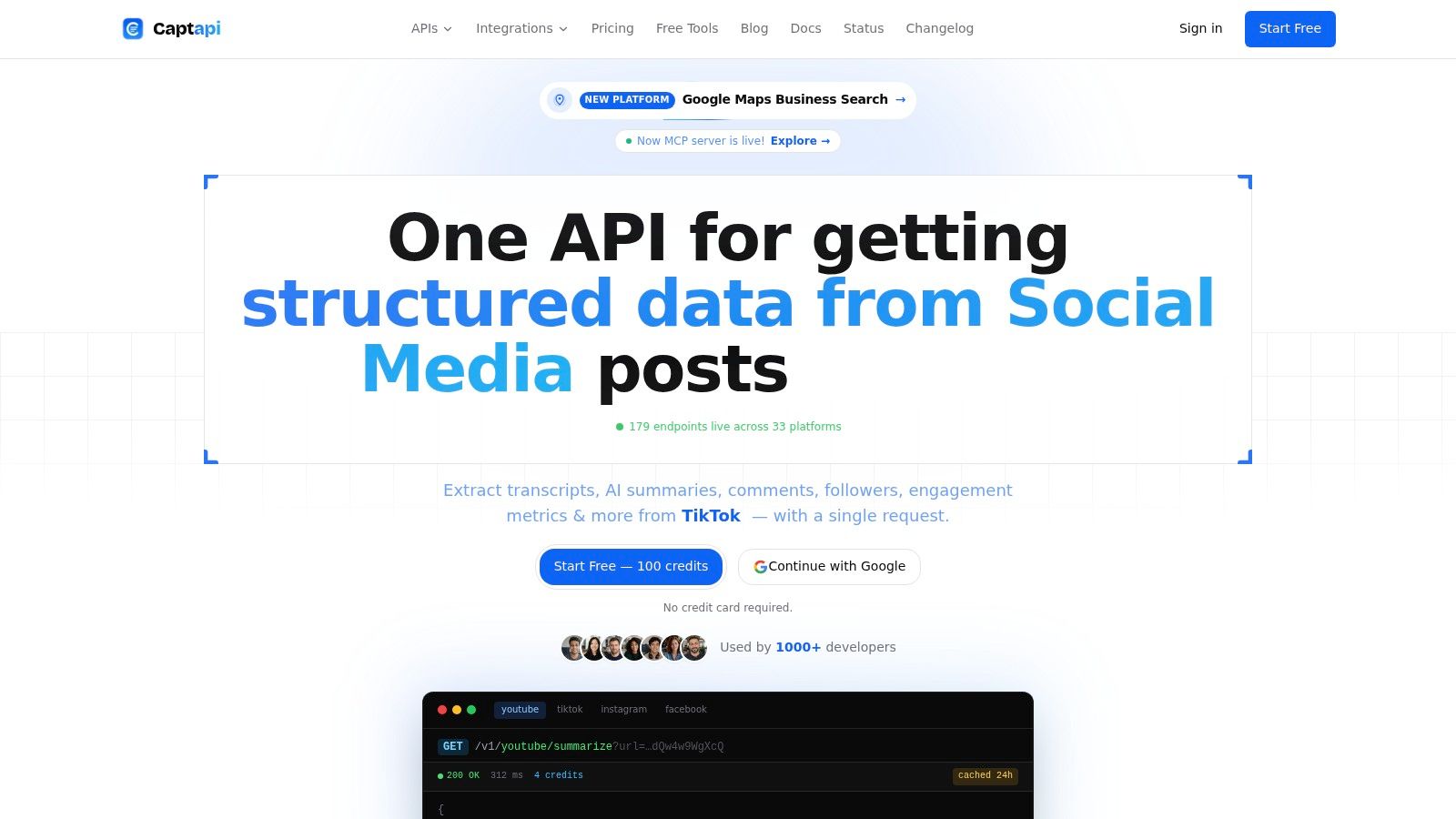
Captapi suits applications that need public social-media data across several platforms and cannot justify a separate integration for each network. It exposes one REST interface for posts, videos, transcripts, comments, profiles, search results, and engagement data across 33 platforms and 179 endpoints, according to Captapi's product information. The practical benefit is consistency: one ingestion pattern, shared response handling, and fewer platform-specific authentication flows.
Authentication uses an API key. Create an account, generate the key, and call an endpoint such as /v1/youtube/summarize. Captapi does not require OAuth for the public data it extracts, which reduces account-linking and token-refresh work. Its Apify-backed scrapers use retries, and an optional 24-hour shared cache can return repeated results without consuming additional credits.
Captapi reports a roughly 97% success rate over the last 30 days and says its service is used by more than 1,000 developers. These are provider-reported figures, so test the endpoints and response types that your workload depends on before making the API part of a critical pipeline.
Where Captapi fits best
The API supports RAG ingestion, video question-answering, competitor monitoring, social listening, caption generation, and comment research. Transcripts and GPT-4o-mini summaries can shorten the path from raw video to searchable knowledge. Normalized engagement fields also reduce custom transformation work when you compare activity across platforms.
Billing uses credits rather than a simple request count. Available tiers include a Free plan with 100 lifetime credits, Starter at $9 per month for 2,000 credits, Pro at $27 per month for 6,000 credits, and Business at $90 per month for 20,000 credits. Business rate limits reach 600 requests per second, with paid support options. Confirm current pricing, quotas, and endpoint costs on Captapi's pricing page before purchase.
Practical rule: Measure credit consumption with the largest response types, not only a lightweight profile lookup. Bulk comments, transcripts, and AI summaries can produce a very different operating cost from cached reads.
The main limitation is scope. Captapi is read-only and public-data focused. It does not provide private content, account-level permissions, or publishing operations. Your team still owns downstream storage, retention, consent, and compliance decisions. That trade-off fits broad public extraction through one interface, while products requiring private access or write operations may need an official platform API.
2. Algolia
Algolia works best when search is a customer-facing product rather than a database query you happen to expose. It provides hosted indexing, typo tolerance, ranking rules, synonyms, personalization, analytics, and AI-assisted discovery. The integration is usually straightforward because the platform supplies APIs, UI libraries, connectors, and implementation guidance for common ecommerce and content-search patterns.
Authentication is based on application credentials and scoped keys. Keep administrative keys on the server, generate restricted search-only credentials for clients, and treat index permissions as part of your application security model. Algolia's request and record metering is easier to reason about than a vague “unlimited search” promise, but the model still requires you to understand which operations create billable usage.
The main operational question is not whether Algolia can handle search. It's whether your ranking configuration remains understandable as business rules, personalization, synonyms, and AI features accumulate. A relevance issue can look like an API failure when the actual problem is an index configuration or a ranking rule that no longer matches user intent.
Cost and limits
Starter quotas make evaluation accessible, while larger indexes and advanced AI capabilities can become expensive as usage grows. Enterprise AI features such as premium tiers require a larger commercial commitment. Forecasting needs both search request volume and indexed-record growth, plus the cost of optional relevance and personalization features.
For an ecommerce team, Algolia can be a faster route to a polished search experience than building ranking, typo handling, analytics, and merchandising controls internally. For a small internal tool with modest search requirements, PostgreSQL full-text search may create less operational overhead.
The best search API isn't the one with the most ranking controls. It's the one your team can debug when users say the right result isn't appearing.
Read the practical differences between hosted search approaches in this guide to search and discovery, then test real queries rather than relying on a demo index. The limitation is cost complexity at the advanced end. Algolia's documentation and tooling are strong, but premium relevance features can turn a simple search bill into a multi-variable commercial calculation.
Explore Algolia before committing your catalog or content index.
3. OpenAI API
The OpenAI API is a practical fit for applications that combine language, image, audio, realtime interaction, and tool use. Its Responses API and SDKs support common workloads such as RAG, summarization, coding assistance, and agent orchestration. The strength is breadth. You can start with a text workflow and add multimodal inputs or structured tool calls without replacing the whole integration.
Authentication uses API keys, so key storage and project separation matter from the first prototype. Keep keys server-side, restrict who can create them, and monitor usage by project. Token-based billing gives you a direct relationship between input, output, model choice, and cost, but it also means prompts, retrieved context, tool results, and retries all influence the bill.
Model selection is the first thing that tends to break forecasting. The lineup changes, capabilities differ, and a workflow that works well on one model may need different prompting or output validation on another. Batch processing and caching can improve economics for suitable workloads, while faster tiers can change the cost and latency trade-off.
Building an agent safely
An agent integration needs more than a successful chat response. Define schemas for tool arguments, validate outputs, set timeouts, log request identifiers, and make side effects idempotent. Postman's 2025 State of the API report found that 89% of respondents used generative AI in daily work, while only 24% designed APIs with AI agents in mind. That gap makes disciplined tool design more important than exposing more endpoints.
For a concrete implementation pattern, this guide on how to build AI agents is relevant when your model needs external data and actions. The limitation is operational volatility. Pricing, model behavior, context handling, and recommended APIs evolve quickly, so pin versions where possible and maintain regression tests for prompts, schemas, and safety boundaries.
You can also use the API as part of a media workflow, such as turning a script into a video, but separate the generation workflow from your core application logic so provider changes don't force a full rewrite.
Review the OpenAI developer platform and estimate cost from representative prompts, not average token assumptions.
4. Supabase
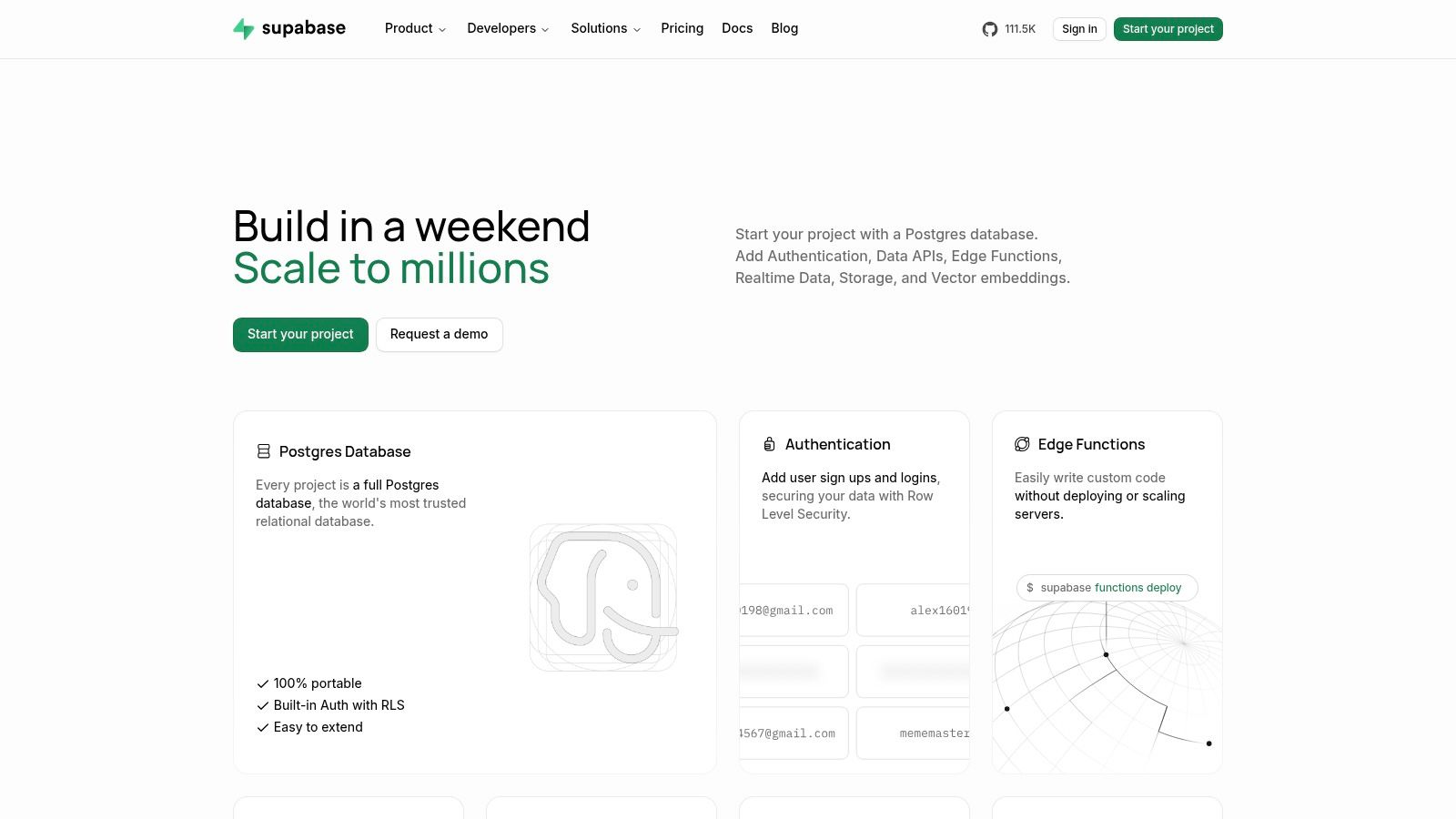
Supabase is a strong default for teams that want a managed Postgres database and useful application APIs without assembling a backend from separate vendors. A project can combine database access, REST and GraphQL interfaces, authentication, row-level security, storage, realtime events, and edge functions. That combination makes it especially effective for an MVP that needs a credible path to production.
Authentication can be handled through Supabase Auth, but security boundary is usually Postgres row-level security. Teams that rely only on frontend visibility rules will eventually expose data they meant to protect. Write policies early, test them with different roles, and keep service-role credentials out of browser code.
The API experience is productive because database schema changes can flow into generated interfaces quickly. That convenience has a cost. A schema that grows without clear ownership can create tightly coupled clients, difficult migrations, and queries that are easy to write but expensive to operate.
Budgeting the backend
Supabase exposes usage through several meters. Compute sizing, database storage, egress, storage, realtime activity, and other features can affect the final bill. Spend caps and backups help, but they don't replace workload testing. Heavy queries, large file transfers, or an undersized compute tier tend to appear before the database itself becomes the obvious bottleneck.
Supabase is a good match for a social-content application that stores normalized profiles, transcripts, comments, and processing status. This overview of a social-media database describes the kind of structured data model such a project may need. For teams wanting a broader backend setup with Supabase, the same warning applies: keep database policy and cost monitoring in the implementation plan.
The limitation is that “managed Postgres” doesn't eliminate database engineering. Production workloads still need indexes, migration discipline, backup testing, connection management, and careful query review.
Evaluate Supabase with your real schema and the heaviest query your application will run.

5. Firebase
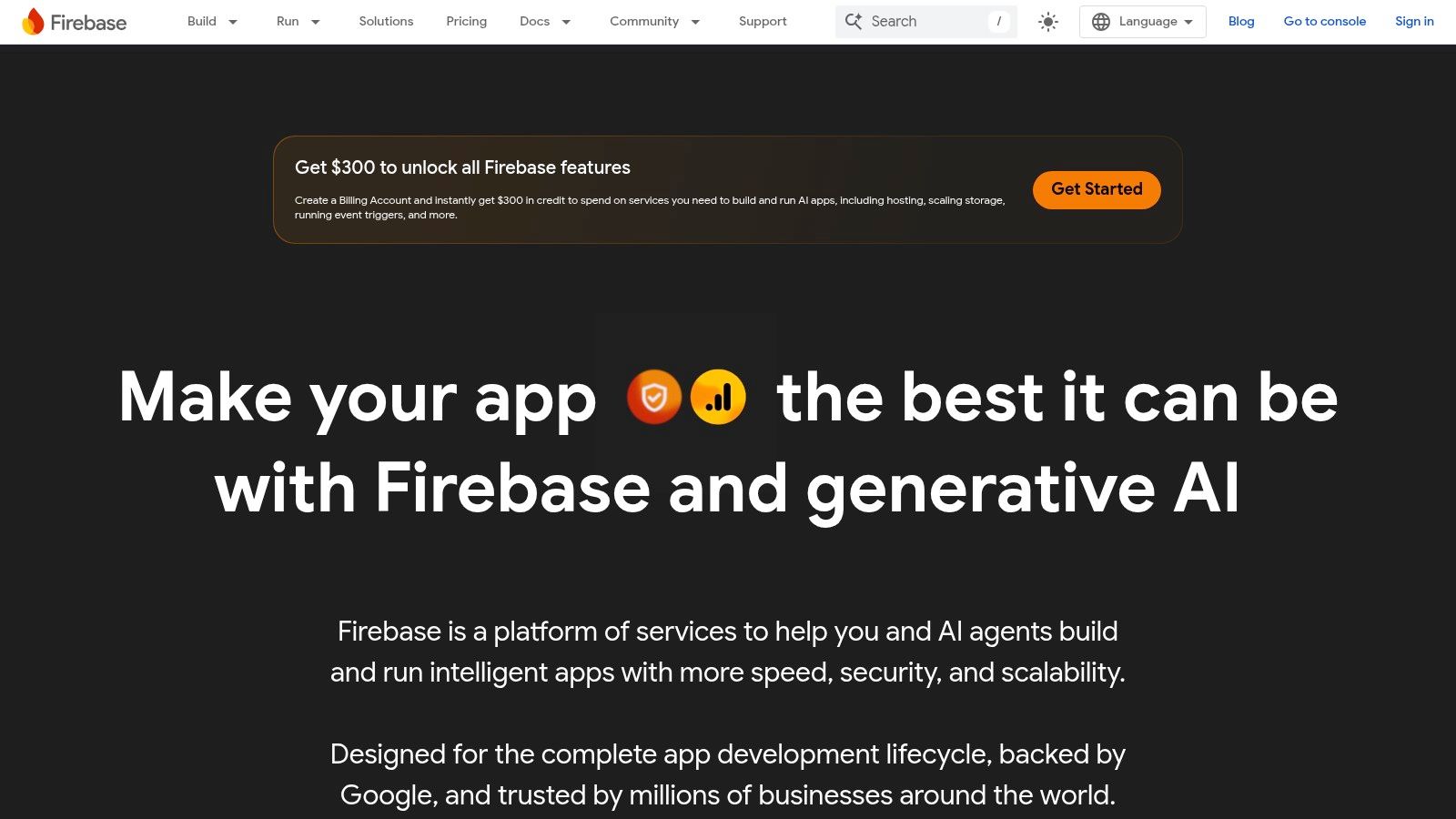
Firebase remains a practical choice for mobile and serverless products where SDK quality and rapid iteration matter more than relational database flexibility. Authentication, Firestore, Realtime Database, Cloud Functions, Hosting, Cloud Messaging, analytics, Crashlytics, testing, and Google Cloud integration create a cohesive developer workflow.
Client SDKs are the key advantage. A mobile team can implement sign-in, offline behavior, realtime updates, push notifications, and analytics without building each subsystem. The same client-first design requires careful security rules. Firestore rules are part of the application boundary, not a convenience layer to add after launch.
Firebase authentication is usually simple to start, but identity providers, custom claims, session handling, and server-side administrative access need explicit design. Firestore's document model can also encourage denormalized data structures that work well for reads but make transactional changes and reporting more involved.
The billing trap
The Spark no-cost products and published free quotas make experimentation easy. Blaze uses pay-as-you-go billing backed by Google Cloud, and that can make the total cost harder to forecast because reads, writes, storage, network traffic, functions, and related services don't behave like one flat API meter.
Set budgets, alerts, and usage dashboards before production traffic arrives. Test the queries your clients generate, especially listeners and broad collection reads. A feature that looks inexpensive in a small test can behave differently when every connected client subscribes to updates.
Firebase is a good fit for an app where mobile delivery speed and integrated tooling are priorities. It's less comfortable when the product needs complex relational reporting, portable infrastructure, or a simple all-in-one unit price. The limitation is vendor coupling across Firebase and Google Cloud services.
See what Firebase provides, then model the most active user journey rather than only the initial sign-up flow.
6. Stripe
Stripe is the best fit on this list when payments are a core business capability and you need more than a card form. Its APIs cover payment methods, Checkout, subscriptions, invoicing, payouts, tax, Connect, Issuing, Treasury, Radar, disputes, and authentication flows such as 3DS. The documentation and SDKs reduce the amount of payment infrastructure a product team has to build itself.
Authentication is straightforward for server-side requests, but webhook verification is the detail that causes real failures. Treat webhook events as untrusted until signatures are verified, store event identifiers, and make handlers idempotent. Payment state is asynchronous, so your application shouldn't assume that a successful browser redirect is the final source of truth.
Billing costs are also less intuitive than a headline processing rate. Refunds, disputes, currency conversion, payment methods, Connect accounts, tax features, and optional risk tools can each change the economics. Processing fees from the original transaction may not be returned when you issue a refund, so your finance model needs to account for the complete transaction lifecycle.
What breaks first
Teams usually encounter webhook retries, duplicate event handling, incomplete subscription state, or unexpected payment-method behavior before they encounter a basic API limitation. Use Stripe's test environments heavily, replay events against a staging endpoint, and record every state transition you need for customer support.
The API is powerful enough to support marketplaces and embedded finance, but that power increases the number of account, capability, compliance, and payout states your application must represent. Stripe reduces infrastructure work. It doesn't remove the need for financial reconciliation.
This API documentation examples guide is useful when reviewing whether examples expose the detail developers need from a production API.
Review Stripe's platform and map payment, refund, dispute, and payout events before choosing an integration pattern.
7. Twilio
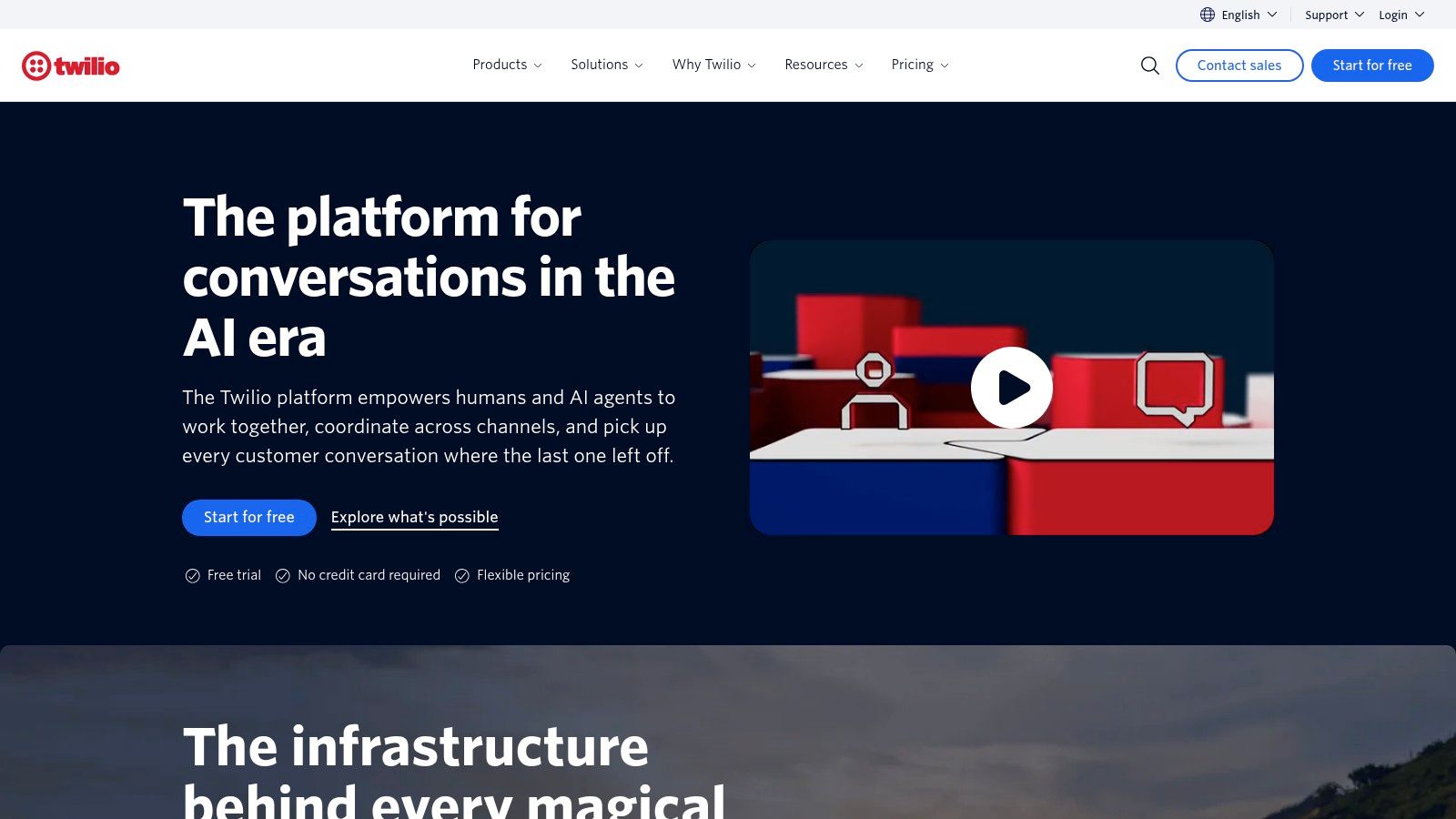
Twilio is a dependable choice for programmable communications, including SMS, WhatsApp, voice, video, Conversations, Verify, and email through SendGrid. The value is operational maturity. You get APIs, SDKs, compliance tooling, delivery status, and a large ecosystem for transactional notifications, two-factor authentication, and multichannel messaging.
Authentication normally starts with account credentials and service-specific tokens. Separate production and test credentials, restrict access by service, and avoid treating a phone number or messaging service as the whole security model. Verify flows also need abuse controls, attempt limits, and monitoring because attackers target messaging endpoints directly.
Rate limits and throughput vary by channel, destination, sender type, country, and carrier. A request accepted by Twilio isn't the same as a message delivered to a handset. Your application needs delivery statuses, retry logic, opt-out handling, and a queue that can absorb provider or carrier delays.
Pricing depends on geography
Twilio publishes per-country pricing, but carrier passthrough fees, registration requirements, number rental, WhatsApp rules, and optional add-ons make forecasting more involved. A global product should model its actual destination mix, message type, sender registration, and failure behavior.
The common mistake is treating SMS as an ordinary HTTP notification. It's a regulated, carrier-dependent channel with regional restrictions. If your business sends login codes, make the code lifetime short, rate-limit requests, and provide an alternative recovery path.
Twilio's limitation is not capability. It's the interaction between country rules, carrier behavior, sender reputation, and billing meters. Those variables sit outside your application code but still affect the user experience.
Compare Twilio's communication APIs and test delivery in every market where your product will operate. For teams evaluating temporary numbers, rent via Quackr may appear in the broader tooling discussion, but don't use an unverified number workflow for production identity assurance.
8. Twilio SendGrid
SendGrid is built for transactional email that needs a REST API or SMTP path, templates, suppression management, analytics, and deliverability controls. It's a sensible fit for receipts, password flows, onboarding, alerts, and other messages where the application shouldn't maintain its own mail infrastructure.
API-key authentication is easy to implement and easy to mishandle. Use restricted keys, keep them out of repositories and client applications, and rotate them when team membership or deployment infrastructure changes. A leaked sending credential can create both an unexpected bill and a serious sender-reputation problem.
The v3 Mail Send API and official SDKs make integration quick. Dynamic templates help separate application data from email layout, while suppression lists prevent repeated delivery attempts to addresses that have bounced, unsubscribed, or marked messages as spam. Dedicated IPs and advanced deliverability features may require higher plans, so don't assume the entry tier represents the complete production setup.
The first operational failure
Email failures often surface as deliverability rather than API errors. The provider may accept a message while a recipient's provider delays, filters, or rejects it. Track events, inspect suppression reasons, authenticate your sending domain, and separate transactional traffic from marketing traffic when the volume or reputation requirements differ.
SendGrid's pricing can also change when you exceed included usage or add dedicated infrastructure. Set account limits and alerts before sending a large migration or bulk notification.
The limitation is that no email API can guarantee inbox placement. SendGrid gives you mature tools and visibility, but your content, domain reputation, list quality, and authentication configuration still determine outcomes.
Explore Twilio SendGrid and send test messages to the actual clients and domains your users rely on.
9. Mapbox
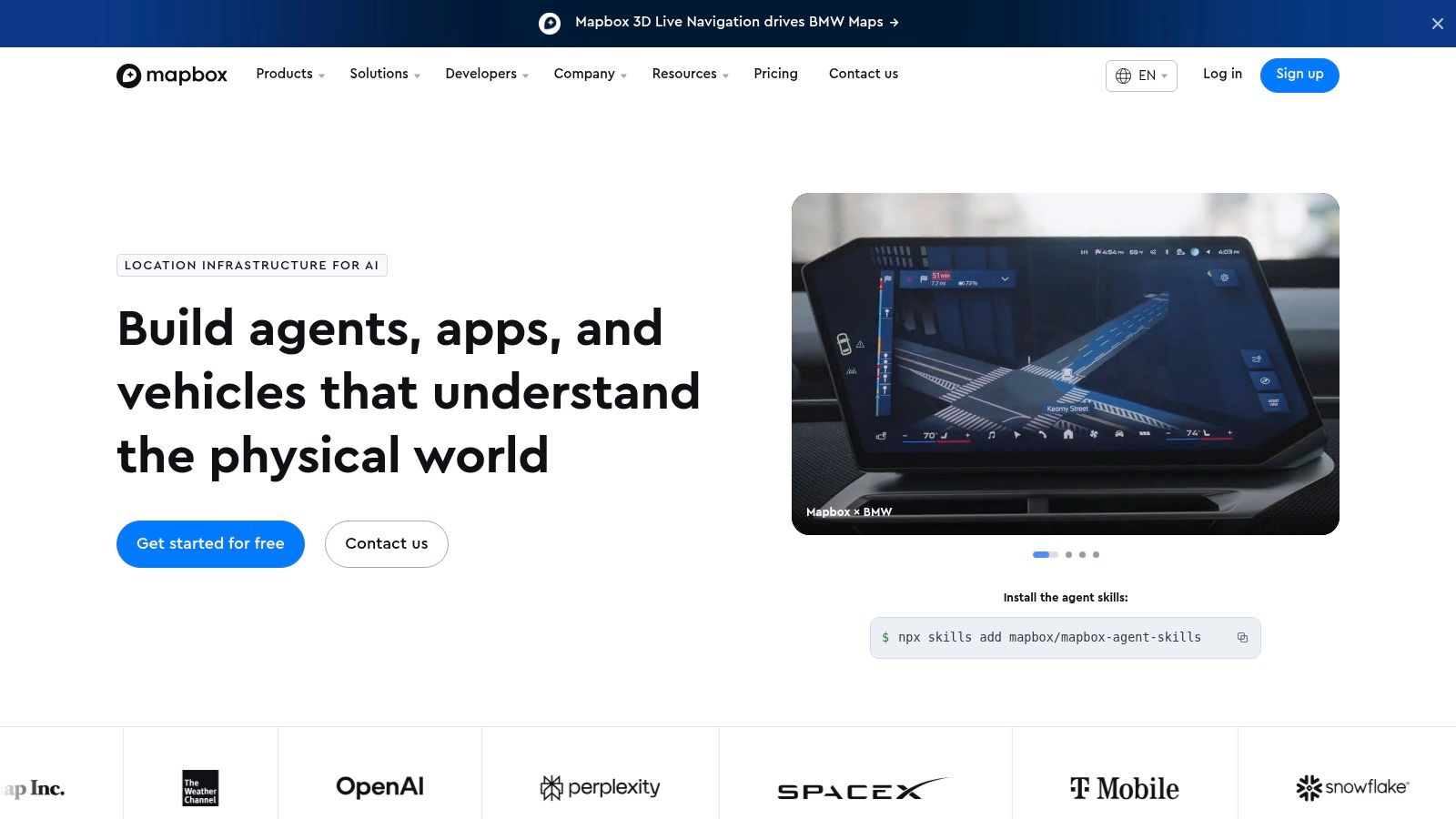
Mapbox is a strong option for products where location is part of the user experience, not just an address field. Its APIs cover maps, navigation, search, geocoding, directions, map matching, isochrones, vector tiles, and custom styling through Mapbox Studio. Web and mobile SDKs give teams control over the visual layer while the services handle spatial operations.
Authentication uses scoped access tokens, which is useful because browser, mobile, and server workloads shouldn't share the same credential. Public tokens still need URL restrictions or usage controls where available, while secret tokens must stay on trusted infrastructure. Build a token rotation plan before distributing a mobile application.
The first cost mistake is counting map loads while ignoring search, geocoding, routing, tiles, and monthly active user meters. Mapbox's pay-as-you-go model includes free tiers, volume discounts, and commit-to-save options, but the product-specific meters require careful reading. A location-heavy application can use several services in one user journey.
What tends to break
Geocoding ambiguity, poor address normalization, tile-loading behavior, and route assumptions cause more trouble than a basic map render. Store the provider's response data only when the applicable terms allow it, cache responsibly, and decide how your application behaves when a route or search request times out.
Mapbox is excellent for custom spatial interfaces and performance-sensitive maps. It may be excessive for a simple embedded map or a product that needs a provider-neutral geocoding layer. This overview of social-media data is unrelated to mapping implementation, but it illustrates the same integration principle: define the data you need before selecting a broad platform.
The limitation is pricing and architecture complexity across products. Review Mapbox with a realistic journey that includes map display, autocomplete, geocoding, and navigation rather than evaluating each API in isolation.
10. Plaid
Plaid is designed for financial connectivity, not generic data synchronization. Its products cover Link, Auth, Balance, Transactions, Identity, Income, Investments, Liabilities, KYC and AML workflows, and risk controls. The deep product surface and established financial-institution coverage make it useful for fintech applications that need users to connect bank accounts.
Authentication is more involved than an API-key integration because the end user authorizes access through a bank-connection flow. Your system must handle link tokens, public-token exchange, access-token storage, item status, reauthentication, institution outages, and permission changes. Never expose long-lived access credentials to the browser or mobile client.
Sandbox and limited production testing reduce the risk of discovering institution-specific behavior after launch. Still, financial connectivity is not uniform. Some institutions require reauthentication, some fields arrive differently, and transaction data can change after an initial response.
Price discovery takes work
Plaid offers pay-as-you-go, growth, and custom pricing, with billing models that can include one-time, subscription, or per-request charges. The supplied product information notes that public per-call prices are limited and that many products require a sales discussion. That makes a realistic volume and product-scope brief essential before signing.
The biggest limitation is commercial opacity for teams that need precise forecasting early. Plaid may be the right technical fit, but you should obtain pricing for every product in the intended flow, including refreshes, verification, identity checks, and production support.
Evaluate Plaid's connectivity products with the institutions and account types your users have. Treat consent, data minimization, retention, and user deletion as core implementation requirements, not post-launch compliance work.
Top 10 Developer APIs Comparison
| Product | Key features | UX & reliability (★) | Price & value (💰) | Target audience (👥) | Unique selling points (✨) |
|---|---|---|---|---|---|
| Captapi 🏆 | Unified social-media REST API, transcripts, GPT-4o-mini summaries, comments, engagement (33 platforms, 179 endpoints) | ★★★★★ · ~97% success; sub‑sec cached hits; 24h shared cache | 💰 Free (100 credits) → Starter $9/mo → Pro $27 → Business $90; credit‑based; free cached repeats | 👥 Developers, data teams, researchers | ✨ No OAuth; Apify‑backed resilient scrapers; quick integration; GPT summaries |
| Algolia | Hosted search: indexing, typo tolerance, ranking, personalization | ★★★★★ · low‑latency search | 💰 Request/record metering; free starter quotas; can be expensive at scale | 👥 E‑commerce & content teams, in‑app search | ✨ Prebuilt UI libraries; neural/AI search; rich analytics |
| OpenAI API | Multimodal models (text/image/audio/realtime), Responses API & SDKs | ★★★★★ · SOTA models; strong tooling | 💰 Token‑based (Fast/batch tiers); caching discounts; cost forecasting can be complex | 👥 ML engineers, RAG builders, app devs | ✨ High-quality multimodal models; realtime & enterprise options |
| Supabase | Managed Postgres + REST/GraphQL, Auth, Storage, Realtime, Edge Functions | ★★★★☆ · solid dev DX for backends | 💰 Usage-based (compute/egress); transparent sizing but can rise with scale | 👥 Backend devs, startups, product teams | ✨ Postgres-first stack with RLS and instant APIs |
| Firebase | Auth, Firestore/Realtime DB, Cloud Functions, Hosting, analytics | ★★★★☆ · tight mobile SDKs, integrated tooling | 💰 Generous free quotas; Blaze pay‑as‑you‑go (Google Cloud billing complexity) | 👥 Mobile/web app devs, rapid MVP teams | ✨ Deep Google Cloud integration; client SDKs and observability |
| Stripe | Payments, Billing, Invoicing, Connect, Radar, Tax | ★★★★★ · reliable global payments | 💰 Transaction fees + add‑ons (billing, tax); enterprise pricing for advanced features | 👥 Commerce platforms, SaaS, marketplaces | ✨ Global payments + compliance, dashboards, webhooks |
| Twilio | SMS, WhatsApp, Voice, Verify, Conversations, Email (SendGrid) integrations | ★★★★☆ · mature scaling & docs | 💰 Per‑message/per‑country pricing; carrier passthroughs | 👥 Comms engineers, Ops teams, platforms | ✨ Multi‑channel programmable communications; carrier tooling |
| Twilio SendGrid | Transactional email API/SMTP, templates, deliverability tools | ★★★★☆ · high deliverability at scale | 💰 Tiered pricing; dedicated IPs and deliverability add‑ons cost extra | 👥 Product teams, SaaS, high‑volume email senders | ✨ Suppression management, analytics, deliverability tooling |
| Mapbox | Maps, Navigation, Search, Geocoding, vector tiles, SDKs | ★★★★☆ · high‑performance mapping | 💰 Pay‑as‑you‑go with volume discounts; multiple product meters | 👥 Location apps, logistics, travel | ✨ Custom styling (Studio), vector tiles, strong SDKs |
| Plaid | Bank connectivity: Auth, Transactions, Balance, Identity, Investments | ★★★★☆ · broad bank coverage | 💰 Pay‑as‑you‑go / Growth / Custom; some SKUs require sales | 👥 Fintechs, financial apps, accounting tools | ✨ Deep financial integrations, sandbox & limited production testing |
Match the API to Your Data, Scale and Budget Before You Sign Up
There isn't one universal winner among the best APIs for developers. Captapi is a strong fit for public social data and cross-platform extraction. Algolia is built for hosted search. OpenAI supports multimodal and agent workflows. Supabase and Firebase accelerate backend delivery through different database and infrastructure models. Stripe handles payments, Twilio handles communications, SendGrid handles transactional email, Mapbox handles spatial experiences, and Plaid handles financial connectivity.
Start by writing down the exact capability your product needs. Separate read from write access, public data from private data, synchronous requests from asynchronous jobs, and user-authorized access from server-owned data. This step prevents a common mistake, choosing a broad platform because its feature list looks impressive when a narrower service would create less integration risk.
Next, test authentication in the provider's sandbox or free tier. Verify key creation, token refresh, webhook signatures, role permissions, OAuth consent, and failure responses. Don't stop after the happy path. Revoke credentials, send malformed requests, retry timeouts, exceed a quota in a controlled environment, and confirm that your application can recover without duplicating work.
Then model cost at 10 times your current volume. Include retries, cache misses, background processing, storage, egress, webhooks, regional fees, add-ons, and support requirements. A request price is only one part of the cost. For credit-based APIs, measure the most expensive response types. For token-based AI APIs, use real prompts and retrieved context. For communications, model the destination mix. For maps, count every service in the user journey.
A production API decision is also a dependency decision. Ask how much notice you get for breaking changes, whether historical results can be reproduced, and what fallback exists when an upstream provider changes access rules.
Finally, identify what the provider leaves to you. That may include consent, lawful reuse, data retention, encryption, deletion workflows, monitoring, fraud controls, or compliance evidence. Postman's 2025 API report found that 55% of developers struggled with inconsistent documentation, while 34% couldn't find existing APIs inside their own organizations. Documentation quality therefore deserves a place beside rate limits and pricing, not below them.
Choose two finalists, implement the same realistic task with both, and record time to first successful result, failure recovery, and projected cost. That small experiment will tell you more than a feature matrix. Today, take one representative workload, run it through the provider's test environment, and document every credential, quota, error, and billable operation before you approve production access.
Captapi gives developers one REST interface for public social data across major platforms, including transcripts, comments, profiles, summaries, and engagement metrics. If that fits your RAG, monitoring, research, or content workflow, visit Captapi to test the API and compare its credit model with the integration cost of maintaining multiple platform connectors.