
Social Media Scraping: A Practical Guide for 2026

Social media scraping means automatically collecting publicly visible posts, profiles, comments, hashtags, and engagement data, not breaking into private accounts or restricted messages. The legal boundary became clearer on January 23, 2024, when a U.S. federal judge granted Bright Data summary judgment in Meta Platforms Inc. v. Bright Data Ltd., reinforcing the distinction between public data collection and unauthorized access.
You may be looking at a blank dashboard, a competitor's public posts, or a pile of social content that someone on your team has been copying by hand. The obvious question is whether a scraper can collect it faster. The useful question is broader: what data is visible, how can you access it responsibly, how will the platform detect your traffic, and who will maintain the system when the page changes?
A working scraper is not just a loop that sends requests. It's a small data platform with an access layer, parser, scheduler, retry policy, storage model, monitoring, and compliance controls. This guide builds that mental model from the first request through the build-versus-buy decision.
Table of Contents
- What Social Media Scraping Actually Means
- How a Scraper Works Under the Hood
- Anti-Bot Defenses and Why Simple Scripts Break
- Rate Limiting, Retries, and Caching Strategies
- Build Your Own Scraper vs Use a Managed API
- Legal and Compliance Reality Check
- Real-World Use Cases Across the Stack
What Social Media Scraping Actually Means
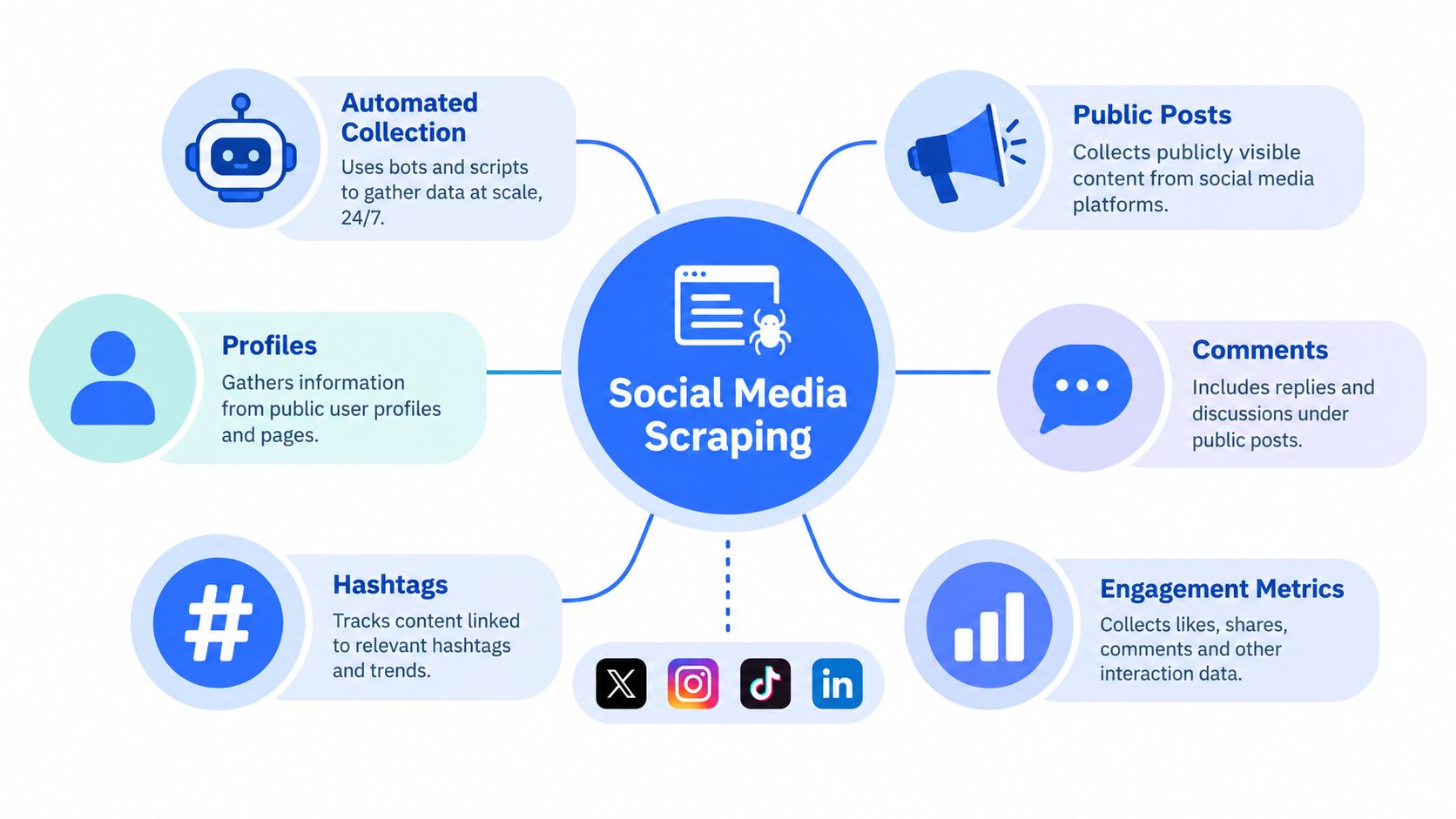
Social media scraping is the automated collection of information that a person can view without special access. Typical targets include public profiles, posts, comments, hashtags, search results, captions, timestamps, and visible engagement metrics across platforms such as X, Instagram, TikTok, LinkedIn, Facebook, and Reddit.
The word “public” needs careful handling. A public profile viewed while logged out is different from a logged-in feed. A visible post is different from a direct message, draft, private group, or account protected by an access control. Collecting the first category may be possible, while bypassing the second category can create serious legal and ethical problems.
Three questions define the job
Before choosing a library or API, classify the project on three axes:
- Data source: Is the target a public profile, a logged-out page, a logged-in feed, or restricted content?
- Access method: Will you use an official API endpoint, retrieve rendered HTML, operate a browser, or rely on another interface?
- Purpose: Are you doing research, brand monitoring, internal analysis, model training, lead discovery, or resale?
That classification prevents a common mistake: treating all extraction as the same activity. Pulling public posts associated with a hashtag is materially different from using a session cookie to retrieve a user's drafts. The second example involves authenticated access and should not be treated as ordinary public-data scraping.
Scraping and APIs aren't interchangeable
An official platform API usually returns structured data through sanctioned endpoints. It may require an application, token, documented permissions, quotas, and compliance with platform rules. Scraping instead reads information presented through a public web interface, often by parsing HTML or running a browser that executes JavaScript.
Neither method automatically solves compliance. An API can still expose personal data that requires careful handling, while a public page can still carry privacy, contractual, or database-rights implications. The practical rule is simple: visibility is one input to the decision, not the entire decision.
How a Scraper Works Under the Hood
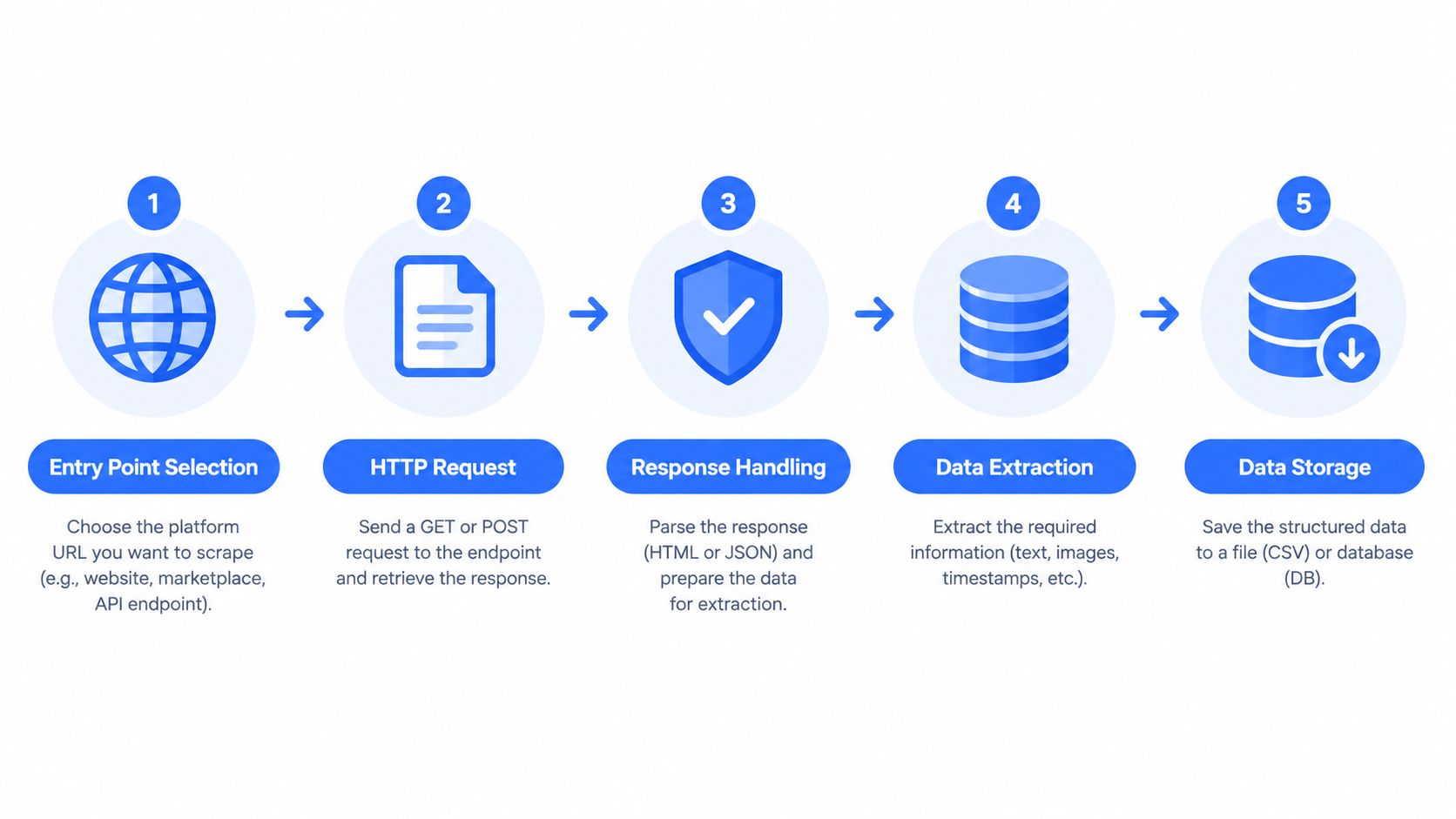
A scraper begins with an entry point. That might be a public desktop page, a mobile web route, or an official endpoint. The client sends a request with headers such as User-Agent and Accept-Language, follows redirects, receives a response, and decides whether the result contains usable content or an access challenge.
A basic HTTP client can parse server-rendered markup with tools such as BeautifulSoup or lxml. Modern social pages often render content after the initial response, though, so a browser controlled by Playwright or Puppeteer may need to execute JavaScript, wait for hydration, and inspect the resulting DOM. Some applications also place structured data inside embedded JSON state or shadow-DOM elements.
The request and transport layers
A realistic collection system separates request construction from parsing. That lets you change the access strategy without rewriting the extraction logic. The request layer might look conceptually like this:
- Select a public URL or approved endpoint.
- Send a request with normal protocol headers.
- Record the status, response headers, and retrieval time.
- Classify the response as content, throttling, authentication, or challenge.
- Pass only valid content to the parser.
Network identity matters because platforms can inspect more than the source IP. Research on modern anti-bot systems describes signals including TLS handshake fingerprints, HTTP/2 sequencing, JavaScript telemetry, and behavioral anomalies in research on large-scale web scraping defenses. A default Python request can therefore look unlike a normal browser even when its headers appear convincing.
Parsing, normalization, and storage
The parser should extract stable fields rather than depend on one fragile CSS selector. A post record might include a platform identifier, canonical URL, author reference, text, media references, timestamps, and observed engagement fields. Store the raw response when your retention policy permits it, but preserve a normalized record for downstream systems.
Production orchestration adds queue workers, deduplication, change detection, and a storage sink. A post ID is usually a stronger deduplication key than the full URL. A content hash can reveal whether a page changed, while PostgreSQL, object storage, or a vector store can serve different downstream needs.
For a practical introduction to the Python side of crawler architecture, see this guide to building Python web crawlers. The important lesson isn't the library choice. It's the separation of concerns: fetch, classify, parse, validate, deduplicate, and persist.
Anti-Bot Defenses and Why Simple Scripts Break
A scraper that works during a first test can fail later because platforms evaluate traffic as a pattern, not as a single request. Modern defenses inspect browser and transport characteristics, user behavior, network reputation, and challenge responses. Research describes platforms using combinations of rate limiting, IP blocking, HTML changes, and stricter authentication requirements, while one study found that more than 75% of protected websites in its dataset defended successfully against basic Python-script or PhantomJS bots in its evaluated dataset.
Four layers of detection
The first layer is fingerprinting. A service can compare TLS and HTTP/2 behavior, browser properties, rendering signals, and the consistency of the client environment. A script that claims to be Chrome but exposes contradictory browser characteristics creates a stronger signal than an ordinary missing header.
The second layer is behavior analysis. Platforms can examine navigation order, scrolling, interaction timing, and request sequences. A headless browser that loads pages in a perfectly repetitive order may look suspicious even when it renders the same HTML as a human browser.
The third layer is network reputation. Datacenter, residential, and mobile networks carry different reputational signals. An address that makes requests at unusual frequency, or rotates too quickly across related sessions, can increase scrutiny.
The fourth layer is a challenge system. A platform may require a browser challenge, additional verification, or stronger authentication when earlier signals accumulate. The right engineering response isn't to assume every challenge should be defeated. It's to stop, respect the access boundary, and reassess whether the source or method is appropriate.
| Defense Layer | Signals Inspected | Common Failure Trigger |
|---|---|---|
| Fingerprinting | TLS, HTTP/2, browser and rendering consistency | A default script presents an unusual client profile |
| Behavior analysis | Navigation, timing, scrolling, and interaction patterns | Repetitive, perfectly timed page visits |
| Network reputation | Network type, reputation, frequency, and concentration | High-volume requests from a suspicious source |
| Challenge systems | Browser checks, verification, and authentication signals | Multiple earlier signals indicate automation |
A proxy can change the network path, but it doesn't make a collection workflow compliant or reliable by itself. If you need to understand network distribution as an infrastructure choice, review this explanation of residential backconnect proxies. Treat proxy management as one component, not a substitute for public-data boundaries, pacing, and platform rules.
Rate Limiting, Retries, and Caching Strategies
Reliable collection starts with restraint. A scraper should have a host-level budget before it sends its first request, rather than discovering the platform's tolerance through repeated failures.
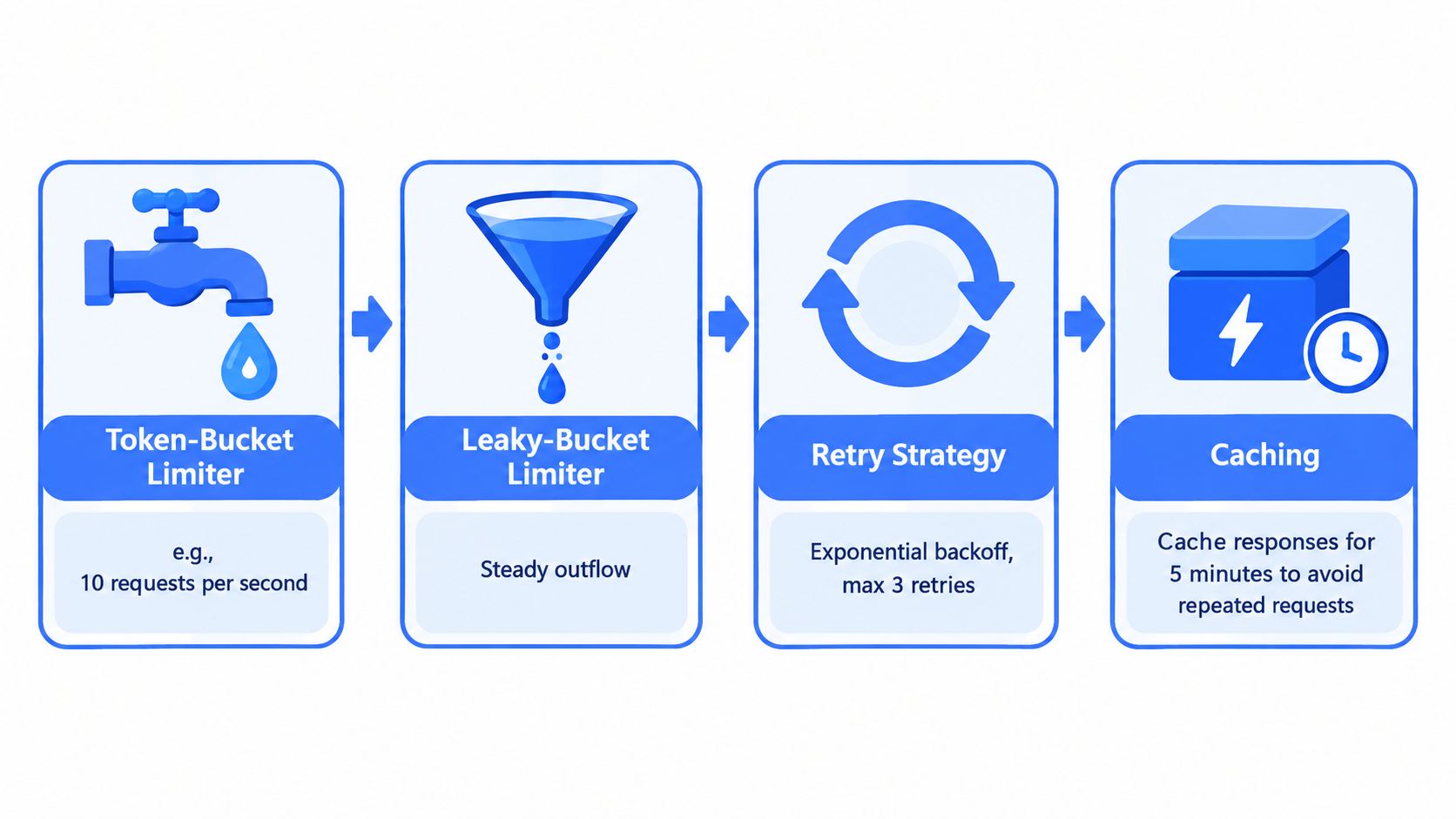
A token-bucket limiter adds tokens at a controlled rate and spends one for each request. It permits small bursts when tokens have accumulated while maintaining an average pace. A leaky-bucket limiter instead releases work at a steady rate, which can produce smoother traffic. Either model is preferable to launching a large batch and sleeping only after the server responds.
Retries should reduce pressure
A retry policy needs to distinguish transient failure from a permanent access decision. A timeout or temporary server error may justify a retry. A response indicating authentication, a blocked route, or a repeated challenge should normally move the item to review instead of entering an endless loop.
Use exponential backoff with full jitter, meaning each worker selects a random delay within the current backoff window. This prevents many workers from retrying at the same instant. Honor a server-provided Retry-After value when one exists, and cap the total attempts so a poisoned queue item can't consume the entire worker pool.
Practical rule: A retry is successful only when it gives the upstream service more time and your system more information.
A circuit breaker adds another safety valve. When a host produces a sustained pattern of throttling or access errors, the breaker pauses new work, records the event, and allows a controlled recovery probe later. That protects both the platform and your own queue from a thundering herd.
Caching changes the economics
Caching isn't just a speed optimization. It prevents your system from repeatedly requesting data that hasn't changed. Use conditional requests with ETags where the source supports them, and calculate content fingerprints when you need application-level change detection.
A useful cache policy assigns different refresh windows to different entities. A stable profile can have a longer time-to-live than a fast-moving search result. Store retrieval timestamps, source identifiers, and parser versions so analysts can distinguish a changed post from a changed extraction rule.
For the mechanics of designing request budgets around service quotas, consult this API rate-limit guide. Good queueing, bounded concurrency, caching, and clear stop conditions matter more than a clever request loop.
Build Your Own Scraper vs Use a Managed API
A product team needs public post data by tomorrow morning. One engineer can build a parser tonight, but the first release also creates ownership for browser behavior, transport changes, proxy operations, parser regressions, monitoring, and compliance review. The decision is whether collection infrastructure belongs inside the product your team plans to maintain.
Start with target volume, refresh cadence, team size, and tolerance for operational and legal exposure. Add mean time between breakage, the expected interval before a platform change requires repairs. A narrow scraper may be cheap to launch and expensive to keep alive if markup changes repeatedly.
| Dimension | Build Your Own | Managed API, e.g. Captapi |
|---|---|---|
| Control | Direct control over requests, parsing, and storage | Control through documented API inputs and outputs |
| Engineering burden | Your team owns browsers, queues, retries, and parser changes | The provider operates much of the collection infrastructure |
| Data shape | Custom schema and platform-specific fields | Provider-defined normalized responses |
| Failure response | Your alerts and engineers investigate upstream changes | Provider handles collection-layer maintenance, within service limits |
| Compliance | Your team evaluates source, purpose, and retention | The service doesn't remove your compliance responsibilities |
Build when the target is narrow, the page is stable, and your application needs unusual fields or specialized transformations. Direct collection also gives your team control over raw evidence, storage, and extraction logic. That fit can matter when an external service is not acceptable in your environment.
Buy when several platforms would create separate maintenance paths, the team needs a predictable integration surface, or collection infrastructure does not distinguish the product. For a broader comparison of collection options, see this guide to choosing a web data collector.
Captapi exposes public data from YouTube, TikTok, Instagram, and Facebook through a REST interface. Its responses can include transcripts, comments, summaries, engagement data, and search results. Using that interface can reduce request, browser, retry, and normalization work, while leaving your team responsible for the intended use and downstream handling.
A short selection checklist
Choose build when most answers are yes:
- Schema control: Do you need fields available services do not expose?
- Operational ownership: Can your team monitor and repair the collector?
- Access fit: Is the target consistently public and suitable for your method?
Choose buy when these conditions describe the project:
- Delivery priority: Does the product need a maintained data interface rather than a scraping project?
- Platform breadth: Will several platforms create several maintenance paths?
- Team focus: Would collection infrastructure distract from the application's core value?
A managed service reduces infrastructure work, not accountability. Your organization still controls the collection purpose, retention period, users, and downstream processing. Confirm those requirements before comparing implementation effort alone.
Legal and Compliance Reality Check
“Is social media scraping legal?” has no universal yes-or-no answer. The safer question asks which data, collected from which surface, by which method, for which purpose, under which jurisdiction and platform terms.
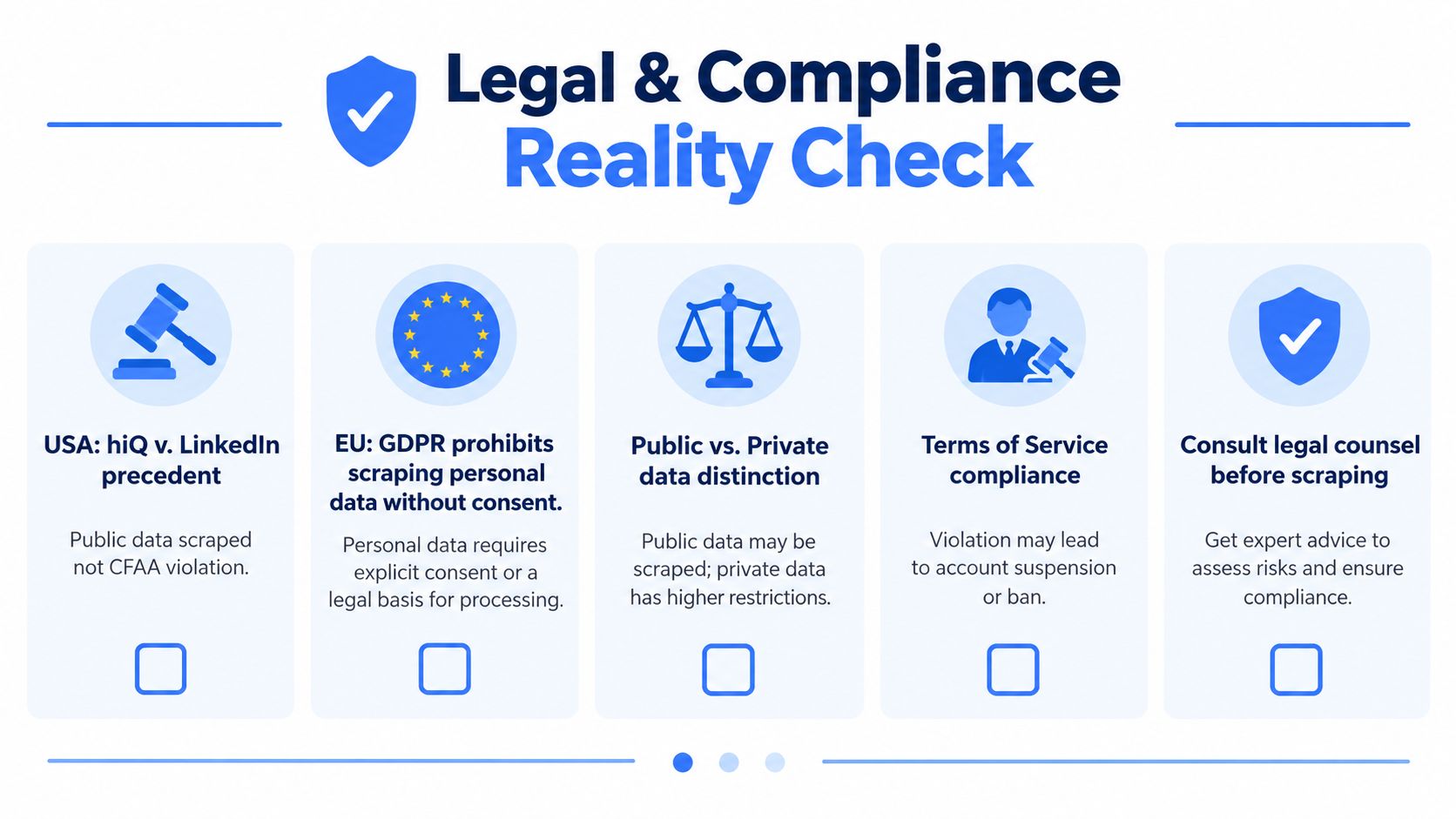
In the United States, the Ninth Circuit's 2022 view in hiQ Labs v. LinkedIn treated scraping publicly accessible web data as outside the Computer Fraud and Abuse Act in that context. The January 23, 2024 decision in Meta Platforms Inc. v. Bright Data Ltd. reinforced the distinction between publicly accessible Facebook and Instagram data and gated or private data, making it harder to argue that collecting public-facing information alone automatically constitutes unlawful access. The ruling is discussed in this analysis of the Meta and Bright Data scraping decision.
That doesn't erase other risks. Terms of Service can create contractual or account-access disputes, and privacy laws can apply even when CFAA liability doesn't. A public page can contain personal data, and the way you combine, enrich, retain, or resell that data may matter more than the fact that a person could view the original page.
Public visibility isn't a compliance plan
European privacy regimes, including GDPR-style obligations, require teams to examine lawful basis, purpose limitation, transparency, minimization, retention, and individual rights. The U.S. also has a patchwork of privacy rules, while European database rights and the UK GDPR can add separate questions. A global workflow therefore needs jurisdiction-aware review rather than a policy copied from a U.S. blog post.
The 2021 Facebook contact-import incident remains a warning about scale and downstream harm. Data linked to about 533 million users was exposed online, and Ireland's Data Protection Commission fined Meta €265 million over inadequate safeguards, as summarized in this overview of the Facebook scraping incident and its legal implications. Public or semi-public origin doesn't make mass aggregation harmless.
A practical review before collection
- Define purpose: Write down why you need each field and reject fields that don't serve that purpose.
- Classify access: Confirm the target is public and logged out, and don't bypass authentication, private groups, DMs, or other restrictions.
- Minimize data: Collect the smallest useful set, separate identifiers from analysis data, and avoid unnecessary sensitive information.
- Set retention: Decide when raw responses and derived records will be deleted.
- Document controls: Record the source, collection method, date, legal basis where applicable, and downstream recipients.
- Escalate uncertainty: Ask qualified counsel to review high-risk, cross-border, personal-data, or resale use cases.
For a plain-language review of these issues, see this social media scraping legal guide. It should inform your questions, not replace legal advice.
Real-World Use Cases Across the Stack
A RAG pipeline might collect public posts, remove duplicate copies, preserve source URLs, and send cleaned text to an embedding service and vector store. Freshness matters, but so do attribution and deletion. If the pipeline stores only embeddings without a source record, the answer system may struggle to explain where a passage came from or remove it later.
A brand-monitoring dashboard has a different shape. It may gather public mentions, normalize spelling variations, score sentiment, and attach engagement fields for analyst review. Here, latency determines architecture. A team watching a live incident may prefer an approved streaming or API path, while a periodic research dashboard can tolerate queued batch retrieval.
OSINT and threat-intelligence researchers may map public accounts, correlate posts, and preserve observations during an incident. They need strong source attribution, careful access boundaries, and operational-security controls. Researchers should avoid turning public collection into harassment, doxxing, or unnecessary identity exposure.
Academic and market-research teams often value reproducibility over immediacy. They may capture snapshots, store parser versions, and document inclusion rules so another analyst can understand how the dataset was assembled. For B2B teams working with consent-based acquisition rather than public scraping, this guide to LinkedIn lead gen forms offers a useful alternative workflow for capturing submitted lead information directly.
| Use Case | Data Type | Latency Need | Recommended Approach |
|---|---|---|---|
| RAG enrichment | Public text, captions, transcripts, source metadata | Periodic refresh | Managed API or stable API, with deduplication and provenance |
| Brand monitoring | Mentions, posts, comments, engagement fields | Low to moderate | API or managed collection with queues and alerting |
| OSINT research | Public posts, account metadata, relationships | Case-dependent | Controlled collection with strong audit and retention rules |
| Academic analysis | Snapshots, historical records, annotations | Batch-oriented | Reproducible custom pipeline or managed batch extraction |
The failure mode differs by project. RAG teams lose provenance, monitoring teams miss timely mentions, OSINT teams over-collect, and academic teams can't reproduce an undocumented crawl. Pick the architecture around that failure, not around the appeal of writing a scraper from scratch.
Captapi provides a REST interface for public social data across YouTube, TikTok, Instagram, and Facebook, including transcripts, comments, summaries, engagement fields, and search results. If you want to test a maintained collection layer instead of owning every browser and retry component, visit Captapi and evaluate it against your source, compliance requirements, refresh schedule, and storage design.