
Utilizing Social Media Data for AI Agents
Utilizing Social Media Data for AI Agents
AI agents leverage social media data to perform a wide range of functions, significantly enhancing their capabilities in real time. With access to vast amounts of user-generated content, AI agents can analyze and learn from the patterns and behaviors expressed within these platforms.
One key application is sentiment analysis. By evaluating posts, comments, and reviews from platforms like Twitter and Facebook, AI agents can gauge public opinion on various topics, brands, or products. This analysis helps businesses adjust their strategies based on consumer perception and provides valuable insights into market trends.
Social media data also plays a crucial role in natural language processing (NLP). AI agents use data from platforms like Reddit and Instagram to understand and generate human-like text, improving their conversational abilities. This capability is vital for chatbots and virtual assistants that require up-to-date language comprehension to interact effectively with users.
Moreover, AI agents use this data for personalized recommendations. By analyzing user interactions and preferences on platforms like YouTube and Pinterest, AI agents can deliver curated content that is more likely to engage users, thus enhancing user satisfaction and retention.
- Sentiment analysis for understanding public opinion
- Natural language processing to improve conversational AI
- Personalized content recommendations
In addition, real-time data from social media enables AI agents to detect emerging trends and potential issues, allowing businesses to respond swiftly to developing situations. This dynamic capability ensures that organizations remain agile and responsive in a continuously evolving digital environment.
Types of Social Media Data for AI Agents
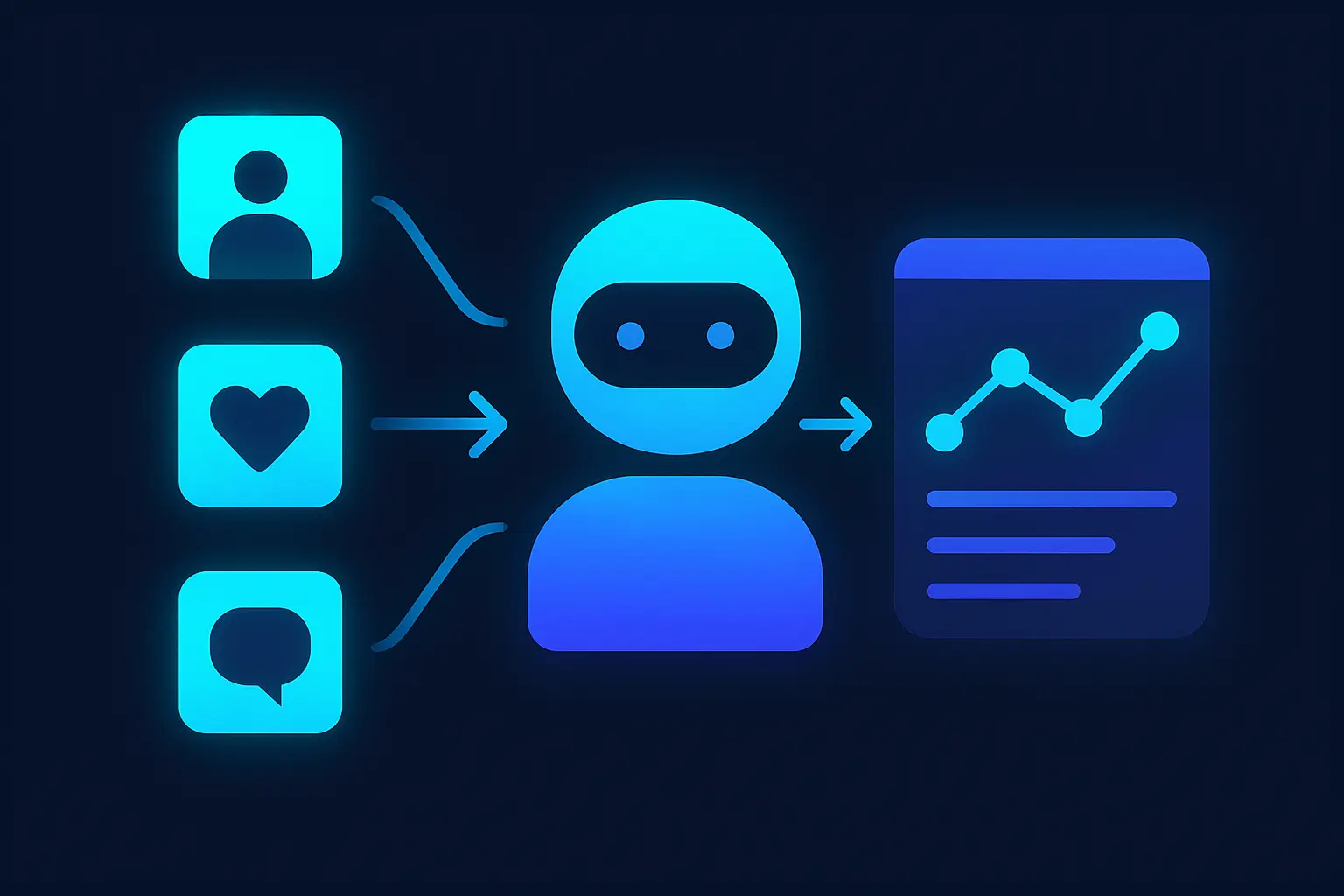
AI agents leverage various types of social media data to perform tasks such as content analysis, sentiment assessment, and trend forecasting. Understanding these data points is essential for effectively deploying AI-driven solutions.
Prominent social media data categories for AI agents include:
- Profiles: Metadata containing user information such as usernames, bio descriptions, follower counts, and profile pictures. This data is crucial for audience analysis and influencer identification.
- Posts: Text, images, and videos shared on social platforms. AI agents analyze post content to extract sentiment, detect topics, and evaluate engagement levels.
- Comments: Responses to posts providing insights into audience reactions and opinion trends. They help AI models assess sentiment and identify emerging conversations.
- Transcripts: Textual representations of video and audio content. Transcripts allow AI agents to analyze spoken content for information extraction and sentiment analysis.
- AI Summaries: Concise evaluations generated by AI from extensive text or media content. These summaries offer quick insights into large volumes of data.
Consider using REST APIs, such as Captapi's integrations, to efficiently access this data. Different social platforms may require varied extraction strategies, and an API can streamline data acquisition from numerous sources.
| Data Type | Use Case | Complexity |
|---|---|---|
| Profiles | Audience Analysis | Low |
| Posts | Sentiment & Topic Detection | Medium |
| Comments | Opinion Mining | Medium |
| Transcripts | Content Analysis | High |
| AI Summaries | Data Synthesis | High |
Capturing Social Media Data with REST APIs
To capture social media data using REST APIs, developers need to make HTTP requests to endpoints provided by the API documentation. These requests typically require an API key and may include parameters specifying the type of data and filters based on the platform or content. A common approach is using GET requests to retrieve data, which then returns it in a structured format like JSON.
Below is a basic example of how to make an API request using curl and Python to access social media data via a REST API. Replace YOUR_API_KEY and RESOURCE_ENDPOINT with your actual API key and resource endpoint.
# Using curl
curl -X GET "https://api.captapi.com/RESOURCE_ENDPOINT" \
-H "Authorization: Bearer YOUR_API_KEY"

# Using Python with requests library
import requests

url = "https://api.captapi.com/RESOURCE_ENDPOINT"
headers = {
    "Authorization": "Bearer YOUR_API_KEY"
}

response = requests.get(url, headers=headers)
data = response.json()
print(data)
The JSON response structure depends on the specific API used and the endpoint called. A typical JSON snippet might look like:
{
    "data": [
        {
            "id": "post123",
            "author": "username",
            "content": "Sample social media post content.",
            "timestamp": "2023-10-01T10:00:00Z"
        }
    ],
    "status": "success"
}
Developers can use this structured JSON output from REST APIs to feed data into AI agents for analysis, predictions, or training purposes. Selecting an API like Captapi that integrates multiple platforms can simplify the process, allowing for scalability and a broader data set for AI applications.
Challenges in Accessing and Using Social Media Data
Working with social media data for AI agents involves several hurdles, primarily due to platform restrictions and data variability. Many social media platforms implement stringent API rate limits and complex authentication processes, which can hinder data acquisition. These limitations are designed to prevent excessive server load and protect user privacy, but they can pose significant obstacles for developers needing large-scale data access.
Additionally, the structure and format of social media data vary significantly across platforms. This inconsistency requires developers to implement robust parsing logic to convert data into a uniform format suitable for AI processing. Since social media platforms frequently update their data schemas, maintaining data compatibility can be a continuous challenge. Developers need to stay informed of these changes and adjust their systems accordingly.
Data privacy regulations, such as the GDPR and CCPA, also impose substantial compliance requirements on developers. Ensuring that data collection and processing adhere to these legal standards is critical to avoid potential legal repercussions. Compliance involves implementing consent management strategies and ensuring data anonymization where necessary.
- API rate limits and authentication challenges
- Variability in data structure across platforms
- Data privacy regulations and compliance
Furthermore, social media platforms may occasionally restrict access to certain types of data or specific endpoints, especially during policy shifts or when anomalies are detected. Developers must be prepared to handle such access restrictions, which may require adapting to alternative data sources or employ data synthesis techniques to mitigate gaps in data availability.
Best Practices for Working with Social Media Data
When integrating social media data into AI agents, it is crucial to employ structured workflows that ensure data accuracy, relevance, and ethical considerations. Start by defining clear objectives for data usage. Understanding what specific outcomes your AI agent needs to achieve will guide the selection of relevant data types and sources.
Next, prioritize data quality. Social media data can be noisy, containing irrelevant or misleading information. Implement data filtering and cleansing techniques to enhance accuracy. Develop algorithms to remove duplicate or irrelevant data points and correct inconsistencies. This ensures the AI agent receives clean, actionable insights.
Data security and privacy are paramount. Given the sensitive nature of social media content, adhere to platform-specific data usage policies and global data protection regulations, such as GDPR or CCPA. Consider anonymizing personal data to minimize privacy risks and maintain user trust.
Additionally, employ data enrichment strategies to enhance contextual understanding. Integrating metadata like geolocation, timestamps, and user engagement metrics with primary data can significantly improve the AI’s ability to interpret social dynamics and sentiment trends effectively.
- Use scalable data pipelines to handle large volumes of incoming data efficiently.
- Continuously refine data models to adapt to dynamic social media landscapes.
- Leverage machine learning techniques like sentiment analysis and natural language processing for deeper insights.
Finally, conduct regular evaluations of the AI agent's performance using real-world scenarios to ensure that the social media data integration yields the desired results. Adapt the system based on findings to improve accuracy and effectiveness continuously.
Choosing the Right API for Your AI Agent
When selecting an API to power your AI agents with social media data, consider several key factors to ensure efficiency and effectiveness. Look for comprehensive platform support; the API should provide access to a broad range of social media platforms, ensuring your AI agent can gather diverse data points from various user demographics. Captapi, for example, offers data from 27 different platforms, providing a wide array of information.
Prioritize APIs that deliver clean and structured data. JSON format is preferable as it is easy to parse and integrate into applications, ensuring seamless data processing. Check that the API includes well-documented endpoints and examples, facilitating smooth integration for developers.
Evaluate the scalability of the API offering. As your AI agent's data demands grow, the API should be capable of handling increased requests without significant performance degradation. Examine rate limits and ensure the service can accommodate your expected usage patterns.
Data refresh rates are also critical. Ensure the API can deliver data with the required frequency, whether real-time or periodic updates, to maintain the relevance and accuracy of your AI agent's output.
- Comprehensive platform support
- Easy-to-parse data format (e.g., JSON)
- Scalable and reliable service
- Good documentation and support
Finally, consider the API's cost structure. Assess whether the API offers a free tier or a pricing model that aligns with your budget, especially during the initial phases of development. Captapi provides a free tier with 100 credits and no credit card requirement, offering a low-risk entry point for initial testing and integration.
Frequently asked questions
Is there really a social media for AI agents?
No, there is not a dedicated social media solely for AI agents. AI agents interact with existing human-centric social media platforms like Facebook, Twitter, and Instagram. These platforms provide the data and interaction frameworks that AI agents can leverage to perform tasks such as data analysis, sentiment analysis, and automated content generation.
Can AI agents post on social media?
Yes, AI agents can post on social media, provided they comply with the platform's terms of service and have the necessary permissions. These agents can automate the posting of content, responding to comments, and other interactions to manage presence and engagement on social media platforms effectively.
What are common challenges with using social media data for AI agents?
Common challenges include handling the vast volume and velocity of data generated on social media, maintaining data privacy and compliance with various regulations, and accurately interpreting the diverse and unstructured data types. Additionally, AI agents must navigate platform-specific restrictions and anti-bot measures when accessing data.
Which platforms provide the best social media data for AI agents?
The best platforms vary depending on the specific needs of the AI agents. Platforms like X (formerly Twitter) and Reddit are rich in textual data and public discussions, making them ideal for sentiment and trend analysis. Visual platforms like Instagram and TikTok offer valuable data for image and video-based AI applications. Captapi consolidates data access, providing a wide range of platform data through a unified API.