
10 Best Social Media API Free Tiers for 2026

“Free” is the most misleading word in social media API documentation. A free tier may still come with a lifetime credit cap, a daily quota, an app review queue, or terms that limit storage and commercial use. Twitter's history makes the risk clear. Its first public API launched in September 2006, but free access ended in February 2023. The former academic plan allowed as many as 100 million tweets per month, while a later $100 monthly plan offered 10,000, a reduction documented by The Conversation.
This list compares social media API free access on the same practical axes: authentication, quota model, rate limits, approval friction, data scope, and compliance limits. The right choice depends on the job. Public-data extraction needs a different API from owned-account publishing, and research access differs from a creator dashboard. The entries below get to those trade-offs quickly, so you can match a free tier to a real workload instead of choosing by platform popularity.
Table of Contents
- 1. Captapi
- 2. YouTube Data API v3
- 3. Instagram Graph API
- 4. Facebook Graph API
- 5. TikTok for Developers
- 6. Pinterest API v5
- 7. Reddit Data API
- 8. Twitch API Helix
- 9. Mastodon API
- 10. Bluesky API
- Top 10 Free Social Media APIs Comparison
- Picking Your Free Social Media API Stack
1. Captapi
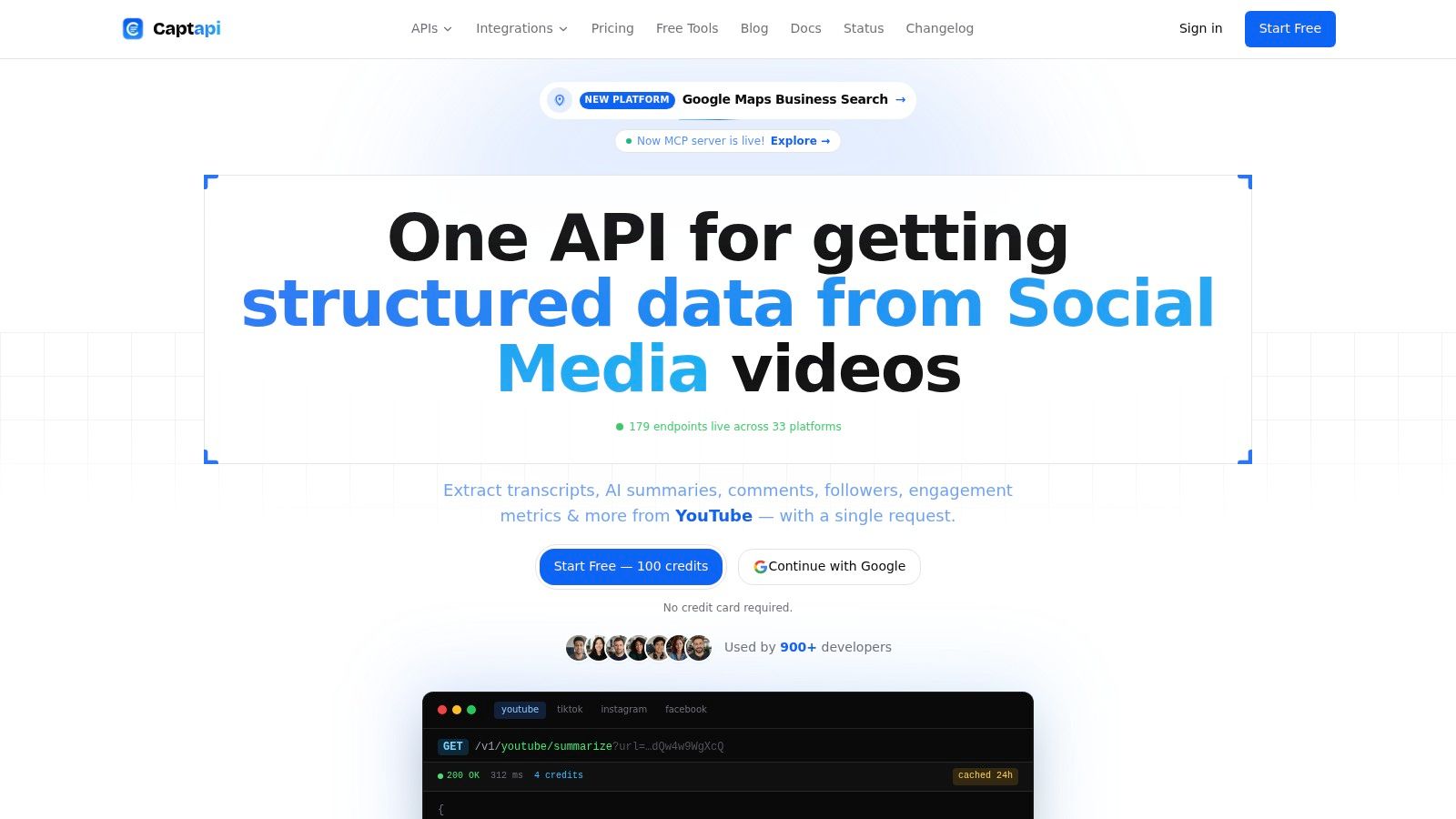
Captapi is the strongest starting point when you need public social data across several platforms, not publishing into an account you control. It presents structured read access to 33 platforms through 179 REST endpoints, including YouTube, TikTok, Instagram, Facebook, X, Reddit, LinkedIn, and ad libraries. The interface stays consistent across sources, so your application doesn't need a separate SDK and OAuth implementation for every network.
Authentication uses an API key rather than per-platform OAuth. The free plan includes 100 lifetime credits, with 40 requests per minute, and no credit card is required to start. Captapi uses credit-based billing, which is easy to forecast for small experiments but can become expensive for broad extraction if each endpoint consumes credits differently. Its optional shared cache can return repeat results without consuming credits when you pass cache=true, which makes repeated development calls much easier to manage.
The data scope is broad. Endpoints can return transcripts, comments, public profiles, engagement metrics, search results, bulk exports, and GPT-4o-mini summaries covering key points, topics, and sentiment. Apify-backed scrapers and automatic retries support production workloads, while higher plans offer rate limits up to 600 requests per second.
Where Captapi fits
Captapi is useful for RAG pipelines, video question-answering, caption generation, competitive monitoring, social listening, OSINT, and research exports. You can sign up, copy an API key, and call an endpoint such as /v1/youtube/summarize without implementing a platform-specific login flow.
Practical rule: Use Captapi when your application needs public data from multiple networks. Use an official API when it must publish, access private information, or manage an authenticated account.
The limitation is important. Captapi is read-only and extracts publicly accessible data. It isn't a substitute for official APIs when you need private account data or first-party publishing. You also remain responsible for privacy, storage, redistribution, and downstream compliance. The free tier is excellent for validation and small workloads, but large extraction jobs can consume credits quickly.
2. YouTube Data API v3
The YouTube Data API v3 is a dependable choice for applications built around videos, channels, playlists, comments, or search. It uses Google Cloud credentials, and OAuth is required when your application needs access to a user's account or owner-level analytics. Public discovery can use an API key, which makes the first prototype relatively straightforward.
YouTube's quota model is the main constraint. Requests consume quota units, and different operations have different costs. Search and list operations can use the budget quickly, especially when a pipeline repeatedly queries broad terms or paginates through results. You need a quota dashboard, request caching, and careful field selection before moving beyond a small test.
The API exposes detailed metadata and statistics for channels, videos, and playlists. It also supports comment threads and owner workflows such as uploads and analytics through OAuth. The documentation and client-library ecosystem are mature, so debugging tends to be easier than with newer platform APIs.
Practical rule: Treat search as an expensive operation. Cache results, avoid unnecessary pagination, and separate discovery from enrichment.
The largest data-scope limitation is transcripts. The official API doesn't universally expose transcripts for third-party videos. If your product needs reliable transcript extraction across public videos, compare it with Captapi's YouTube API, which is designed around broader public-content extraction. YouTube Data API v3 remains the better fit for official account management, structured metadata, and authenticated owner analytics.
3. Instagram Graph API
The Instagram Graph API is built for Business and Creator accounts, not personal profiles. Authentication runs through Meta's app and OAuth system. That gives you a proper first-party connection for publishing and analytics, but it also creates more setup work than an API-key integration.
The API supports publishing posts and reels through a container-and-publish flow, media and account insights, comments, mentions, selected messaging features, Business Discovery, and hashtag search. It works well for agencies, brand dashboards, moderation tools, and content workflows tied to professional accounts.
App review is the key approval barrier. Many useful permissions require Meta to review the application, and the process can delay a launch even when the code is complete. Rate limits are also tied to business-use-case formulas, so you can't evaluate capacity from a single universal request number. Watch response headers, log usage by account, and design queues that handle throttling.
The account restriction is equally important. A personal Instagram profile isn't a valid substitute for a Business or Creator account, and the API won't turn a consumer automation idea into an approved professional workflow.
For a detailed public-data alternative, see this Instagram public data API guide. It addresses a different problem, namely reading publicly accessible content without building the full Meta publishing stack. If your goal is publishing to owned accounts, use the official Graph API and plan for review. For operational context, this Instagram post automation guide covers the publishing workflow from a marketer's perspective.
4. Facebook Graph API
The Facebook Graph API is the official route for managing Facebook Pages, comments, moderation, Page insights, and advertising workflows. Its authentication model is Meta OAuth, with permissions tied to the Page and the actions your app requests. A basic prototype may be quick, but production access often requires app review and, depending on the use case, business verification.
Facebook is strongest for owned-page operations. Your application can read and publish Page content, respond to comments, support moderation, retrieve Page insights, and connect to Marketing API workflows for ads and measurement. That makes it a sensible foundation for a community-management dashboard or an internal reporting tool.
Personal-profile publishing is the central limitation. The API is designed around Pages and approved permissions, not general automation of individual profiles. You should model the account type early, because changing the product later can require a different permission set and a different review submission.
Managing quota and version risk
Meta exposes rate-limit information through headers and business-use-case models. Track those values per app and Page. Don't assume that a successful development request proves your production capacity. Usage changes with the account, endpoint, and application context.
Facebook's versioned API also creates maintenance work. Metrics and endpoints can change or deprecate, so build an adapter layer around the fields your product uses. The Facebook API documentation guide is useful for evaluating the native surface before you commit to that maintenance burden.
5. TikTok for Developers
TikTok for Developers splits the relevant work across different programs. The Content Posting API handles uploads, publishing, and status checks for authenticated accounts. The Research API provides public-data access for qualified researchers. Those are separate use cases with different approval expectations, so choosing the wrong program can stop a project before implementation begins.
Authentication uses OAuth and user consent for account-level workflows. Content posting is a good fit for creator tools, scheduling products, and publishing assistants. The Research API is better for approved academic or research organizations that need structured access to public TikTok data.
Approval is the main friction. Access can be selective, and rate limits may be tight for high-volume systems. TikTok also documents error codes and 429 responses, so your integration needs retry logic, backoff, and clear handling for partial publishing failures.
The data scope varies by program. Don't assume that access to profile or media information through one developer product grants access to research endpoints. Review the eligible organization type, requested permissions, and intended use before building your data model.
For researchers comparing the public-data route, this TikTok Research API overview explains how the program differs from publishing access. If your immediate need is content production rather than data collection, a free TikTok caption generator can help with copy creation without requiring API approval.
6. Pinterest API v5
The Pinterest API v5 is a practical option for teams managing boards, Pins, analytics, and approved advertising workflows. It uses OAuth for account authorization and provides a sandbox for testing. The API has Trial and Standard access tiers, with different rate-limit categories and application requirements.
The free entry point works best for validating a workflow. You can manage boards and Pins, upload media, retrieve analytics, and test the integration before asking for higher access. Standard access isn't automatic, though. Pinterest may require an application and additional review, so a production launch needs time for approval rather than just implementation.
Pinterest's quota model is categorized by operation. That gives you better visibility than an opaque limit, but it means you need to monitor each class of request separately. A publishing workflow may be healthy while analytics or search calls approach their own ceiling.
The important scope decision
Pinterest fits content workflows and commerce discovery better than broad public social listening. Its tools are first-party and useful, but the ecosystem is smaller than those around YouTube or Meta. Some specialized workflows may require additional engineering or a separate data source.
Before you build board management into a larger product, read this Pinterest API guide for boards and Pins. It helps clarify whether native OAuth, trial access, and category-specific limits fit your use case.
7. Reddit Data API
The official Reddit Data API is valuable when your application needs threaded discussions, subreddit listings, posts, comments, users, or search. OAuth handles user-level access, while public endpoints still operate within client and policy limits. The API's richness makes it attractive for discourse analysis, topic monitoring, journalism, and research.
Reddit's trade-off is policy uncertainty. Commercial access, bulk use, and long-term storage may require approval or a paid agreement. The platform's access and pricing policies have changed since 2023, so a free assumption is unsafe for a critical product. Validate the current terms before you promise customers historical coverage or permanent dataset retention.
Rate-limit handling is well understood technically. Response headers indicate limits, 429 responses need backoff, and established wrappers can reduce implementation effort. That doesn't remove the compliance burden. A technically successful crawler can still violate restrictions around storage, redistribution, or commercial use.
The cheapest request is still costly if your data-retention policy makes the integration noncompliant.
Reddit works best when you need conversation structure and can accept changing access conditions. It is a weaker choice for a product that requires guaranteed high-volume ingestion without a commercial agreement. Keep your ingestion layer replaceable, store only what your policy allows, and separate raw collection from derived analytics.
8. Twitch API Helix
The Twitch Helix API is designed for live-stream metadata, not general social publishing. It can query streams, users, games, clips, followers, and videos. EventSub and webhook-style subscriptions support event-driven monitoring, which is useful for creator dashboards, stream alerts, and real-time discovery.
Authentication has two paths. App tokens cover application-level public data, while user tokens support account-specific operations. That split is sensible, but it adds token management work when a product combines public discovery with creator features.
Twitch documents rate-limit headers and 429 behavior, but limits can vary by endpoint and authentication context. Build a throttling layer rather than placing raw calls throughout the application. EventSub can reduce polling for supported events, preserving quota and lowering latency.
What Twitch doesn't provide
Twitch is not a general replacement for Instagram, Facebook, or YouTube APIs. Its scope is centered on live-streaming surfaces and Twitch-owned objects. If your product needs cross-platform comments, transcripts, or broad public search, you'll need another provider or an aggregation layer.
The free access is a good fit for a focused monitoring tool. It becomes less attractive when you need to normalize Twitch with several other networks and maintain separate token, webhook, retry, and schema logic for each one.
9. Mastodon API
The Mastodon API offers REST and streaming interfaces across a decentralized network of servers. OAuth supports user-level access, while app tokens can support public-data workflows. The API is open and documented, with timelines, accounts, statuses, media, notifications, and streaming endpoints.
Mastodon's authentication and approval experience is simpler than centralized platforms. There isn't one corporate review queue for the entire network. Instead, each instance can apply its own registration rules, rate limits, moderation policies, and acceptable-use requirements.
That distribution is both the benefit and the engineering cost. A request to one server doesn't represent the full Fediverse. Coverage depends on federation, instance selection, and the data your application can discover. Server policies can also change the behavior of an otherwise valid integration.
Design for uneven coverage
Use instance-aware configuration. Store the server associated with each account, read rate-limit headers, and treat a failed instance as a local problem rather than assuming the entire network is unavailable. Streaming can support efficient monitoring, but you still need reconnection logic and deduplication.
Mastodon is a strong choice for OSINT experiments, decentralized trend analysis, and prototypes that value open access. It is less convenient for teams that need one centrally governed dataset with uniform retention and identical coverage across all users.
10. Bluesky API
The Bluesky API documentation exposes posts, feeds, profiles, likes, follows, moderation metadata, and the underlying AT Protocol record model. Its Personal Data Server architecture gives developers a modern, decentralized foundation for experimental social apps and analytics pipelines.
Authentication is built around the AT Protocol ecosystem and supports app-level and account-level workflows. The platform is more developer-friendly than many legacy networks, but it is still evolving. Developers should expect documentation, tooling, and operational conventions to mature as the network grows.
Bluesky's data scope is promising for researchers and startups exploring open social graphs. You can work with feeds and records without committing to the same platform-specific assumptions that shape Meta or YouTube integrations. The trade-off is ecosystem maturity. Some workflows may lack the polished libraries, stable business tooling, or broad operational guidance available elsewhere.
Rate-limit behavior is enforced by platform and infrastructure policies. A production client needs retries, backoff, pagination controls, and monitoring even when the API feels open during early testing. Federation also means that the Personal Data Server architecture matters to how data is stored and retrieved.
Bluesky is a good match for experimentation, protocol-aware products, and public social analysis. It isn't the safest sole dependency for a mature commercial workflow that needs settled conventions and predictable compatibility across every integration point.
Top 10 Free Social Media APIs Comparison
| Product | Core features ✨ | UX & Reliability ★ | Pricing & Value 💰 | Best for 👥 |
|---|---|---|---|---|
| Captapi 🏆 | Transcripts, GPT-4o-mini summaries, comments, engagement metrics, 179 endpoints, 24h shared cache ✨ | Apify-backed scrapers, retries, sub‑second cache hits, up to 600 RPS ★★★★★ | Free tier (100 lifetime credits) → Starter $9, Pro $27, Business $90; predictable credit billing 💰 | Developers, RAG pipelines, analytics, OSINT, cross‑platform integrations 👥 |
| YouTube Data API v3 (Google) | Video/channel/playlist metadata, search, comments, captions metadata ✨ | Official, stable, mature docs and client libs ★★★★ | Free with daily quota; quota units can limit heavy use 💰 | Content discovery, authenticated owner analytics, comment mining 👥 |
| Instagram Graph API (Meta) | Media publishing, insights, comments, mentions, hashtag search ✨ | Official first‑party for business accounts; requires app review ★★★ | Free to use but app review & business verification often required 💰 | Brands, publishers, social publishing & analytics for pro accounts 👥 |
| Facebook Graph API (Meta) | Page posts, comments, Page Insights, Marketing API (ads) ✨ | Deep first‑party access; rich but complex and versioned ★★★★ | Free with app review/verification; complex quota model 💰 | Enterprises, ad/measurement teams, owned‑page management 👥 |
| TikTok for Developers | Upload/publish, profile/media data, Research API for approved researchers ✨ | First‑party posting & clear error codes; approval required ★★★ | Access approval required; rate limits can be tight 💰 | Creator tools, scheduling, qualified research programs 👥 |
| Pinterest API v5 | Boards & Pin management, analytics, ads endpoints ✨ | Clear docs, trial/standard tiers; OAuth flows ★★★ | Free to start; higher limits via application 💰 | E‑commerce, content workflows, visual discovery analytics 👥 |
| Reddit Data API (official) | Listings, posts, comments, search, OAuth scopes ✨ | Active community & wrappers; policies evolving since 2023 ★★★ | Historically free; commercial/bulk use may require paid agreements 💰 | Discourse analysis, topic tracking, dataset building 👥 |
| Twitch API (Helix) | Live streams, clips, VODs, users, EventSub/webhooks ✨ | Real‑time surfaces and robust tooling; auth complexity ★★★★ | Free within documented rate limits; endpoint‑specific limits exist 💰 | Live‑stream analytics, trend dashboards, creator tools 👥 |
| Mastodon API (Fediverse) | Timelines, statuses, accounts, streaming APIs ✨ | Open, instance‑varied; transparent rate headers ★★★ | Free; rate limits & policies vary by instance 💰 | OSINT, decentralized trend analysis, experimentation 👥 |
| Bluesky API (AT Protocol) | AT Protocol feeds, records, PDS architecture for decentralization ✨ | Modern open protocol, rapidly evolving ★★★ | Free to use; limits and federation behavior still evolving 💰 | Experimental social apps, researchers exploring decentralized graphs 👥 |
Picking Your Free Social Media API Stack
Choose by access model, not by the word free. If you need public data across YouTube, TikTok, Instagram, Facebook, X, or Reddit, a unified read layer such as Captapi reduces the number of authentication flows, schemas, retry systems, and compliance reviews your team must maintain. Its free tier is suited to prototyping and small workloads, while the shared cache can make repeated development requests cheaper when cache=true is enabled.
Use official APIs when you own the account and need first-party actions. YouTube Data API v3 fits channel and video metadata plus owner workflows. Instagram Graph API and Facebook Graph API fit professional accounts and Pages. TikTok is the right choice when you need authenticated content publishing or qualify for its Research API. Pinterest works well for boards, Pins, and approved analytics workflows. Twitch is the specialist option for live-stream data and event-driven monitoring.
Open protocols are better for experiments. Mastodon gives you decentralized REST and streaming access, but instance coverage varies. Bluesky offers an evolving protocol surface for developers testing new social applications. Reddit remains valuable for threaded public discussion, but its commercial, storage, and approval conditions deserve careful validation before you make it a core dependency.
A practical quick-start path
- Public cross-platform data: Start with Captapi and test profiles, posts, comments, transcripts, search, and engagement endpoints.
- Video and channel workflows: Read the YouTube Data API v3 documentation.
- Instagram publishing and insights: Review the Instagram Graph API documentation.
- Facebook Page operations: Use the Facebook Graph API documentation.
- TikTok publishing or research: Start at TikTok for Developers.
- Pinterest content workflows: Read the Pinterest developer documentation.
- Reddit discussions and listings: Check the official Reddit API reference.
- Twitch live data: Use the Twitch Helix documentation.
- Mastodon instances and streaming: Read the Mastodon API documentation.
- Bluesky and AT Protocol: Start with the Bluesky developer documentation.
Before writing production code, confirm four things. Check the authentication method and token lifetime. Check quotas and rate limits by endpoint, account, and application. Plan for app review, research approval, or business verification delays. Then validate the terms governing storage, redistribution, commercial use, public-data collection, and derived datasets. A social care team should also account for operational ownership, escalation, and response workflows, as described in this social care operations guide by Sift AI.
The history of Twitter's API shows why this planning matters. Platform policy can change faster than your product roadmap, so use caching, request limits, retries, exports, and a contingency provider where the data is business-critical. A free tier can be a sensible entry point, but it shouldn't be your only reliability strategy.
Captapi gives developers one REST interface for public data across platforms including YouTube, TikTok, Instagram, Facebook, X, and Reddit, with transcripts, summaries, comments, profiles, search, and engagement metrics. Its free plan includes 100 lifetime credits, and cached repeat responses can avoid credit use when cache=true is enabled. Start testing your cross-platform workflow with Captapi before committing to several separate integrations.