
Instagram API Cost: Real Pricing Guide for 2026
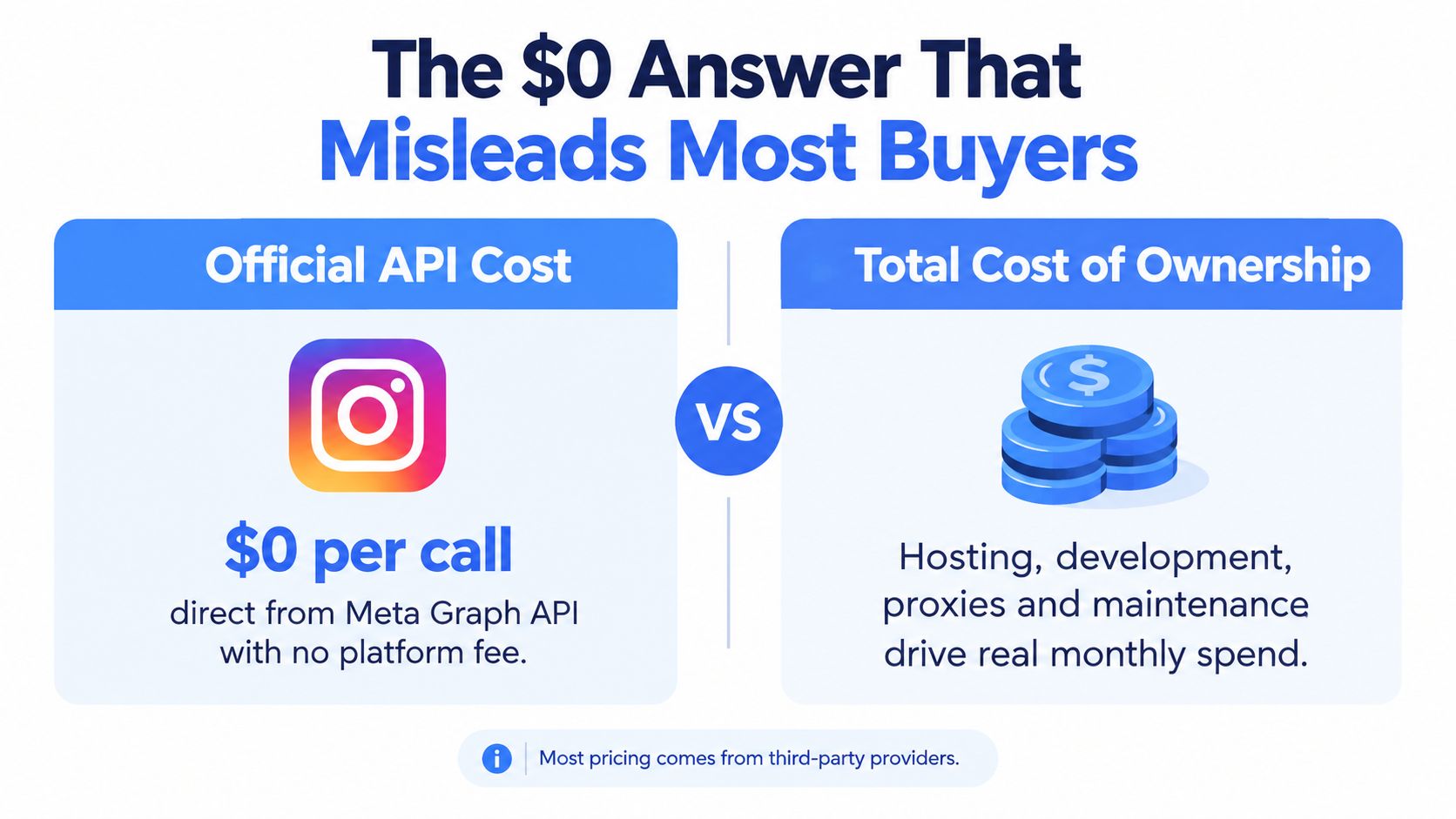
Instagram's official Graph API costs $0 per call at the platform level. Instagram API cost is total ownership, including authorization, app review, engineering, maintenance, and any paid access layer your workload requires.
That answer contradicts the advice most pricing guides lead with, but only superficially. Meta doesn't add a per-request toll, yet a free endpoint can still consume developer time, delay a launch, and force your team to build the reliability layer that an aggregator sells as a service.
The useful question isn't, “Does Instagram charge for API calls?” It's, “Which access route produces the lowest total cost for this data, account model, and request pattern?” Official Graph API access is usually the right foundation for managing accounts you control. Third-party providers become more relevant when you need public-data extraction, broader discovery, bursty workloads, or fewer authorization responsibilities.
| Access route | Platform or provider fee | What you still pay for |
|---|---|---|
| Official Instagram Graph API | $0 per call | App setup, permissions, review, OAuth, tokens, rate-limit engineering, and maintenance |
| Pay-per-call provider | Varies by requests or credits | Provider usage, integration, data validation, and acceptable-use review |
| Pay-per-result provider | Varies by records or results | Extracted data, storage, monitoring, and provider dependency |
| Monthly provider tier | Varies by subscription | Fixed capacity, overage risk, integration, and contract or plan constraints |
The distinction matters most for teams building RAG pipelines, social listening systems, competitive intelligence tools, and client-facing dashboards. The official route can be economically attractive but narrow. Paid services can broaden access, but their pricing models vary sharply.
Table of Contents
- The $0 Answer That Misleads Most Buyers
- How Instagram Graph API Pricing Actually Works
- Official Graph API vs Third-Party Providers
- Hidden Costs Behind Free Instagram API Access
- Cost Scenarios for Real Use Cases
- Which Pricing Model Fits Your Stack
- Modeling Your Monthly Instagram API Bill
The $0 Answer That Misleads Most Buyers
Meta's official Instagram Graph API charges $0 per call, with no platform subscription or API-key fee for standard access. The official Instagram API documentation describes that platform-level model, and independent pricing coverage reaches the same conclusion: Meta does not bill developers for each request.
The invoice is free. The integration is not.
A production implementation still requires an eligible Instagram account, a Meta developer app, OAuth flows, permission scopes, token storage, refresh handling, error recovery, and rate-limit controls. Applications serving accounts beyond their own organization may also face app review and business verification. These requirements do not add a line item to Meta's API bill, but they can extend delivery and maintenance work.
The free route has a labor bill
Developers must document each requested permission, support account connection, store credentials safely, handle revoked access, and make retries safe. Analytics products also need safeguards for missing fields, delayed responses, pagination, caching, and changes to Meta's access rules.
That makes “free API” a poor synonym for “cheap integration.” The platform fee is zero, while the operational workload can become substantial for brands, agencies, and SaaS products connecting many customer accounts.
Practical rule: Treat Meta's $0 as an API fee, not as a total-cost estimate.
The distinction also affects product planning because the old Basic Display API route ended in December 2024, according to current coverage of Meta's API changes in this Instagram API access overview. New consumer-facing integrations therefore need to assess the current Instagram Login path or Graph API instead of budgeting around a deprecated interface.
Public-data workflows introduce a different access layer. Profile discovery, search, comments, or extraction from accounts that have not authorized an app may require a paid provider. The Instagram API without login guide addresses that route. Compare providers by cost per usable result, not only by the price of an HTTP request, because credits, failed extractions, integration effort, and data validation can change the total bill.
How Instagram Graph API Pricing Actually Works
Meta's official route carries a $0 per-call platform fee, but that figure describes only one access layer. The actual cost depends on the account type, requested feature, permissions, app configuration, and engineering required to stay within platform controls.
The Graph API is built mainly for professional Instagram accounts, including Business and Creator accounts. Before an application can make useful requests, the team may need to link accounts, configure a Meta app, manage tokens, and obtain the permissions required by its workflow. Instagram Login supports a different set of consumer-facing use cases, while the discontinued Basic Display path should not guide new implementation plans.
Access is permissioned, not purchased
An app may request scopes such as instagram_basic and instagram_manage_comments, along with related Meta permissions such as pages_show_list. Advanced permissions and production access can require app review. Meta does not charge a separate per-call price for that review, but the process creates launch work: the team must demonstrate the feature, explain data use, and request only the access the product needs.
The product family and access model should be checked against the current official Instagram API product page before implementation. Documentation, permissions, and supported workflows can change, so older tutorials are poor pricing references.
Limits shape the economics
Industry guidance commonly describes a working ceiling of 200 calls per user per hour for many Instagram Graph API endpoints, as summarized in this Instagram Graph API cost guide. Applications with heavier traffic can also encounter app-level and rolling-window controls. That turns quota management into an engineering cost: scheduled jobs, response caching, compatible request batching, retry logic, and backoff handling all affect the bill even when the request price is zero.
| Scope | Account type required | Rate limit | App review needed | Practical cost surface |
|---|---|---|---|---|
| Account media and profile access | Business or Creator, depending on endpoint | Endpoint and account controls apply, including media and profile request quotas | Often depends on permissions and production use | OAuth, account linkage, storage, pagination |
| Comment management | Professional account | Shared quota and endpoint controls apply to comment reads, replies, and moderation actions | Requested permissions may require review | Webhooks, moderation logic, retries |
| Insights and analytics | Professional account with eligible access | Endpoint and account controls apply to insights reads and reporting windows | Restricted permissions can require review | Data normalization, historical storage, missing-field handling |
| Public discovery or hashtag workflows | Supported professional-account access path | Platform and search controls apply to discovery requests | Access depends on app configuration | Narrow coverage, caching, quota planning |
| Consumer profile and media access | Supported Instagram Login account flow | Route-specific controls apply to login and media requests | Depends on product and permissions | Login experience, token lifecycle, consent handling |
The request can therefore be free while the integration remains expensive to operate. Public-data requirements add another access layer. A public Instagram data API may fit profile discovery, search, comments, or extraction from accounts that have not authorized the app better than stretching an account-management API beyond its intended scope. Evaluate that route by cost per usable result, since failed extractions, validation, credits, and integration work can outweigh the advertised request price.
Official Graph API vs Third-Party Providers
The official Graph API and commercial providers solve different problems. Meta offers sanctioned access to eligible accounts and account-owned workflows. Third-party services may package extraction, pagination, retries, proxy infrastructure, normalization, and broader discovery into a usage unit.
The price comparison is therefore not just “free versus paid.” It's “build and operate the access layer yourself versus buy a data-delivery layer with its own limitations.”
Independent 2026 pricing comparisons report official Graph API usage at $0, while paid alternatives range from about $6 for 10,000 requests on some providers to roughly $600 for 1 million requests. Other offerings begin near $100 per month and reach around $1,400 per month for higher-volume extraction tiers, according to this 2026 Instagram API pricing comparison.
| Provider | Pricing model | Entry price | Per-unit cost | Best fit |
|---|---|---|---|---|
| Meta Graph API | Free platform access | $0 | $0 per call | Authorized Business and Creator account workflows |
| Pay-per-request provider | Requests or credits | About $6 for 10,000 requests on some offerings | Varies by provider and volume | Known targets and variable extraction |
| Pay-per-result service | Records or results | Varies by plan | Some comparisons cite $1.50 per 1,000 results | Profile, post, comment, or record collection |
| Monthly data tier | Subscription or daily quota | Near $100 per month in cited offerings | Effective rate depends on consumption | Predictable, recurring pipelines |
| High-volume extraction tier | Subscription | Up to about $1,400 per month in cited offerings | Lower effective unit cost may depend on utilization | Large, steady workloads |
Captapi's own product documentation describes credit-based Instagram endpoints. Its Post and Reel Details API uses one credit per successful call, while cached hits cost zero credits, and its Reels Search API uses two credits per successful call, as documented in the social media API overview. That model is materially different from Meta's account-authorized Graph API, because the buyer pays for a packaged data operation rather than an official platform request.
What the paid unit includes
A provider's billed unit may include more than transport. It can represent a successful extracted result, a search operation, an enriched record, or a request routed through scraping infrastructure. The buyer should verify whether pagination, empty results, retries, comments, and cached responses consume credits.
Data freshness and geographic coverage also need explicit testing. Official access may offer stronger platform sanction for supported account operations, while third-party services may expose broader public-data workflows with different compliance responsibilities. Neither route automatically guarantees every field, account, region, or historical record.
The right comparison is a test query against your actual workload. Measure usable records, failure handling, latency, and integration effort before converting a published unit price into a monthly forecast.
Hidden Costs Behind Free Instagram API Access
The hidden bill starts before the first successful request. A team has to create and configure the Meta app, connect eligible accounts, choose scopes, build consent screens, and prepare the evidence required for production access.
Some integrations finish quickly. Others encounter review questions, rejected submissions, account-linking problems, or permission changes that require another engineering pass. The cost depends on your team's familiarity with Meta's platform and the complexity of the product, so a responsible forecast should use internal estimates rather than pretend there's one universal build time.
A practical cost stack
| Cost item | One-time setup | Recurring work | Notes |
|---|---|---|---|
| Meta app and product configuration | Team estimate | Low | Includes environments, secrets, and redirect handling |
| Permission and review preparation | Team estimate | Periodic | Scope explanations, screen recordings, and revisions |
| Business verification support | Team estimate | As needed | Documentation and organizational ownership checks |
| OAuth and account connection | Team estimate | Ongoing support | Consent, callback failures, revoked access |
| Token lifecycle management | Team estimate | Scheduled maintenance | Long-lived tokens still require rotation planning |
| Rate-limit handling | Team estimate | Ongoing monitoring | Backoff, caching, batching, and alerting |
| Data storage and normalization | Team estimate | Ongoing | Historical metrics, pagination, schema changes |
| Deprecation and version work | Team estimate | Periodic | Regression testing and endpoint changes |
Meta's platform controls create a maintenance obligation even when the API invoice stays at zero. Current guidance emphasizes app review, verification, OAuth setup, token refresh, and rate-limit handling as the main operational sources of cost, a gap discussed in this Instagram API pricing analysis.
How to estimate hours without false precision
Don't copy a generic implementation estimate into your budget. Ask the engineer who owns the integration to record a range for each line item:
- Setup: Include app configuration, test accounts, secrets, and callback handling.
- Access: Include permission documentation, review preparation, and possible revisions.
- Reliability: Include retries, pagination, idempotency, caching, and quota alerts.
- Operations: Include token failures, revoked permissions, support tickets, and schema changes.
This approach produces a more credible Instagram API cost model than assigning a token price to a supposedly free service. If your team also needs proxy-backed public-data collection, proxy selection and monitoring become separate infrastructure concerns. The difference between direct platform access and proxy-backed workflows is outlined in this residential backconnect proxy guide.
Cost Scenarios for Real Use Cases
A request count alone doesn't determine the cheapest route. The decisive variables are what data you need, whether the account authorized your app, and whether the workload is steady or bursty.
The scenarios below use the volumes specified for planning purposes. They're decision models, not claimed invoices. Because the verified pricing data doesn't provide a single Captapi rate for every scenario, the pay-per-call column should be calculated from your selected endpoint and credit schedule rather than filled with invented dollar amounts.
Scenario A, a RAG pipeline
A retrieval-augmented generation system pulling 50,000 posts per month needs more than a transport endpoint. It needs stable pagination, deduplication, metadata normalization, storage, and a repeatable way to handle failed or empty results.
The official Graph API may work if the posts belong to accounts that authorized the app and the workflow fits the endpoint's access rules. It won't automatically become a general public Instagram search engine because the request volume is large. A third-party provider can be a better operational fit when the pipeline starts with public discovery or needs bursts around a research topic.
Scenario B, brand monitoring
Checking 10,000 hashtag mentions per day creates a frequent polling problem. The official route may be constrained by search scope, account eligibility, and rolling controls, so the team should test whether the available hashtag workflow covers its monitoring definition.
A paid service can simplify extraction, but the bill depends on whether it charges per request, result, credit, or subscription. A flat tier becomes attractive when the monitoring volume is predictable and the plan includes enough capacity without forcing the team to manage token refresh and quota retries.
Scenario C, OSINT research
An OSINT workflow collecting public profile and post metadata from 500 target accounts has a different shape. The target list is known, which favors a request or result-based provider when the official API can't authorize the accounts or expose the required fields.
| Scenario | Monthly volume | Official Graph API | Captapi, pay-per-call | Flat-fee tier |
|---|---|---|---|---|
| RAG post collection | 50,000 posts | $0 platform fee, but access and engineering constraints apply | Calculate endpoint credits and successful-call rules | Compare predictable capacity against expected ingestion |
| Brand hashtag monitoring | 10,000 mentions per day | $0 platform fee, subject to supported search and quota controls | Calculate calls, result pagination, and retries | Often easier to budget for steady monitoring |
| OSINT target-account research | 500 accounts | $0 platform fee where authorization and endpoint eligibility fit | Calculate profile, post, and comment operations | Useful when research runs continuously |
The surprising conclusion is that volume doesn't automatically favor the official API. Data eligibility can matter more than request count. A paid route may be cheaper than building an elaborate system around an endpoint that can't return the data your product requires.
Which Pricing Model Fits Your Stack
There isn't one winning model. The best choice depends on whether you need sanctioned account management, public-data breadth, predictable capacity, or minimal engineering ownership.
Choose the official Graph API when control is narrow
The free Graph API is the natural choice when your product works with a known set of Business or Creator accounts and the users can authorize the app. It's especially compelling for publishing, account insights, comment management, and workflows where Meta's official permissions match the product requirement.
Your team still needs capacity for review, OAuth, token rotation, and rate-limit retries. If that work is already part of the platform, the $0-per-call structure can be difficult for a paid aggregator to beat.
The 10,000 requests per month threshold in the planning brief is a useful internal rule of thumb, not a universal Meta limit. Treat it as a point for comparing engineering cost against provider spend, not as a platform boundary.
Use pay-as-you-go for irregular extraction
Pay-per-call or pay-per-credit providers suit workloads that arrive in bursts, change targets often, or need data outside the authorized-account model. RAG enrichment, scraping, research, and one-off exports fit this pattern because a monthly subscription can leave unused capacity during quiet periods.
Captapi is one example of a credit-based option. Its Instagram endpoints can charge credits for successful calls and assign zero-credit treatment to cached hits, so teams should model cache behavior and endpoint mix rather than compare a headline plan alone.
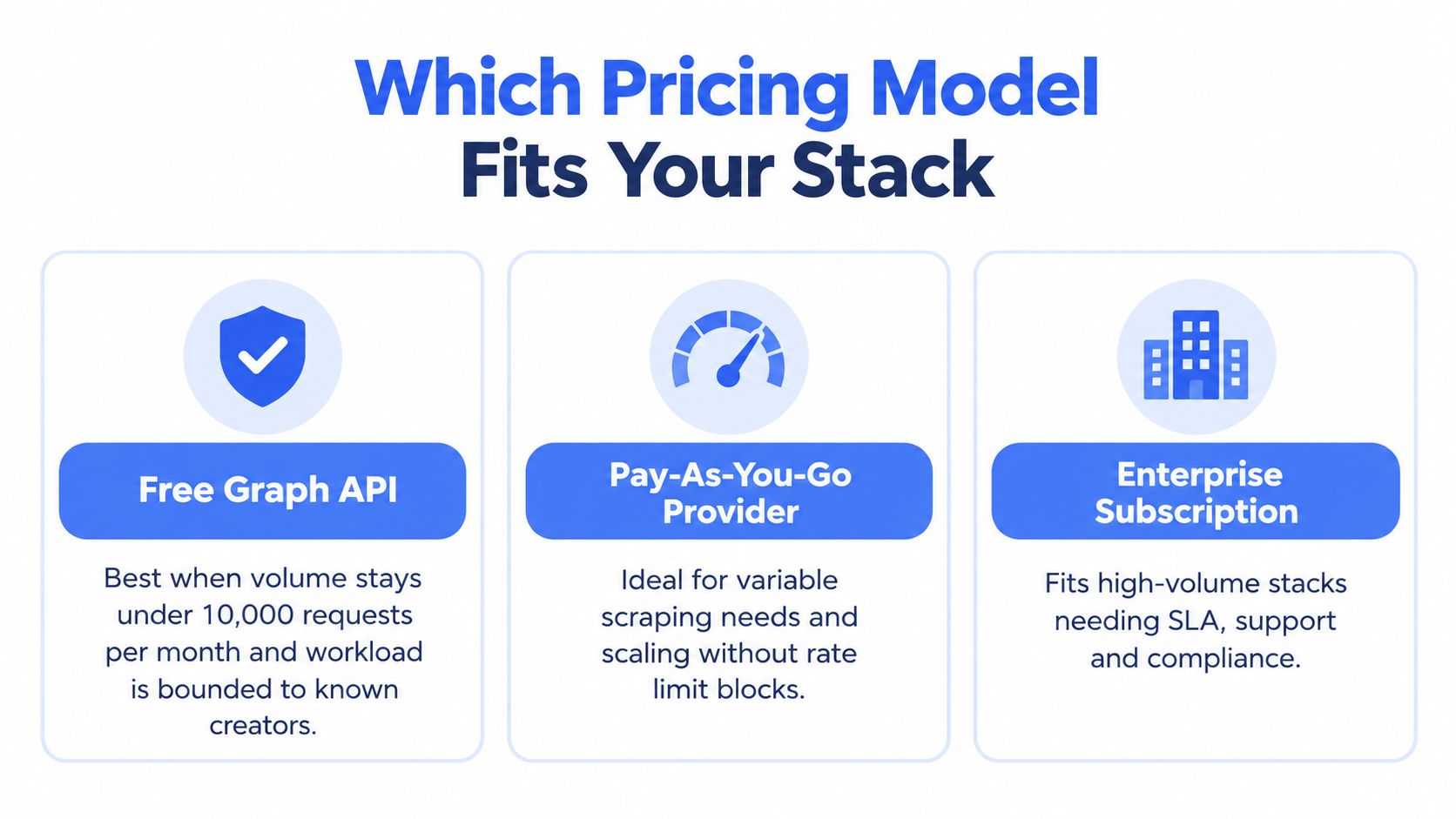
Use monthly tiers for steady operations
A flat-fee tier can make sense for an enterprise monitoring dashboard with predictable volume, tight latency expectations, and a team that doesn't want to own token refresh or provider-level extraction reliability. The risk is underutilization, because a subscription remains payable during a quiet month.
A practical pricing rule is to compare the provider's effective cost per 1,000 calls or results with the fully loaded internal cost of the official route. The brief's suggested decision boundary, below $2 per 1,000 calls favoring aggregators and above $5 per 1,000 favoring self-hosting, should be treated as a heuristic. It only works after you include engineering, infrastructure, review delays, and support.
Modeling Your Monthly Instagram API Bill
Build the forecast before choosing a provider. A simple worksheet prevents the most common mistake, comparing Meta's zero platform fee with a provider's usage price while ignoring the labor required to make either route production-ready.
Four steps for a defensible estimate
- Estimate requests by endpoint. Separate profile lookups, post details, searches, comments, pagination, retries, and refresh operations. Don't count only the first request in a workflow.
- Add a retry buffer. The planning brief specifies a 20% buffer for retries, backoff, and traffic spikes. Apply it to request volume before comparing tiers.
- Add fixed operating costs. Include engineering time, hosting, storage, monitoring, review preparation, token operations, and any provider subscription minimum.
- Model three routes. Price an official-only build, a hybrid model that sends overflow or public-data work to a paid provider, and a full third-party workflow.
| Forecast line | Official only | Hybrid | Full third-party |
|---|---|---|---|
| Platform or provider fees | Meta platform fee | Official access plus provider usage | Provider usage or subscription |
| Engineering | Highest ownership | Shared ownership | Lower platform-specific ownership, still requires integration |
| Coverage | Authorized and supported data | Official data plus selected paid access | Depends on provider and endpoint |
| Main risk | Review, quotas, maintenance | Two systems and routing logic | Vendor pricing, availability, and compliance |
The daily usage guide can help organize provider consumption into a repeatable operating process. Record actual successful calls, cache hits, failed requests, and credits consumed, then revise the forecast with observed behavior.
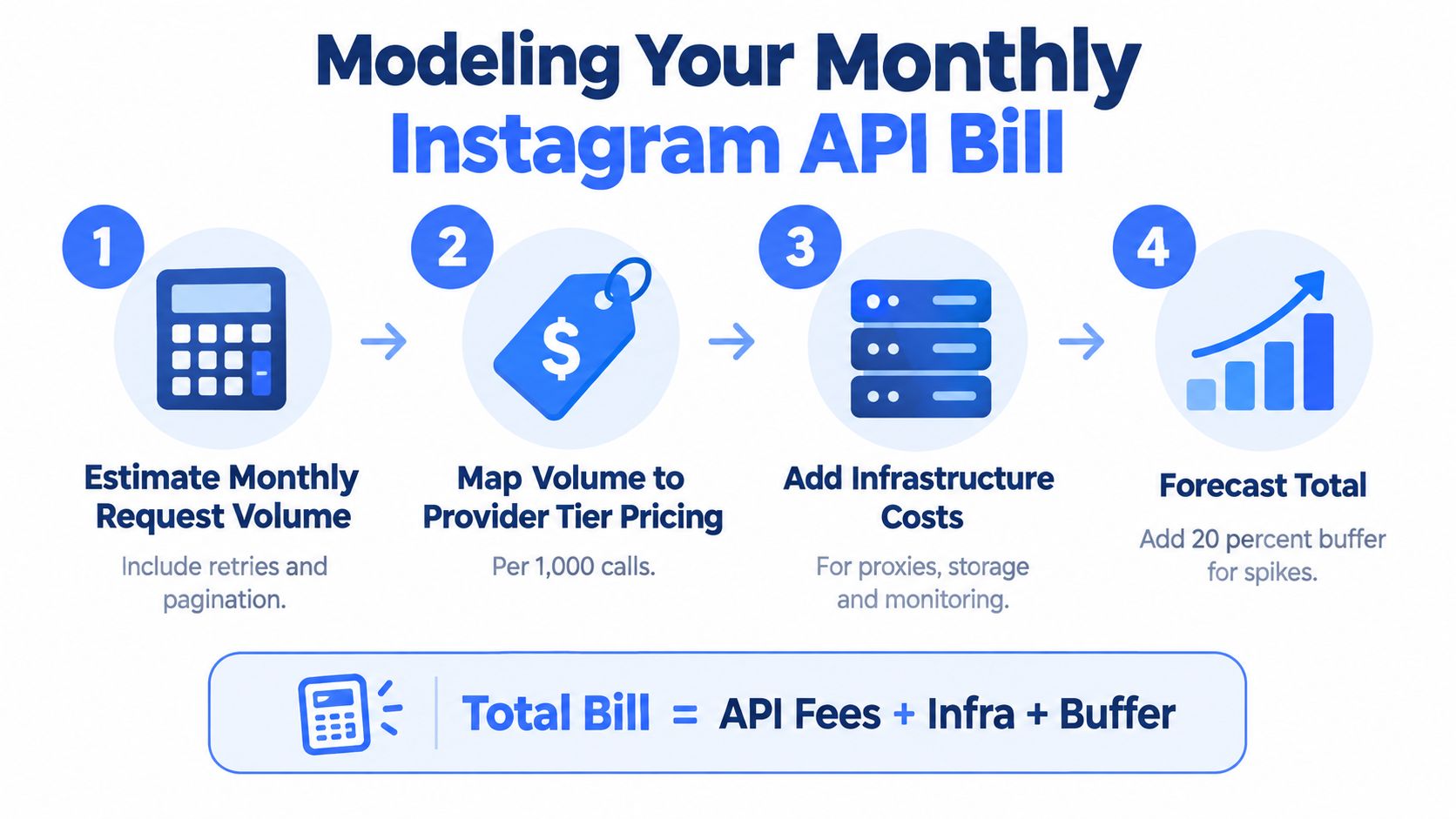
The decision rule is straightforward: use the official Graph API when its access model matches your data and your team can absorb the operational work, use pay-as-you-go for variable extraction, and use a monthly tier when demand is stable enough to consume its capacity.
Captapi provides a credit-based social data API for Instagram and other platforms, with endpoints for public data extraction, search, details, and related workflows. If you're comparing the $0 Graph API with paid access layers, visit Captapi to review the endpoint costs, credit behavior, and integration path against your own monthly request forecast.