
How to Find a YouTube Channel by Email
Most advice on how to find a YouTube channel by email starts with the wrong assumption. An email address isn't a universal public key that YouTube lets you submit to a channel database. In most cases, you're dealing with either a private Google Account address that YouTube protects, or a public business contact address that a creator has deliberately exposed.
That distinction changes the entire workflow. Instead of hunting for a private account lookup, treat the problem as public metadata discovery and identity correlation. Manual OSINT can work for a single high-value target. For larger datasets, a structured API pipeline is more practical, provided it only processes contact details that creators have made public.
Table of Contents
- The Privacy Reality of YouTube Email Lookups
- Public Email Availability Across Channel Sizes
- Manual OSINT Techniques for Channel Discovery
- Scaling Extraction with Social Media Data APIs
- Navigating Compliance and Data Handling Ethics
- Building a Reliable Creator Data Pipeline
The Privacy Reality of YouTube Email Lookups
A YouTube channel is tied to at least one Google Account, but that doesn't make the account's login email searchable. Google uses the account email for authentication and recovery, while YouTube gives creators a separate option to publish a business inquiry address. Those are different data fields with different privacy expectations.
Google's own guidance distinguishes the email used to sign in from the contact information a creator chooses to display publicly in the channel's About or Basic info area. The official explanation of YouTube account email addresses makes the boundary clear: the login address belongs to the Google Account, while a public contact email is optional.
Practical rule: If the creator hasn't published an address, don't assume a technical lookup exists behind the interface.
This is why recovery workflows and discovery workflows shouldn't be mixed. If your own channel is compromised, YouTube says you must recover the underlying Google Account first. Google also treats a recovery email as a security mechanism for regaining account access and receiving alerts. YouTube's hacked-channel support is limited to incidents within the past 9 months because of its retention policy, as described in YouTube's account recovery guidance. Those systems verify ownership. They aren't designed to reveal another person's hidden email address.
What an email lookup can realistically return
There are three useful outcomes:
- A public business email, displayed through the channel's contact mechanism.
- A matching address in channel text, such as a description or linked website.
- A corroborated public identity, where the email appears across several public profiles that point to the same channel.
The private Google Account address generally isn't one of them. A channel may also represent a brand, team, or organization rather than the individual who operates it. That creates another identity gap, because an email can belong to a manager or agency while the channel itself belongs to a separate brand.
For teams designing research systems, this is a data modeling issue. Store public_contact_email separately from any account or authentication identifier, and record where the address was observed. Good privacy practices for social data collection should be part of the design from the beginning, not added after a scraping pipeline is already processing records. The data privacy best practices guide offers useful principles for that separation.
Public Email Availability Across Channel Sizes
Public contact data is unevenly distributed. Smaller creators often have no business inquiry workflow, while larger channels are more likely to publish an address because sponsorships, press requests, and commercial partnerships require a contact route.
A 2026 sample from Heepsy reported that approximately 6% of channels below 10K subscribers published a business email. The rate rose to about 14% for channels with 10K–100K, 22% for 100K–500K, 27% for 500K–1M, and 31% for channels with 1M+ subscribers. These figures come from the Heepsy YouTube email finder data, and they should be treated as sample-based availability estimates rather than a guarantee for any individual channel.
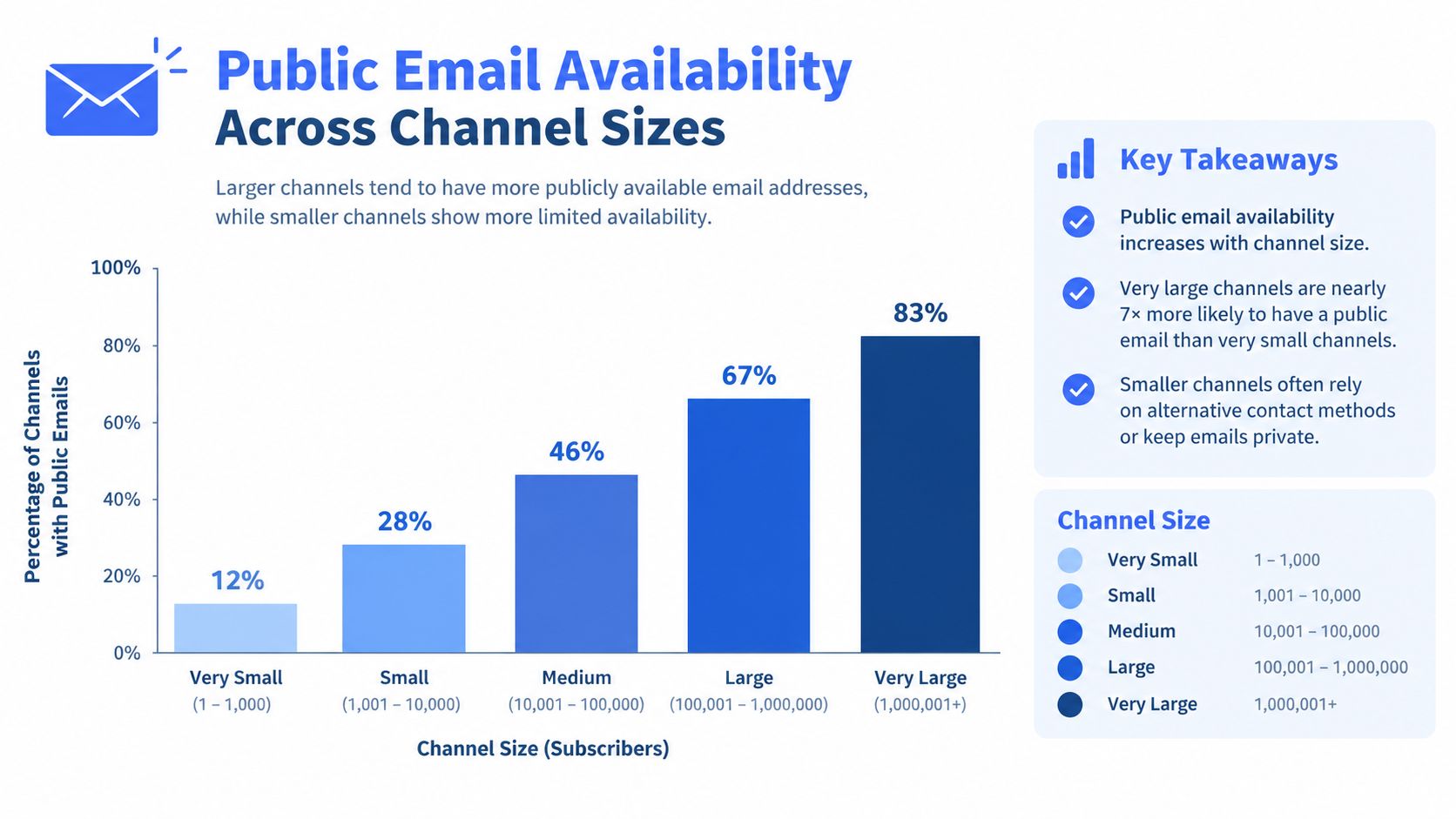
The operational conclusion is straightforward. If your target list is dominated by small or emerging channels, an email-first strategy will produce many empty results. If you're researching established creators, managed brands, or sponsorship candidates, public contact discovery becomes more viable, though it still depends on deliberate disclosure.
What the published addresses reveal
The same Heepsy dataset reported that around 73% of published addresses were Gmail addresses. Roughly one-fifth used the creator's own domain or a management company's domain, and about 5% of channels listed more than one email address. Each of those patterns affects matching:
- Gmail addresses may identify a creator, but they can also be personal, shared, or reused across projects.
- Management domains often indicate that the visible contact is an intermediary rather than the channel owner.
- Multiple addresses may separate sponsorships, press, support, and general inquiries.
Don't use subscriber count as proof of identity. Use it as a prioritization signal. A data team can decide whether to inspect channels manually, query public metadata programmatically, or discard low-yield segments before investing in enrichment.
The most important metric in your own workflow isn't a promised universal match rate. It's the proportion of records with a verifiable public contact endpoint and at least one corroborating channel signal. That distinction keeps an outreach database from treating missing data as an extraction failure.
Manual OSINT Techniques for Channel Discovery
For one address or a small number of targets, manual OSINT is often more reliable than rushing into automation. The objective isn't to force YouTube to reveal an account. It's to find public traces and test whether they converge on the same creator or brand.
Start with an exact-match search for the email address in quotation marks. Add terms such as YouTube, channel, the suspected creator name, or a known topic. Then test narrower searches that target public pages, for example:
"name@example.com" YouTube"name@example.com" channel"name@example.com" site:youtube.com"name@example.com" site:creator-domain.example
Search engines may index the email in a channel description, a video description, a creator website, or a public social profile. They won't return every public occurrence, and an absence of results doesn't prove that the address isn't published. Indexing, page visibility, and formatting all affect what appears.
Inspect the channel's public contact surface
If you already have candidate channels, open each channel's About or Basic info area and look for the business inquiry email. YouTube may place that address behind a verification step, CAPTCHA, or anti-abuse control. Those checks are a signal that the platform doesn't intend the field to function as an unrestricted directory.
Next, inspect the channel description and linked website. Creators often repeat a business address in several public locations, but repetition alone isn't enough to establish ownership. Check whether the linked domain uses the same brand name, whether the channel links back to it, and whether the website identifies the same host, company, or content niche.
A useful investigation record includes:
- Observed address: Store the exact public string and normalize it only in a separate field.
- Source location: Note whether it came from the About area, description, website, or another public profile.
- Channel identity: Record the channel name, handle, URL, and visible brand context.
- Corroboration: Compare biographies, linked domains, profile images, naming, and content topics.
- Confidence: Mark the result as confirmed, probable, ambiguous, or unsupported.
Don't call a match confirmed just because an email appears in a search result. Confirm that the public address and the channel identity support each other.
Cross-site correlation matters when a creator operates multiple brands or uses an agency. An email may point to a personal portfolio, a production company, and several channels. The OSINT workflow for social media research provides useful context for collecting those public traces without confusing a single matching string with definitive attribution.
Scaling Extraction with Social Media Data APIs
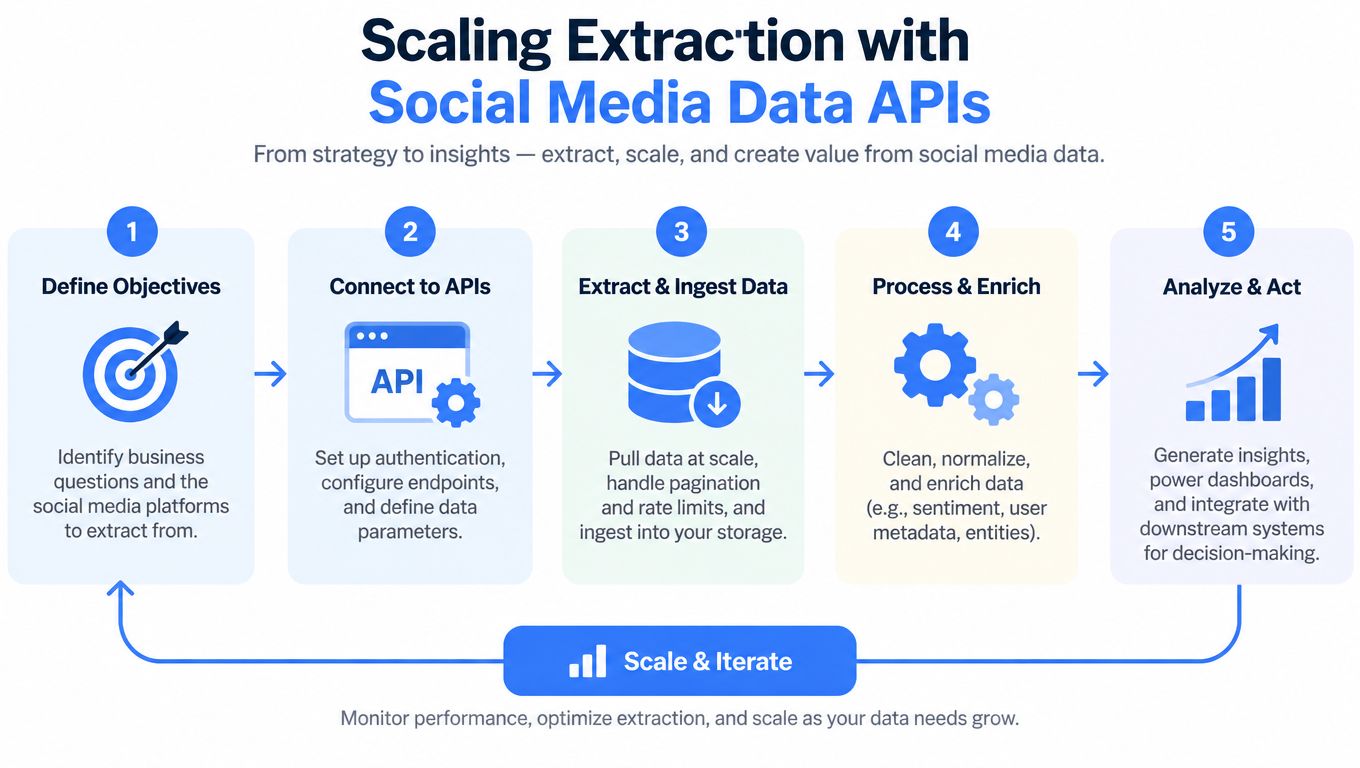
Manual research breaks down when a team needs to process a creator list, refresh records, or feed channel metadata into a CRM or machine-learning system. Browser extensions and custom scrapers can collect visible fields, but they also inherit the instability of the interface. Layout changes, consent screens, CAPTCHA challenges, pagination behavior, and rate limits can all break a brittle extraction job.
A structured REST API changes the engineering boundary. Instead of automating clicks in a browser, your application requests channel metadata, receives normalized fields, and applies its own parsing and validation rules. A developer-focused YouTube data API guide describes this general approach to collecting channel information programmatically.
Manual work versus an API pipeline
| Requirement | Manual OSINT | Structured API extraction |
|---|---|---|
| Single high-value target | Strong fit | May be unnecessary |
| Repeated channel refreshes | Slow and inconsistent | Easier to schedule |
| Cross-channel metadata | Requires repeated browsing | Can be normalized into records |
| Anti-abuse handling | Human encounters the controls directly | Depends on the API's collection method and limits |
| Identity verification | Strong contextual judgment | Requires explicit validation rules |
| CRM or analytics integration | Usually involves copying data | Designed for machine-readable output |
The API doesn't solve the identity problem by itself. It can return a channel description or a publicly exposed contact field, but your application still needs to distinguish an email from ordinary text, remove obvious junk, and check whether the result belongs to the relevant channel.
A practical extraction flow looks like this:
- Collect candidate channels: Start with known channel URLs, handles, search results, or a curated creator list.
- Request public metadata: Retrieve the channel name, description, links, and any exposed contact field.
- Parse conservatively: Detect email-shaped strings without assuming every string is valid or appropriate for outreach.
- Correlate signals: Compare the email domain, linked website, channel branding, and external profiles.
- Persist provenance: Store the retrieval time, source field, confidence status, and review decision.
Retries, caching, and rate-limit handling matter more than a clever parser. A custom browser scraper may succeed during development and fail later when a visual selector changes. A unified API can reduce that maintenance burden, but it doesn't remove the need to respect platform rules or to review the data you collect.
Security validation also matters. YouTube warns that legitimate platform messages come from @youtube.com or @google.com, a useful safeguard when someone presents an email as an official platform contact. That warning is covered in YouTube's guidance on legitimate messages. Don't treat a public creator email as proof that a message claiming to represent YouTube is authentic.
Navigating Compliance and Data Handling Ethics
Public visibility doesn't eliminate responsibility. A business inquiry address is exposed for a purpose, usually to receive relevant commercial, media, or collaboration requests. That doesn't grant permission to build an unrestricted personal profile, share the address broadly, or send unrelated bulk messages.
The first control is classification. Keep public business contact data separate from inferred personal identity, private account information, and authentication credentials. If a Gmail address appears publicly, its provider doesn't tell you whether it's a business inbox, a personal inbox, or a shared manager account.
Controls that belong in the pipeline
- Purpose limitation: Define why you're collecting the address, such as creator outreach, press research, or channel analysis.
- Provenance tracking: Save the public page or metadata field where the address appeared.
- Access control: Limit internal access to contact records and log exports.
- Retention rules: Remove records that no longer serve the stated purpose.
- Suppression handling: Honor unsubscribe requests, do-not-contact flags, and internal exclusions.
- Review gates: Require human approval before automated outreach uses an ambiguous match.
A responsible system also limits collection. Don't attempt to bypass account recovery controls, CAPTCHA barriers, hidden fields, or access restrictions. Don't test guessed addresses against login or recovery forms. Those actions move from public-data research toward unauthorized access and can expose both the researcher and the creator to security risk.
Ethical boundary: Publicly visible doesn't mean context-free. Use the address only in a way that matches why the creator published it.
Phishing is another practical concern. A researcher may discover an address and then receive a message that claims to be from YouTube, Google, a sponsor, or an agency. Validate the sender independently, inspect the domain carefully, and avoid treating a channel match as proof of the sender's authority.
Enterprise teams should document the collection method, permitted use, escalation path, and deletion process before running a large job. The social media compliance guidance is a useful reference for connecting extraction practices with governance, consent expectations, and platform terms.
Building a Reliable Creator Data Pipeline
Email discovery works best as one stage in a broader creator intelligence system. The durable design starts with channel identity, not the email field. A channel record should retain its canonical URL or handle, visible name, description, links, collection time, extracted contacts, and evidence supporting each match.
A simple architecture separates acquisition from interpretation:
- Acquire public channel metadata through an approved collection method.
- Normalize the response into stable fields, preserving the original text.
- Extract candidate emails from the fields where public contact information may appear.
- Score corroboration using channel branding, linked domains, profile references, and content context.
- Route uncertain records to manual review instead of forcing a binary match.
- Publish approved records to the CRM, research store, dashboard, or analysis pipeline.
This structure supports more than outreach. The same channel metadata can feed competitor monitoring, creator segmentation, content research, sentiment analysis, or a retrieval system. The email is only one optional attribute, and often not the most reliable identifier.
For marketers who need a practical workflow around creator contact research, this guide for digital marketers provides additional context on turning public creator information into campaign inputs. Use any enrichment guide alongside your own provenance, review, and suppression rules.
A production implementation should also monitor data quality. Track missing contact fields, duplicate channels, changed handles, stale records, and ambiguous brand relationships. The data pipeline automation guide offers a useful framework for making these processes repeatable rather than relying on ad hoc spreadsheet updates.
The central lesson is simple: you can't reliably discover a private YouTube login account by email, but you can build a scalable workflow around public business contact data. Start with a narrow manual investigation when context matters. Move to structured extraction when volume, refresh frequency, or downstream integration justifies it, and keep human verification where the evidence doesn't support a confident match.
Captapi provides a developer-first REST API for extracting public YouTube channel details and other social media metadata without juggling multiple platform SDKs. Use it to collect channel records, parse publicly exposed contact fields, and feed verified results into your CRM or data pipeline. Visit Captapi to start building a more reliable channel discovery workflow.