
8 Competitor Analysis Benefits for Smarter Growth

Competitor analysis pays off when it changes a decision, not when it fills a slide deck. That's the surprising part. One market summary reports that 90% of Fortune 500 firms use competitive intelligence, and sales teams with access to it close deals 28% faster. The value isn't in awareness alone. It's in using outside signals to decide where to spend next week's budget, which feature to ship next quarter, and which sales message to retire now.
That's the lens for the competitor analysis benefits that matter most. For each one, look for four things: the signal, the action it enables, the trade-off it introduces, and the ROI question it should answer. If a finding can't support a resource decision, it's probably noise.
This matters more now because teams are collecting more public market data than ever, but many still run competitor analysis as an occasional research task. That leaves marketing, product, sales, and research working from separate interpretations of the same market. A better approach is to treat competitor analysis as an operating system for allocation.
For teams studying social content specifically, Captapi is one practical option for consolidating public data from YouTube, TikTok, Instagram, and Facebook into one workflow. It gives teams a way to pull transcripts, comments, summaries, search results, and engagement signals without stitching together separate platform processes. Used well, that kind of data pipeline turns observation into repeatable decisions.
Table of Contents
- 1. Identify Market Gaps and Opportunities
- 2. Benchmark Performance Against Industry Standards
- 3. Improve Pricing and Product Strategy
- 4. Enhance Marketing and Content Strategy
- 5. Detect Threats and Stay Ahead of Market Shifts
- 6. Inform Sales and Positioning Strategy
- 7. Support OSINT, Research, and Trend Analysis
- 8. Enable Data-Driven Decision Making and Risk Reduction
- 8-Point Competitor Analysis Benefits Comparison
- Turn Competitive Signals Into Measurable Returns
1. Identify Market Gaps and Opportunities
Looking at competitors to see what's crowded is a common starting point. The better use is to find what competitors consistently ignore. That usually shows up in content themes they don't cover, audience questions they leave unanswered, regions they don't serve well, or channels where they post without building real conversation.
Recent industry coverage points to a common blind spot: competitor analysis can reveal untapped channels, low-saturation regions, and operational benchmarks such as share of voice, ROAS, win rates, deal velocity, and ACV, yet many teams still stop at generic gap-spotting instead of ranking which gaps deserve budget now, as noted in Joey Giunta's competitor research analysis. That's the opportunity. Not every white space is worth pursuing this quarter.

With Captapi, a team can pull public posts, comments, transcripts, and engagement across YouTube, TikTok, Instagram, and Facebook, then compare what rivals publish versus what audiences keep asking for. That's especially useful when paired with broader market research techniques for validating demand. If five competitors keep pushing product demos while audience comments ask basic implementation questions, the gap may not be product depth. It may be onboarding education.
Turn the gap into an allocation decision
A simple workflow works better than a one-off brainstorm:
- Track a fixed set: Follow a stable list of direct and adjacent competitors so signal quality improves over time.
- Review by audience problem: Group competitor content and comments by job-to-be-done, not by platform alone.
- Prioritize by actionability: Choose gaps you can serve with existing team capacity before chasing broader expansion.
Practical rule: A market gap matters only if your team can assign budget, owner, and success criteria to it within the current planning cycle.
A digital agency, for example, might notice competitors rarely respond to public comments quickly. That signal doesn't just suggest “better engagement.” It suggests a service line around response operations, moderation, or social care. The trade-off is focus. Every new gap pursued means something else gets delayed. The ROI checkpoint is straightforward: did the new content pillar, service offer, or segment focus create stronger conversion quality or reduce wasted output?
2. Benchmark Performance Against Industry Standards
Benchmarking is where competitor analysis becomes an operating system for resource allocation. It helps teams decide whether to put the next hour, dollar, or sprint into content production, audience development, sales enablement, or measurement fixes.
Internal trendlines matter, but they can hide weak relative performance. A channel can grow and still lose share of attention if competitors are improving faster or attracting higher-intent engagement. That is why benchmarking works best as a decision tool, not a reporting exercise.
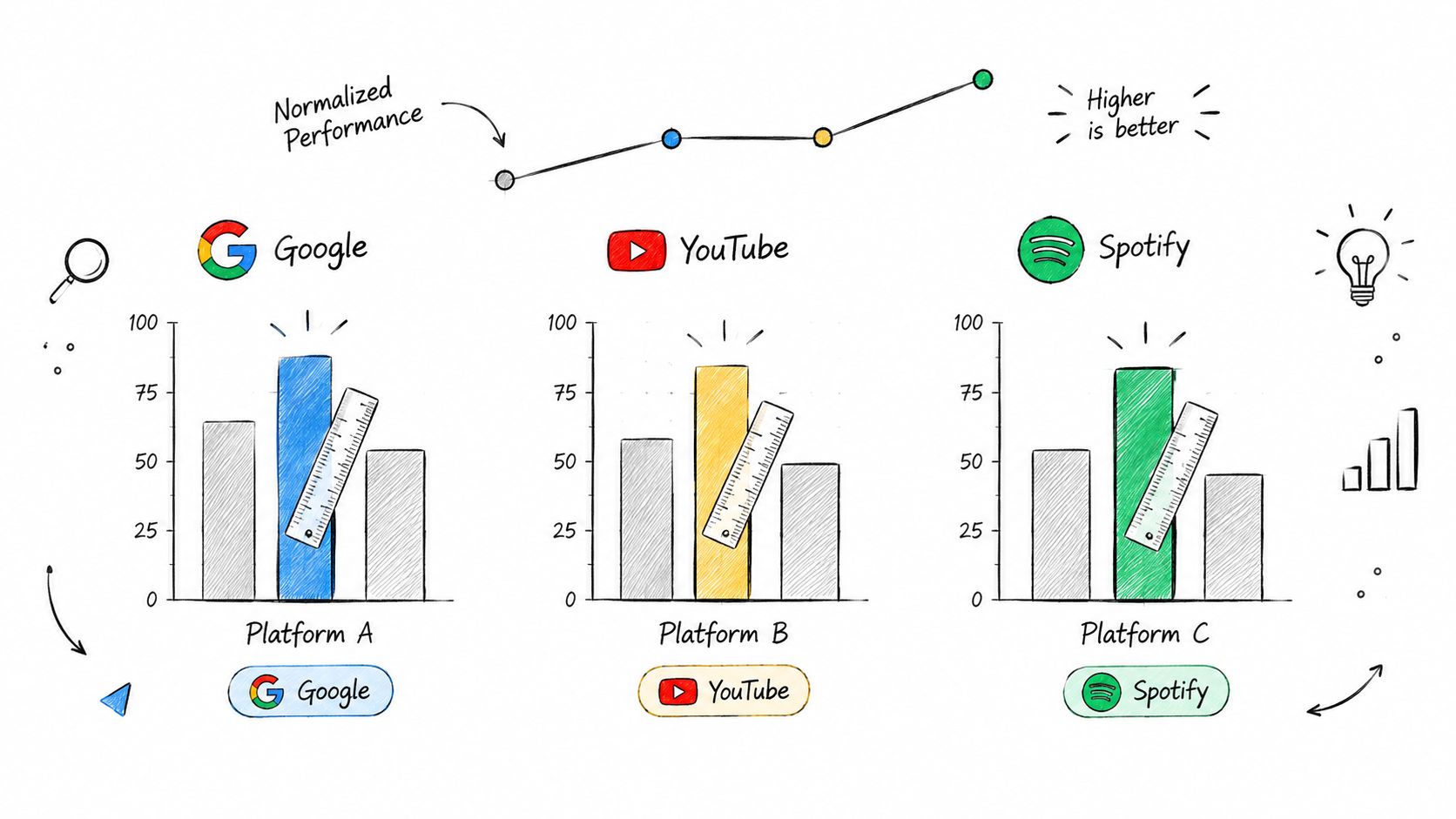
The practical challenge is comparability. If one analyst reviews YouTube manually, another exports TikTok metrics, and a third logs Instagram screenshots, the benchmark will be inconsistent before any analysis begins. Captapi helps collect public posts, comments, transcripts, and search results across platforms so teams can compare like with like. That matters for companies trying to benchmark LinkedIn competitors while also tracking short-form video and using a documented competitor analysis benchmarking process.
What a useful benchmark answers
A benchmark should resolve a specific allocation question.
If competitors publish less often but generate more qualified discussion per post, increasing volume may be the wrong response. If their tutorials attract repeated implementation questions, the issue may sit in education design rather than topic choice. If one format produces reach but little downstream interest, the team may be buying visibility at the cost of conversion quality.
A useful monthly benchmark usually covers three comparisons:
- Output efficiency: Which competitor gets the most useful response per post, video, or campaign asset?
- Engagement quality: Do public comments indicate buying intent, confusion, advocacy, or passive reaction?
- Format economics: Which content types appear to justify more production time, distribution budget, or repurposing effort?
Each comparison should point to an action, a trade-off, and a check on return. For example, if competitor explainers generate stronger discussion than polished brand clips, the action is to test more educational formats. The trade-off is reduced investment in high-production creative. The ROI checkpoint is simple. Did the change improve lead relevance, shorten iteration cycles, or raise assisted conversion rates?
There are limits. Public engagement does not reveal full funnel performance, and benchmark data can be distorted by paid distribution, audience size, or campaign timing. Still, a consistent benchmark is good enough to improve operating decisions if teams review it on a fixed cadence and use the same definitions each month.
A growth team might find that its posts match competitors on reach but fall behind on substantive comments and reposts from decision-makers. That signal should change the brief, the channel mix, and possibly the owner of the program. The point of benchmarking is not to build a prettier dashboard. It is to reassign effort toward channels and formats that produce measurable business value.
3. Improve Pricing and Product Strategy
Pricing and product strategy determine where a company spends scarce resources. Competitor analysis helps teams place those bets with less guesswork by connecting market signals to concrete allocation choices across product, marketing, sales, and research.
The useful question is not whether a rival launched a feature or changed a price. The useful question is whether that move changes buyer behavior enough to justify a response from your team. A feature copycat build consumes engineering time. A discount response can compress margins and retrain buyers to wait for concessions. A packaging change may solve the same problem with less cost and less operational drag.
Public competitor signals can narrow that decision. Product teams can review launch messaging, demo transcripts, support themes raised in comments, and customer reactions across channels to see what buyers are struggling to understand or adopt. Captapi is relevant here because it helps teams collect that public social data across platforms, then compare recurring questions, claims, and engagement patterns in one workflow.
A repeated pattern matters more than a loud announcement.
If a competitor promotes advanced functionality but public responses keep circling back to setup time, integrations, or documentation gaps, the implication is practical. The market may not be rewarding feature depth as much as faster time to value. That should shift the next decision. Instead of funding a parity build, a team might prioritize onboarding, implementation support, packaging, or a simpler entry tier.
Research from Gartner on win-loss analysis points in the same direction. Gartner found that companies that systematically use win-loss analysis can improve win rates by 15 percent to 30 percent. The takeaway is operational, not theoretical. Systematic review of buyer choices improves how teams decide what to build, how to price it, and where to remove friction in the sales process.
A simple operating workflow helps keep this repeatable:
- Collect the signal. Track competitor pricing changes, feature announcements, demo framing, and audience questions.
- Classify the likely impact. Separate signals that affect acquisition, expansion, retention, or only brand visibility.
- Choose the lowest-cost response. Test packaging, positioning, onboarding, or documentation before committing to roadmap work.
- Set an ROI checkpoint. Review deal progression, discount rates, retention risk, or implementation speed after the change.
The limitation is clear. Public data will not reveal private discounting, contract terms, or full product usage. It is still useful for reducing obvious mistakes. Teams do not need perfect visibility to avoid building low-value parity features or reacting to pricing moves that have more promotional value than commercial impact.
A developer tools company might see a competitor's launch generate strong reach but also a large volume of questions about setup complexity. The action is to strengthen the quick-start path and clarify pricing tiers before expanding the roadmap. The trade-off is slower feature expansion. The ROI checkpoint is whether trial-to-paid conversion improves, sales objections drop, or onboarding time falls.
4. Enhance Marketing and Content Strategy
Competitive content analysis affects budget allocation more than ideation. It helps teams decide which messages deserve more production, which formats deserve less, and which audience questions are still expensive to ignore.

A 2026 survey of more than 1,200 founders, product managers, and CI professionals found that 73% of seed-stage startups rated competitive intelligence as “critical” or “very important,” while 47% reported using dedicated CI tools versus 28% in 2024. The useful conclusion is operational. More teams are treating competitor analysis as recurring input for go-to-market decisions, not occasional brand review.
For marketing leaders, that changes the job. The goal is not to copy high-performing competitor posts. The goal is to route public signals into a repeatable content system that allocates time across campaigns, sales enablement, product education, and research support.
Captapi is relevant here because content teams often need multiple public signals in one workflow. Transcripts show message framing. Comments reveal objections and buyer language. Engagement patterns show which topics attract response across channels. That makes it easier to plan content repurposing strategies from social source material instead of funding net-new assets without clear demand evidence.
A useful review process can stay lean:
- Pull the signal. Collect competitor videos, clips, posts, comments, and engagement data from the channels buyers use.
- Map signal to action. Separate themes that support acquisition, retention, category education, or sales objection handling.
- Choose the trade-off. Decide whether to invest in differentiated thought leadership, faster response content, or lower-cost repurposing.
- Set the ROI checkpoint. Measure output against qualified traffic, demo conversion, sales content usage, or production hours saved.
An AI startup, for example, might review competitor demo transcripts and find repeated claims about model quality across every major player. Comments under those same posts may show buyers asking different questions about setup time, integration burden, and workflow fit. The practical response is to shift editorial priority toward implementation content, comparison pages, and proof assets for sales. The trade-off is less attention on broad category storytelling. The ROI checkpoint is whether those assets improve campaign conversion, shorten evaluation cycles, or reduce repeated objections in calls.
The limitation matters. Public engagement does not reveal attribution, assisted pipeline impact, or whether a popular topic influences closed-won deals. Teams should ask whether the observed competitor advantage changes buying behavior or creates the impression of strength. That question keeps content analysis tied to resource allocation rather than vanity metrics.
Later in the workflow, teams can review examples directly:
5. Detect Threats and Stay Ahead of Market Shifts
Competitor analysis becomes an operating system here. The job is not to watch rivals for interesting updates. It is to decide, earlier than the market does, where to shift budget, research time, product attention, or message defense.
Public signals usually change before reported market outcomes do. A competitor may narrow its category claim, push one use case across several channels, attract a different set of questions in comments, or start showing up in adjacent search conversations. None of those signals proves a market shift on its own. In combination, they can justify action while the cost of responding is still low.
A practical rule helps. Escalate only when one pattern appears in more than one public surface and persists long enough to affect planning.
Captapi is useful in that workflow because it lets teams collect public social posts, videos, comments, and cross-platform activity in one monitoring process. That matters less for surveillance than for triage. If product marketing, paid search, and research teams are looking at the same signal set, they can decide whether a change calls for a pricing test, a content reset, a sales brief, or no action at all.
Consider a smaller competitor that starts publishing repeatedly around one adjacent workflow. Video titles change first. Comment threads then fill with implementation questions from a new buyer segment. A few weeks later, the same framing starts appearing in paid acquisition copy and community discussions. The immediate threat is rarely lost revenue that quarter. The larger risk is category reframing, where buyers begin to evaluate vendors against a use case your team is not staffed or positioned to answer.
That kind of detection should trigger decisions such as:
- reallocating research time to validate whether the use case is expanding or just concentrated in one audience
- pausing spend on a weakening message before paid and content teams reinforce the wrong angle
- giving sales a temporary response framework while product decides whether the shift deserves roadmap attention
Each action has a trade-off. Early response can protect share, but it can also pull resources toward noise. The ROI checkpoint should match the action. Track whether the alert changed budget allocation, reduced wasted campaign spend, shortened time to counter-message, or improved forecast accuracy for a segment at risk.
Search teams can apply the same logic to channel defense. If a rival's new framing appears in organic content, ad copy, and audience discussions at the same time, the issue is no longer creative variation. It is a distribution move that may justify bid changes, landing page revisions, or query expansion, alongside broader Prometheus Agency SEM insights.
The limitation is straightforward. Public data shows movement, not intent, and it rarely reveals whether a competitor's apparent momentum is profitable. That is why the workflow matters more than any single signal. Teams get value when they review the same indicators on a set cadence, define escalation thresholds in advance, and tie each alert to a resource decision with a clear follow-up measure.
6. Inform Sales and Positioning Strategy
Sales positioning is one of the fastest places to test whether competitor analysis affects revenue decisions or just produces summaries. If public competitor signals never change how reps frame trade-offs, qualify fit, or respond to objections, the analysis is not yet functioning as an operating system for resource allocation.
The useful input is specific. Which claims do rivals repeat in demos? Which objections show up in launch comments? Which implementation concerns keep appearing under product walkthroughs? Captapi helps teams collect that public social data across platforms so enablement, product marketing, and sales operations can review the same evidence instead of relying on anecdote.
That shared evidence supports a tighter workflow.
Start with recurring competitor messages and audience reactions. Then translate them into three sales assets: a qualification prompt, a positioning contrast, and an objection response. Each one should force a decision about where to spend attention. Should reps lead with speed to value, control, support depth, or lower switching risk? They cannot emphasize all four equally without making the pitch less clear.
A practical example makes the trade-off visible. A developer platform reviews competitor webinar transcripts and comment threads and finds a pattern: prospects respond well to ease-of-use messaging, but technical evaluators repeatedly ask about limits, integrations, and workflow control. That signal should not only change sales copy. It may justify shifting product marketing time toward migration guides, giving solutions engineers better comparison material, and narrowing who receives the simplicity-first pitch.
The return should be checked at the deal level, not assumed. Teams can track whether revised talk tracks improve late-stage conversion, reduce objection handling time, increase win rates in a defined segment, or lower the rate of deals that stall after technical review. If those measures do not move, the competitor insight may be directionally interesting but not decision-ready.
Public data has limits. It shows what competitors emphasize and how audiences react in visible channels. It does not show private pricing concessions, internal product usage, or why a buyer changed course in procurement. The workaround is process discipline: review the same signal set on a fixed cadence, document which sales assets changed, and keep only the messages that improve measurable sales outcomes.
7. Support OSINT, Research, and Trend Analysis
Competitor analysis also serves a different operating need. It helps teams decide where to assign research time, monitoring budget, and analyst attention before a market shift becomes obvious in formal reporting.
That matters for OSINT work because public signals appear early, but they are noisy. Product launch videos, executive interviews, comment threads, community posts, and search results can show which claims are spreading, which objections keep recurring, and which topics are becoming category requirements. The practical question is not whether to collect more material. It is which signal deserves a response from marketing, product, sales enablement, or research.
A simple workflow makes the signal usable.
Start with a narrow question. For example: Which competitor narrative is gaining traction, and does it justify changing our research agenda or monitoring cadence? Then define the unit of analysis, such as channels, posts, comments, or weekly transcript themes. Keep the collection rules stable across review periods so analysts can compare like with like. Captapi fits here as a factual collection layer for public social data across platforms, especially for teams building repeatable OSINT research workflows and tool stacks that need transcripts, summaries, comments, or search output for later review.
The trade-off is breadth versus decision quality.
A wide collection scope helps spot weak signals earlier, but it also raises review time and increases the odds of chasing noise. A tighter scope misses some context, yet it usually produces faster decisions. Teams should choose deliberately. If the goal is trend detection, broader monitoring may be justified. If the goal is to support a near-term resource decision, such as whether to fund a new message test or expand competitor tracking in one segment, narrower rules often produce a better return.
Consider two different uses. A research team tracking AI adoption might compare how competitors frame implementation risk over several quarters, then test whether public response shifts from curiosity toward compliance, cost, or workflow concerns. A policy or journalism team might examine where company claims diverge from audience questions across interviews, launch events, and comments. In both cases, the output is not the archive itself. It is a documented finding that changes what gets investigated next.
The ROI checkpoint should match that use case. Research teams can measure faster issue identification, stronger publication quality, or fewer hours spent rebuilding manual datasets. Commercial intelligence teams can check whether early public signals improved category monitoring, reduced dependence on slower secondary sources, or justified reallocating analyst time toward a topic before it affected pipeline or roadmap decisions.
Public data still has limits. It shows visible narratives and reactions, not private usage patterns or internal decision logic. The workaround is methodological discipline. Record what was collected, why it was collected, what action it triggered, and whether that action produced a better decision on the next review cycle.
8. Enable Data-Driven Decision Making and Risk Reduction
Competitor analysis earns its budget when it changes allocation decisions before costs harden. The practical question is not whether a rival did something interesting. It is whether a visible signal justifies shifting spend, delaying a launch, revising sales guidance, or asking for more proof.
Used well, competitor analysis functions like an operating system for resource allocation across marketing, product, sales, and research. A pricing page rewrite may point to a packaging test. A sudden increase in executive posts about one use case may suggest a demand bet. A cluster of negative launch comments may signal adoption friction rather than momentum. Each observation should lead to one decision owner, one response path, and one review date.
History matters here, but only as context. As noted earlier, competitive intelligence became a formal business practice long before digital channels made public monitoring easier. What changed is the speed and volume of observable signals. Teams can now collect recurring evidence from social platforms, comment streams, and public company messaging, then route it into a repeatable workflow instead of relying on one-off competitor reviews. Captapi is relevant in that process because it helps teams collect public social data across platforms and feed it into data pipeline automation for recurring analysis.
A useful operating rule is simple: convert signals into thresholds.
For example, if a competitor changes pricing language, launches supporting content, and receives sustained positive response from buyers, the action may be a pricing review or a sales enablement update. The trade-off is time. React too early and the team spends resources chasing noise. React too late and the market narrative settles without you. The ROI checkpoint is whether that trigger improved win rate support, reduced wasted campaign spend, or prevented roadmap work on a weaker assumption.
The same logic applies to risk control. Public competitor data does not reveal internal margins, pipeline quality, or customer retention. It does show what companies choose to emphasize, how often they repeat a claim, and how audiences respond in public. That is enough to reduce uncertainty, not remove it. Teams that document the signal, the decision taken, the cost of action, and the result in the next planning cycle usually get more value than teams that treat monitoring as background reading.
The result is better governance, not perfect foresight. That distinction matters because the return from competitor analysis often appears as avoided waste, faster course correction, and tighter prioritization, which are harder to celebrate than a new campaign but often more valuable.
8-Point Competitor Analysis Benefits Comparison
| Item | 🔄 Implementation Complexity | ⚡ Resource Requirements | 📊 Expected Outcomes | 💡 Ideal Use Cases | ⭐ Key Advantages |
|---|---|---|---|---|---|
| Identify Market Gaps and Opportunities | Medium, continuous monitoring & analysis | Medium, data collection, analytics team | Reveal underserved segments; faster time-to-market | Early product positioning; finding content white space | High discovery potential; first-mover opportunities (⭐⭐⭐⭐) |
| Benchmark Performance Against Industry Standards | Low–Medium, set KPIs and normalize metrics | Low, Captapi normalization + periodic reporting | Clear performance targets; actionable gaps | KPI setting, budget justification, performance tracking | Objective cross-platform benchmarks (⭐⭐⭐⭐) |
| Improve Pricing and Product Strategy | Medium, track pricing, features, sentiment | Medium, market research, comment analysis | Competitive pricing decisions; prioritized roadmap | SaaS pricing reviews; feature prioritization | Reduce product risk; data-driven feature choices (⭐⭐⭐) |
| Enhance Marketing and Content Strategy | Low–Medium, transcript/summarize pipelines | Low–Medium, content team + summarization tools | Higher relevance and engagement; faster ideation | Content calendars, repurposing, SEO optimization | Faster content decisions; proven topic selection (⭐⭐⭐⭐) |
| Detect Threats and Stay Ahead of Market Shifts | High, continuous alerts & trend detection | High, automation, analysts, real-time feeds | Early warnings; timely pivots; threat mitigation | Fast-moving industries (AI, dev tools); launch monitoring | Proactive competitive defense; momentum detection (⭐⭐⭐) |
| Inform Sales and Positioning Strategy | Low, compile talk tracks and enablement | Low, sales enablement + concise summaries | Improved win rates; shorter sales cycles | Competitive deals, objection handling, demos | Data-backed positioning; stronger sales messaging (⭐⭐⭐⭐) |
| Support OSINT, Research, and Trend Analysis | High, large-scale export & compliance workflows | High, research teams, storage, data expertise | Research-grade datasets; longitudinal insights | Academia, journalism, market research reports | Reproducible, large-scale trend analysis (⭐⭐⭐⭐) |
| Enable Data-Driven Decision Making and Risk Reduction | Medium, dashboards and decision frameworks | Medium, cross-team analytics, dashboards | Reduced strategic risk; aligned stakeholders | Strategic investments, board-level decisions | Holistic competitive view; faster confident decisions (⭐⭐⭐⭐) |
Turn Competitive Signals Into Measurable Returns
Competitor analysis creates value when it becomes a recurring operating rhythm. The pattern is simple. Start with one decision that matters, define the baseline, monitor a focused set of competitors, validate the signal across more than one metric, assign an owner, and review the outcome against the original ROI hypothesis.
That sequence keeps teams from confusing activity with insight. If marketing wants to use competitor content analysis, the baseline might be current engagement quality, content production time, or conversion from social traffic. If product wants to use competitor launch monitoring, the baseline might be feature adoption, churn reasons, or open sales objections. If leadership wants earlier threat detection, the baseline might be how long it currently takes the company to recognize and respond to a market shift.
The biggest discipline is choosing the right signal. Public comments may reveal friction points that product should address. Transcript patterns may show that every competitor is competing on the same claim, which gives marketing a positioning opening. A pricing-page change may matter less than the reaction it gets from prospects and customers. Raw observation isn't enough. The useful question is always, “What decision does this justify changing?”
It's also worth acknowledging the limits of the data. Public competitor signals are directional, not complete. They show what companies choose to promote, what audiences choose to say in public, and how visible market narratives evolve. They don't reveal every internal result, conversion driver, or customer conversation. That's why the strongest teams use competitor analysis to sharpen judgment, not replace it.
Another practical rule matters here: competitor analysis should improve differentiation, not trigger copying. The point isn't to mirror the loudest rival. It's to understand where competitors are overinvested, underexplaining, poorly aligned with audience needs, or creating a narrative you can reframe. In many categories, the winning move isn't feature parity. It's better onboarding, clearer positioning, stronger support, or more credible proof.
The best starting point is one decision area. Pick content, pricing, sales positioning, or risk monitoring. Build a recurring review cadence around that one domain before expanding into a broader intelligence function. Weekly can work for fast-moving categories. Monthly may be enough for slower cycles. The key is consistency.
If you need a practical infrastructure layer for public social data, Captapi is one option to consider. It can help teams collect transcripts, comments, summaries, search results, and engagement signals across major platforms in a more repeatable way.
Choose the cadence now. Then document the next decision your competitor analysis is supposed to support, who owns it, and how you'll judge whether the insight improved the outcome.
Captapi gives teams one REST API for public YouTube, TikTok, Instagram, and Facebook data, including transcripts, summaries, comments, engagement metrics, and search results. If you want competitor analysis to become a repeatable workflow instead of a manual research exercise, visit Captapi and see how it can support monitoring, benchmarking, and social data collection across platforms.