
10 Best Practices for API Security
Most API breaches don't start with exotic crypto failures. They start with ordinary engineering gaps. Recent industry research found that 84% of organizations experienced API security incidents, and separate research across Fortune 500 APIs reported that authentication or authorization problems were the primary attack vector in 78.2% of breaches, which is why object-level checks and least-privilege design deserve more attention than perimeter-only defenses in any serious set of best practices for API security.
That's the practical frame I use in production. API security isn't one setting in your gateway or one OAuth checkbox in your identity provider. It's a chain of controls that reduce blast radius, protect data in transit and at rest, resist abuse, detect misuse, and keep catching regressions after the first release.
The engineering mistake I see most often is local success with global failure. A team adds auth to the main endpoint, validates the obvious body fields, and enables TLS at the edge, but misses the older versioned route, the internal worker endpoint, the browser CORS exception, or the third-party integration that can call too broadly. The result is an API that looks secure in a happy-path demo and fails under real traffic.
Use the list below like a release checklist, not a philosophy document. Each control ties back to an implementation decision, a common failure mode, a CI test, and a runtime signal worth watching. The same approach applies whether you run your own API, consume a partner API, or integrate a social data service through a developer API trust platform. If you're integrating a third-party API like Captapi, the discipline doesn't change. You still need key hygiene, scoped access, request validation, alerting, and negative tests before production.
Table of Contents
- 1. API Key Management and Rotation
- 2. Principle of Least Privilege and Role-Based Access Control
- 3. OAuth 2.0 and OpenID Connect for Authentication
- 4. HTTPS and TLS Encryption for Data in Transit
- 5. Input Validation and Sanitization
- 6. Rate Limiting and Throttling Implementation
- 7. Logging and Monitoring for API Security
- 8. API Security Testing and Penetration Testing
- 9. API Versioning, Deprecation, and Documentation
- 10. Cross-Origin Resource Sharing Configuration
- 11. Deployment and Runtime Hardening
- 11-Point API Security Best Practices Comparison
- Turn the Checklist Into a Release Gate
1. API Key Management and Rotation
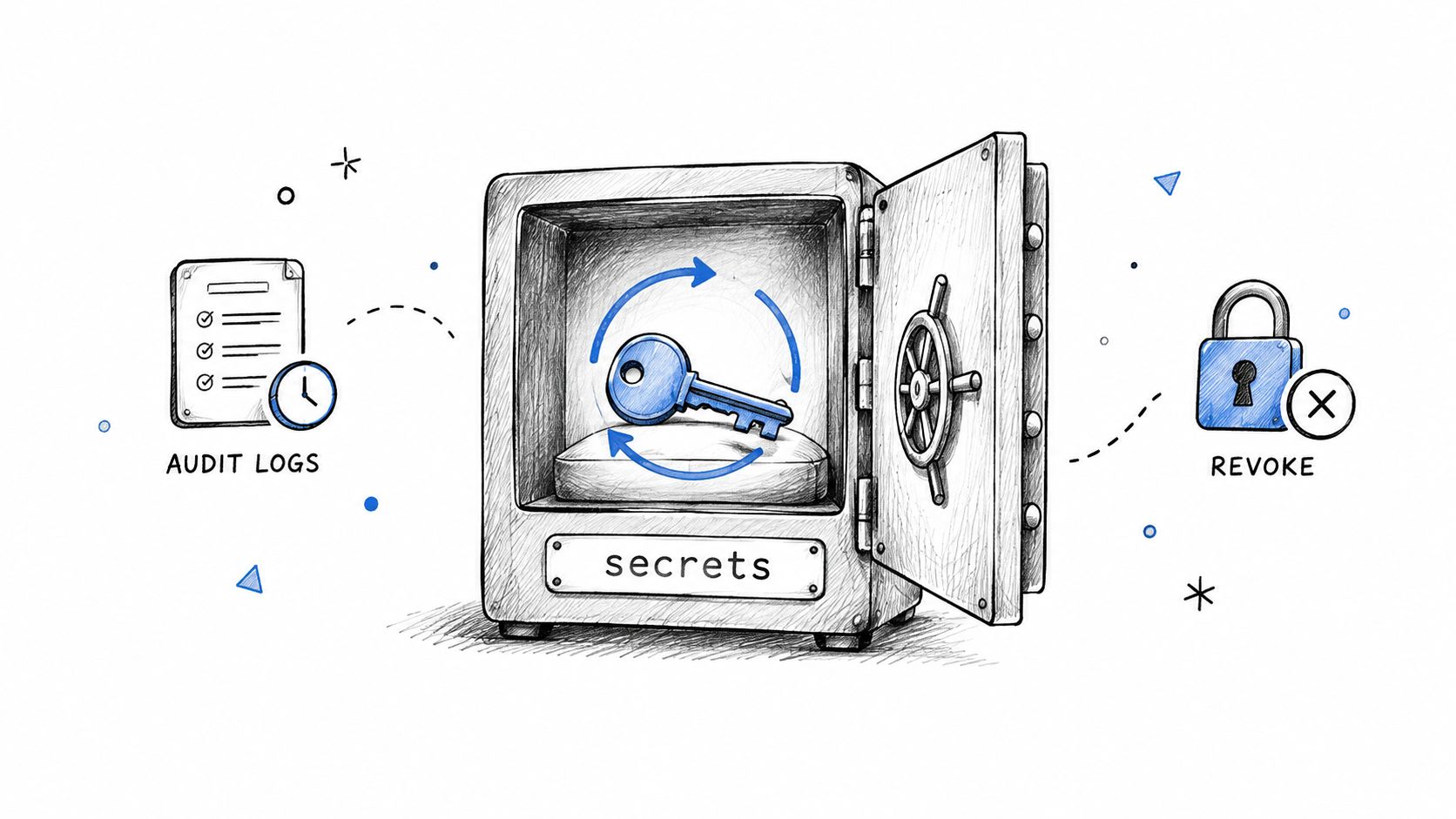
API keys are credentials, not configuration. Teams still leak them by treating them like harmless identifiers and scattering them across code, CI variables, local scripts, browser bundles, and copied curl examples.
For integrations such as Captapi, put keys in a secret manager or environment variables, never in source control. Keep separate keys for development, staging, and production so revoking one doesn't stall every environment. If you need a practical starting point, Captapi's guide to API key management is worth aligning with your internal runbook.
Rotation has to be operational
A rotation policy that nobody can execute during an incident isn't a policy. Document where keys live, who can revoke them, what applications depend on them, and how to test a replacement before cutover.
A simple pattern works well:
- Issue per-service keys: Give your web app, worker, CI pipeline, and local developer tooling different credentials.
- Record ownership: Tag each key with service name, environment, and owner in your secrets inventory.
- Practice revocation: Run a game day where you disable one noncritical key and verify failover or redeploy behavior.
Practical rule: Assume one key will leak. Design your storage, scoping, and rotation so that one leaked key becomes a contained incident, not a platform-wide outage.
If compromise is suspected, revoke first and investigate second. That's also why best practices for access key revocation matter more than elaborate detection logic alone. In CI, add secret scanning on commits and block merges when credentials appear in tracked files, examples, or test fixtures.
2. Principle of Least Privilege and Role-Based Access Control
Overexposed permissions break APIs faster than weak crypto. Teams usually notice after an incident, when a valid token reaches an endpoint it should never have been allowed to call.
Treat authorization as an engineering matrix, not a policy statement. For each endpoint, define four things before release: who can call it, which fields they can set, which records they can touch, and what should be redacted in the response. That forces decisions that generic roles like admin or user tend to hide.
A permission model gets easier to audit when it is explicit:
comments.readcomments.writereports.read_ownreports.read_anytranscripts.exportchannels.admin
That split matters. reports.read_any is an operational privilege with a much larger blast radius than reports.read_own, and it should be rare.
The common failure mode is simple. An endpoint checks that the caller has a broad role, then skips the object-level check. /reports/:id returns any report whose ID exists. /users/:id/tokens allows support staff to inspect credentials they should never see. The fix is equally simple, but it has to be implemented everywhere: check both the permission and the resource relationship on every request path, including background jobs, admin panels, bulk export tasks, and internal APIs.
Captapi integrations follow the same rule set. If one service only fetches transcripts, give it a key or token scoped to transcript retrieval in one environment. Do not reuse that credential for internal moderation tools, CI utilities, or export workflows. Third-party API access should fit the same least-privilege inventory as internal services.
I use three checks to keep this honest in delivery pipelines and production.
First, write authorization tests against negative cases, not just happy paths. Authenticate as User A and request User B's object IDs. Call read endpoints with write-only scopes. Retry requests after a role downgrade and confirm the old access path fails.
Second, test the stale-access window. If permissions are cached in JWTs, Redis, or an API gateway, measure how long revoked access remains usable. Short-lived tokens reduce that window, but they increase refresh traffic and operational complexity.
Third, watch runtime signals that usually point to authorization drift: sudden spikes in 403s on one endpoint, support accounts accessing high-value records, service accounts calling admin routes, and batch jobs with unusually wide query ranges.
Role design also needs restraint. Too many roles create exceptions nobody can reason about. Too few roles push teams toward broad access and manual workarounds. Start with small action-resource scopes, group them into roles only where it reduces repeated policy code, and review any role that bypasses ownership checks.
Analysts at 42Crunch, citing API exposure trends and CISA KEV overlap in their State of API Security 2026 report, reinforce the same operational lesson: authorization bugs stay near the top of the exploit path. Put ownership checks, scope reviews, and shadow endpoint discovery high on the release checklist for best practices for API security.
3. OAuth 2.0 and OpenID Connect for Authentication
OAuth mistakes get exploited long before teams notice them in dashboards. Treat OAuth 2.0 and OpenID Connect as an engineering decision tree, not a checkbox. The flow you choose controls token lifetime, revocation behavior, secret handling, CI coverage, and the runtime signals you need to watch.
Use OAuth 2.0 for delegated access. Use OpenID Connect when the client also needs verified identity claims. For nearly every user-facing web or mobile app, Authorization Code with PKCE is the default. For service-to-service calls with no end user, Client Credentials is usually the cleaner fit.
The practical question is not “are we using OAuth?” It is “where can this token be replayed, mis-scoped, cached too long, or accepted by the wrong API?”
A good implementation review checks five points:
- Flow-to-client match: PKCE for browser and mobile clients. Client Credentials for backend workers, scheduled jobs, and machine identities.
- Token validation at the API: Verify signature, issuer, audience, expiration, and required scopes on every protected request.
- Claim minimization: Put only the claims the API needs into tokens. Large JWTs create parsing overhead and accidental data exposure.
- Refresh token handling: Store refresh tokens only in controlled locations such as secure, HTTP-only cookies or a hardened server-side store.
- Revocation plan: Decide how quickly role changes, logout, and client disablement must take effect, then choose token TTLs and introspection patterns that meet that target.
That last point causes real trade-offs. Self-contained JWTs reduce identity provider calls and simplify scaling, but they create a stale-access window after revocation. Introspection or very short-lived access tokens reduce that window, but they add latency, more moving parts, and more failure modes during provider outages.
For third-party integrations, apply the same review you use for your own APIs. If your app calls Captapi or another external service, keep machine tokens scoped to the smallest action set, rotate client secrets on a schedule, and verify that the callback and redirect settings cannot be widened accidentally. Captapi's guide to API authentication methods for different client and integration patterns is useful reference material during design reviews.
CI should break on predictable auth failures. Add tests for wrong audience, missing scope, expired token, altered nonce, reused refresh token, and a token signed by an untrusted key. Also test issuer key rotation. Teams often validate against yesterday's JWKS and find out only after a real rotation event.
In production, watch for signals that point to auth drift instead of simple user error. Repeated 401s after a deployment can mean a broken audience or issuer config. A spike in token refresh failures can point to cookie policy changes, mobile storage regressions, or an identity provider incident. Access tokens being accepted on endpoints that should require stronger scopes usually means route-level policy checks have diverged from the identity layer.
For a visual walkthrough of token-based auth flow, this short clip is a useful refresher before reviewing your implementation details:
4. HTTPS and TLS Encryption for Data in Transit
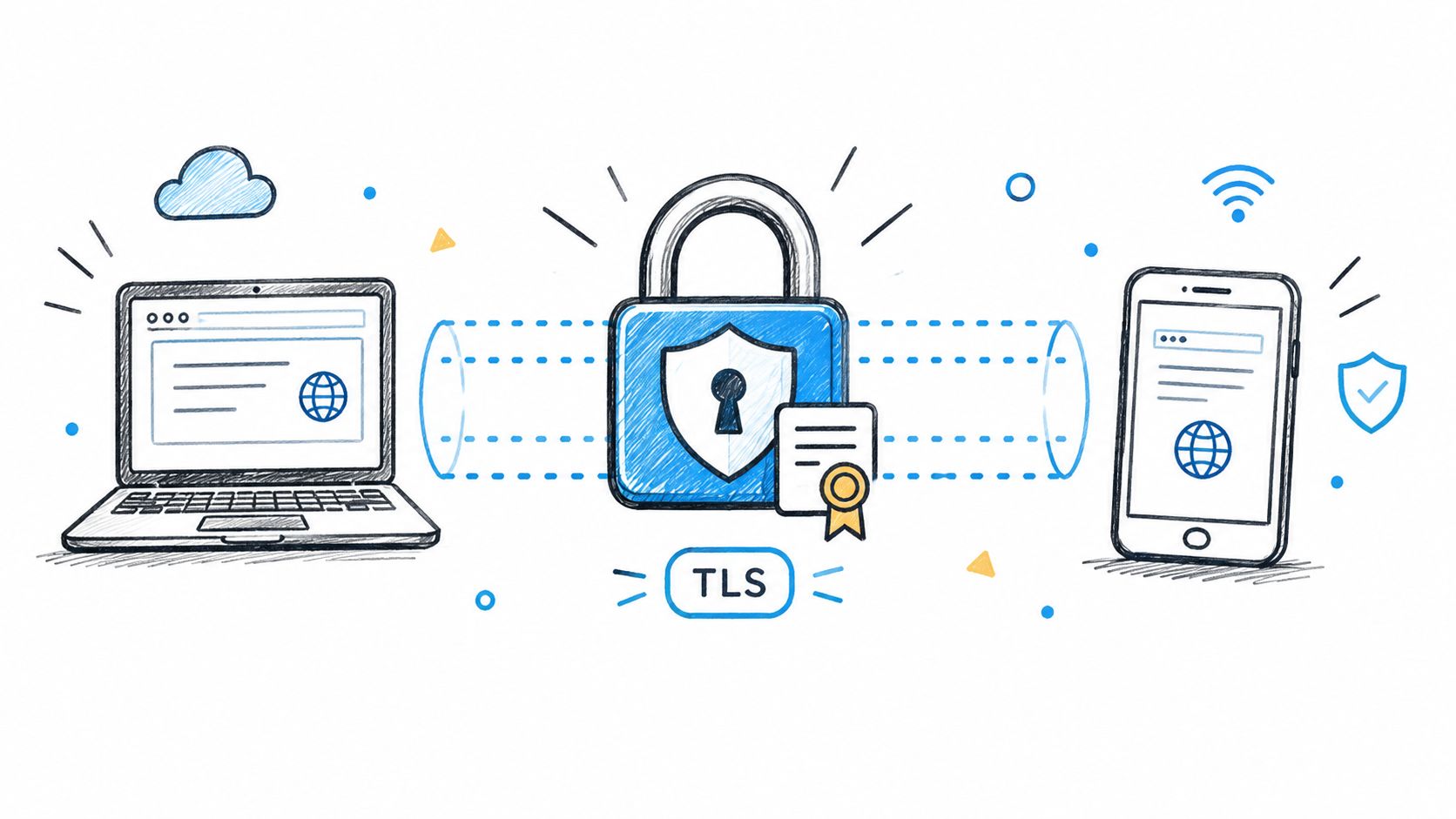
One plaintext hop is enough to turn a well-designed API into an incident. If HTTP is still reachable in production, or if a client can skip certificate validation without failing, fix that before tuning headers or cipher preferences.
TLS is not just an edge setting. Apply it on every path that carries credentials, session cookies, webhook payloads, customer data, or internal service traffic crossing hosts, clusters, or network zones. Teams often protect the public gateway and forget the callback receiver, background worker, or exporter that forwards the same identifiers deeper into the stack.
The practical question is simple: where can a request travel in cleartext, or through a client that accepts the wrong certificate?
I treat that question as an engineering checklist tied to failure modes:
- Public ingress: Serve HTTPS only after migration is complete. Keep redirects temporary during cutover, then remove plaintext listeners so scanners and misconfigured clients cannot keep using them.
- Protocol and certificate policy: Set TLS 1.2 or higher on load balancers, API gateways, and outbound clients. Reject self-signed or expired certificates unless you have an explicit private PKI path and trust distribution process.
- Browser-facing controls: Enable HSTS on domains that should never downgrade. Do not preload until every subdomain is ready, or you can lock users out of legacy endpoints you forgot about.
- Service-to-service traffic: Encrypt east-west calls when traffic leaves a single host boundary. In Kubernetes, that usually means ingress plus service mesh or sidecar-based mTLS for sensitive namespaces.
- Client behavior: Make mobile apps, SDKs, and backend jobs fail closed on certificate errors. Temporary debug bypasses have a habit of reaching production builds.
A quick release check catches a lot here. Run testssl.sh or an equivalent scanner against the public endpoint. Confirm HTTP either redirects during migration or is fully disabled after it. Inspect the client code for flags like verify=false, rejectUnauthorized: false, or custom trust managers that accept any certificate. Those shortcuts are common in staging and easy to miss in production reviews.
Third-party API integrations need the same scrutiny. If a service such as Captapi handles request payloads or returns sensitive transcript data, verify that your outbound client enforces certificate validation, that webhook callbacks use HTTPS, and that retries do not fall back to weaker transport settings. Captapi's write-up on data privacy best practices is the kind of operational detail worth checking during vendor onboarding.
Certificate pinning can make sense for high-risk mobile or embedded clients. It also creates an operational trap. Pin without a rollover plan, backup pins, and a tested replacement procedure, and the next certificate change becomes your outage instead of an attacker's failure.
5. Input Validation and Sanitization
Bad input breaks APIs long before it looks like an attack. A single permissive parser, an ignored field, or an unbounded array can turn into privilege changes, queue pressure, or poisoned downstream data.
Validation needs to act like a gate, not a suggestion. Define what each endpoint accepts, reject everything else, and make that decision before business logic, ORM binding, search indexing, prompt construction, or background jobs touch the payload. OpenAPI schemas, JSON Schema, Pydantic, Joi, and Zod all work if teams enforce strict types, field allowlists, length limits, enums, and unknown-field rejection.
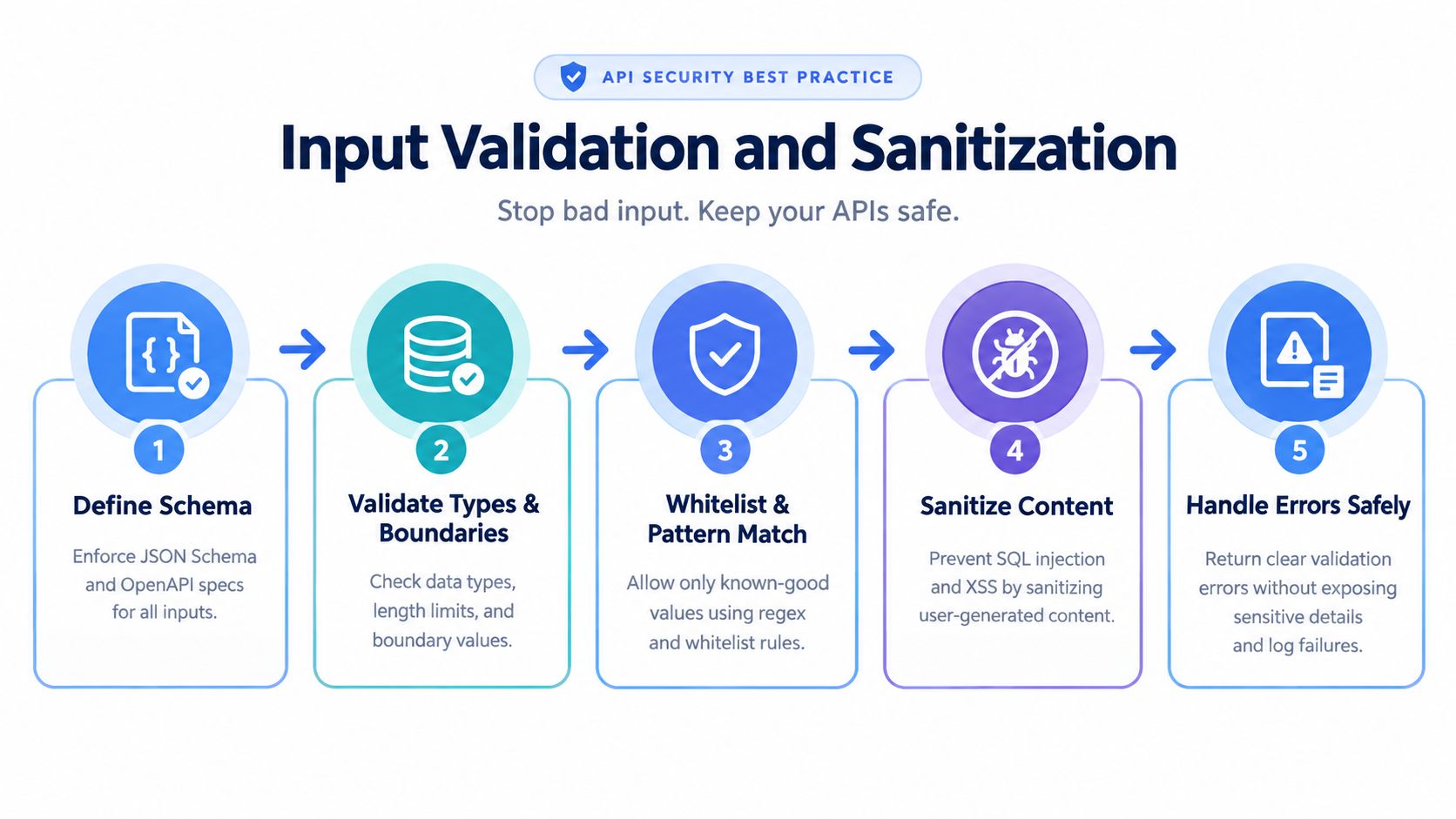
The common failure mode is treating validation as a formatting check. It is also an authorization and safety boundary. If role, plan, account_id, or is_admin arrives from a client on an endpoint that should never accept those fields, the correct behavior is a hard reject, not silent ignore. Silent ignore has a habit of becoming future trust.
A better review question is simple: what can this field break after it passes validation?
Transcript text is a good example. Safe storage does not make it safe for every later use. The same value may later land in an HTML dashboard, a search index, a prompt for an LLM, or a CSV export opened in a spreadsheet. Each target needs its own handling, so keep the boundary clear:
- Validate structure and size on ingress.
- Normalize only when the business rule is explicit.
- Escape or encode at the point of output.
- Strip or reject dangerous content only if the downstream consumer requires it.
Third-party API integrations follow the same pattern. If your app sends YouTube URLs, video IDs, usernames, or channel handles to Captapi, validate those formats before the request leaves your system. Then treat Captapi responses as untrusted input inside your own environment. Check expected fields, cap payload size, and sanitize transcript content before it enters a RAG pipeline, summary renderer, analytics job, or admin UI.
The CI checks here are practical and cheap:
- Contract tests that fail on unknown properties or missing required fields.
- Negative tests for duplicate query parameters, invalid Unicode, nested arrays, and mismatched
Content-Typeheaders. - Body size tests that confirm the API rejects oversized payloads early.
- Fuzz cases for fields that later reach templates, prompts, search, or file exports.
Runtime signals matter too. Watch for spikes in 400 and 422 responses by route, repeated schema failures from one client, and parser exceptions that bypass normal validation paths. Those are early signs of probing, client drift, or a code path that validates less than the OpenAPI spec claims.
OWASP's best practices for API security remain a useful reference here because they reinforce the same operational point. Validation reduces attack surface, but it does not replace object-level authorization, property-level authorization, or safe handling of data returned by other APIs.
6. Rate Limiting and Throttling Implementation
A weak rate limit turns a small client mistake into an outage. A good one contains brute force attempts, scraping, and bursty automation before they consume database connections, worker slots, or third-party quota.
Treat this control as an engineering budget, not a generic gateway toggle. Decide what you are protecting first. Login endpoints need low thresholds and short windows. Search and list endpoints need controls that account for pagination abuse. Expensive routes such as exports, transcript fetches, and summarization need concurrency caps, queue depth limits, and tenant quotas, not just requests-per-minute.
One rule rarely fits the whole API.
A practical way to implement this is to classify routes by cost and failure mode:
- Authentication paths: strict per-IP and per-account limits, with temporary lockouts and strong jitter on retries
- Read-heavy collection endpoints: token bucket or sliding window limits, plus caps on page size and concurrent requests
- High-cost async work: accept the request, enqueue it, and enforce per-tenant job limits so one customer cannot drain workers
- Write operations: lower burst limits and require idempotency keys before allowing automatic retries after 429 or timeout responses
Third-party integrations need the same discipline on outbound traffic. If your application calls Captapi for transcripts or metadata, your service should respect the provider limit, but also reserve quota internally by tenant, job type, and environment. A staging load test should never consume the same outbound budget as production. Captapi's guidance on API rate limits and retry behavior is worth reading before you set client defaults.
The failure mode to avoid is familiar. Ten workers hit a 429, all retry at once, queue depth spikes, and the system spends the next minute amplifying its own traffic. Exponential backoff with jitter helps. So do circuit breakers, bounded queues, and deadlines that stop stale work instead of retrying forever.
Make the policy testable. In CI, run burst tests that confirm the right routes return 429 at the expected threshold, verify Retry-After behavior, and check that idempotent writes do not duplicate side effects under retry. In production, watch for sustained 429s by route, rising queue latency, retry storms from one client, and uneven tenant consumption. Those signals show whether the limit is blocking abuse, masking a bad SDK default, or throttling legitimate traffic too aggressively.
7. Logging and Monitoring for API Security
Production logs are where API security controls prove they still work. If an endpoint starts failing open, if a token parser begins accepting malformed claims, or if one tenant starts probing object IDs, the first usable evidence should be in your telemetry, not in a support ticket.
Useful logging starts with restraint. Capture route, method, status, latency, tenant or account ID, auth result, policy decision, correlation ID, and caller IP or trusted proxy chain. Do not store raw API keys, bearer tokens, passwords, session cookies, or full request bodies unless a narrow use case requires them and redaction is enforced before write. Teams often over-log during incident response and then forget to remove it. That turns a security event into a long-term data handling problem.
The fields matter less than the questions they answer. Can you tell which control rejected the request? Can you separate bad credentials from missing scope? Can you trace one request across gateway, app, worker, and outbound provider call? If the answer is no, the log line is probably too vague.
Here is a practical event model many teams can implement:
- Authentication events: token missing, token invalid, signature failure, expired token, mTLS failure
- Authorization events: scope denied, role denied, object ownership denied, policy engine error
- Input handling events: schema validation failure, blocked content type, body too large, unsafe file upload rejected
- Operational abuse signals: repeated 404s on guessed routes, bursts of 401s, spikes in 5xx from one client, retry storms
- Outbound dependency events: upstream status, timeout, circuit breaker open, provider request ID, internal caller service
Patterns matter more than isolated errors. Repeated 403s against sequential resource IDs can indicate enumeration. A run of 401s followed by one success from the same source can indicate credential stuffing. Requests to deprecated routes after a cutoff date usually mean an unmanaged client still exists.
For a third-party integration such as Captapi, treat outbound calls as part of the same security surface. Log which internal service made the call, which environment it came from, the upstream endpoint, the returned status, the provider request ID if available, and whether the response was served from cache or retried. That record helps answer two hard questions during incidents: did your code fail, or did the dependency fail, and which tenants were exposed to the blast radius.
A short checklist works better here than another policy statement:
| Control decision | What to log | Failure mode you can catch | CI or pre-prod check | Runtime signal |
|---|---|---|---|---|
| Auth enforced at gateway and app | auth result, reason, route | gateway bypass, inconsistent middleware | send unsigned requests to every protected route | sudden change in 401 rate by route |
| Object-level authorization | actor ID, resource ID hash, deny reason | IDOR probes, policy regressions | request another user's object in API tests | repeated 403s on sequential IDs |
| Sensitive data redaction | redaction flag, schema version | token or PII leakage into logs | scan test logs for secrets | DLP alerts, unusual access to log indices |
| Outbound API wrapper | provider status, timeout, request ID | hidden dependency failures, bad retries | simulate 401, 429, and timeout from provider | error concentration by upstream endpoint |
| Incident traceability | correlation ID across services | untraceable multi-hop failures | assert ID propagation in integration tests | missing IDs in sampled traces |
Keep alerts narrow enough that responders trust them. A high-volume API will always produce noise. Alert on rate of change, concentration by route or tenant, and combinations of signals instead of raw counts alone. In practice, "403s against sequential IDs plus one source plus 10 minutes" is more actionable than "403s are up."
Log retention has trade-offs. Longer retention helps investigations and abuse pattern analysis. It also increases storage cost and the impact of any logging mistake. Set shorter retention for verbose request logs, longer retention for audit events, and strict access controls for both. Security logs are sensitive data stores in their own right.
One final test catches a surprising number of failures. During staging and after major releases, trigger known bad requests and verify three things: the denial happens, the right event is emitted, and no secret appears anywhere in the log pipeline. If any one of those fails, the control is not ready for production.
8. API Security Testing and Penetration Testing
APIs fail at the edges first. Security testing needs to target those edges on purpose, then turn what it finds into release checks that block regressions.
A useful way to run this section in practice is to split the work into three lanes. CI catches repeatable failures on every change. Staging exposes integration mistakes and unsafe defaults. Manual penetration testing focuses on authorization gaps, business-logic abuse, and chained behaviors that scanners miss.
Start with tests that map directly to common failure modes:
- Missing or expired token returns 401, with no token details in the body
- Valid token with the wrong scope or role gets denied
- User A cannot read or modify User B's object by changing an ID
- Invalid JSON, oversized payloads, and type mismatches fail cleanly
- Burst traffic triggers 429s, and clients back off instead of stampeding
- Error responses never expose stack traces, SQL fragments, internal hostnames, or provider secrets
Those checks belong in CI, not in a quarterly spreadsheet. For every route tagged as authenticated, add negative tests beside the happy-path tests. For every authorization rule, add one test that should pass and one that should fail. Teams that skip the failing case usually discover broken access control from a customer report or an incident review.
Manual testing still matters because scanners do not understand intent. They will find a reflected header or a weak cookie flag. They will not reliably catch "support_agent can export all tenants by combining these two filters" or "a cancelled subscription still permits write access through an older mobile path." That is where Burp Suite, OWASP ZAP, and a human tester earn their time.
Third-party integrations need the same treatment. If your API calls Captapi or any other upstream service, test the wrapper as its own security boundary. Force upstream 401s, 403s, 429s, malformed responses, and timeouts. Confirm your service fails closed where it should, strips provider details from downstream errors, and does not retry unsafe operations forever. A wrapper that turns every upstream auth failure into a generic 500 will bury the signal your on-call team needs.
Load and abuse testing belong here too, but with controls. The goal is to prove limits, backoff, queue behavior, and degradation paths before real traffic does it for you. This guide shows how to find API limits without production outages without turning production into the test environment.
One pattern works well as a release gate:
- Run authenticated negative tests in CI on every merge.
- In staging, replay a small abuse pack against protected routes and third-party wrappers.
- Verify the API returns the expected denial or throttle response.
- Check that the event appears in monitoring with the right route, tenant, and error class.
- Fail the release if any test passes functionally but produces the wrong security signal.
That last step is where many teams fall short. A control is not ready just because the request was blocked. It also has to fail in a way operators can identify, triage, and distinguish from routine client noise.
9. API Versioning, Deprecation, and Documentation
Unmanaged API versions keep old security decisions alive long after the team has stopped defending them. If a legacy route still accepts weaker auth, looser validation, or broader response fields, that route becomes the path attackers and overdue clients both keep using.
Treat versioning as a security control with an owner, a retirement date, and test coverage. Breaking changes tied to auth, scopes, signing rules, idempotency behavior, or response redaction need a clear version boundary. They also need telemetry. Teams should know which customers still call v1, which endpoints drive that traffic, and whether those requests hit code paths with known exceptions or compensating controls.
Documentation matters because undocumented security behavior turns migrations into guesswork. A useful API spec does not stop at schemas. It states how authentication works per version, which scopes changed, which fields were removed or reclassified as sensitive, how rate-limit headers behave, and what error code clients should expect during sunset periods.
One practical pattern works well:
- Publish version-specific examples for authentication and authorization, with placeholder secrets only.
- Add a deprecation header and sunset date on legacy responses.
- Track deprecated endpoint usage by tenant, client ID, or API key.
- Fail CI if a deprecated route is changed without updating the OpenAPI spec and migration notes.
- Block final removal until support, operations, and the service owner have reviewed active callers.
Third-party dependencies need the same discipline. If your service wraps Captapi or another upstream API, keep an internal record of the exact upstream version, endpoints used, auth method, retry assumptions, and fields your system persists. Vendor docs help, but they do not capture your blast radius. This API versioning strategy guide is a good reference point for structuring the version plan, but the migration checklist still has to be local to your system.
A simple failure mode shows why. An upstream provider changes error formats or tightens scope requirements in a new version. Your wrapper still parses the old response, converts upstream 403s into 500s, and your clients keep retrying. That is not a documentation problem alone. It is a versioning, observability, and release-control failure.
Keep the rule simple: every supported version must have a documented security contract, a measurable client footprint, and a removal plan. If one of those is missing, the version is not under control.
10. Cross-Origin Resource Sharing Configuration
CORS mistakes are common because they look small and feel frontend-specific. They aren't. A permissive browser policy can expose authenticated API behavior to origins you never intended to trust.
For sensitive APIs, never use Access-Control-Allow-Origin: * with credentials. Be explicit about origins, methods, and headers. Keep development and production origin lists separate so a loose localhost rule doesn't leak into the main deployment.
Browser access should be intentional
Many APIs don't need browser access at all. If an integration is purely server-to-server, remove CORS entirely and require calls from your backend with proper credentials.
When browser access is necessary, validate origin server-side and review preflight behavior during testing. Stripe-style embedded flows and dashboard apps often need careful allowlists because headers and credential handling change across environments.
Use a small verification set:
- Allowed origin test: Approved frontend origin succeeds with only needed methods and headers.
- Unapproved origin test: Unknown origin gets no permissive CORS response.
- Credential test: Cookies or auth headers aren't accepted from wildcard or unintended origins.
CORS should describe trust you already decided on elsewhere. It shouldn't become the place where trust gets invented ad hoc during debugging.
11. Deployment and Runtime Hardening
A secure API can still fail at deploy time.
The route logic may validate input and enforce auth correctly, yet the running system exposes a debug port, trusts an outdated base image, or lets engineers bypass the gateway and hit services directly. Those failures happen in the release path and at runtime, so hardening needs to sit on the same checklist as auth, validation, and logging.
Focus on the controls that change real attack paths in production. Restrict network reachability, ship minimal images, run processes with limited privileges, and make configuration drift visible before it becomes an incident. For Captapi integrations, that means more than storing separate keys per environment. It also means pinning outbound destinations where possible, keeping those keys in a secret manager instead of container images, and confirming that staging jobs cannot call the live Captapi account by mistake.
A short release gate catches a lot:
- Reachability check: Only intended routes, ports, and admin interfaces are exposed through ingress, load balancers, and security groups.
- Workload hardening check: Containers run as non-root, use read-only filesystems where the app allows it, and drop unnecessary Linux capabilities.
- Image hygiene check: Base images, runtimes, and security patches follow a defined update cadence. Images are scanned in CI and blocked on high-severity findings your team has chosen not to accept.
- Secret handling check: No production secrets in build args, images, logs, or crash dumps. Rotation does not require a redeploy that leaves old credentials active longer than planned.
- Rollback check: Rollbacks restore a known-good version without reopening deprecated endpoints, weakening TLS settings, or reintroducing expired secrets.
I usually test this the same way an attacker would. Scan the deployed surface, verify that only the gateway is reachable, exec into a container to confirm filesystem and user restrictions, and review whether a rolled-back service still accepts current tokens and secret references. Those checks are simple to automate in CI and useful to repeat in production after infrastructure changes.
The trade-off is operational friction. Tight egress rules can break third-party integrations. Read-only filesystems can break libraries that expect local temp storage. Blocking every image finding can stall releases over packages that are not reachable in your runtime path. Good teams handle that by documenting exceptions, setting expiry dates on them, and alerting on drift instead of treating hardening as a one-time setup.
Deployment hardening works best as a release gate, not a best-effort review item. If a service cannot prove that its runtime matches the expected security baseline, it should not ship.
11-Point API Security Best Practices Comparison
| Control | 🔄 Implementation complexity | ⚡ Resource requirements | 📊 Expected outcomes | ⭐ Key advantages | 💡 Ideal use cases |
|---|---|---|---|---|---|
| API Key Management and Rotation | Moderate, secret manager + automation workflows | Secrets vaults, rotation tooling, audit logs, ops time | Faster revocation; lower credential compromise impact | Limits damage from leaked keys; auditability; per-app isolation | Static-key APIs, CI/CD pipelines, multi-team environments |
| Principle of Least Privilege & RBAC | High, role design, permission modeling | IAM systems, access review processes, admin overhead | Reduced blast radius; clearer access trails | Minimizes insider risk; improves compliance | Large orgs, multi-tenant systems, sensitive-data access |
| OAuth 2.0 & OpenID Connect | High, flow implementations + token lifecycle | IdP or auth service, secure backend, token storage | Delegated access, SSO, revocable scoped access | No password sharing; fine-grained scopes; federated auth | User-facing apps, third‑party integrations, SSO scenarios |
| HTTPS / TLS Encryption | Low, enable TLS + config management | Certificates, CDNs/load balancers, renewal automation | Prevents MITM and eavesdropping; compliance alignment | Strong transport protection; widely supported | All APIs (mandatory for production and compliance) |
| Input Validation & Sanitization | Moderate, schemas + validation rules | Validation libraries, test suites, maintenance effort | Fewer injection/XSS bugs; higher data quality | Reduces attack surface; more robust APIs | Public endpoints, user input handling, RAG pipelines |
| Rate Limiting & Throttling | Moderate, algorithm + distributed enforcement | Gateway/limiter, monitoring, tuning effort | Controls abuse; improves availability under load | Protects infra; enables fair usage and tiers | High-traffic/public APIs, billing-sensitive endpoints |
| Comprehensive Logging & Monitoring | Moderate–High, design, aggregation, alerting | Log stack (ELK/Datadog), storage, analyst time | Faster detection & incident response; audit trails | Visibility into security and performance | Production systems, security‑sensitive services |
| API Security & Penetration Testing | Moderate–High, automation + manual tests | Security tools, expert testers, test environments | Finds vulnerabilities before production | Lowers breach risk; provides compliance evidence | Release pipelines, high‑risk apps, regulated projects |
| API Versioning, Deprecation & Docs | Moderate, versioning policy + docs upkeep | Docs tooling, migration guides, developer comms | Predictable changes; fewer breaking integrations | Smooth migrations; clearer developer expectations | Public APIs, multi-client ecosystems, long‑lived products |
| CORS Configuration | Low, header and origin policies | Gateway/server config, testing | Prevents browser-based cross-origin misuse | Controls browser origins; reduces CSRF exposure | Browser clients calling APIs; frontend integrations |
| Deployment & Runtime Hardening | High, infra, IaC reviews, hardening policies | DevOps tooling, patching, access controls, audits | Reduced attack surface; safer rollouts | Better containment; repeatable secure deployments | Production deployments, regulated or high‑risk systems |
Turn the Checklist Into a Release Gate
The best practices for API security work when they become release criteria, not when they live as good intentions in a wiki. Teams ship safer APIs when they convert each recommendation into an explicit pre-production check with an owner, an automated test where possible, and a runtime signal after deployment.
Start by mapping trust boundaries and data flows. List every caller, every credential type, every user role, every third-party dependency, and every place data crosses from one service or environment into another. That exercise usually exposes the forgotten route, the overly broad service account, the browser endpoint that should have stayed server-side, or the background job that still bypasses your main gateway.
Then define authentication and authorization rules in a way engineers can test. Specify which endpoints require OAuth or bearer tokens, which scopes or roles are valid, which objects require ownership checks, and which fields must never be returned to certain callers. Many teams discover that they documented authentication but never fully documented authorization.
From there, lock in the transport and request-handling basics. Enforce TLS, validate all input against schemas, reject unknown or oversized payloads, and return minimal responses. Add rate-limit handling in both directions. Your API should protect itself from abusive clients, and your clients should back off cleanly when a provider enforces limits.
CI should catch the obvious failures before code review even starts. Scan commits for secrets. Scan dependencies for known issues. Run authenticated tests that verify 401s, 403s, validation failures, and 429s in the right places. If an endpoint that should deny access suddenly succeeds, treat that as a broken build, not a future cleanup task.
In production, make observability part of the contract. Log authentication outcomes, authorization failures, request IDs, route usage, and abuse indicators without exposing raw secrets. Alert on spikes in failed auth, sequential object access attempts, new shadow routes, and unexpected version usage. Runtime monitoring is how you verify that a control still works after configuration drift, traffic changes, or a rushed release.
Document exceptions every time you can't meet the standard control. Maybe a legacy client can't support a newer auth flow yet. Maybe a partner integration still needs a temporary broader scope. That can happen, but it needs an owner, a reason, an expiry date, and a compensating control. Exceptions without review become permanent attack paths.
Finally, revisit the checklist whenever the API changes. New endpoint. New third-party integration. New data-processing workflow. New browser client. New batch export path. Each of those changes the trust model. If you use a service like Captapi, the same discipline applies. The vendor can secure its interface and credential handling, but your team still owns key storage, access scope, response handling, downstream sanitization, and how integrated data moves through your own systems.
Security maturity usually improves when teams stop asking, “Do we have auth?” and start asking, “What exactly fails closed, how do we prove it, and who notices when it stops working?”
Captapi gives teams one REST interface for YouTube, TikTok, Instagram, and Facebook data, with bearer-token authentication, environment-friendly API key usage, and endpoints that fit common transcript, summary, comments, and research workflows. If you're building social-data features and want to apply the checklist above to a real integration, review the docs and test your client against Captapi.